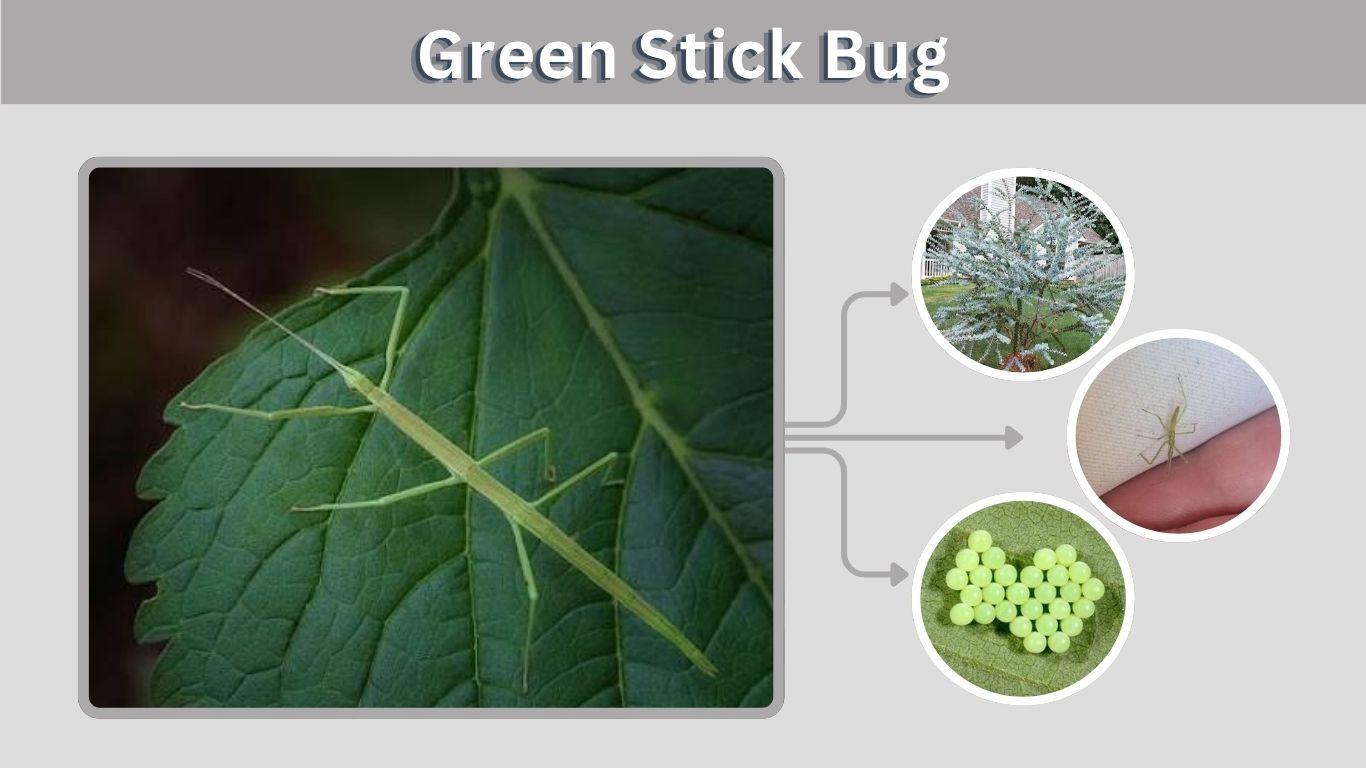
A green stick bug is a plant-eating insect with a long, slender body that resembles a fresh twig or plant stem. Also called a green walking stick or stick insect, it relies on camouflage, stillness, and slow movement to avoid predators. Although its unusual appearance can seem alarming, a green stick bug is generally harmless to people, pets, and homes.
What Is a Green Stick Bug?
“Green stick bug” is not the name of one particular species. It is an informal term for green-colored members of the order Phasmatodea, which includes walkingsticks, stick insects, leaf insects, and phasmids.
Phasmatodea comes from a Greek word meaning “phantom,” referring to the insects’ ability to disappear visually among leaves and branches. More than 3,600 species are recognized worldwide, with the greatest diversity occurring in tropical and subtropical regions.
Green Stick Bug Identification
A true green walking stick typically has:
- Six long, slender legs
- An elongated, cylindrical body
- Long or moderately long antennae
- Chewing mouthparts
- A green, olive, yellow-green, or greenish-brown color
- A small head compared with its body
- Wings that are absent, reduced, or fully developed
- Slow, deliberate movements
The legs are generally similar in shape and length. When resting, the insect may extend its front legs forward so they appear to be part of its body, improving its resemblance to a twig.
How Big Are Green Stick Bugs?
Size varies considerably among species. Many North American walkingsticks are approximately 2–4 inches long, but the female giant walkingstick can reach around 7 inches. Some tropical species grow close to 12 inches, not including their extended legs. Females are frequently larger and heavier than males.
A tiny green stick bug may be a small species or an immature nymph. A large individual is often an adult female.
Why Do Green Stick Insects Look Like Twigs?
Their shape and color provide camouflage against birds and other predators. A motionless green stick insect can resemble a new stem, while brown individuals look more like dry twigs or bark.
Walkingsticks may also sway gently from side to side, imitating the movement of vegetation in a breeze. Many remain inactive during daylight and feed after dark, making them even harder for visual predators to detect.
Can Green Stick Bugs Change Color?
Some species can make limited color adjustments in response to light, humidity, temperature, or time of day. Young walkingsticks may also begin life green and become brown or darker as they mature.
However, they cannot instantly change to any color like a fictional camouflage creature. Their normal range of color is determined mainly by species, age, sex, genetics, and surroundings.
Do Green Stick Bugs Have Wings?
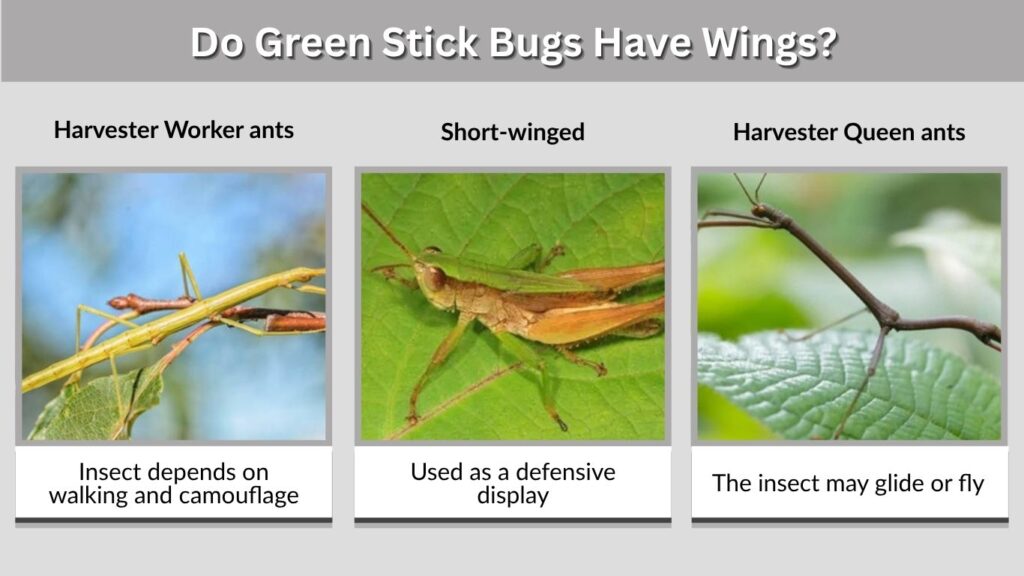
Some green stick insects have fully developed wings, while others have short wings or none at all. Wing condition depends on the species and sometimes the insect’s sex.
| Wing type | What it means |
| Wingless | The insect depends on walking and camouflage |
| Short-winged | Wings may be used as a defensive display but not for sustained flight |
| Fully winged | The insect may glide or fly, although ability varies |
| Winged male and wingless female | A pattern found in some species |
Most familiar North American walkingsticks are wingless. Winged forms are more common among certain tropical groups. Some species rapidly expose brightly colored hind wings when disturbed, startling a predator before returning to camouflage.
A green flying insect with thick jumping legs is more likely a katydid than a walkingstick.
What Do Green Stick Bugs Eat?
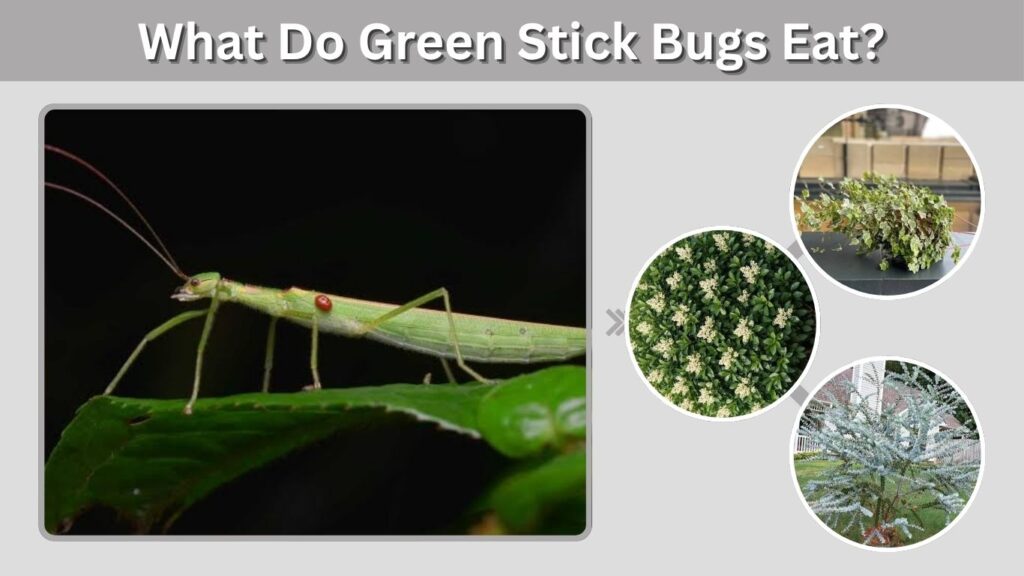
All stick insects are herbivores. They use chewing mouthparts to consume leaves rather than hunting insects or feeding on blood. Different species prefer different plants.
Their diet may include foliage from:
- Oak
- Hazelnut
- Rose
- Blackberry
- Eucalyptus
- Privet
- Ivy
- Bramble
- Grass and shrubs
North American species commonly feed on deciduous trees and shrubs. Most feeding occurs at night, while the insect rests quietly during the day.
An occasional walkingstick generally causes little noticeable harm. However, unusually large populations can remove significant foliage from trees and shrubs. Healthy trees usually recover from isolated outbreaks, but repeated defoliation can cause stress.
Do Green Stick Bugs Bite?
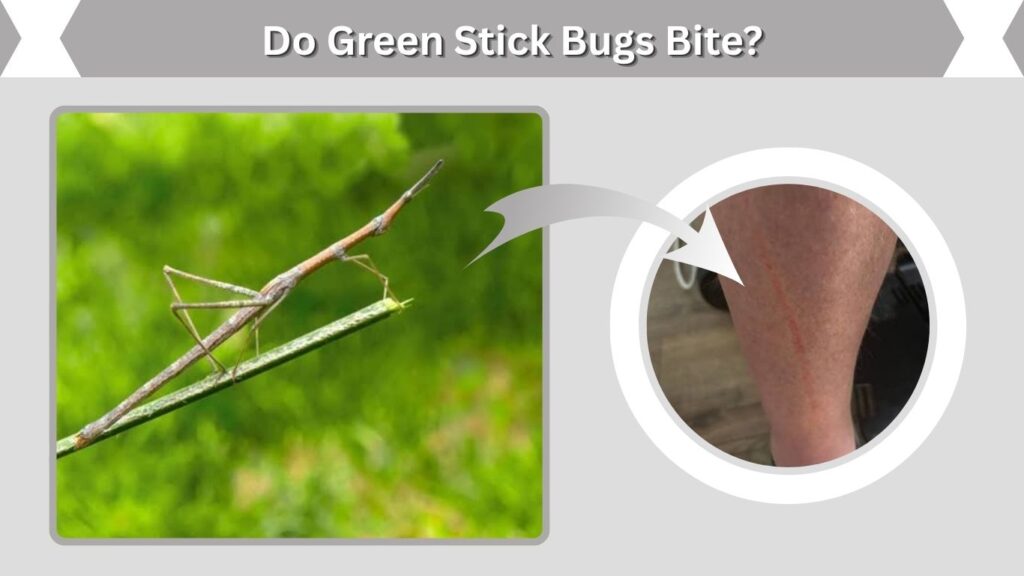
A true green stick bug does not normally bite people. Walkingsticks are plant feeders rather than predatory or blood-feeding insects, so humans are not viewed as food.
A large or spiny species might pinch, scratch, or press its leg spines into the skin when roughly handled. This is defensive contact rather than a feeding bite. The insect is more likely to freeze, drop from the plant, sway, or attempt to escape.
A painful bite from a long green insect may instead come from a predatory insect, such as an assassin bug, that has been mistaken for a walkingstick.
Are Green Stick Bugs Poisonous?
Green stick bugs are not venomous and do not possess stingers. Nevertheless, several walkingstick species have chemical defenses.
The two-striped walkingstick of the southeastern United States can spray a strong-smelling substance that painfully irritates the eyes and mucous membranes. Other species may release foul-smelling or unpleasant fluids to discourage predators.
Avoid holding an unidentified walkingstick close to your face. When handling is necessary, wear gloves, keep the insect pointed away from your eyes, and wash your hands afterward. Flush exposed eyes with clean water and seek medical attention if irritation is severe or persistent.
Green Stick Bug Life Cycle
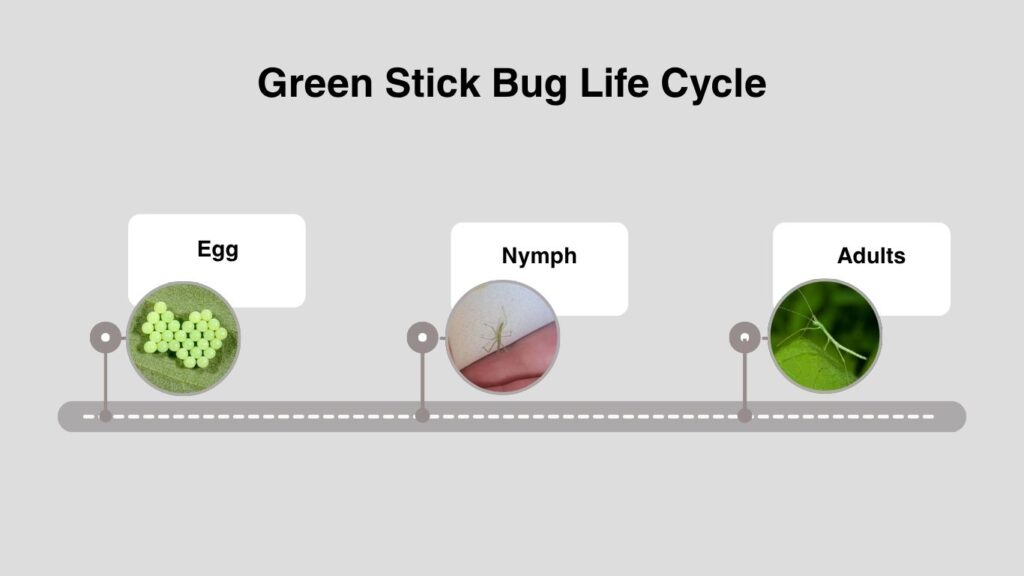
Stick insects undergo incomplete metamorphosis with three main stages:
- Egg
- Nymph
- Adult
The nymph resembles a miniature adult but is smaller and lacks fully developed reproductive organs and wings. It grows through several molts before reaching adulthood.
Females of many species drop individual eggs onto the ground, where the eggs resemble small seeds. In colder regions, eggs may remain in leaf litter throughout winter and hatch in spring. Some species can reproduce through parthenogenesis, allowing females to produce offspring from unfertilized eggs.
Green Stick Bug vs. Common Lookalikes
Several green insects may initially look like sticks.
Praying Mantis
A mantis has thick, folded front legs equipped for catching prey. Its triangular head can turn noticeably, while a walkingstick has six relatively slender walking legs and a much narrower body.
Katydid
Katydids usually have broad, leaflike wings and powerful hind legs adapted for jumping. Their antennae are extremely long, and many produce calls. Walkingsticks move more slowly and lack enlarged jumping legs.
Assassin Bug
An assassin bug may have a narrow body and long legs, but it possesses a noticeable curved beak used to pierce prey. Unlike a herbivorous walkingstick, it can deliver a painful defensive bite.
Leaf Insect
Leaf insects belong to the same order as walkingsticks. Instead of resembling narrow twigs, they have broad, flattened bodies and leg extensions that imitate leaves and leaf veins.
What Should You Do After Finding One?
A green walking stick found outdoors can normally be left alone. It does not infest buildings, damage furniture, attack people, or reproduce successfully inside an ordinary home without suitable host plants.
When one enters a building, place a container over it, slide a piece of stiff paper underneath, and release it onto nearby vegetation. Avoid pulling it by a leg because some stick insects can detach a leg as a defensive response.
FAQs
What is the name of a green bug that looks like a stick?
It is probably a walking stick or stick insect belonging to the order Phasmatodea. However, “green stick bug” covers numerous species rather than one specific insect. Location, size, wings, leg shape, and markings are needed for a precise identification.
Is a baby stick bug green?
Many young walkingsticks are green, helping them blend with fresh vegetation. Their colors may become darker or browner as they grow. Baby stick insects are called nymphs and resemble smaller versions of adults.
Is a green stick bug harmful to plants?
One insect usually causes minimal damage. Walkingsticks eat leaves, but serious defoliation generally occurs only when populations become unusually dense. Repeated outbreaks can stress shrubs or trees.
What does seeing a green stick bug mean spiritually?
Walkingsticks are sometimes symbolically associated with patience, stillness, adaptation, and blending into one’s surroundings. These interpretations come from cultural or personal beliefs and are not scientific characteristics of the insect.
Can a green stick bug fly?
Some species can fly or glide, but many walkingsticks are completely wingless. A green stick-shaped insect with wings may therefore be a winged phasmid, although it could also be a katydid, mantis, or another lookalike.