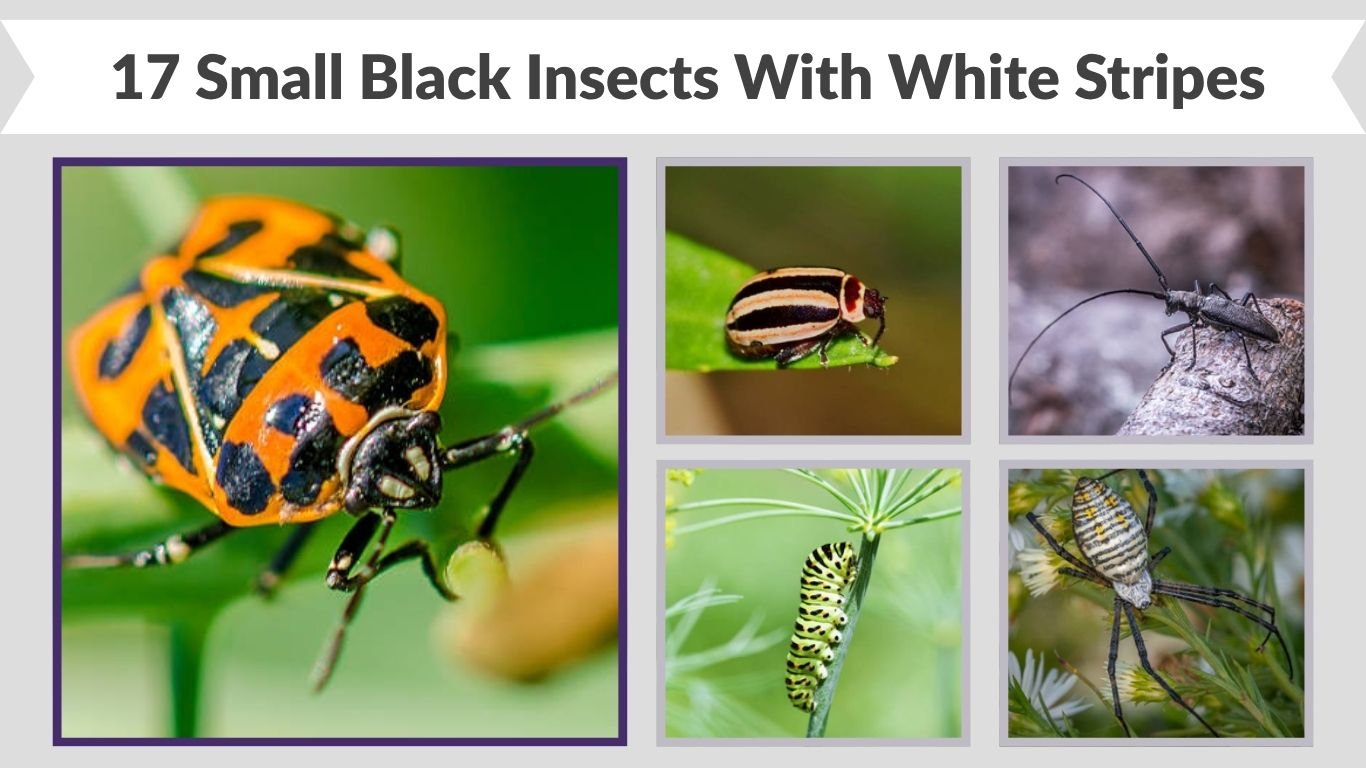
Small black insects with white stripes are common in gardens, forests, homes, and outdoor spaces worldwide. Some are harmless pollinators or beneficial predators, while others may damage plants or become household pests. Their bold striped patterns often help with camouflage, warning predators, or species recognition. From tiny beetles and caterpillars to jumping spiders and wasps, these insects come in many shapes and behaviors. This guide introduces 17 small black insects with white stripes, helping you identify them through their appearance, habitat, behavior, diet, and lifespan.
1. Zebra Jumping Spider

The Zebra Jumping Spider is a small black-and-white spider recognized for its striped body and energetic hunting style. Unlike web-building spiders, it actively chases prey and leaps with remarkable accuracy. This harmless species is commonly seen on walls, fences, windows, rocks, and garden plants during warm daylight hours. Its excellent eyesight and curious behavior make it one of the most fascinating tiny spiders found around homes and outdoor spaces.
Identification
- Black body with bright white zebra-like stripes
- Compact, hairy, and slightly flattened appearance
- Large front-facing eyes with excellent vision
- Usually grows between 5 and 9 mm in length
- Strong jumping legs designed for quick movement
- Males are often darker and more patterned than females
- Frequently moves in short, rapid jumps instead of crawling
Habitat and Distribution
Zebra Jumping Spiders are widely distributed across Europe, North America, and parts of Asia. They thrive in sunny environments where insects are plentiful and surfaces are warm. These spiders are commonly found on brick walls, fences, tree trunks, window frames, and garden furniture. They adapt very well to urban environments and are often spotted around homes and buildings. Because they prefer dry and bright conditions, they are most active during spring and summer months. Despite their small size, they are highly territorial hunters and usually stay close to their chosen hunting area throughout the day.
Behavior and Diet
Unlike many spider species, the Zebra Jumping Spider does not depend on a web for catching prey. It uses its sharp eyesight to carefully stalk insects before leaping onto them with precision. Its diet mainly consists of flies, mosquitoes, gnats, and other tiny insects commonly found around homes and gardens. This spider is extremely active during daylight hours and often pauses to observe movement around it. Zebra Jumping Spiders are curious creatures and may even turn toward humans when approached. They are harmless to people and rarely bite unless directly threatened or handled roughly.
Lifespan
The Zebra Jumping Spider typically lives between one and two years, depending on environmental conditions and food availability. Young spiders hatch from eggs and gradually mature through several molting stages before reaching adulthood. Males usually have shorter lifespans because they spend more energy searching for mates and may die soon after breeding. Females often survive longer and protect their egg sacs until the spiderlings emerge. During colder months, these spiders may hide in cracks, bark, or sheltered corners to survive low temperatures. Their lifespan can be slightly longer in warm climates with steady food sources.
2. Asian Tiger Mosquito

The Asian Tiger Mosquito is a small black mosquito famous for its striking white stripes and aggressive daytime biting behavior. Originally native to Southeast Asia, this mosquito has spread across many parts of the world through global trade and transportation. It is considered one of the most recognizable mosquito species because of its zebra-like markings and active nature. Besides being a nuisance, it is also known for carrying several viral diseases in some regions.
Identification
- Small black body with bold white stripes
- Single white stripe running down the center of the thorax
- White-banded legs creating a striped appearance
- Slim body shape with narrow wings
- Usually measures about 2–10 mm long
- Females are larger and bite humans for blood meals
- Active mainly during daylight hours rather than at night
Habitat and Distribution
Asian Tiger Mosquitoes are found in tropical, subtropical, and temperate regions around the world. They commonly breed in small collections of standing water such as flower pots, buckets, tires, birdbaths, and clogged gutters. This species adapts well to urban and suburban environments where water sources are easily available. It is widespread across Asia, Europe, North America, South America, and parts of Africa. Warm temperatures and humid conditions help their populations grow rapidly, especially during rainy seasons.
Behavior and Diet
Female Asian Tiger Mosquitoes feed on human and animal blood because they need protein for egg production. Males feed mainly on nectar and plant juices. Unlike many mosquito species, they are aggressive daytime biters and often attack ankles and exposed skin. They are fast flyers and difficult to swat because of their quick movements. These mosquitoes are capable of transmitting diseases such as dengue, chikungunya, Zika virus, and yellow fever in affected areas. Their ability to breed in tiny water containers makes them difficult to control in populated regions.
Lifespan
The average lifespan of an Asian Tiger Mosquito ranges from two weeks to about one month, depending on climate and environmental conditions. Females generally live longer than males and can lay several batches of eggs during their lifetime. Eggs can survive dry conditions for months before hatching when exposed to water. In warm climates, multiple generations may develop within a single season, leading to rapid population growth. Cooler temperatures and lack of standing water usually reduce their survival rate.
3. Banded Alder Borer

The Banded Alder Borer is a longhorn beetle known for its shiny black body and bold white bands across its wings. This striking insect is often mistaken for a wasp because of its color pattern and movement. It is harmless to humans and plays an important role in breaking down dead wood in forests. Adult beetles are most commonly seen during warm months resting on flowers, tree bark, or wooden surfaces.
Identification
- Large black beetle with distinct white or pale blue bands
- Extremely long antennae, especially in males
- Hard wing covers with smooth, glossy texture
- Body length usually ranges from 15–30 mm
- Six strong legs designed for climbing bark and wood
- Larvae are creamy white and live inside decaying trees
- Often resembles a wasp because of its striped pattern
Habitat and Distribution
Banded Alder Borers are commonly found in forests, wooded areas, parks, and regions with decaying hardwood trees. They are especially associated with alder, oak, willow, birch, and maple trees where larvae develop inside dead or dying wood. This beetle species is widely distributed across North America, particularly in Canada and the United States. Adults are active mainly during spring and summer when temperatures are warm. They are often spotted on logs, fences, flowers, or recently cut wood piles where they search for mates and suitable egg-laying locations.
Behavior and Diet
Adult Banded Alder Borers feed mostly on nectar, pollen, and tree sap, while the larvae feed on decaying wood beneath bark surfaces. Females lay eggs in cracks of dead or weakened trees, and the developing larvae tunnel through the wood as they grow. Although their larvae can weaken dead timber, they rarely damage healthy living trees. These beetles are slow-moving and non-aggressive, making them harmless to humans. Their strong jaws are mainly used for chewing wood fibers rather than defense. Adults are attracted to light and may occasionally enter homes or buildings by accident.
Lifespan
The Banded Alder Borer has a relatively long life cycle compared to many insects. Larvae may spend two to three years developing inside dead wood before transforming into adults. Most of their lifespan is spent in the larval stage feeding and growing within tree trunks or branches. Adult beetles usually live only a few weeks to several months, depending on environmental conditions and food availability. Warm temperatures and moist wood environments support healthy development, while extremely dry conditions can slow larval growth and survival.
4. White-Marked Tussock Moth Caterpillar

The White-Marked Tussock Moth Caterpillar is a fuzzy black caterpillar covered with white tufts, long hair pencils, and colorful markings. It is one of the most visually unusual caterpillars found in forests, parks, and backyard trees. Although attractive in appearance, its hairs can cause skin irritation in sensitive people. This caterpillar later transforms into the White-Marked Tussock Moth, a species commonly found throughout North America.
Identification
- Black body covered with dense hair and bristles
- Four thick white tufts along the back
- Bright red or orange head with contrasting markings
- Long black hair pencils extending from the front and rear
- Yellow or cream-colored side stripes
- Usually grows between 25–35 mm long
- Hairy appearance helps protect it from predators
Habitat and Distribution
White-Marked Tussock Moth Caterpillars are commonly found in forests, gardens, orchards, and urban parks. They feed on a wide range of deciduous trees including oak, maple, elm, birch, apple, and willow. This species is widespread across the United States, southern Canada, and parts of Mexico. Caterpillars are most active during late spring through early autumn when leaves are abundant. They are often seen crawling on tree trunks, branches, fences, or outdoor furniture while searching for food or pupation sites.
Behavior and Diet
These caterpillars are active leaf feeders and consume foliage from many hardwood tree species. Large populations can sometimes strip leaves from trees, although healthy trees usually recover. Their colorful tufts and irritating hairs serve as a defense mechanism against birds and predators. When threatened, they may raise their front body segments or remain motionless to avoid attention. Contact with their hairs may cause itching, redness, or mild allergic reactions in some people. Adult moths emerge after pupation and are mainly active at night around lights and vegetation.
Lifespan
The White-Marked Tussock Moth typically completes its life cycle within one year. Eggs hatch during spring, and caterpillars spend several weeks feeding and growing before forming cocoons. The pupal stage lasts for a short period before adult moths emerge. Adult males are winged and capable of flight, while females are mostly wingless and remain near their cocoons after emerging. After mating and laying eggs, adults die shortly afterward. The species survives winter mainly in the egg stage until warmer temperatures return.
5. Bald-Faced Hornet

The Bald-Faced Hornet is a black-and-white social wasp known for its bold markings and large paper nests. Despite its common name, it is not a true hornet but a type of yellowjacket wasp. This insect is highly protective of its colony and can become aggressive when disturbed. Bald-Faced Hornets are beneficial predators because they help control flies, caterpillars, and other garden pests.
Identification
- Black body with bright white markings on the face
- White bands or stripes near the end of the abdomen
- Smooth body with narrow waist typical of wasps
- Long wings folded against the body when resting
- Adults usually measure between 15–20 mm long
- Females are larger than males
- Builds large gray paper nests with layered texture
Habitat and Distribution
Bald-Faced Hornets are commonly found in forests, gardens, parks, farms, and suburban areas. They prefer building nests in trees, shrubs, utility poles, roof edges, and other elevated locations. Their large enclosed nests are made from chewed wood fibers mixed with saliva, creating a papery material. This species is widespread across North America, especially in the United States and southern Canada. Colonies are most active during late spring and summer when food sources and warm temperatures are plentiful.
Behavior and Diet
These hornets are social insects living in colonies led by a single queen. Workers hunt insects such as flies, caterpillars, and spiders to feed developing larvae. Adults also consume nectar, fruit juices, and sugary substances for energy. Bald-Faced Hornets are known for aggressive nest defense and may sting repeatedly if threatened. Unlike bees, they can sting multiple times without dying. Their strong defensive behavior helps protect the colony from predators including birds, raccoons, and other insects.
Lifespan
A Bald-Faced Hornet colony survives for only one season. Queens emerge during spring after surviving winter in sheltered locations. Worker hornets live for several weeks during the active season, spending their lives gathering food and defending the nest. Males and new queens are produced near the end of summer. After mating, males die while fertilized queens search for protected places to overwinter. The old colony, including workers and the original queen, dies when cold weather arrives.
6. Striped Cucumber Beetle

The Striped Cucumber Beetle is a small agricultural pest recognized by its bright yellow body and bold black stripes. It commonly attacks cucumber, squash, melon, and pumpkin plants, causing damage to leaves, flowers, and fruits. Farmers and gardeners often consider it one of the most destructive insects for vine crops because it can spread harmful plant diseases while feeding.
Identification
- Yellow or yellow-green body with three black stripes
- Oval-shaped body with smooth wing covers
- Black head and antennae
- Usually measures about 5–6 mm long
- Thin legs designed for climbing plants
- Larvae are white with dark heads and worm-like bodies
- Often found crawling on cucumber and squash leaves
Habitat and Distribution
Striped Cucumber Beetles are commonly found in gardens, farms, greenhouses, and agricultural fields. They prefer areas where cucumbers, melons, pumpkins, and squash are grown. This insect is widespread throughout North America, especially in warm and humid regions with large vegetable crops. Adults overwinter in plant debris, soil, or sheltered vegetation before emerging during spring. They are most active during the growing season when fresh leaves, flowers, and fruits become available.
Behavior and Diet
Adult beetles feed on leaves, flowers, stems, and fruits of cucurbit plants. Their feeding creates holes and weakens plant growth. Larvae live underground and feed mainly on plant roots and stems. These beetles are especially dangerous because they can spread bacterial wilt disease between plants while feeding. They are active during daytime and quickly move or fly when disturbed. Birds, spiders, and predatory insects naturally feed on them, but large infestations can still cause serious crop damage.
Lifespan
The Striped Cucumber Beetle usually lives several weeks to a few months depending on weather conditions and food availability. Females lay eggs in the soil near host plants, and larvae hatch within a short period. After feeding underground, larvae pupate in the soil before emerging as adults. Multiple generations may occur during a single growing season in warm climates. Their population often increases rapidly during hot summers with abundant crops.
7. Zebra Longwing Caterpillar

The Zebra Longwing Caterpillar is a striking black caterpillar covered with long black spines and pale stripes. It eventually transforms into the Zebra Longwing butterfly, a well-known species famous for its elegant black-and-yellow striped wings. Although the caterpillar looks dangerous because of its spiny body, it is harmless to humans. This insect is commonly associated with passionflower vines, which serve as its main food source.
Identification
- Black body with thin white or pale yellow stripes
- Covered with long black branched spines
- Cylindrical body shape with soft texture beneath the spines
- Usually grows between 25–40 mm long
- Head is dark and slightly rounded
- Spines help protect against predators
- Often seen feeding openly on passionflower leaves
Habitat and Distribution
Zebra Longwing Caterpillars are commonly found in tropical and subtropical regions, especially in gardens, forests, and areas with passionflower plants. They are widespread across Central America, South America, Mexico, and the southern United States, particularly in Florida and nearby coastal regions. These caterpillars thrive in warm, humid environments where host vines grow abundantly. They are often spotted on leaves, stems, and tendrils of passionflower vines during spring and summer.
Behavior and Diet
These caterpillars feed almost exclusively on passionflower leaves, consuming large amounts as they grow. Their spiny appearance acts as a warning to predators, although the spines are not venomous. Zebra Longwing Caterpillars are slow-moving and spend much of their time feeding openly during daylight hours. As they mature, they form hanging chrysalises where transformation into butterflies takes place. Adult Zebra Longwing butterflies feed mainly on nectar and pollen and are known for their slow, graceful flight patterns.
Lifespan
The Zebra Longwing Caterpillar stage usually lasts several weeks before pupation begins. After forming a chrysalis, the butterfly emerges within one to two weeks depending on temperature and humidity. Adult Zebra Longwing butterflies often live longer than many other butterfly species, sometimes surviving for several months. Warm climates with steady food supplies help support longer lifespans and multiple generations throughout the year.
8. White-Banded Crab Spider

The White-Banded Crab Spider is a small hunting spider known for its black body and pale white bands or markings. Unlike web-building spiders, it waits patiently on flowers, leaves, or bark before ambushing prey. Its crab-like stance and sideways walking style make it easy to recognize. This spider is harmless to humans and plays an important role in controlling small insect populations in gardens and natural habitats.
Identification
- Small black or dark brown body with white bands or patches
- Front legs are longer and thicker than the rear legs
- Crab-like posture with sideways movement
- Flattened body shape for camouflage on surfaces
- Usually measures between 5–12 mm long
- Hairy legs and body texture
- Females are generally larger than males
Habitat and Distribution
White-Banded Crab Spiders are commonly found in gardens, meadows, forests, shrubs, and flowering plants. They prefer locations where insects frequently visit, especially flowers rich in nectar. These spiders are distributed across North America and parts of Europe and Asia depending on the species. They are most active during warm months when insect activity is high. Their camouflage allows them to blend into bark, leaves, or petals while waiting for prey.
Behavior and Diet
These spiders are ambush predators that do not spin webs to capture food. Instead, they remain motionless until an insect comes close enough to grab with their strong front legs. Their diet mainly includes flies, bees, butterflies, mosquitoes, and other small insects. White-Banded Crab Spiders are patient hunters and may stay in one location for long periods. Although they possess venom for subduing prey, they are not dangerous to humans and rarely bite unless directly threatened.
Lifespan
The White-Banded Crab Spider generally lives for about one year, though lifespan varies by climate and food availability. Females usually survive longer than males and often guard egg sacs before dying. Young spiderlings hatch from eggs and pass through several molting stages before reaching adulthood. Warm environments with abundant insect prey support faster growth and better survival rates.
9. Banded Garden Spider

The Banded Garden Spider is a colorful orb-weaving spider recognized for its black body marked with pale yellow or white bands. It is famous for building large circular webs in gardens, fields, and around vegetation. Although its appearance may seem intimidating, this spider is harmless to humans and highly beneficial because it captures many flying insect pests. Females are much larger and more noticeable than males.
Identification
- Black body with yellow, white, or silver banded markings
- Long slender legs with alternating dark and light bands
- Rounded abdomen with striking patterns
- Females usually measure 15–25 mm long
- Males are much smaller and less colorful
- Creates large circular orb-shaped webs
- Often hangs upside down in the center of its web
Habitat and Distribution
Banded Garden Spiders are commonly found in gardens, grasslands, farms, forests, and roadside vegetation. They prefer sunny areas with tall plants where webs can be anchored securely. This species is widely distributed across North America, especially in warm and temperate regions. During late summer and early autumn, their webs become more visible because of increased insect activity and morning dew. They are often seen near flowers, shrubs, fences, and crop fields.
Behavior and Diet
These spiders are skilled web builders that use sticky orb webs to trap flying insects. Their diet mainly includes flies, mosquitoes, grasshoppers, moths, and bees. Once prey becomes trapped, the spider quickly wraps it in silk before feeding. Banded Garden Spiders are non-aggressive and rarely leave their webs unless disturbed. When threatened, they may vibrate the web rapidly to confuse predators. Their presence is considered beneficial because they naturally reduce harmful insect populations.
Lifespan
The Banded Garden Spider usually lives for about one year. Spiderlings hatch during spring and gradually mature through several molts during summer. Adult females survive through late summer and autumn while producing egg sacs filled with hundreds of eggs. After laying eggs, most adults die as temperatures drop. The next generation survives winter inside protected egg sacs until warmer weather returns.
10. Black Swallowtail Caterpillar

The Black Swallowtail Caterpillar is a smooth-bodied caterpillar known for its black coloration combined with white or yellow bands and orange spots. It later transforms into the beautiful Black Swallowtail butterfly, a common species found in gardens and open fields. Young caterpillars often resemble bird droppings for camouflage, while older caterpillars develop their bold striped appearance. This species is harmless and commonly feeds on herbs and vegetable plants.
Identification
- Black body with yellow or white band-like markings
- Rows of orange or yellow spots along the body
- Smooth skin without long hairs or spines
- Usually grows between 25–50 mm long
- Young caterpillars resemble bird droppings
- Possesses a hidden orange defense organ called an osmeterium
- Often found on parsley, dill, fennel, and carrot plants
Habitat and Distribution
Black Swallowtail Caterpillars are widely distributed across North America, especially in gardens, meadows, farms, and woodland edges. They prefer habitats where host plants from the carrot family grow abundantly. Common host plants include parsley, dill, fennel, celery, and wild carrot. These caterpillars are most active during spring and summer when fresh plant growth is available. They thrive in sunny areas with moderate warmth and good vegetation coverage.
Behavior and Diet
These caterpillars spend most of their time feeding on leaves and stems of herb plants. When threatened, they extend a bright orange forked organ called an osmeterium from behind the head, releasing a strong odor to scare predators. Their diet mainly consists of plants from the carrot family, making them common visitors in herb gardens. Despite occasional plant damage, they are valued because they develop into pollinating butterflies. Birds, spiders, and parasitic wasps are their main natural predators.
Lifespan
The Black Swallowtail Caterpillar stage usually lasts several weeks before pupation begins. After forming a chrysalis, the butterfly may emerge within one to two weeks during warm weather. In colder climates, pupae can survive winter and emerge the following spring. Adult Black Swallowtail butterflies typically live for several weeks while feeding on nectar and reproducing. Warm temperatures and abundant host plants support multiple generations each year.
11. Ebony Jewelwing Damselfly

The Ebony Jewelwing Damselfly is a slender black insect recognized for its dark wings and metallic body colors. Males are especially striking with iridescent blue-green bodies and completely black wings, while females often have smoky wings with pale markings. This elegant insect is commonly found near clean streams and shaded woodland waters. It is harmless to humans and helps control populations of mosquitoes and other small insects.
Identification
- Slender metallic black or blue-green body
- Broad dark black wings in males
- Females may have smoky wings with white wing spots
- Long thin abdomen with delicate legs
- Large widely separated eyes
- Usually measures between 40–55 mm long
- Holds wings together above the body when resting
Habitat and Distribution
Ebony Jewelwing Damselflies are commonly found near slow-moving streams, rivers, ponds, and woodland creeks. They prefer clean freshwater habitats surrounded by vegetation and shaded trees. This species is widely distributed across eastern North America, including parts of the United States and southern Canada. Adults are most active during late spring and summer when temperatures are warm and aquatic habitats support breeding. They are often seen resting on leaves, stems, and branches near water.
Behavior and Diet
These damselflies are agile daytime hunters that feed on mosquitoes, flies, gnats, and other tiny flying insects. They capture prey while flying using their strong legs and sharp vision. Males are territorial and may defend small sections of streams from rival males during breeding season. After mating, females lay eggs in aquatic plants or submerged vegetation. Their aquatic larvae, called nymphs, also hunt small underwater organisms before transforming into adults. Ebony Jewelwings are non-aggressive and completely harmless to humans.
Lifespan
The Ebony Jewelwing Damselfly spends most of its life in the aquatic nymph stage, which may last several months to over a year depending on environmental conditions. Adult damselflies usually live only a few weeks during the breeding season. Warm temperatures, clean water, and healthy vegetation greatly improve survival and reproductive success. After emerging from the water, adults quickly mature and begin hunting and mating activities near streams and ponds.
12. Striped Flea Beetle

The Striped Flea Beetle is a tiny jumping beetle known for its black body marked with pale yellow or white stripes. It is considered a common agricultural pest because it feeds on vegetable crops and ornamental plants. Its powerful hind legs allow it to jump suddenly like a flea when disturbed, which is how it received its name. Despite its small size, large populations can cause serious damage to young plants.
Identification
- Small oval-shaped black beetle with pale stripes
- Thin yellow or white lines running along the wing covers
- Strong enlarged hind legs used for jumping
- Usually measures about 2–4 mm long
- Smooth shiny body surface
- Antennae are short and dark colored
- Creates tiny round feeding holes in leaves
Habitat and Distribution
Striped Flea Beetles are commonly found in gardens, farms, crop fields, and grassy areas. They thrive in environments where leafy vegetables and agricultural plants grow abundantly. This species is widespread across North America and other temperate regions with warm growing seasons. Adults often overwinter in plant debris, soil, or sheltered vegetation before emerging in spring. They are especially common around cabbage, radish, mustard, potato, tomato, and related crops.
Behavior and Diet
These beetles feed mainly on plant leaves, chewing numerous tiny holes that give foliage a damaged appearance. Young seedlings are particularly vulnerable because heavy feeding can weaken or kill them. Larvae usually feed on plant roots beneath the soil surface while adults attack leaves and stems above ground. When threatened, Striped Flea Beetles quickly jump away using their strong hind legs. Birds, spiders, and predatory insects help control their numbers naturally, although severe infestations may still affect crop production.
Lifespan
The Striped Flea Beetle generally lives for several weeks to a few months depending on climate and food availability. Females lay eggs near host plants, and larvae hatch within a short period before feeding underground. After pupation in the soil, new adults emerge and continue feeding on vegetation. Multiple generations may occur during a single growing season in warm climates, allowing populations to increase rapidly during summer months.
13. White-Spotted Sawyer Beetle

The White-Spotted Sawyer Beetle is a large black longhorn beetle recognized for its white spot near the center of its back and extremely long antennae. It is commonly associated with pine forests and freshly cut conifer wood. Although its appearance may seem intimidating, this beetle is harmless to humans and plays an important role in breaking down dead trees and recycling forest nutrients.
Identification
- Large black beetle with a single white spot on the wing covers
- Very long black-and-white banded antennae
- Cylindrical body with hard wing covers
- Usually measures between 15–35 mm long
- Males have longer antennae than females
- Strong legs designed for climbing bark and wood
- Larvae are creamy white and tunnel inside trees
Habitat and Distribution
White-Spotted Sawyer Beetles are commonly found in pine forests, woodland areas, logging sites, and places with dead or weakened conifer trees. They prefer pine, spruce, fir, and other softwood trees where larvae can develop beneath the bark. This species is widely distributed across North America, especially in Canada and the northern United States. Adults are most active during late spring and summer and are often attracted to freshly cut timber or fallen trees.
Behavior and Diet
Adult beetles feed mainly on bark, pine needles, and plant material, while larvae tunnel through dead or dying wood beneath tree bark. Females lay eggs in cracks of weakened trees, and the developing larvae create tunnels as they feed. Although they can damage timber quality, they rarely attack healthy living trees. White-Spotted Sawyer Beetles are slow-moving and non-aggressive. When threatened, they may produce squeaking sounds by rubbing body parts together as a defense mechanism.
Lifespan
The White-Spotted Sawyer Beetle spends most of its life in the larval stage inside wood, which may last one to three years depending on temperature and wood quality. After pupation, adults emerge during warm months and usually survive for several weeks. Warm forest conditions and abundant dead wood help support successful development and reproduction. Their life cycle contributes significantly to forest decomposition and nutrient recycling.
14. Zebra Caterpillar

The Zebra Caterpillar is a black-and-white striped caterpillar commonly found feeding on cabbage, kale, broccoli, and other leafy garden plants. Its bold striped appearance makes it easy to recognize in vegetable gardens and agricultural fields. Although small populations usually cause limited damage, large infestations can quickly skeletonize leaves and weaken crops. This caterpillar eventually transforms into a small brown moth.
Identification
- Black body with bold white or pale yellow stripes
- Cylindrical smooth body without long hairs
- Rounded dark head capsule
- Usually grows between 25–40 mm long
- Thin yellow side markings may be visible
- Young caterpillars are lighter in color before darkening
- Often found clustered on leafy vegetables
Habitat and Distribution
Zebra Caterpillars are commonly found in gardens, farms, meadows, and agricultural areas where leafy crops are grown. They prefer cabbage, kale, broccoli, cauliflower, beets, spinach, and related plants. This species is widely distributed across North America, especially in warm and temperate regions. Caterpillars are most active during late spring through early autumn when fresh foliage is abundant. They are often seen feeding openly on leaves during daytime hours.
Behavior and Diet
These caterpillars are active leaf feeders that consume large portions of plant foliage as they grow. Heavy feeding can leave leaves full of holes or stripped down to veins. Zebra Caterpillars mainly feed on vegetable crops and wild leafy plants, making them occasional agricultural pests. When disturbed, they may curl slightly or drop from plants for protection. Birds, spiders, parasitic wasps, and predatory insects naturally help control their populations in outdoor environments.
Lifespan
The Zebra Caterpillar completes its life cycle within several weeks to a few months depending on environmental conditions. Females lay eggs on host plants, and young caterpillars hatch quickly before beginning to feed. After reaching full size, the caterpillar pupates in soil or sheltered plant material before emerging as an adult moth. Multiple generations can occur during warm growing seasons, especially in regions with mild climates and abundant vegetation.
15. Harlequin Bug

The Harlequin Bug is a brightly patterned black insect marked with white, yellow, orange, or red stripes and spots. It belongs to the stink bug family and is considered a serious garden pest because it feeds heavily on cabbage-family plants. Its bold warning colors help protect it from predators, while its unpleasant odor acts as a defense mechanism. This insect is commonly found in vegetable gardens during warm seasons.
Identification
- Flat shield-shaped black body with colorful stripes or spots
- White, yellow, orange, or red markings across the back
- Six black legs with short antennae
- Usually measures between 8–12 mm long
- Distinctive stink bug shape with broad body
- Eggs are barrel-shaped with black-and-white banding
- Produces a strong odor when disturbed or crushed
Habitat and Distribution
Harlequin Bugs are commonly found in gardens, farms, greenhouses, and agricultural fields. They prefer warm climates and areas where cabbage-family plants are abundant. Common host plants include cabbage, broccoli, kale, mustard, cauliflower, radish, and turnip. This species is widespread across the southern United States and has gradually expanded into more temperate regions. Adults often overwinter beneath leaves, plant debris, or bark before becoming active again during spring.
Behavior and Diet
These insects feed by piercing plant tissues and sucking out fluids from leaves, stems, and buds. Their feeding causes yellow spots, wilting, browning, and weakened plant growth. Large infestations can severely damage vegetable crops and reduce harvest quality. Harlequin Bugs are active during daylight hours and often gather in groups on host plants. When threatened, they release a strong unpleasant odor as protection against predators. Birds, spiders, and predatory insects naturally feed on them, although their warning colors discourage many attackers.
Lifespan
The Harlequin Bug usually lives several weeks to a few months depending on temperature and food availability. Females lay clusters of patterned eggs on the undersides of leaves, and young nymphs hatch within a short time. Nymphs pass through multiple growth stages before becoming adults. Warm weather allows several generations to develop during a single growing season, causing populations to increase rapidly in summer months.
16. White-Banded Assassin Bug

The White-Banded Assassin Bug is a slender black predatory insect marked with pale white bands across its body and legs. It belongs to the assassin bug family, a group known for hunting and feeding on other insects. This species is beneficial in gardens and forests because it helps reduce pest populations naturally. Although it can bite if handled carelessly, it is not considered dangerous to humans.
Identification
- Black or dark brown body with white bands or markings
- Long narrow body with folded wings
- Thin legs with pale banding patterns
- Distinct curved piercing mouthpart beneath the head
- Usually measures between 12–20 mm long
- Antennae are long and segmented
- Nymphs may appear wingless with brighter markings
Habitat and Distribution
White-Banded Assassin Bugs are commonly found in gardens, forests, fields, shrubs, and around outdoor lights. They prefer warm habitats where insect prey is abundant. This species is distributed across parts of North America, Central America, and tropical regions depending on the exact species type. They are often seen resting on leaves, bark, flowers, and fences while searching for prey. Warm weather and dense vegetation support their highest activity levels.
Behavior and Diet
These insects are active predators that hunt caterpillars, beetles, flies, mosquitoes, and other small insects. They use their sharp piercing mouthparts to inject saliva into prey and then consume the liquefied body contents. White-Banded Assassin Bugs are usually solitary hunters and rely on stealth rather than speed. When threatened, they may defend themselves with a painful bite. Despite this, they are considered useful insects because they help naturally control many agricultural and garden pests.
Lifespan
The White-Banded Assassin Bug generally lives several months to about one year depending on climate and food supply. Females lay eggs on plants or hidden surfaces, and young nymphs hatch after a short development period. Nymphs pass through several molting stages before becoming fully winged adults. Warm temperatures and abundant insect prey help increase survival and reproductive success throughout the active season.
17. Black and White Paper Wasp

The Black and White Paper Wasp is a slender social wasp recognized for its dark body marked with white stripes or pale patterns. Like other paper wasps, it builds umbrella-shaped nests made from chewed wood fibers mixed with saliva. These wasps are beneficial predators because they feed on many harmful garden insects. Although generally non-aggressive away from the nest, they may sting when defending their colony.
Identification
- Slender black body with white or pale markings
- Narrow waist connecting the thorax and abdomen
- Long legs that hang while flying
- Smooth shiny body with folded wings
- Usually measures between 15–25 mm long
- Antennae are long and slightly curved
- Builds open paper-like nests beneath sheltered surfaces
Habitat and Distribution
Black and White Paper Wasps are commonly found in gardens, forests, farms, parks, and around buildings. They prefer sheltered nesting sites such as roof edges, tree branches, sheds, porches, and window frames. These wasps are distributed across warm and temperate regions in various parts of the world depending on the species. Colonies become most active during spring and summer when food sources and nesting materials are abundant. Their nests are usually suspended in protected locations safe from rain and predators.
Behavior and Diet
These wasps are social insects that live in colonies led by a queen. Workers hunt caterpillars, flies, beetles, and other insects to feed developing larvae. Adult wasps mainly consume nectar, fruit juices, and sugary liquids for energy. Black and White Paper Wasps are important natural pest controllers because they reduce populations of plant-damaging insects. They are usually calm when away from the nest but can become aggressive if the colony is disturbed. Unlike bees, they can sting multiple times without dying.
Lifespan
A paper wasp colony typically lasts for one season. Queens survive winter in sheltered locations and begin building new nests during spring. Worker wasps usually live several weeks while performing duties such as nest construction, feeding larvae, and colony defense. Toward the end of summer, new queens and males are produced for reproduction. After mating, males die while fertilized queens search for protected places to overwinter. The original colony dies when cold weather arrives.
FAQs
Are Black and White Paper Wasps dangerous to humans?
Black and White Paper Wasps are generally not aggressive unless their nest is disturbed. They may sting to defend the colony, but they usually avoid humans when left alone. Their sting can be painful, especially for people allergic to wasp venom.
What do Black and White Paper Wasps eat?
Adult wasps mainly feed on nectar, fruit juices, and sugary liquids. They also hunt insects such as caterpillars, flies, and beetles to feed their larvae. This behavior makes them beneficial for natural pest control in gardens.
Where do Black and White Paper Wasps build nests?
They commonly build paper-like nests under roof edges, tree branches, porches, sheds, fences, and other sheltered locations. Their nests are open and umbrella-shaped, usually attached to a single stalk.
How long does a paper wasp colony survive?
Most colonies survive for only one season. Workers and the old queen die during cold weather, while newly fertilized queens survive winter and start new colonies the following spring.
Can Black and White Paper Wasps sting more than once?
Yes, unlike bees, paper wasps can sting multiple times because their stinger does not detach after use. They mainly sting when they feel threatened or when defending their nest.