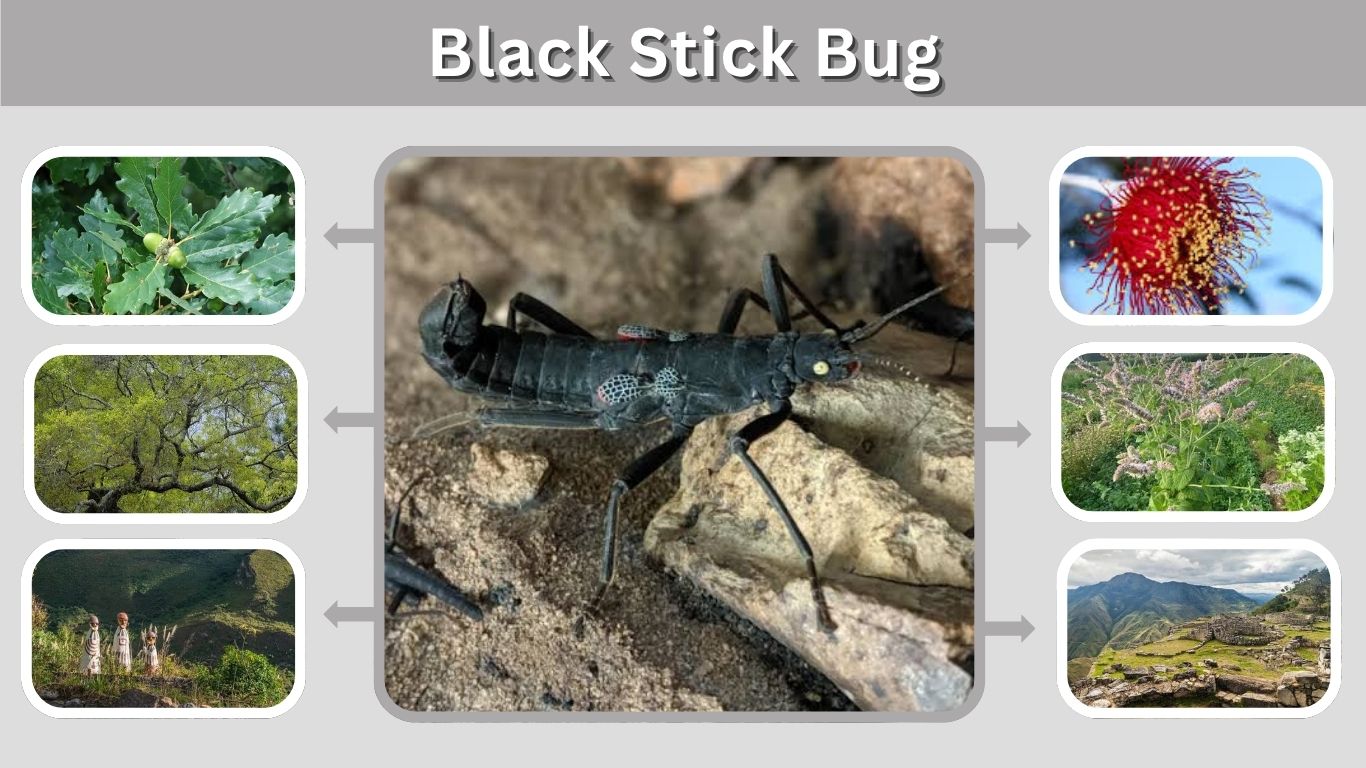
A black stick bug is usually a dark-colored member of the stick insect order Phasmatodea rather than one specific species. The best-known example is the Black Beauty stick insect, a rare Peruvian species with a velvety black body, yellow eyes, and bright red hindwings. Other insects described as black stick bugs include dark walkingsticks from North America and black-and-orange two-striped walkingsticks found in the southeastern United States.
What Is a Black Stick Bug?
Stick bugs, walkingsticks, and stick insects are herbivorous insects famous for resembling twigs, stems, or leaves. Most are brown or green, but some species are naturally black, while others become darker because of age, sex, lighting, or environmental conditions. Stick insects vary widely in body shape and may be smooth, spiny, winged, or wingless.
The phrase “black stick bug” may refer to several insects:
| Possible identification | Main appearance | Location |
| Black Beauty stick insect | Velvety black with yellow eyes and red wings | Northern Peru |
| Two-striped walkingstick | Black or dark brown with orange stripes | Southeastern United States |
| Northern walkingstick | Brown, gray, or very dark slender body | North America |
| Stick insect nymph | Small, dark, and usually wingless | Depends on species |
| Water stick insect | Thin aquatic predator with a breathing tube | Ponds and wetlands |
Black Beauty Stick Insect
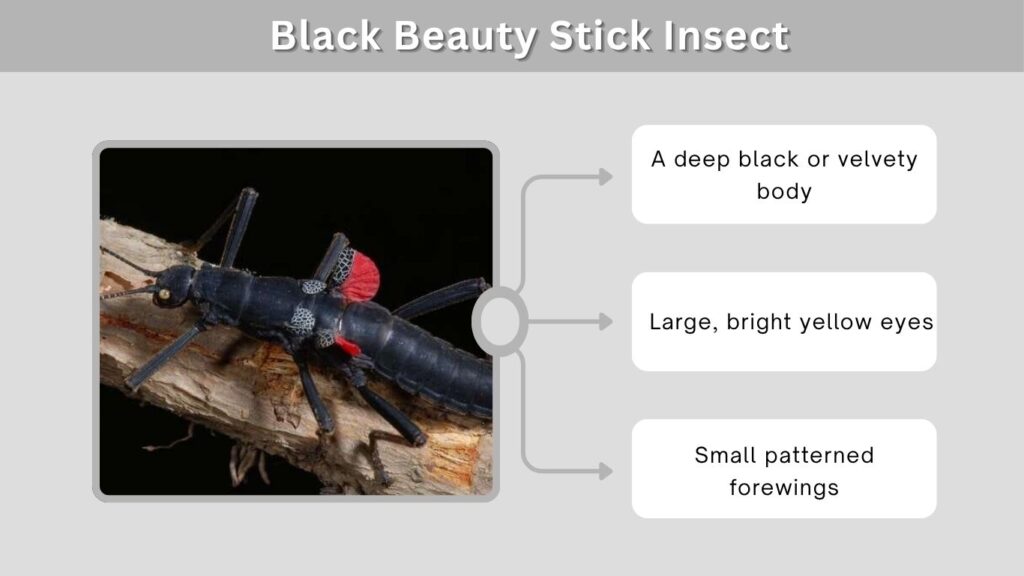
The Black Beauty stick insect, scientifically named Peruphasma schultei, is the species most strongly associated with the term “black stick bug.” It is also known as the golden-eyed or velvet stick insect.
Identification
A Black Beauty stick insect has:
- A deep black or velvety body
- Large, bright yellow eyes
- Long black legs and antennae
- Small patterned forewings
- Bright red hindwings hidden beneath the forewings
- A relatively thick, curved abdomen
- Shorter males and noticeably larger females
Females average approximately 2.75 inches long, while males are usually around 1.5 inches. Both sexes possess wings, although they do not resemble the extremely long, twig-like walkingsticks familiar to many people.
Habitat and Distribution
Black Beauty stick insects are found naturally only within a very small area of northern Peru. They were formally discovered in the wild in 2005 and are considered threatened because fires, agricultural expansion, and habitat loss affect their restricted range.
These insects are nocturnal. They hide during the day and become more active after dark, when they feed and move among vegetation.
Diet
Like other true stick insects, Black Beauties are herbivores. They eat leaves rather than hunting smaller animals. Pepper tree foliage is an important part of their diet, although captive diets may differ depending on the breeder’s established feeding program.
Pet insects should receive only fresh, pesticide-free leaves from a confirmed food plant. Random garden plants, florist foliage, and chemically treated leaves can be dangerous.
Black-and-Orange Stick Bugs
A long black stick bug with orange, tan, or yellow stripes may be a two-striped walkingstick, Anisomorpha buprestoides. This species is especially associated with Florida and other parts of the southeastern United States.
How to Identify It
The two-striped walkingstick has a dark body marked by contrasting longitudinal stripes. Its body is thicker and shorter than that of many slender twig-mimicking walkingsticks. Adult males are much smaller and are frequently seen riding on the backs of females.
Its bold colors serve as a warning rather than camouflage. For this reason, a black-and-orange walkingstick should not be picked up or brought close to the face.
Defensive Spray
Two-striped walkingsticks can spray a strong-smelling defensive secretion from glands near the front of the body. The liquid is intensely irritating to the eyes and mucous membranes and may cause severe pain, redness, tearing, or temporary visual problems.
Do not crush or provoke the insect. Keep children and pets away, and gently leave it alone or guide it outdoors without placing your face near it.
Are Black Stick Bugs Dangerous?
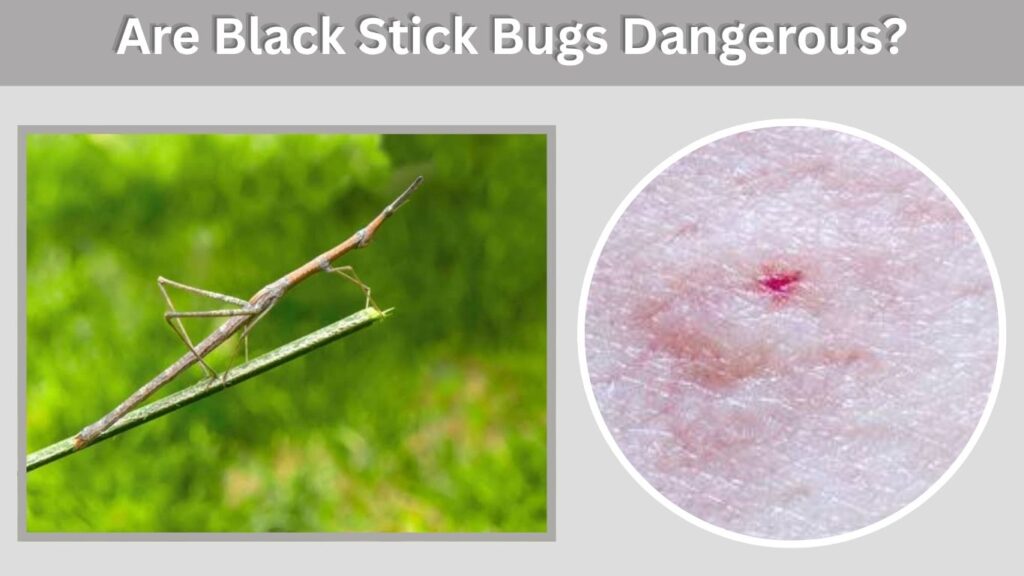
Most black stick insects are not aggressive and do not seek out people. They are leaf-eating insects whose main defenses include camouflage, remaining motionless, dropping from vegetation, displaying colorful wings, or releasing defensive chemicals.
Do They Bite or Sting?
Stick insects have chewing mouthparts for cutting leaves, but they rarely bite humans. They do not possess stingers and cannot inject venom like bees or wasps.
Some large or spiny species may pinch or scratch when restrained. The greater concern with Black Beauty and two-striped walkingsticks is their defensive chemical secretion. The Black Beauty may raise its red wings and release an irritating fluid when threatened.
What to Do After Eye Exposure
Immediately rinse the affected eye with plenty of clean running water. Remove contact lenses when possible and avoid rubbing the eye. Seek urgent medical advice when pain, redness, light sensitivity, or blurred vision continues.
What Do Black Stick Bugs Eat?
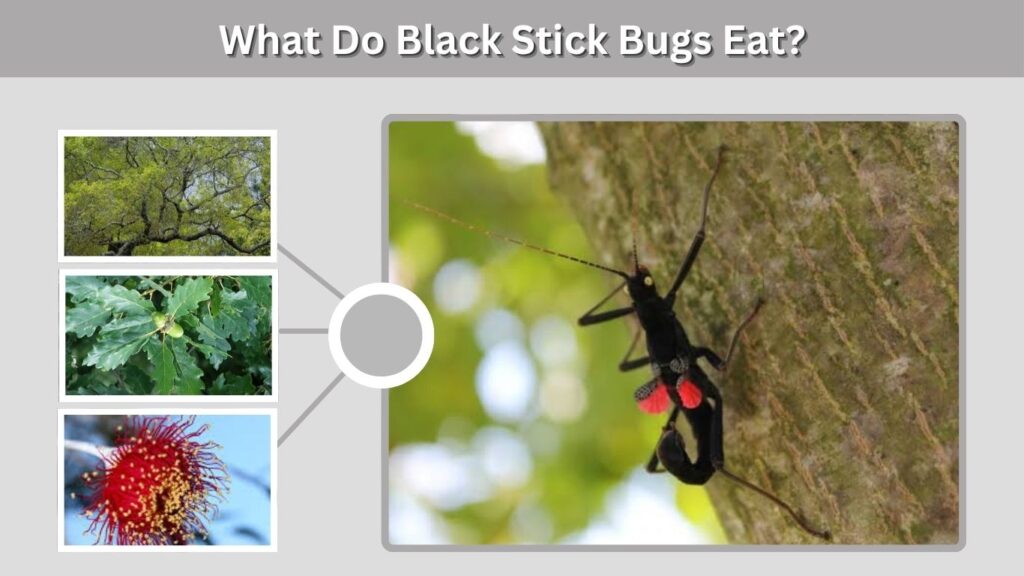
Black stick bugs eat foliage, although the correct host plant depends on the species. Stick and leaf insects are herbivores that consume leaves from particular trees, shrubs, and vines.
Potential foods for different captive species include:
- Pepper tree leaves
- Privet
- Bramble or blackberry
- Rose
- Oak
- Hawthorn
- Eucalyptus
- Raspberry leaves
A leaf accepted by one species may be rejected or harmful to another. Anyone keeping a black stick insect should obtain its scientific name and follow a species-specific feeding guide.
Black Stick Bug in the House
A black walkingstick may accidentally enter a home through an open door, window, plant, or piece of outdoor furniture. It does not establish infestations in beds, carpets, clothing, or stored food.
Place a container over the insect, slide a stiff piece of paper underneath, and move it outdoors. Avoid grabbing its body or legs because stick insects are fragile and may lose a leg when handled roughly.
Treat a black-and-orange specimen more cautiously because it could be a defensive two-striped walkingstick. Keep it away from your face while relocating it.
Tiny Black Bugs That Stick to Skin
A tiny black bug attached firmly to human skin is unlikely to be a true stick insect. Walkingsticks have long legs, visible antennae, and elongated bodies, and they feed on leaves rather than blood.
Do not identify a skin-attached insect solely by color. Carefully remove or collect it for identification, especially when it appears embedded, causes pain, or leaves a spreading rash. A very small attached arthropod could belong to an entirely different group.
Is the Men in Black Stick Bug Real?
Searches for a “Men in Black stick bug” usually refer to fictional insect-like aliens from the movie franchise rather than an actual species. The original Men in Black features an extraterrestrial villain called the Bug, while later films also include the fictional, coffee-loving Worm Guys.
These characters were created for science-fiction entertainment and are not representations of the Black Beauty stick insect or another real walkingstick.
FAQs
Are all black stick bugs Black Beauty stick insects?
No. “Black stick bug” is a descriptive phrase rather than a precise species name. A dark walkingstick could be a Black Beauty, a two-striped walkingstick, a dark-colored local species, or a young nymph. Location, body markings, wings, and size are needed for identification.
Can a Black Beauty stick insect fly?
Black Beauty stick insects have two pairs of wings, but their wings are used mainly in defensive displays. When threatened, the insect exposes its vivid red hindwings, creating a sudden flash of color intended to discourage predators.
Are Black Beauty stick bugs good pets?
They are kept in specialist insect collections, but owners must understand their food, ventilation, humidity, space, and defensive behavior. They should not be handled close to the eyes because they can release an irritating secretion when frightened.
Why is my stick bug turning black?
Darkening may be associated with its species, maturity, sex, recent molt, temperature, lighting, or natural color variation. Sudden darkening combined with weakness, poor grip, injury, or failure to eat may indicate stress or unsuitable enclosure conditions.
What is a black stick bug with yellow stripes?
A dark walkingstick with yellow, orange, or tan stripes may be a two-striped walkingstick, particularly in Florida or elsewhere in the southeastern United States. Avoid handling it because this species can direct an irritating defensive spray toward the face and eyes.