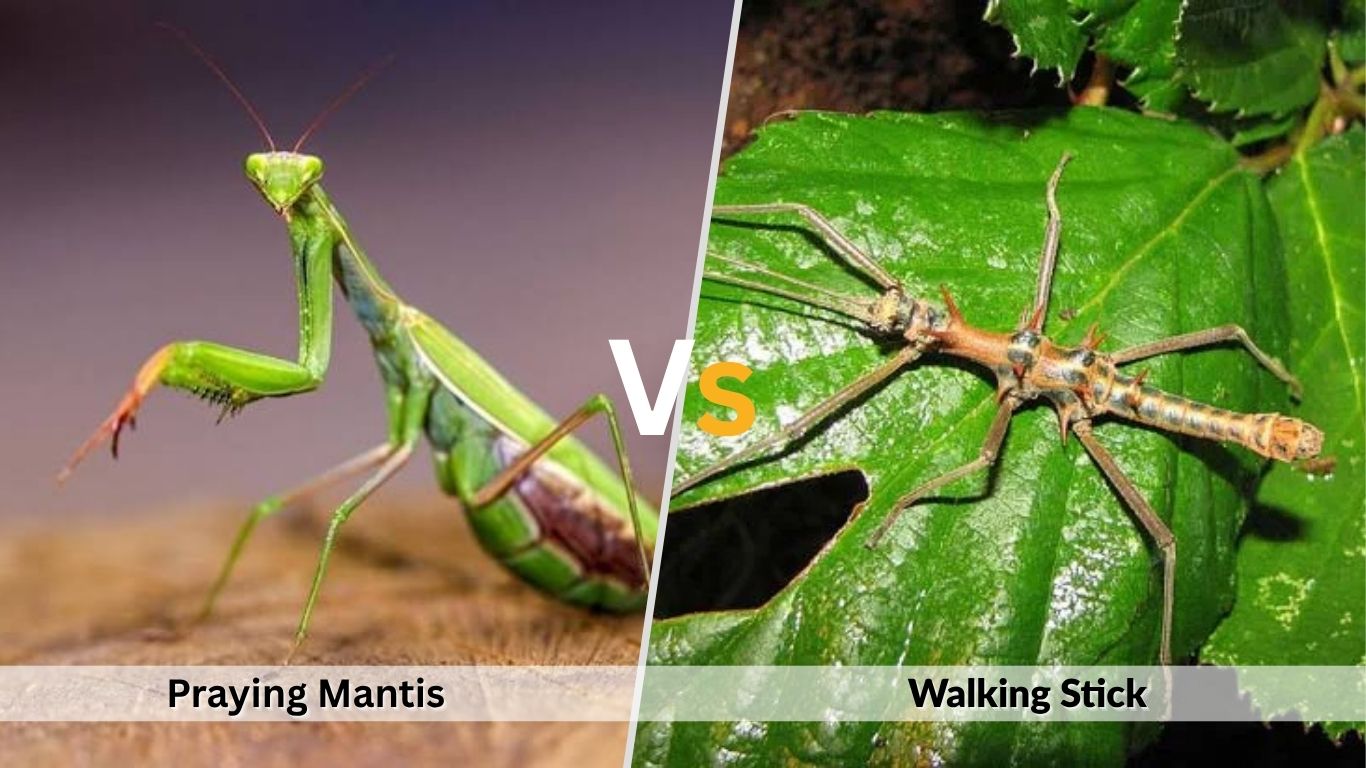
A praying mantis and a walking stick can look remarkably similar when resting among leaves and branches. Both have long bodies, six legs, and camouflage that helps them disappear into vegetation. However, they are very different insects. A praying mantis is an ambush predator equipped with powerful grasping legs, while a walking stick is a slow-moving herbivore shaped to resemble a twig.
Praying Mantis vs Walking Stick Comparison
Praying mantises belong to the order Mantodea, while walking sticks belong to Phasmatodea. Their different diets and lifestyles are reflected in their head shape, legs, movement, and defensive behavior.
| Feature | Praying Mantis | Walking Stick |
| Insect order | Mantodea | Phasmatodea |
| Diet | Carnivorous | Herbivorous |
| Front legs | Thick, folded, and spiny | Long and similar to other legs |
| Head | Broad and triangular | Small and narrow |
| Eyes | Large and prominent | Relatively small |
| Body shape | Long with an extended thorax | Extremely thin and twiglike |
| Movement | Can strike quickly | Usually slow and swaying |
| Primary defense | Camouflage and grasping legs | Camouflage, stillness, or chemicals |
| Typical behavior | Waits for animal prey | Feeds on leaves |
How to Identify a Praying Mantis
A praying mantis has a recognizable triangular head, large compound eyes, an elongated thorax, and powerful front legs held in a folded position. This posture resembles hands held in prayer, which explains its common name.
Key Identification Features
- Broad, triangular head
- Large, forward-facing eyes
- Long and flexible necklike thorax
- Thick front legs armed with spines
- Forelegs held folded against the chest
- Green, brown, gray, or patterned body
- Wings present in many adults
- Quick striking movement
The front legs are the most important identification feature. They are modified into raptorial limbs that close around prey. Mantises usually remain motionless until an insect moves close enough to capture.
What Do Praying Mantises Eat?
Praying mantises are predators that primarily consume insects and other arthropods. Their prey may include flies, moths, grasshoppers, crickets, beetles, caterpillars, bees, and other mantises. Large species may occasionally capture small vertebrates, but insects make up their usual diet.
Mantises are not selective pest controllers. They may eat garden pests, but they can also capture pollinators and other beneficial insects.
How to Identify a Walking Stick
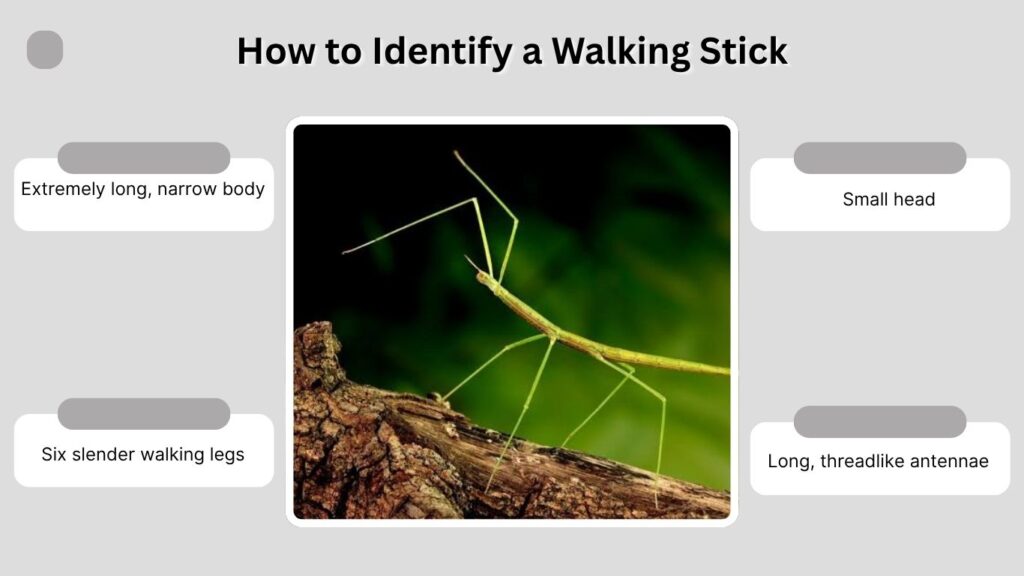
A walking stick has a much thinner body that resembles a twig, stem, or narrow branch. Its head is small, and all six legs are generally long and slender. Unlike the mantis, it does not have thick front legs designed for capturing prey.
Key Identification Features
- Extremely long, narrow body
- Small head
- Six slender walking legs
- Long, threadlike antennae
- Brown, tan, gray, or green coloration
- Slow and deliberate movement
- Twiglike resting posture
- Wings absent or reduced in many species
Walking sticks frequently extend their front legs beside their head, making the legs look like part of a continuous branch. Some also sway gently, resembling vegetation moving in the wind.
What Do Walking Sticks Eat?
Walking sticks are herbivores. They use chewing mouthparts to consume leaves from trees, shrubs, and other plants. The exact host plants depend on the species, but oak and other deciduous trees commonly support North American walking sticks.
They do not hunt insects, drink blood, or attack animals. Most feed at night and remain motionless among vegetation during the day.
Praying Mantis vs Walking Stick Size
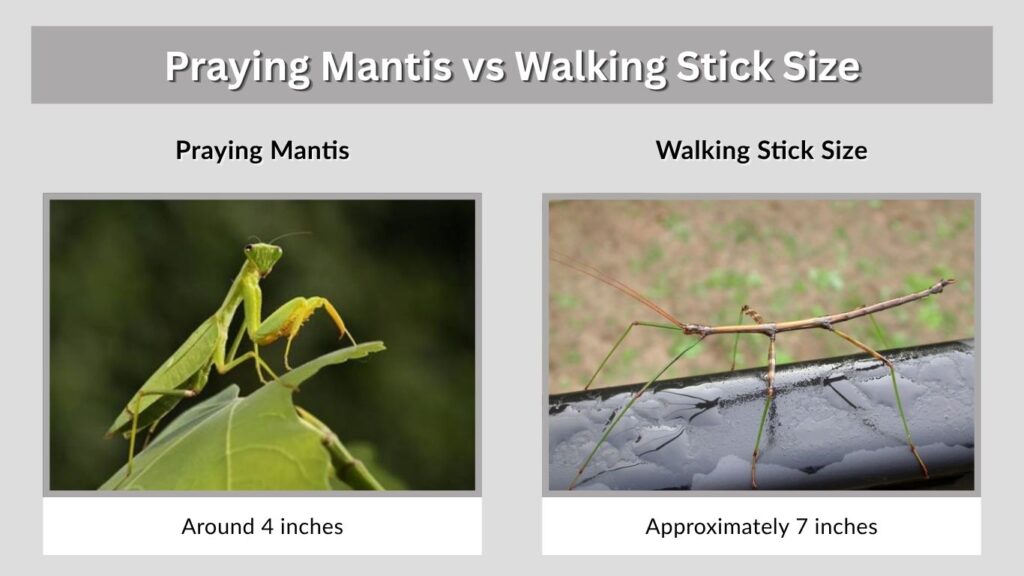
Size varies considerably because both groups contain many species. A typical mantis may be a few inches long, while some large walking sticks become much longer.
Texas A&M notes that mantises may reach approximately four inches. By comparison, female giant walking sticks can reach about seven inches and are among North America’s longest insects. Many ordinary walking sticks are smaller, however, so size alone cannot reliably identify one.
| Measurement | Praying Mantis | Walking Stick |
| Common appearance | Medium-sized and robust | Thin and elongated |
| Large examples | Around 4 inches | Up to approximately 7 inches in North America |
| Body width | Relatively broad | Extremely narrow |
| Female size | Often larger than male | Frequently much larger than male |
A short, broad insect with folded front legs is probably a mantis. A longer insect with a uniformly thin body and six similar-looking legs is more likely a walking stick.
Brown Praying Mantis vs Walking Stick
Brown coloration can make identification difficult because both insects may blend with bark, dry leaves, and branches. Instead of relying on color, examine the head and front legs.
A brown praying mantis has:
- A triangular, mobile-looking head
- Large, noticeable eyes
- Thick, folded front legs
- A wider upper body
- An alert predatory posture
A brown walking stick has:
- A small, narrow head
- Six similarly slender legs
- A nearly uniform twig-shaped body
- Slow, swaying movements
- No specialized grasping forelegs
Both use camouflage, but they use it for different purposes. The mantis hides while waiting to ambush prey, whereas the walking stick primarily hides to avoid being eaten.
Praying Mantis vs Walking Stick: Who Would Win?
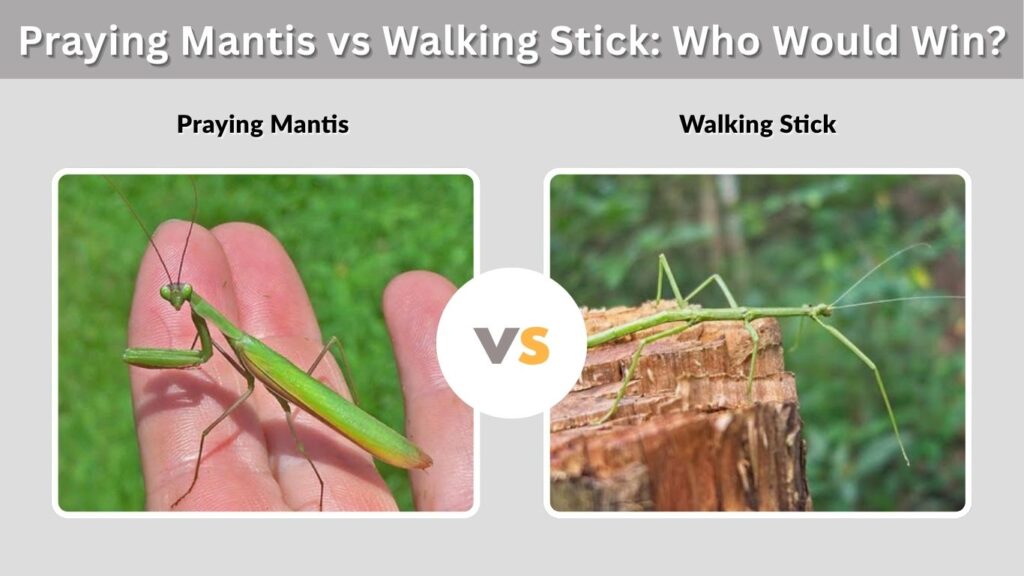
In a hypothetical encounter between similarly sized individuals, a praying mantis would generally have the advantage. It is a predator with spiny grasping legs, strong chewing mouthparts, and a rapid strike. A walking stick is a plant eater whose main defenses are camouflage, remaining still, dropping from vegetation, or attempting to escape.
This is an inference based on their anatomy and feeding behavior rather than a guaranteed outcome. A very large walking stick might be too difficult for a smaller mantis to overpower. Some walking sticks also produce irritating defensive chemicals that could discourage an attacker.
The insects should never be placed together to test the result. A mantis may treat a smaller walking stick as prey, causing unnecessary injury or death.
Are Praying Mantises and Walking Sticks Related?
They are separate insect groups but share some broad characteristics. Both undergo incomplete metamorphosis, meaning the young resemble smaller, wingless versions of the adults and develop through several molts.
Their visual similarity is largely connected to camouflage and life among vegetation. Mantises developed grasping legs and predatory behavior, while walking sticks evolved extremely elongated bodies that imitate twigs.
Are They Dangerous to Humans?
Neither insect normally poses a serious threat to people.
A large praying mantis may pinch or bite defensively when restrained, but it has no stinger and does not seek out humans. A typical walking stick is even less likely to bite because it feeds on plants.
However, certain walking stick species can spray irritating defensive fluid. The two-striped walking stick is one example. Its secretion can cause significant eye irritation, so unidentified walking sticks should not be held close to the face.
FAQs
Is a praying mantis a type of walking stick?
No. A praying mantis belongs to Mantodea, while a walking stick belongs to Phasmatodea. Mantises are predators with specialized grasping legs. Walking sticks are herbivores with uniformly slender legs and bodies shaped like twigs.
How can you identify them in pictures?
Look closely at the front legs and head. A mantis has thick, folded, spiny forelegs and a broad triangular head. A walking stick has a small head, an extremely thin body, and six long legs that appear relatively similar.
Can a praying mantis eat a walking stick?
A sufficiently large mantis may attempt to catch and eat a smaller walking stick. Mantises are opportunistic predators that capture many kinds of arthropods. Size, species, defensive chemicals, and the walking stick’s camouflage may affect the encounter.
Which insect is longer?
Walking sticks generally include the longer species. North America’s giant walking stick can reach approximately seven inches, while many mantises remain below four inches. Nevertheless, smaller walking stick species may be shorter than large mantises.
Can walking sticks and praying mantises live together?
No. They should not share an enclosure. Their diets, behavior, and care needs differ, and the mantis could attack the walking stick. Each insect requires its own secure habitat with suitable food, space, ventilation, and molting surfaces.