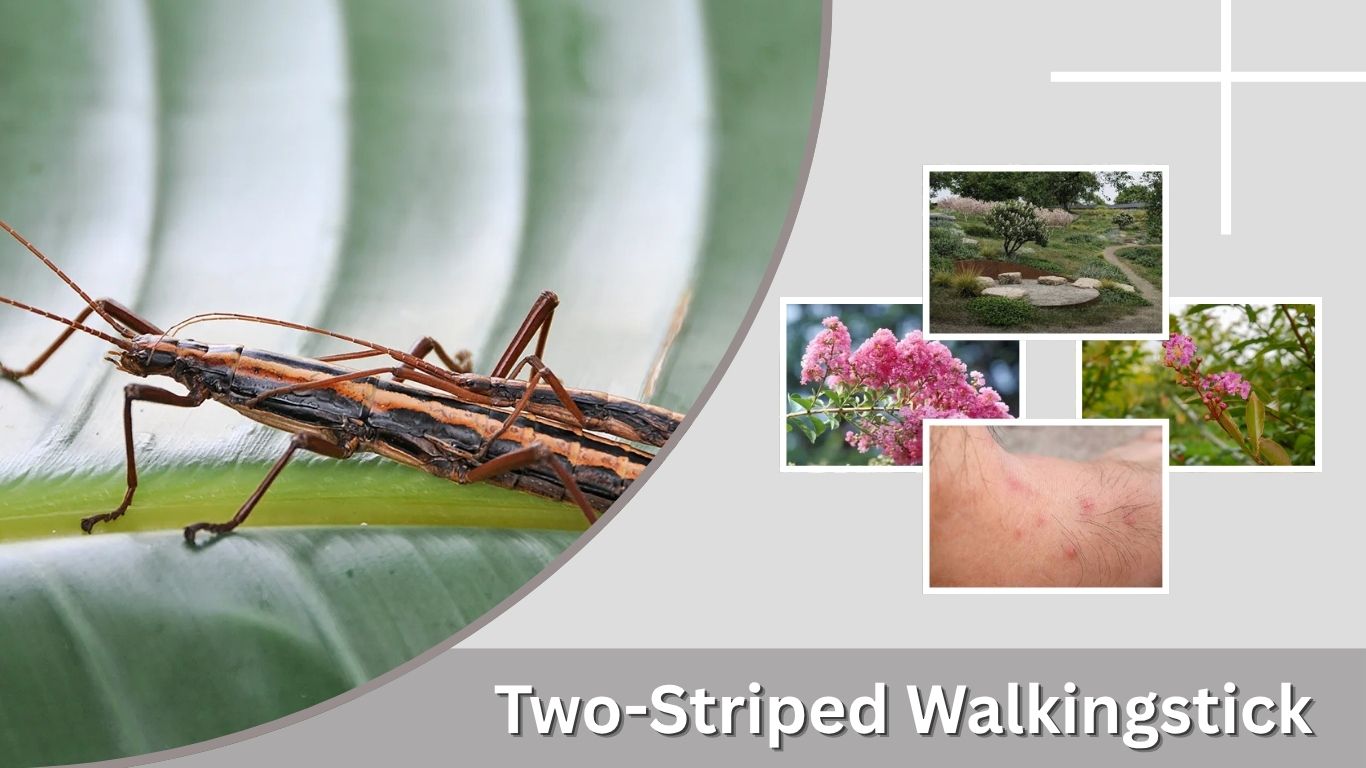
The two-striped walkingstick, Anisomorpha buprestoides, is a sturdy, wingless stick insect found in the southeastern United States. It is also called the southern two-striped walkingstick, two-striped walking stick bug, devil’s riding horse, or musk mare. Unlike most walkingsticks, this species relies on bold stripes and a powerful defensive spray rather than camouflage alone. The chemical can cause intense eye pain, so the insect should be observed without handling it.
What Is a Two-Striped Walkingstick?
The southern two-striped walkingstick belongs to the insect order Phasmatodea and the family Pseudophasmatidae. Its scientific name is Anisomorpha buprestoides. It is one of the most frequently encountered walkingstick species in Florida.
Despite its twig-like shape, it is more robust and colorful than many other North American walkingsticks. Its striped pattern and chemical defense make it relatively easy to recognize.
| Feature | Description |
| Scientific name | Anisomorpha buprestoides |
| Order | Phasmatodea |
| Family | Pseudophasmatidae |
| Average female length | About 2⅔ inches |
| Average male length | About 1⅔ inches |
| Wings | Absent |
| Diet | Leaves of trees and shrubs |
| Main defense | Irritating chemical spray |
| General range | Southeastern United States |
Two-Striped Walkingstick Identification
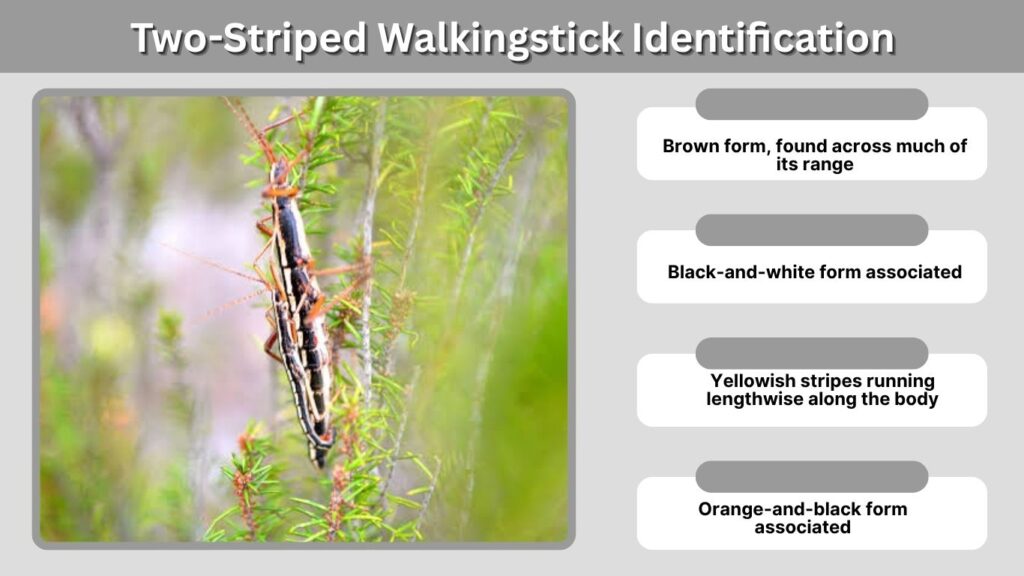
The insect has a long, narrow body, six slender legs, and long antennae. It is large and unusually stout compared with many stick insects. Adults are wingless and cannot fly.
Color and Stripes
The common color form is dark brown with pale tan or yellowish stripes running lengthwise along the body. Although its name mentions two stripes, the overall pattern may appear to include three conspicuous dark longitudinal bands separated by lighter areas.
Several regional color forms occur:
- Brown form, found across much of its range
- Black-and-white form associated with the Ocala National Forest
- Orange-and-black form associated with the Archbold Biological Station area
The living insects are usually much brighter than preserved specimens, which may lose their distinctive coloration after death.
Male vs Female
Females average about 67.7 millimeters, or 2⅔ inches, while males average approximately 41.7 millimeters, or 1⅔ inches. Females are broader and heavier, whereas males are smaller and more slender.
A small male is frequently seen riding on the back of a much larger female. This position is connected with mating behavior and explains common names such as “devil rider” and “devil’s riding horse.”
Where Do Two-Striped Walkingsticks Live?
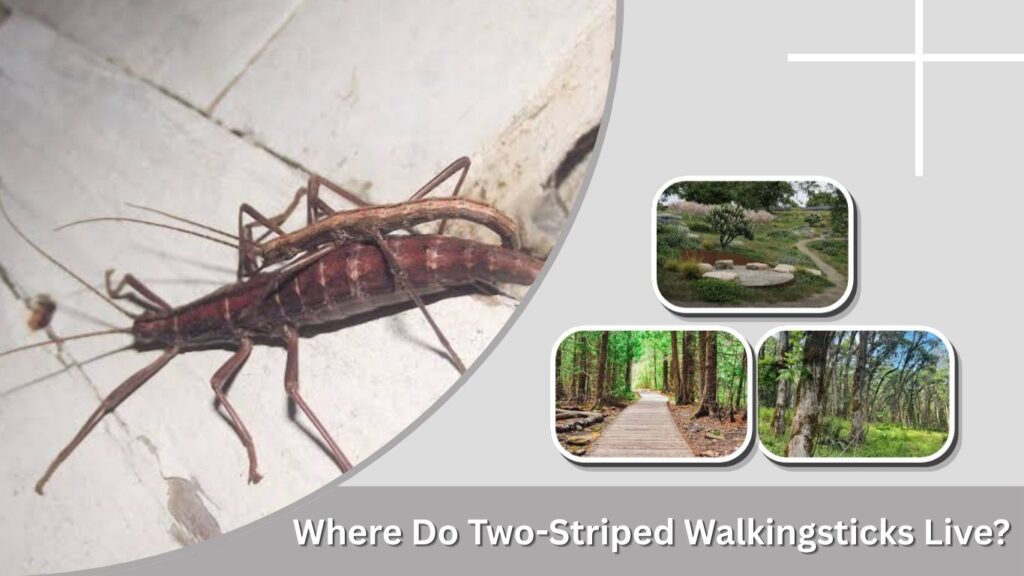
The southern two-striped walkingstick occurs in the southeastern United States. Records include Florida, Texas, Louisiana, Mississippi, Georgia, and South Carolina. BugGuide summarizes its range as extending across the Southeast from Texas through Florida to South Carolina.
It may be found in:
- Scrub and woodland habitats
- Gardens and landscaped areas
- Oak-dominated vegetation
- Shrublands and forest edges
- Beneath loose tree bark
- Protected cracks and sheltered spaces
The insects often gather in groups beneath loose bark or in similarly protected locations. Their activity appears to be mainly nocturnal, so they may remain concealed during daylight and emerge after dark to feed.
What Do Two-Striped Walkingsticks Eat?
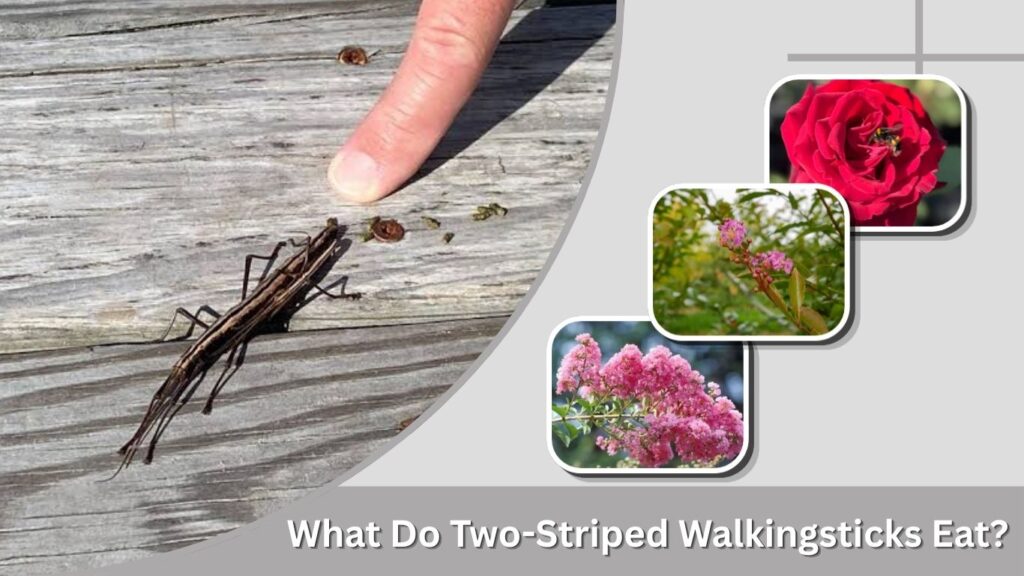
Two-striped walkingsticks are herbivores that feed on leaves from trees and shrubs. Recorded food plants include oak, crepe myrtle, roses, privet, rosemary and lyonia. They may rest on plants without necessarily eating them.
Although groups can sometimes become locally abundant, the University of Florida publication reports no evidence that this species regularly causes the severe defoliation associated with certain other walkingsticks. Minor leaf damage generally does not require treatment.
Is the Two-Striped Walkingstick Poisonous?
The insect is not poisonous in the usual sense of harming someone through a bite or sting. However, it has chemical-defense glands that produce an irritating secretion. These glands are positioned in the thorax and open immediately behind the head.
The active defensive substance is called anisomorphal, a terpene dialdehyde. When the walkingstick feels threatened, it can direct the secretion toward the perceived attacker with considerable accuracy.
Therefore, calling it “venomous” or “poisonous” is less precise than describing it as a chemically defended insect whose spray can injure sensitive tissues, especially the eyes.
Two-Striped Walkingstick Spray
The walkingstick releases a strong-smelling, milky defensive liquid when grabbed, tapped, pinched, repeatedly prodded or closely threatened. Its glands are functional even in newly hatched nymphs.
How Far Can It Spray?
The insect may accurately direct its spray approximately 30–40 centimeters, or about 12–16 inches. Larger females may spray several times before exhausting their supply, after which replenishing the chemical can take one or two weeks.
Because the insect can spray before physical contact occurs, keeping your face away is important even when you are not planning to touch it.
What Happens if the Spray Gets in Your Eyes?
Documented human exposures have caused:
- Immediate, severe burning pain
- Intense redness
- Light sensitivity
- Temporary blurred or impaired vision
- Irritation lasting several hours or days
Most recorded cases eventually resolved without permanent effects, but the symptoms can be severe. Eye injuries have also been reported in dogs.
What Should You Do After Exposure?
Immediately rinse the affected eye with large amounts of clean water. Continue gentle irrigation rather than rubbing the eye, since rubbing may worsen irritation or damage the cornea.
Seek medical care when there is decreased vision, continued severe pain, strong light sensitivity or persistent redness. Pets exposed in the eyes should be examined by a veterinarian.
Do Two-Striped Walkingsticks Bite or Sting?
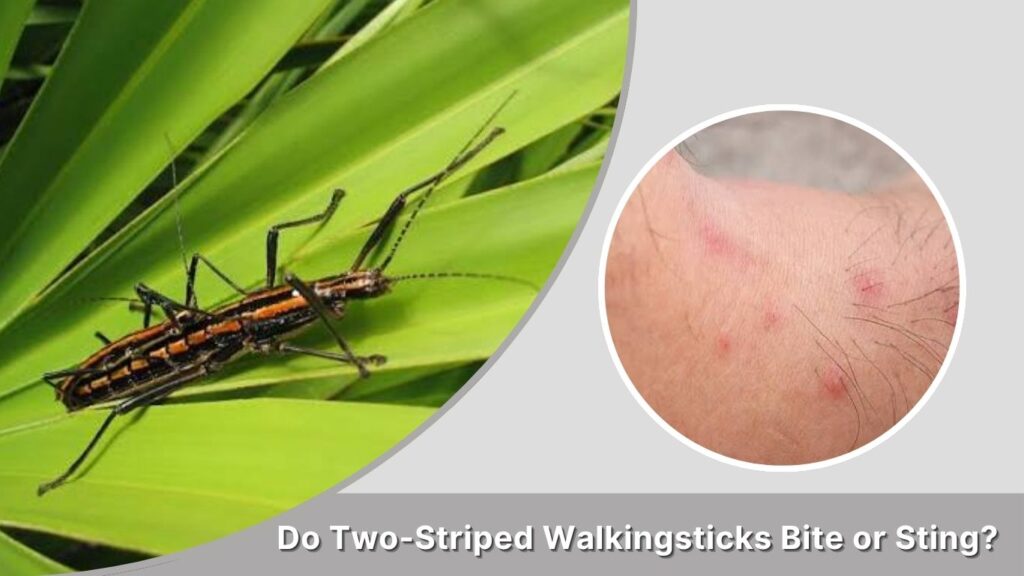
Two-striped walkingsticks do not have stingers and are not aggressive predators. They possess chewing mouthparts for eating leaves, but biting people is not considered their primary defense.
The main hazard is their chemical spray. Avoid picking them up, placing them near your face or allowing children and pets to disturb them.
Life Cycle and Reproduction
A female may dig a small pit in sandy soil, deposit approximately eight to ten eggs and cover them with sand. Females have also been observed placing eggs in crevices in pine-bark mulch.
The young hatch as nymphs that resemble small adults. They grow by repeatedly shedding their exoskeletons. The species’ complete life history has not been thoroughly documented, but adults in Florida are especially abundant during fall, when much of the egg-laying occurs. BugGuide records the species throughout the year in Florida.
Southern vs Northern Walkingstick
The southern two-striped walkingstick should not be confused with the northern walkingstick, Diapheromera femorata.
| Feature | Southern two-striped walkingstick | Northern walkingstick |
| Scientific name | Anisomorpha buprestoides | Diapheromera femorata |
| Body | Stout with bold stripes | Thin and twig-like |
| Main range | Southeastern United States | Much of eastern North America |
| Chemical spray | Strong defensive spray | Lacks the same famous eye-irritating defense |
| Common color | Brown, orange or black with stripes | Brown or greenish brown |
The northern walkingstick is generally longer but much more slender. It relies heavily on twig-like camouflage and feeds primarily on deciduous foliage, including oak and hazelnut.
What to Do When You Find One
Leave the walkingstick undisturbed whenever possible. It is a plant-feeding native insect rather than a household invader seeking food or shelter indoors.
When relocation is necessary:
- Keep your face well away from the insect.
- Wear eye protection and gloves.
- Place a container in front of it.
- Gently guide it inside using a long object.
- Release it outside near shrubs or trees.
- Do not squeeze, grab or repeatedly prod it.
Avoid applying pesticides to a single walkingstick. Physical relocation is usually safer and more appropriate.
FAQs
Are two-striped walking sticks dangerous?
They are not aggressive, but their defensive spray can cause severe eye pain, redness, light sensitivity and temporary visual disturbance. Observe them from a safe distance and avoid handling them.
Can a southern two-striped walkingstick spray you?
Yes. It can aim its defensive secretion toward a threat from approximately 12–16 inches away. Direct physical contact is not always required for the insect to spray.
Are Florida walking stick bugs poisonous?
Most Florida walkingsticks are not dangerous, but the two-striped walkingstick produces an irritating defensive chemical. The greatest risk occurs when the spray reaches a person’s or animal’s eyes.
What does a two-striped walking stick eat?
It eats leaves from trees and shrubs. Recorded foods include oak, crepe myrtle, roses, privet, rosemary and lyonia. It does not hunt or eat other insects.
Can two-striped walkingsticks fly?
No. Both males and females are wingless. They travel by walking and climbing through shrubs, trees, mulch and sheltered areas.