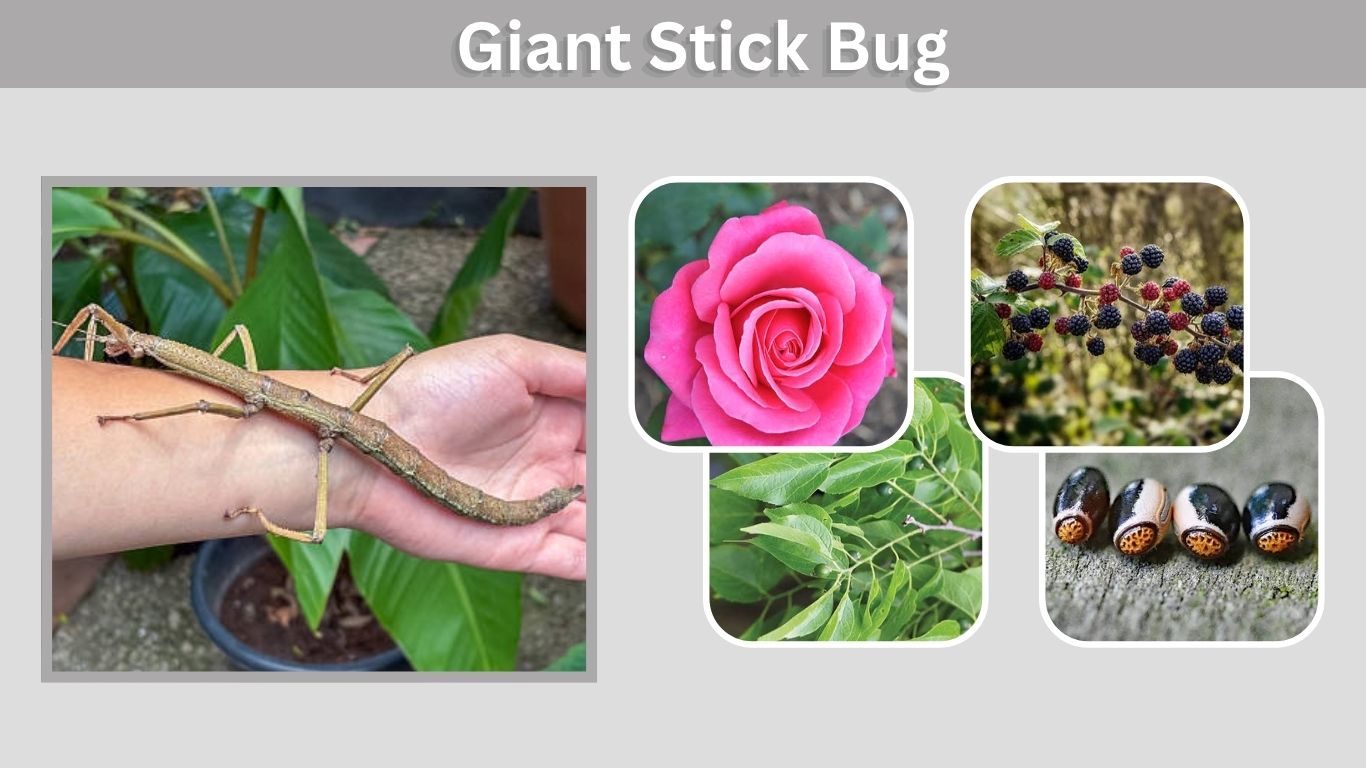
The term giant stick bug does not refer to only one species. It may describe Australia’s giant prickly stick insect, the giant walkingstick of Texas, or exceptionally large tropical species such as the recently described Acrophylla alta. These insects belong to the order Phasmatodea and are famous for resembling branches, twigs, bark, or dried leaves. Despite their intimidating size, giant stick insects are generally slow-moving herbivores rather than aggressive predators.
Giant Stick Bug Quick Facts
Giant stick insects differ in size, shape, habitat, and ability to fly. Some are long and slender, while others have broad bodies covered with leaf-like lobes or protective spines.
| Feature | General information |
| Scientific order | Phasmatodea |
| Common names | Giant stick bug, walkingstick, phasmid |
| Diet | Leaves from trees and shrubs |
| Habitat | Forests, woodlands, and tropical rainforests |
| Activity | Usually nocturnal |
| Main defense | Camouflage and remaining motionless |
| Life cycle | Egg, nymph, and adult |
| Danger to humans | Generally harmless |
| Flight ability | Depends on species and sex |
What Is the Giant Stick Bug?
“Giant stick bug” is an informal name applied to several unusually large members of Phasmatodea. Phasmids are adapted to resemble parts of plants, and their name is associated with the idea of a phantom or apparition because they can nearly disappear against vegetation.
Common Giant Species
Some of the best-known examples include:
- Giant prickly stick insect – Extatosoma tiaratum
- Giant walkingstick – Megaphasma denticrus
- New Australian giant stick insect – Acrophylla alta
- Lord Howe Island stick insect – Dryococelus australis
- Titan stick insect – Acrophylla titan
These insects are not closely related to mantises despite their similar elongated bodies. Stick insects eat vegetation, while praying mantises use modified front legs to capture other animals.
Giant Australian Stick Bug
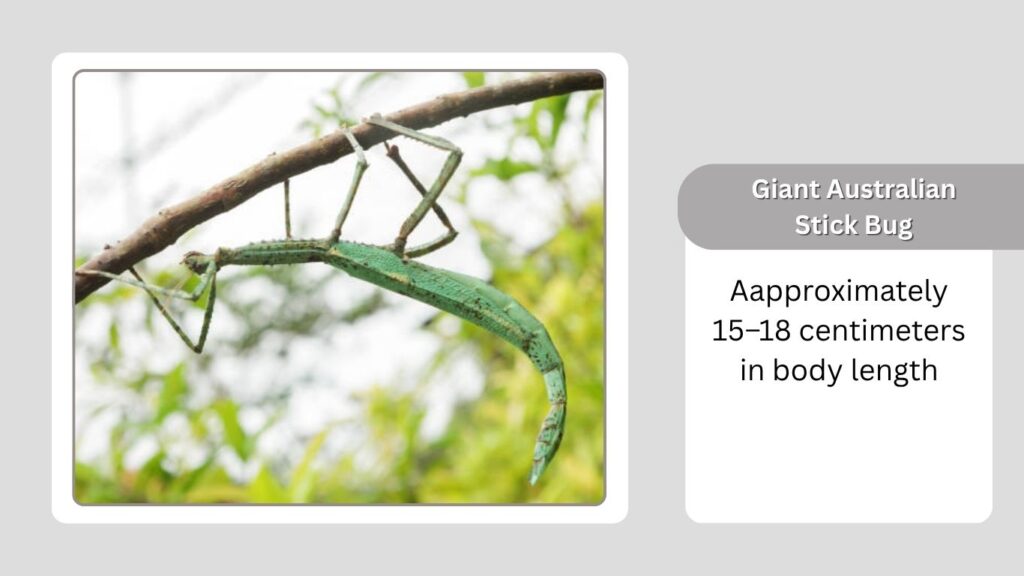
Australia supports many impressive phasmids. The species most often kept or displayed as a “giant Australian stick bug” is the giant prickly stick insect, also called the spiny leaf insect or Macleay’s spectre.
Giant Prickly Stick Insect
The scientific name of the giant prickly stick insect is Extatosoma tiaratum. Females have large, curled bodies covered with spines and leaf-like projections. Their small wings cannot support normal flight. Males are narrower, lighter, and equipped with fully developed wings.
Females may reach approximately 15–18 centimeters in body length. Their brown, tan, green, or gray coloration resembles dried leaves, bark, and broken branches. When threatened, one may curl its abdomen over its body, creating a posture that resembles a scorpion.
Although the pose looks threatening, it does not have a scorpion’s venomous stinger. The insect relies primarily on camouflage, leg spines, sudden movements, and its unusual posture to discourage predators.
New Giant Stick Bug Discovered in Australia
In 2025, researchers formally described Acrophylla alta, a giant stick insect from high-altitude rainforest in Queensland’s Atherton Tablelands. The known females measured roughly 40 centimeters with their legs extended and weighed around 44 grams—slightly less than a golf ball. Researchers described it as a possible contender for Australia’s heaviest known insect.
The species remained overlooked partly because it lives high in the canopy of a small, difficult-to-access rainforest area. Researchers also used its unusually shaped and textured eggs to confirm that it differed from known relatives. Only females and eggs were included in its original scientific description.
The name alta refers to its elevated habitat. Its large body may help it survive the cool and wet conditions found in high-altitude rainforest, although further study is needed to understand its complete biology.
Giant Walking Stick Bug in Texas
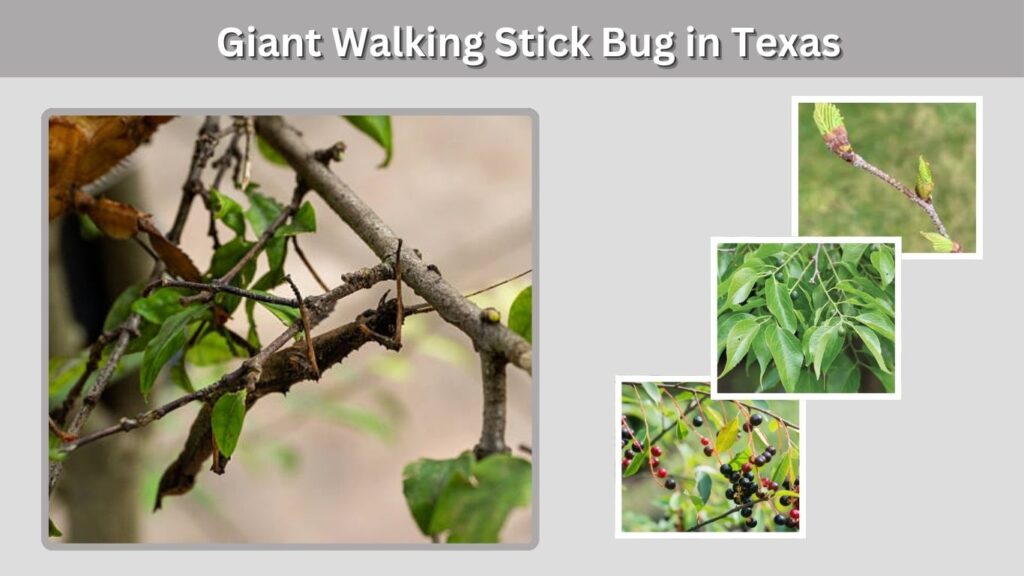
The giant walkingstick, Megaphasma denticrus, is the largest walkingstick native to the United States. Females can approach seven inches in length, making the species particularly noticeable when it appears on screens, walls, trees, or porches.
Identification
A Texas giant walkingstick usually has:
- A long, cylindrical body
- Brown, grayish, or green coloration
- Six extremely slender legs
- Long, thread-like antennae
- No enlarged front legs for capturing prey
- A twig-like appearance
- A slow, swaying walking style
Its narrow body is very different from the thick, curled form of the Australian giant prickly stick insect. Texas A&M notes that walkingsticks use their color, body shape, and behavior to hide from predators.
Habitat and Food
Giant walkingsticks inhabit wooded environments where their preferred host plants grow. Nymphs and adults have chewing mouthparts and consume foliage from trees and shrubs.
Host plants can include:
- Oak
- Pecan
- Hickory
- Hackberry
- Birch
- Apple
- Dogwood
- Wild cherry
- Locust
Young nymphs tend to feed on understory vegetation, while older insects may climb into the crowns of trees. Large populations can occasionally remove noticeable amounts of foliage, but isolated walking sticks rarely cause serious damage.
Can Giant Stick Bugs Fly?
Flight ability depends on the species and sex. Many giant walkingsticks are completely wingless, while others possess wings that differ greatly between males and females.
In the giant prickly stick insect, adult males have functional wings and can fly. Females are much heavier and have wings that are too small for sustained flight. Female Acrophylla alta also possess wings, but their heavy bodies apparently make them relatively poor flyers.
Some species open their wings suddenly to reveal bright colors hidden underneath. This startle display may distract a bird or reptile long enough for the insect to escape.
What Do Giant Stick Bugs Eat?
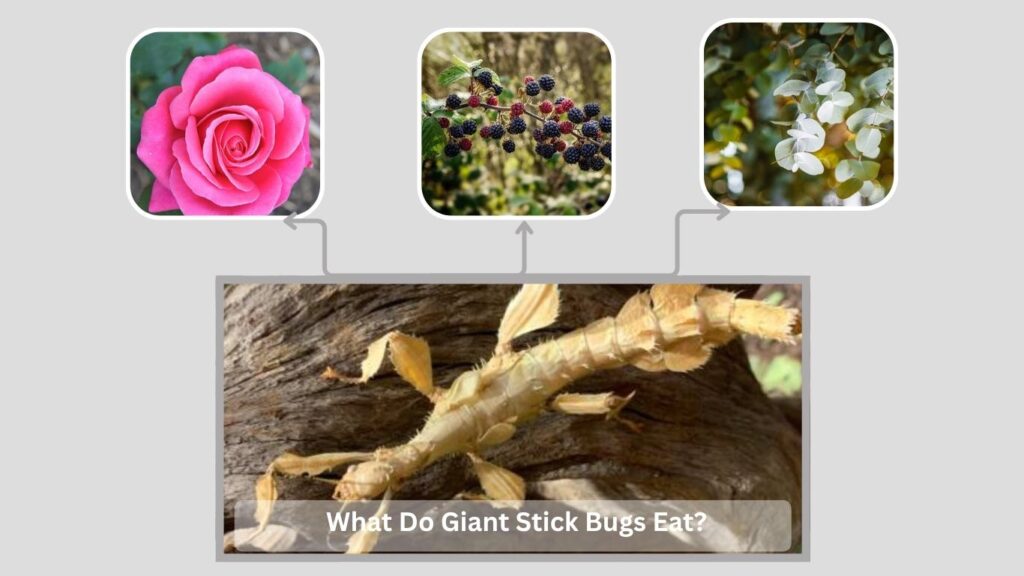
All commonly recognized giant stick insects are herbivores. They use chewing mouthparts to remove sections of leaves, usually feeding after sunset when many visual predators are less active.
Their exact diet varies by species. Australian phasmids commonly feed on eucalyptus and other native trees, while captive giant prickly stick insects may accept bramble, rose, eucalyptus, or suitable substitute foliage.
A wild stick insect should not be moved far from the vegetation where it was found. A nearby plant may be its food source, daytime shelter, or egg-laying habitat.
Giant Stick Bug Life Cycle
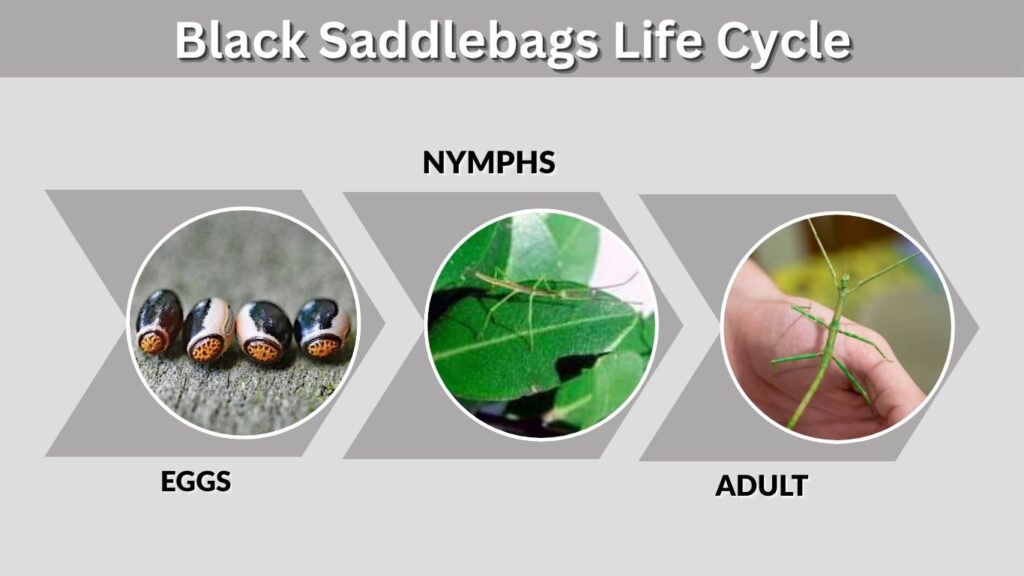
Stick insects undergo incomplete metamorphosis. They do not have a caterpillar or pupal stage. Their three main stages are egg, nymph, and adult.
Eggs and Nymphs
Females commonly release seed-like eggs that fall into leaf litter or soil. Some species attach eggs to plants or place them in protected locations. In temperate Texas species, eggs may remain on the ground through winter before nymphs emerge in spring.
A newly hatched nymph looks like a miniature adult. It grows through several stages called instars, shedding its rigid exoskeleton each time. The insect must hang securely while molting so it can pull its legs and body free.
Spiny leaf insect eggs possess an edible knob called a capitulum. Ants may carry these eggs into their nests, eat the knob, and leave the developing insect unharmed in a protected location.
Reproduction
Females of many stick insect species can reproduce through parthenogenesis, meaning eggs may develop without fertilization by a male. In the spiny leaf insect, unfertilized eggs generally produce female offspring, while mating allows both sexes to be produced.
Are Giant Stick Bugs Dangerous?
Giant stick bugs are not predators and generally do not bite or sting people. Their mouthparts are designed for chewing leaves rather than attacking humans.
However, a large insect may grip tightly with hooked feet, scratch with leg spines, or kick when frightened. Some phasmid species also produce unpleasant or irritating defensive secretions. It is therefore best to keep unfamiliar insects away from the eyes and face.
To move one safely, allow it to step onto a branch or gently guide it into a container. Never pull it by one leg because stick insect limbs are delicate and can break.
Can You Keep a Giant Stick Bug as a Pet?
The giant prickly stick insect is commonly maintained in captivity because of its dramatic appearance and plant-based diet. However, an enclosure must provide enough vertical space for molting, good ventilation, suitable humidity, and a constant supply of safe foliage.
Ownership and import rules vary by country and region because nonnative stick insects can damage plants or establish invasive populations. Prospective keepers should choose legally obtained, captive-bred insects and verify local agricultural and wildlife regulations before acquiring one.
FAQs
How large can a giant stick bug grow?
Size depends on the species. The American giant walkingstick can reach nearly seven inches, while the recently described Australian Acrophylla alta measures roughly 40 centimeters when its legs are included.
Is the giant stick bug poisonous?
Most giant stick insects are neither poisonous nor venomous. Some species use irritating defensive secretions or spiny legs, but they do not have a venomous stinger.
Do giant stick bugs have wings?
Some do. Male giant prickly stick insects have functional wings, while females have much shorter wings. Other giant walkingstick species are wingless, and certain heavy winged females fly poorly.
Where do giant stick bugs live?
They occur in forests, woodlands, shrublands, and rainforests. Large species are found in Australia, Southeast Asia, North America, and other warm or temperate regions.
What should I do after finding one?
Leave it on nearby vegetation or gently move it away from roads, doors, and pets. Do not spray it with pesticide, pull its legs, or carry it far from the habitat where it was discovered.