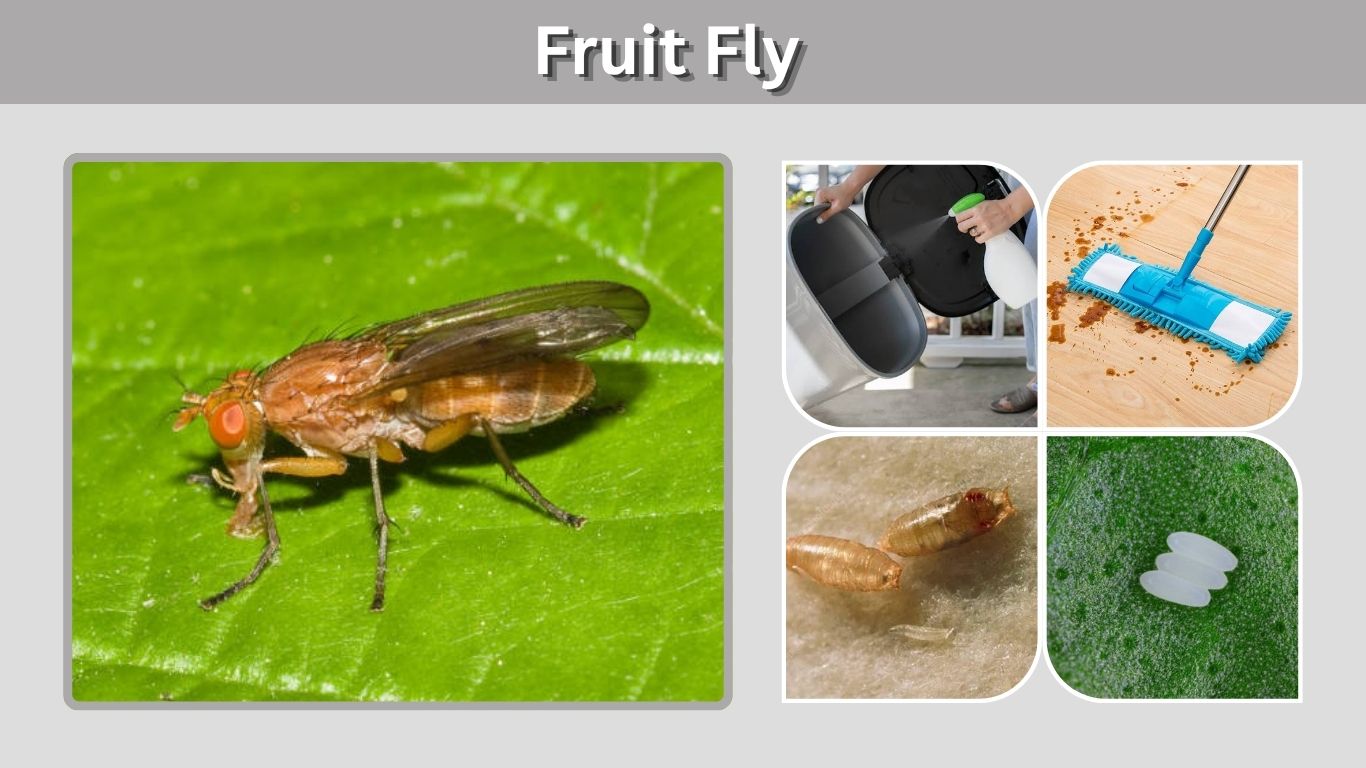
Fruit flies are tiny insects commonly seen hovering around ripe fruit, vegetables, trash cans, drains, and recycling containers. Most household fruit flies belong to the genus Drosophila and are attracted to yeasts growing on fermenting organic material. Although they are mostly nuisance pests and do not bite people, their rapid life cycle allows a few flies to become an infestation quickly. Identifying their breeding source, removing fermenting food, and using an effective fruit fly trap are the best ways to bring them under control.
What Does a Fruit Fly Look Like?
Household fruit flies are among the smallest flies commonly encountered indoors. Adults are usually only a few millimeters long, so details can be difficult to see without magnification. Most common species have tan or yellowish-brown bodies, darker abdominal markings, clear wings, and conspicuous reddish eyes. They are especially noticeable when several adults hover around fruit or beverage containers.
Fruit Fly Identification
Typical characteristics include:
- About 1/16 to 1/8 inch long
- Tan to yellowish-brown body
- Darker or banded abdomen
- Large red eyes in many species
- One pair of transparent wings
- Short antennae
- Quick hovering or circling flight
- Strong attraction to fermenting fruit and liquids
Not every small kitchen fly is a fruit fly. Fungus gnats, drain flies, and phorid flies can occur in the same homes but develop in different materials.
Where Do Fruit Flies Come From?
Fruit flies frequently enter homes with ripe or damaged produce. Adults may also fly indoors and locate food by following the odors produced during fermentation.
Bananas, peaches, tomatoes, potatoes, onions, wine, beer, cider, soft-drink residue, and dirty recycling containers can all provide suitable conditions. Larvae feed mainly on yeasts and microorganisms developing in fermenting organic matter rather than simply eating fresh fruit itself.
Fruit Fly Eggs, Larvae and Life Cycle
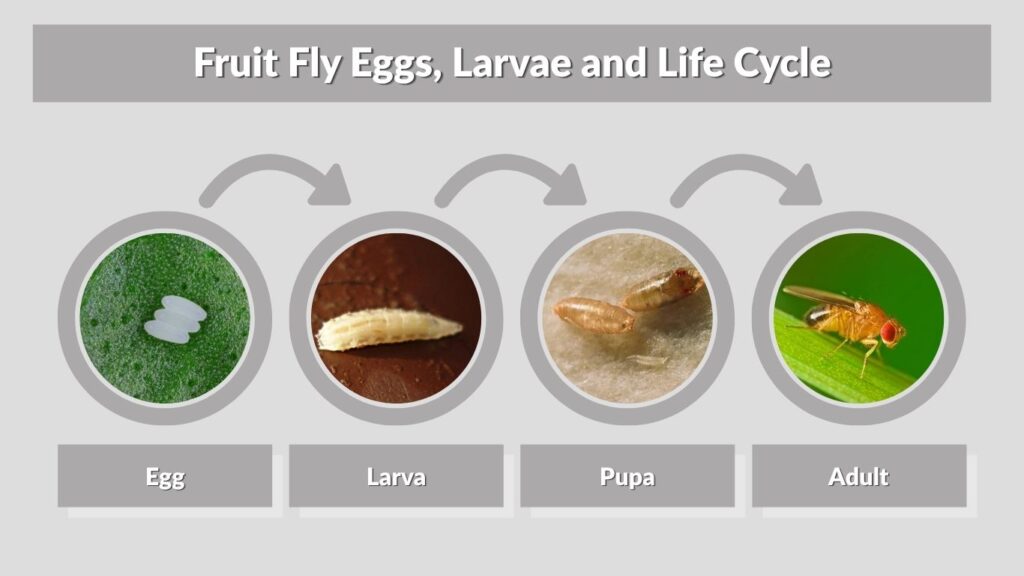
Fruit flies reproduce quickly when warmth, moisture, and fermenting food are available. Their development follows the normal complete-metamorphosis sequence of egg, larva, pupa, and adult. Under favorable conditions, the entire cycle may take little more than a week. This rapid development explains why an unnoticed piece of spoiled produce can suddenly produce dozens of visible adults in a kitchen.
What Do Fruit Fly Eggs and Larvae Look Like?
Female household fruit flies place tiny eggs on or very close to fermenting food and liquids. The eggs are extremely small and may be difficult to notice without magnification.
They can hatch within roughly one or two days. The emerging larvae are pale, legless maggots that feed on yeasts and microorganisms within the breeding material. When mature, larvae move toward a somewhat drier location and form pupae before emerging as adult flies.
How Long Does a Fruit Fly Live?
There is no single lifespan that applies under all conditions. Temperature, diet, species, crowding, and other environmental factors can substantially change longevity.
Laboratory Drosophila melanogaster can live for several weeks, and controlled research conditions may produce much longer lifespans than flies experience around a household kitchen. More important for homeowners is their rapid generation time: new adults can appear roughly 8–10 days after eggs are laid under favorable conditions.
How to Make a DIY Fruit Fly Trap
Homemade fruit fly traps are popular because they require only common household materials. Apple cider vinegar works particularly well because its fermented odor attracts adult Drosophila. However, even the best fruit fly trap should be combined with sanitation. Trapping adults while leaving rotten fruit or beverage residue untouched allows another generation to continue developing.
Apple Cider Vinegar and Dish Soap Trap
To make a simple homemade trap:
- Pour a small amount of apple cider vinegar into a glass or jar.
- Add one small drop of dish soap.
- Leave the trap near the area with the most fruit fly activity.
- Alternatively, cover the jar with plastic wrap and make small entry holes.
- Empty and refresh the trap when necessary.
The vinegar acts as the attractant. Dish soap reduces the liquid’s surface tension, making it more difficult for flies landing on the mixture to escape.
Homemade Trap Without Apple Cider Vinegar
Apple cider vinegar is convenient but not essential. Fruit flies respond to several fermenting odors.
Red wine or a small amount of beer can work as bait. Colorado State University Extension also notes that mashed banana combined with beer can attract small fruit flies. A paper funnel placed in a jar can allow flies to enter while making their escape more difficult.
Do Sticky and Commercial Fruit Fly Traps Work?
Commercial traps can reduce adult populations, particularly when positioned close to active breeding areas. Sticky traps are useful for monitoring activity but do not remove larvae hidden in food residue.
No trap should be considered a complete solution. If adults continue appearing after several days of trapping, there is probably an overlooked breeding source somewhere nearby.
How to Get Rid of a Fruit Fly Infestation
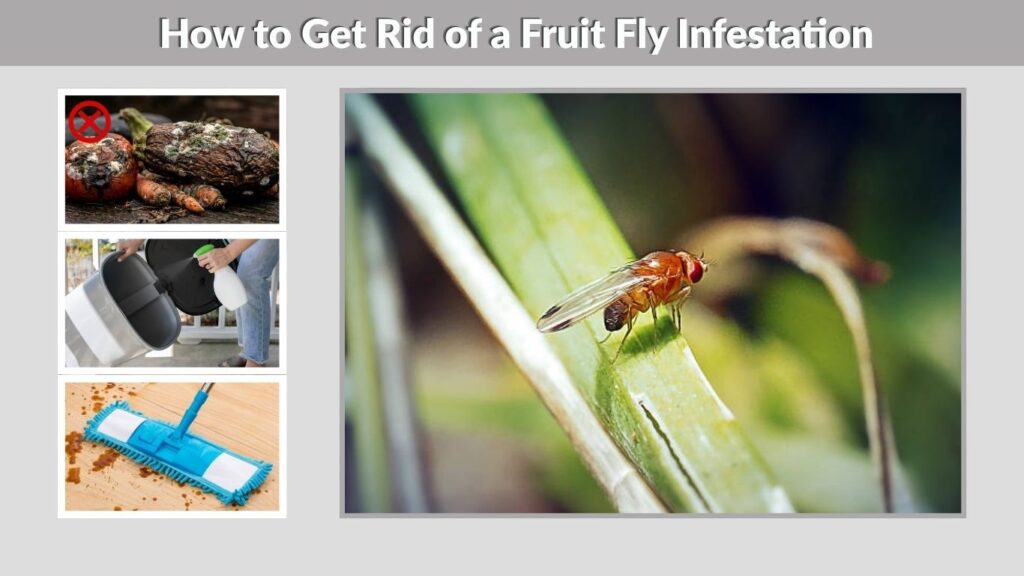
A fruit fly infestation ends only when the insects lose access to breeding material. Spraying visible adults may provide immediate satisfaction, but it does little about eggs and larvae hidden elsewhere. The most effective strategy combines removal of fermenting material, careful cleaning, proper food storage, and trapping of adults that remain after sanitation.
Fruit Fly Control Checklist
Focus on these areas:
- Discard rotten or leaking fruits and vegetables.
- Refrigerate ripe produce temporarily.
- Check stored onions and potatoes.
- Empty and wash trash cans.
- Rinse beer, wine, juice, and soda containers.
- Clean recycling bins.
- Wipe spills beneath appliances.
- Wash and dry damp mops or clothes.
- Clean garbage disposals and food residue.
- Use traps for remaining adult flies.
Sanitation is the key step because removing larval food prevents future generations from replacing the adults being trapped.
Can Fruit Flies Live in Drains?
Small flies around sinks are often assumed to be fruit flies, but identification matters.
Fruit flies can develop where fermenting organic residue accumulates around plumbing. However, fuzzy, moth-like insects breeding deep inside drain slime are usually drain flies. Other flies, including phorid flies, may also develop around plumbing.
If the drain is the source, physically removing organic buildup is more useful than simply killing adults flying above the sink.
Does Fruit Fly Spray Work?
A spray labeled for flying insects may kill exposed adults, but it usually provides only temporary control.
It cannot solve an infestation when larvae remain in fermenting food, dirty containers, or other hidden breeding areas. General fly-control guidance emphasizes that insecticides are secondary tools and that correcting the breeding source is more important for long-term control.
Fruit Fly vs Gnat vs Drain Fly
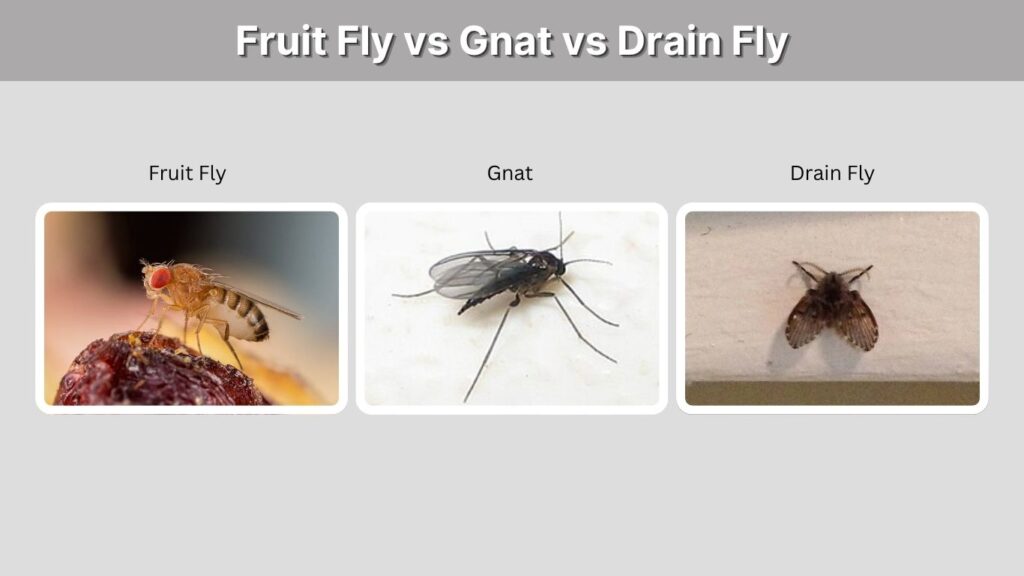
Several tiny flying insects are casually called fruit flies or gnats. Correct identification saves time because each develops in a different environment. Fruit flies favor fermenting materials, fungus gnats typically develop in damp potting soil, and drain flies breed in organic films associated with plumbing. Looking at both appearance and where the insects gather is usually more useful than size alone.
How to Tell Them Apart
- Fruit fly: Tan or brown, commonly red-eyed, usually around fruit, trash, alcohol, or fermented liquids.
- Fungus gnat: Thin, dark, mosquito-like body with long legs; usually found around houseplant soil.
- Drain fly: Small and fuzzy with broad moth-like wings; commonly rests near sinks, showers, and drains.
- Phorid fly: Small, often dark, with a hump-backed appearance and characteristic running behavior.
If tiny flies repeatedly hover above houseplants, investigate the soil before setting fruit fly traps. If they rest directly around drains, check for drain flies and plumbing buildup instead.
Do Fruit Flies Bite Humans?
Fruit flies may be irritating when they hover around a person’s face or food, but ordinary household fruit flies do not bite people. They lack the specialized piercing mouthparts used by biting flies such as mosquitoes and horse flies. Their association with spoiled food and garbage is the greater concern, especially in food-service environments where sanitation is important.
Are Fruit Flies Dangerous?
For most households, fruit flies are mainly nuisance insects rather than a serious medical threat. University of Minnesota Extension describes them as generally not considered a health problem.
Their presence nevertheless indicates that fermenting organic material is available somewhere nearby. Removing that material improves sanitation and stops reproduction at the same time.
FAQs
1. What is the best homemade fruit fly trap?
Apple cider vinegar with a small drop of dish soap is one of the simplest options. A jar with vinegar and a paper funnel is another effective design.
2. What do fruit fly eggs look like?
Fruit fly eggs are extremely small, pale structures deposited on or near fermenting food. They are usually difficult to see without magnification.
3. How quickly do fruit flies reproduce?
Under favorable warm conditions, household fruit flies can progress through their life cycle in roughly 8–10 days, allowing populations to increase rapidly.
4. Do fruit flies bite?
No. Common household fruit flies do not bite humans.
5. Why do fruit flies keep coming back?
Persistent flies usually mean a breeding source remains. Check fruit, vegetables, trash, recycling, beverage residue, drains, damp cleaning materials, and hidden food spills rather than relying only on traps.