
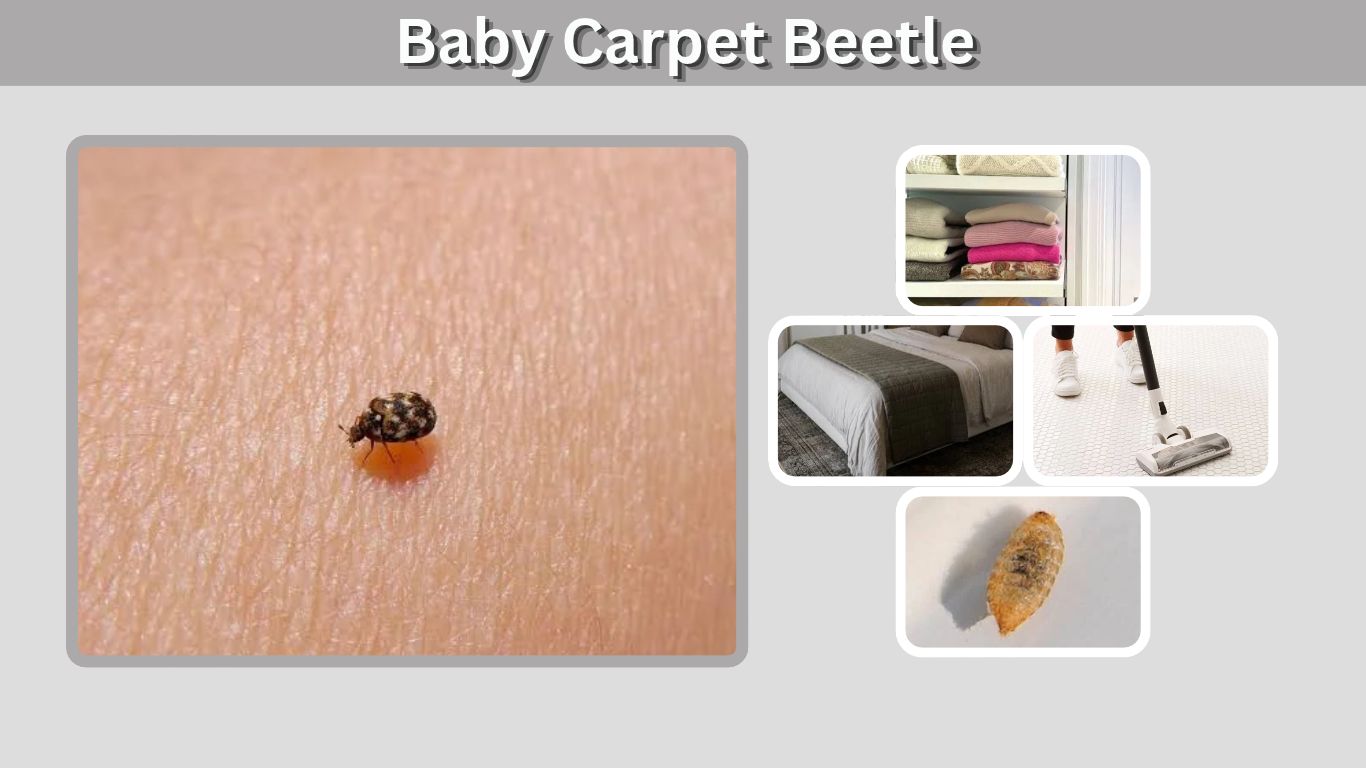
Baby carpet beetles are tiny, hairy larvae that can hide in carpets, clothing, furniture, and other household materials. Unlike adult carpet beetles, these immature insects feed on natural fibers and may cause noticeable damage to fabrics. Their small size makes them difficult to identify, especially when confused with baby bed bugs or cockroaches. Although baby carpet beetles do not bite humans, their bristles can trigger allergic skin reactions in sensitive individuals. Understanding their appearance, behavior, and life cycle can help homeowners identify infestations early and remove these pests effectively.
What Does a Baby Carpet Beetle Look Like?
A baby carpet beetle is the larval stage of a carpet beetle. After hatching from an egg, the young insect develops into a small, elongated larva covered with fine hairs. Its appearance differs significantly from that of an adult beetle, which has a compact body and functional wings.
Baby Carpet Beetle Identification
Newly hatched carpet beetle larvae may appear pale before becoming darker as they develop.
Common identification features include:
- Body shape: Small, elongated, and slightly tapered.
- Body color: Cream, tan, reddish brown, or darker brown.
- Body texture: Covered with fine hairs or bristles.
- Segments: Distinct sections become more noticeable as the larva grows.
- Movement: Slowly crawls across fabrics and other surfaces.
- Wings: No wings are present during the larval stage.
Some species develop distinctive bands or tufts of longer hairs toward the rear of the body.
How Big Is a Baby Carpet Beetle?
Newly hatched carpet beetle larvae are extremely small and may be difficult to notice without magnification.
Their size varies by species and developmental stage. Mature larvae commonly reach approximately 4–8 millimeters long, although some species remain smaller.
Young larvae may initially look like tiny specks moving across fabric or furniture.
Different Types of Baby Carpet Beetles
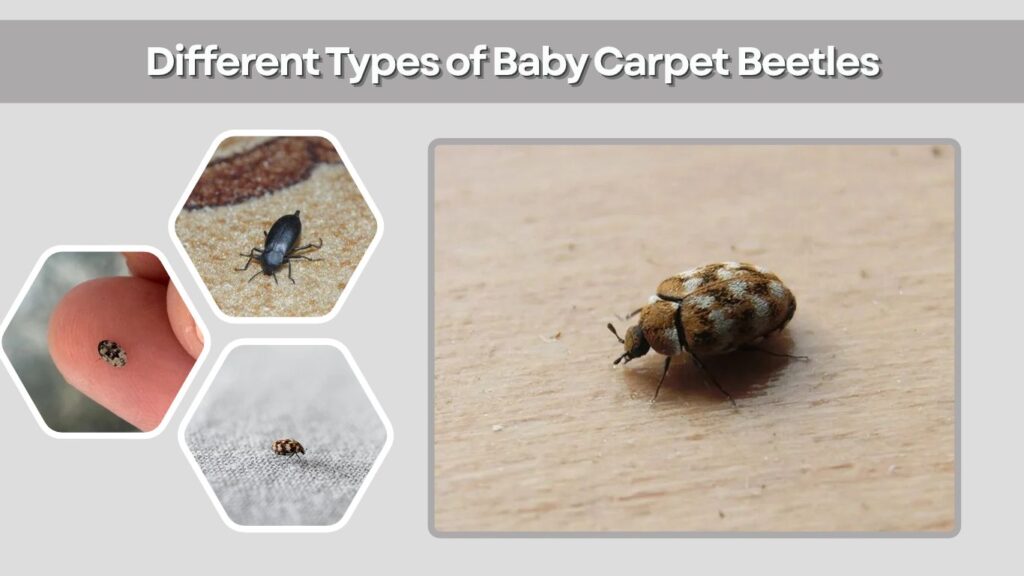
Several carpet beetle species commonly infest homes. Their larvae share similar feeding habits but differ in color, body shape, and hair patterns. Identifying the species can help homeowners recognize the insects found in clothing, carpets, and furniture.
Baby Black Carpet Beetle
Baby black carpet beetles are the immature stage of Attagenus unicolor. Their bodies are elongated and gradually taper toward the rear.
Young larvae are generally light brown to reddish brown, becoming darker as they mature. They develop short, stiff body hairs and a noticeable tuft of longer hairs near the tail.
Unlike the dark-colored adults, baby black carpet beetles are not necessarily black.
Baby Varied Carpet Beetle
Baby varied carpet beetles belong to the species Anthrenus verbasci. Their larvae have brown, segmented bodies covered with dense hairs.
As they mature, alternating light and dark bands become more visible. The body is typically broader toward the rear and narrower near the head.
These larvae commonly infest wool clothing, rugs, feathers, and other animal-derived materials.
Baby Furniture Carpet Beetle
Furniture carpet beetle larvae belong to Anthrenus flavipes. Newly hatched larvae may appear whitish before becoming reddish brown or chestnut-colored.
Their bodies are hairy and usually broader toward the front than the rear.
These larvae can develop inside upholstered furniture, carpets, and stored fabrics containing suitable natural fibers.
Baby Carpet Beetle vs. Bed Bug and Baby Roach
Baby carpet beetles are sometimes mistaken for young bed bugs or cockroaches because all three insects may appear inside houses. However, their physical features and feeding behaviors differ considerably. Recognizing these differences helps avoid unnecessary or ineffective pest treatments.
Baby Carpet Beetle vs. Baby Bed Bug
Baby bed bugs, called nymphs, have flattened, oval bodies and six visible legs. They are often pale or translucent before feeding.
Carpet beetle larvae are more elongated and generally covered with noticeable hairs.
Bed bugs feed on blood, while carpet beetle larvae consume organic materials such as wool, feathers, and animal hair.
Baby Carpet Beetle vs. Baby Cockroach
Baby cockroaches have flattened bodies, long antennae, and relatively fast movements. Their shape resembles a smaller version of an adult cockroach without fully developed wings.
Baby carpet beetles are generally slower, hairier, and more wormlike.
Cockroach nymphs commonly search for food and moisture, while carpet beetle larvae prefer protected locations containing suitable fibrous or animal-based materials.
Baby Carpet Beetle vs. Baby Ladybug
Baby ladybugs are actually ladybug larvae. They typically have elongated bodies with distinct legs and spiny or textured surfaces.
Many ladybug larvae appear dark with orange or yellow markings.
Unlike carpet beetle larvae, ladybug larvae are generally predators that feed on aphids and other small insects.
Baby Carpet Beetle Life Cycle
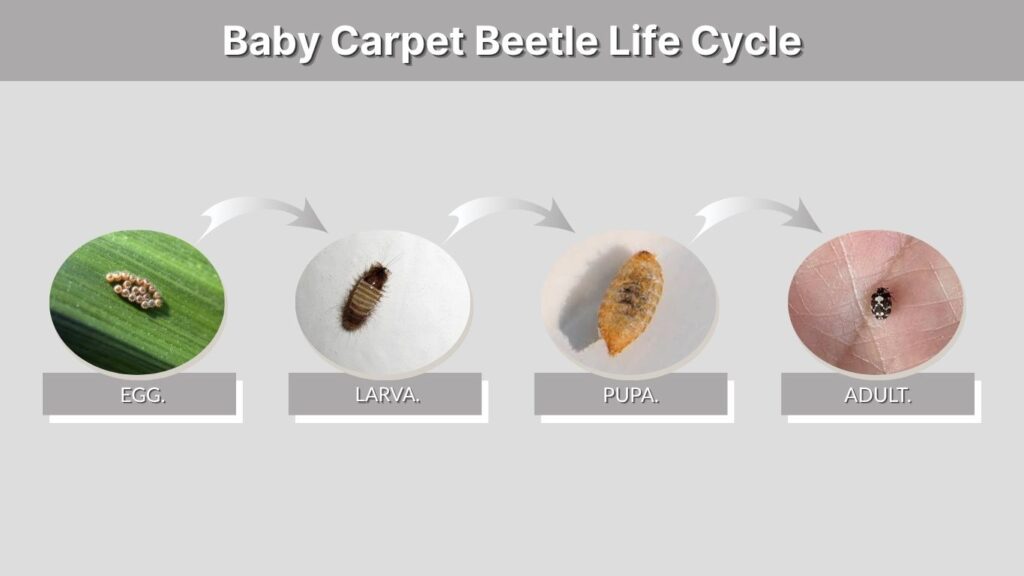
Carpet beetles undergo complete metamorphosis, developing through egg, larva, pupa, and adult stages. The larval stage is particularly important because it is when most feeding damage occurs. Environmental temperature, available food, and species influence how quickly development progresses.
How Do Baby Carpet Beetles Hatch?
Female carpet beetles lay eggs near materials suitable for developing larvae.
Depending on the species, females may produce approximately 40–90 eggs during their reproductive period.
Under favorable indoor conditions, eggs commonly hatch within one to three weeks.
Newly emerged larvae begin searching for accessible food sources and protected hiding places.
How Long Do Baby Carpet Beetles Stay Larvae?
Carpet beetle larvae may remain in their immature stage for several months to more than a year.
During development, they repeatedly shed their outer coverings as they grow.
These discarded skins often accumulate near feeding areas and provide important evidence of an infestation.
After completing the larval stage, the insects pupate and eventually emerge as adults.
Do Baby Carpet Beetles Bite Humans?
Baby carpet beetles do not bite humans or feed on blood. However, their body hairs may cause skin irritation in sensitive individuals. This reaction is commonly described as carpet beetle dermatitis and can sometimes resemble insect bites or other allergic skin conditions.
Baby Carpet Beetle Bites and Skin Reactions
Contact with larval hairs may produce itching, redness, raised bumps, or small irritated patches.
Symptoms can occur when larvae or their shed hairs become trapped in clothing, bedding, or upholstered furniture.
Mild irritation may improve after washing the skin and avoiding further exposure. Persistent or severe symptoms should be evaluated by a healthcare professional.
Are Carpet Beetles Dangerous to Babies?
Carpet beetles do not normally bite, sting, or transmit diseases to infants.
However, larval hairs may irritate sensitive skin, and infestations can contaminate bedding or other household fabrics with shed skins.
If a baby develops an unexplained rash, consult a pediatrician rather than assuming carpet beetles are responsible.
Where Do Baby Carpet Beetles Hide?
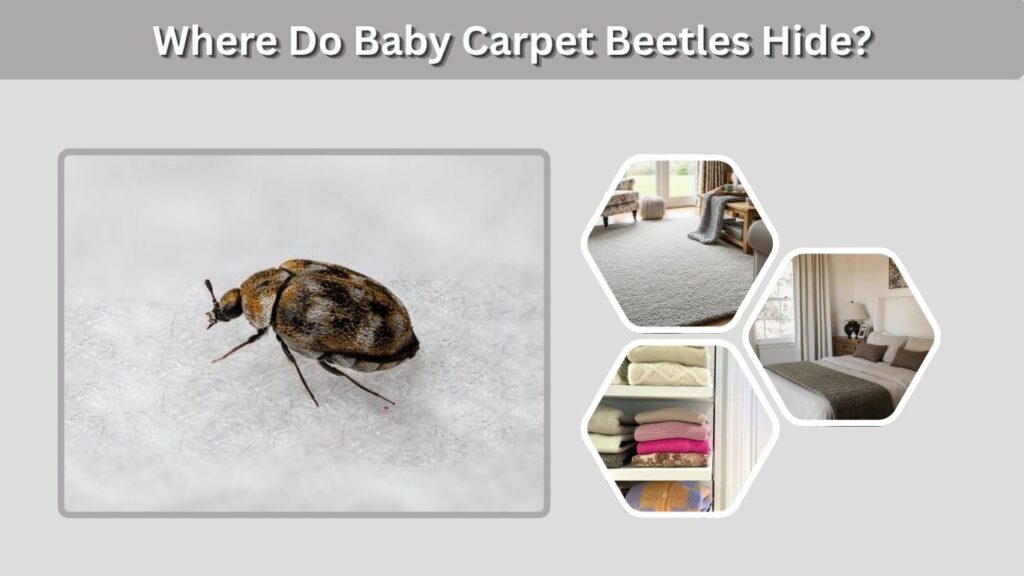
Young carpet beetle larvae prefer dark, protected areas with accessible food. Unlike adult beetles, which are frequently seen near windows, larvae usually remain concealed inside fabrics and household storage spaces. Their hidden behavior can allow infestations to develop unnoticed.
Common Baby Carpet Beetle Hiding Places
Inspect the following locations:
- Carpets and rugs: Particularly beneath furniture and along edges.
- Closets: Inside stored wool clothing and blankets.
- Beds: Around natural-fiber bedding and accumulated lint.
- Furniture: Beneath cushions and inside upholstered furniture.
- Storage boxes: Among fabric items and animal-derived materials.
- Attics: Near abandoned bird nests and dead insects.
Finding larvae in these locations may indicate a nearby food source.
Why Are Baby Carpet Beetles in My Bed?
Carpet beetle larvae may appear around beds when suitable materials or accumulated debris provide food.
Wool blankets, feathers, pet hair, and dead insects can attract larvae.
However, discovering a larva on a mattress does not necessarily mean the mattress is infested. Inspect nearby carpets, furniture, and bedding to locate the actual source.
How to Get Rid of Baby Carpet Beetles
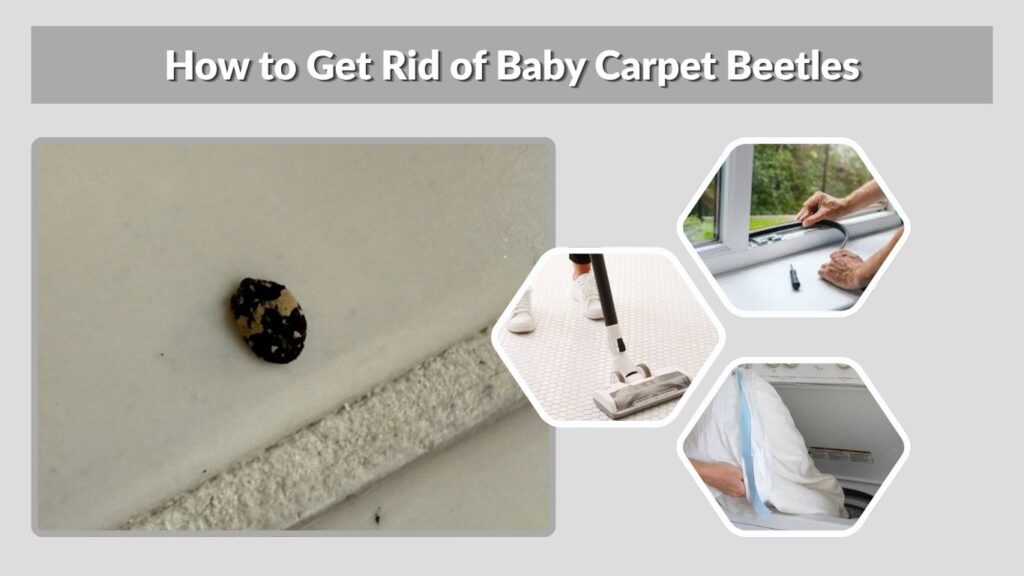
Eliminating baby carpet beetles requires removing larvae, cleaning infested materials, and controlling their food sources. Since the larvae frequently hide in undisturbed areas, thorough household inspection is essential. Several nonchemical methods can control minor infestations effectively.
Effective Baby Carpet Beetle Removal Methods
- Vacuum carpets thoroughly: Clean carpet edges, baseboards, and spaces beneath furniture.
- Wash affected fabrics: Use hot water when allowed by the item’s care instructions.
- Dry-clean delicate clothing: Treat wool garments and other sensitive materials appropriately.
- Remove organic debris: Eliminate accumulated pet hair, lint, and dead insects.
- Inspect furniture: Check upholstery seams and concealed spaces for larvae.
- Store clothing properly: Protect clean, vulnerable fabrics inside sealed containers.
Dispose of vacuum contents promptly to prevent insects from escaping.
Should You Use Insecticides?
Insecticides are not always necessary for carpet beetle control.
Cleaning and removing food sources can eliminate many household infestations. When chemical treatment is needed, use only products specifically labeled for carpet beetles and the intended location.
Never apply household insecticides directly to children’s bedding, clothing, toys, or skin.
How to Prevent Baby Carpet Beetles
Preventing carpet beetles involves limiting adult entry and removing materials that support larval development. Regular cleaning, careful storage, and early inspection can reduce the likelihood of recurring infestations.
Carpet Beetle Prevention Tips
- Vacuum carpets, furniture, and closets regularly.
- Store clean wool clothing in airtight containers.
- Remove pet hair and lint from hidden spaces.
- Inspect secondhand furniture before bringing it indoors.
- Repair damaged window screens.
- Check stored fabrics for larvae and shed skins.
- Remove suitable insect breeding materials from storage areas.
Consistent prevention is more effective than repeatedly treating visible larvae without identifying their source.
FAQs
1. Can Baby Carpet Beetles Fly?
No. Baby carpet beetles are larvae and do not have functional wings. They move by crawling across fabrics and household surfaces. Only adult carpet beetles can fly, allowing them to enter houses and travel between different environments.
2. Are Baby Carpet Beetles the Size of a Pinhead?
Newly hatched carpet beetle larvae can be extremely small, sometimes appearing close to pinhead-sized. However, their dimensions depend on the species and developmental stage. As they grow, larvae become easier to recognize because of their elongated bodies and hairs.
3. How Many Babies Do Carpet Beetles Have?
Female carpet beetles may lay approximately 40–90 eggs, depending on the species. The eggs are deposited near suitable larval food sources. Not every egg necessarily survives to adulthood, and environmental conditions influence successful hatching and development.
4. Can Baby Carpet Beetles Damage Clothes?
Yes. Carpet beetle larvae feed on animal-derived materials, including wool, fur, feathers, and silk. Their feeding can create irregular holes or worn patches in vulnerable fabrics. Adult carpet beetles do not normally cause this type of damage.
5. Does Baby Powder Kill Carpet Beetle Larvae?
Ordinary baby powder is not a reliable or recommended carpet beetle treatment. It does not address hidden larvae or their food sources. Vacuuming, laundering, and removing infested materials provide more dependable control without unnecessarily exposing household members to airborne powders.
