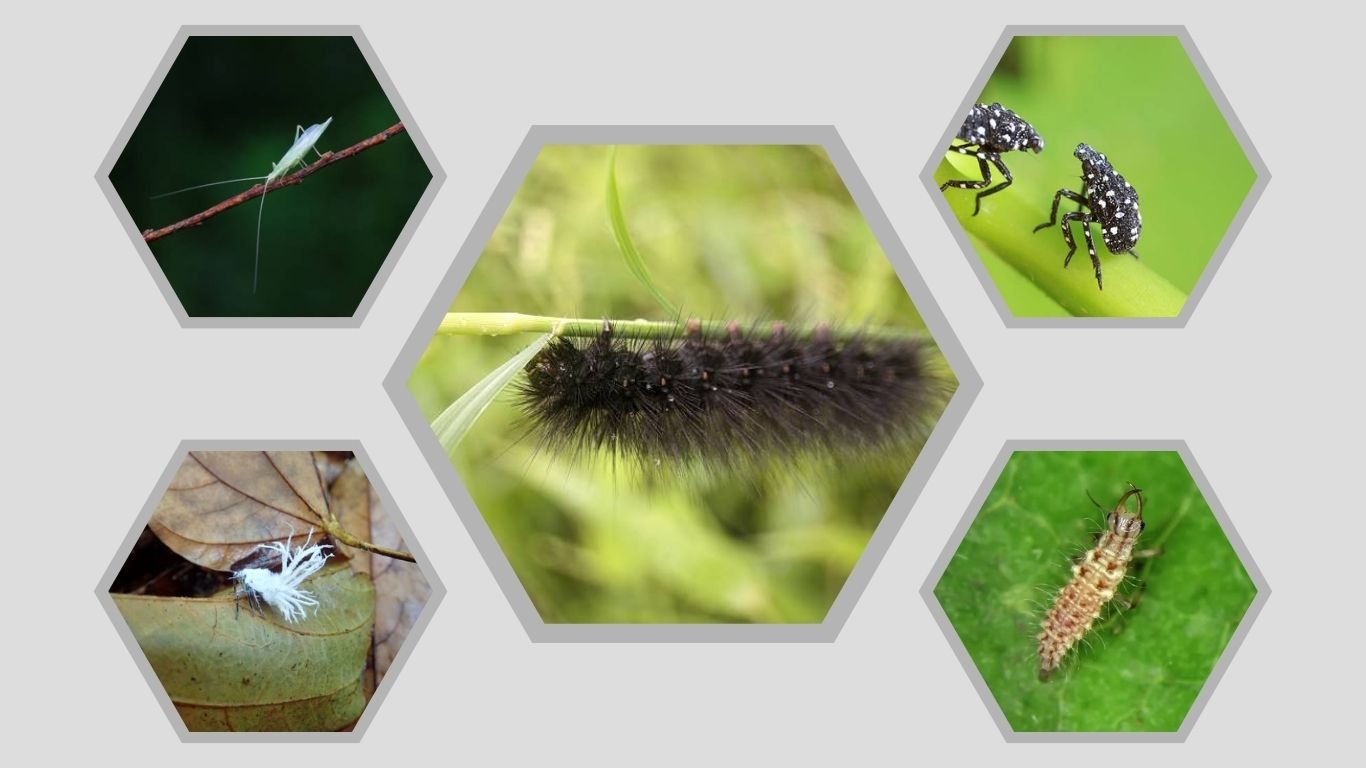
Small white fuzzy insects are commonly found on plants, trees, gardens, and indoor houseplants. Their cotton-like appearance often comes from waxy coatings, hairs, or protective filaments that help them survive in different environments. Some species are harmful plant pests that feed on sap, while others are beneficial predators that help control insect populations naturally. From mealybugs and woolly aphids to fuzzy caterpillars and lacewing larvae, these insects vary greatly in behavior and habitat. This guide explores 15 types of small white fuzzy insects, helping you identify them through their appearance, habitat, diet, behavior, and lifespan.
1. Woolly Aphid

Woolly Aphids are tiny white fuzzy insects covered in a cotton-like waxy substance that gives them a fluffy appearance. These sap-sucking pests are commonly found on trees, shrubs, and garden plants where they gather in clusters on stems and leaves. Their white fuzz acts as protection against predators and environmental conditions. Although small, large infestations can weaken plants and produce sticky honeydew that encourages mold growth.
Identification
- Tiny soft-bodied insects covered with white fuzzy wax
- Cotton-like or woolly appearance
- Usually pale green, brown, or purple beneath the fuzz
- Small oval-shaped bodies measuring about 1–5 mm long
- Often found clustered together on stems or bark
- Produces sticky honeydew on plants
- Some species may have small visible wings
Habitat and Distribution
Woolly Aphids are commonly found in gardens, orchards, forests, parks, and agricultural areas. They prefer trees and shrubs such as apple, elm, maple, pear, and hawthorn. These insects thrive in warm and humid conditions where plant sap is abundant. Woolly Aphids are distributed across many parts of North America, Europe, and Asia. They are most active during spring and summer when plants are actively growing. Colonies are often seen on bark cracks, leaf undersides, roots, and young branches.
Behavior and Diet
These insects feed by piercing plant tissues and sucking sap from stems, leaves, roots, and branches. Their feeding can weaken plants, stunt growth, and cause curled or yellowing leaves. Woolly Aphids also produce honeydew, a sugary liquid that attracts ants and encourages black sooty mold growth. They often remain grouped together for protection and may quickly reproduce during warm weather. Natural predators such as ladybugs, lacewings, and parasitic wasps help control their populations in many environments.
Lifespan
The lifespan of a Woolly Aphid depends on climate, food supply, and species type. Individual aphids may live for several weeks, but colonies can survive much longer through rapid reproduction. Females often reproduce without mating, allowing populations to grow quickly during warm seasons. Multiple generations can develop within a single year, especially in mild climates with abundant host plants. Some species overwinter as eggs or hidden colonies beneath bark and roots until warmer temperatures return.
2. Mealybug

Mealybugs are tiny white fuzzy insects known for their soft bodies and powdery wax coating. These plant pests commonly infest indoor plants, garden shrubs, fruit trees, and greenhouse crops. Their cotton-like appearance makes them easy to recognize on leaves, stems, and plant joints. Mealybugs feed on plant sap and can quickly spread through homes and gardens if left untreated.
Identification
- Small soft-bodied insects covered with white waxy fuzz
- Oval-shaped bodies with segmented appearance
- Usually measure about 2–5 mm long
- White cottony coating gives a fluffy texture
- Often found in clusters on stems and leaf joints
- Slow-moving insects with short legs and antennae
- Produces sticky honeydew on plant surfaces
Habitat and Distribution
Mealybugs are commonly found on houseplants, garden plants, greenhouse crops, fruit trees, and ornamental shrubs. They thrive in warm, humid environments with abundant plant growth. These insects are distributed worldwide and are especially common in tropical and subtropical regions. Indoors, they often infest succulents, orchids, citrus plants, and tropical decorative plants. Outdoor populations are usually most active during warm spring and summer months. They prefer hidden areas such as leaf undersides, stem joints, bark crevices, and root zones.
Behavior and Diet
Mealybugs feed by piercing plant tissues and sucking out sap from leaves, stems, roots, and fruits. Their feeding weakens plants, causing yellowing, wilting, stunted growth, and leaf drop. Like aphids, they produce sticky honeydew that attracts ants and promotes black sooty mold growth. Mealybugs reproduce quickly and may spread from plant to plant through crawling or contaminated gardening tools. Natural predators such as ladybugs and lacewings help reduce infestations outdoors. Severe infestations can seriously damage ornamental and agricultural plants.
Lifespan
The lifespan of a Mealybug varies depending on species, temperature, and food availability. Most individuals live for several weeks to a few months. Females lay large clusters of eggs inside cottony sacs, and young nymphs hatch quickly before spreading to new feeding areas. In warm indoor environments, mealybugs can reproduce continuously throughout the year, allowing populations to grow rapidly. Outdoor populations are usually reduced during colder seasons, although some survive in protected locations or root systems.
3. Citrus Mealybug

The Citrus Mealybug is a small white fuzzy insect commonly found on citrus trees, ornamental plants, and indoor houseplants. It is covered with a waxy white coating that gives it a cotton-like appearance. These pests feed on plant sap and often gather in clusters on leaves, stems, and fruit. Heavy infestations can weaken plants, reduce fruit quality, and encourage mold growth through honeydew production.
Identification
- Small oval-shaped body covered in white waxy fuzz
- Soft-bodied insect with segmented appearance
- Usually measures between 3–5 mm long
- Thin waxy filaments extend from body edges
- Pale yellow or pink body hidden beneath the white coating
- Found clustered on leaves, stems, and fruit surfaces
- Produces sticky honeydew on infested plants
Habitat and Distribution
Citrus Mealybugs are commonly found in orchards, gardens, greenhouses, and indoor plant collections. They prefer warm climates and thrive on citrus trees, grapes, succulents, orchids, and many ornamental plants. This species is distributed worldwide, especially in tropical and subtropical regions. Indoors, they survive year-round in warm environments, while outdoor populations increase during spring and summer. They often hide in leaf joints, bark cracks, fruit clusters, and root areas where they remain protected from predators and environmental conditions.
Behavior and Diet
These insects feed by piercing plant tissues and sucking sap from leaves, stems, roots, and fruits. Their feeding weakens plants, causing yellow leaves, stunted growth, curling foliage, and fruit damage. Citrus Mealybugs also produce large amounts of honeydew, which attracts ants and promotes black sooty mold growth. They reproduce quickly and can spread between plants through crawling, contaminated tools, or infested plant material. Natural predators such as ladybugs and parasitic wasps help control populations outdoors.
Lifespan
The Citrus Mealybug typically lives several weeks to a few months depending on temperature and food availability. Females lay hundreds of eggs inside fluffy cotton-like sacs, and young nymphs quickly begin feeding after hatching. In warm climates or indoor conditions, multiple generations can occur throughout the year, allowing infestations to grow rapidly. Cooler temperatures slow development and reduce survival rates, although protected indoor colonies may continue reproducing year-round.
4. Whitefly

Whiteflies are tiny white fuzzy insects commonly found on garden plants, vegetables, and indoor houseplants. Despite their name, they are not true flies but small sap-feeding insects closely related to aphids and mealybugs. Their powdery white wings and clustered feeding behavior make them easy to identify on the undersides of leaves. Large infestations can weaken plants and spread plant diseases.
Identification
- Tiny white insects with powdery-looking wings
- Soft-bodied and triangular when resting
- Usually measure about 1–3 mm long
- Covered with fine white waxy dust
- Found mainly on the undersides of leaves
- Flies upward in clouds when disturbed
- Produces sticky honeydew on plants
Habitat and Distribution
Whiteflies are commonly found in gardens, greenhouses, farms, orchards, and indoor plant environments. They prefer warm temperatures and thrive on vegetables, flowering plants, herbs, and ornamental shrubs. Common host plants include tomatoes, cucumbers, peppers, hibiscus, poinsettias, and citrus plants. Whiteflies are distributed worldwide, especially in tropical and subtropical regions. Indoor infestations may continue year-round because heated environments provide ideal breeding conditions. Outdoors, populations usually increase during spring and summer.
Behavior and Diet
Whiteflies feed by piercing plant tissues and sucking sap from leaves. Their feeding weakens plants, causing yellowing, curling leaves, wilting, and reduced growth. Like aphids and mealybugs, they produce sticky honeydew that encourages black sooty mold growth and attracts ants. Whiteflies are highly reproductive and can spread rapidly between nearby plants. When disturbed, adults quickly fly upward before settling again on leaves. Natural predators such as ladybugs, lacewings, and parasitic wasps help control populations outdoors.
Lifespan
The lifespan of a Whitefly varies depending on temperature and environmental conditions. Adults generally live for several weeks, while the complete life cycle from egg to adult may take only a few weeks in warm weather. Females lay eggs on leaf undersides, and young nymphs remain attached to plants while feeding. Multiple generations can develop rapidly during warm seasons, leading to severe infestations if left untreated.
5. Flannel Moth Caterpillar

The Flannel Moth Caterpillar is a small white fuzzy caterpillar famous for its soft hair-like covering and hidden venomous spines. Often called the “puss caterpillar,” it looks harmless because of its fluffy appearance, but contact with its spines can cause painful skin reactions. This unusual caterpillar eventually transforms into the Southern Flannel Moth, a species commonly found in warm regions.
Identification
- Thick white or cream-colored fuzzy body
- Soft fur-like hairs covering hidden venomous spines
- Oval or teardrop-shaped appearance
- Usually measures between 20–35 mm long
- Colors may range from white and gray to brown or orange
- No visible legs beneath dense hair covering
- Slow-moving caterpillar often found on leaves or tree branches
Habitat and Distribution
Flannel Moth Caterpillars are commonly found in gardens, parks, forests, and residential areas with trees and shrubs. They prefer oak, elm, citrus, pecan, and many ornamental plants where they feed on leaves. This species is widely distributed across the southern United States, Mexico, and parts of Central America. Caterpillars are most active during late spring through autumn when warm temperatures support feeding and growth. They are often seen on tree trunks, outdoor furniture, fences, and plant foliage.
Behavior and Diet
These caterpillars feed mainly on leaves from trees and shrubs. Their fuzzy coating acts as protection against predators, hiding venomous spines underneath. When touched, the spines can inject toxins that may cause intense pain, swelling, redness, or skin irritation in humans. Flannel Moth Caterpillars move slowly and rely more on camouflage and defense than speed. Birds and predators usually avoid them because of their painful stings and warning appearance.
Lifespan
The Flannel Moth Caterpillar spends several weeks feeding and growing before entering the pupal stage inside a silk cocoon. After pupation, the adult flannel moth emerges within weeks or after overwintering in cooler climates. Adult moths generally live only a short time focused mainly on reproduction. Warm temperatures and abundant host plants support faster development and multiple generations in some regions.
6. Hickory Tussock Moth Caterpillar

The Hickory Tussock Moth Caterpillar is a white fuzzy caterpillar covered with long hairs and bold black markings. Its striking appearance makes it one of the most recognizable fuzzy caterpillars found in forests and residential areas. Although attractive, its hairs can irritate human skin and cause mild allergic reactions. This caterpillar eventually transforms into the Hickory Tussock Moth, a species active mainly during late summer and autumn.
Identification
- White fuzzy body with long soft hairs
- Distinct black patches or stripes along the back
- Black hair pencils near the front and rear
- Usually grows between 30–45 mm long
- Dense hairs cover most of the body surface
- Bright contrasting black-and-white coloration
- Hairy appearance helps protect against predators
Habitat and Distribution
Hickory Tussock Moth Caterpillars are commonly found in forests, woodlands, parks, and suburban gardens. They feed mainly on hickory, walnut, oak, elm, and ash trees. This species is widely distributed across eastern North America, especially in the United States and southern Canada. Caterpillars are most active during late summer and early autumn when leaves are abundant. They are often seen crawling on tree trunks, sidewalks, fences, and outdoor surfaces while searching for food or pupation sites.
Behavior and Diet
These caterpillars feed on tree leaves and may occasionally strip branches during large infestations. Their fuzzy hairs help defend against predators such as birds and insects. Contact with the hairs can cause itching, redness, or skin irritation in sensitive people, so handling them is not recommended. Hickory Tussock Moth Caterpillars are slow-moving and spend most of their time feeding openly on foliage. As they mature, they create cocoons where they pupate before emerging as adult moths.
Lifespan
The Hickory Tussock Moth Caterpillar completes its life cycle within one year. Eggs hatch during warm seasons, and caterpillars spend several weeks feeding and growing before pupation. Adult moths emerge after the pupal stage and live mainly for reproduction. In colder climates, the species survives winter in the cocoon stage until temperatures rise again during spring.
7. Sycamore Tussock Moth Caterpillar

The Sycamore Tussock Moth Caterpillar is a fuzzy white caterpillar known for its long hairs, orange markings, and distinctive hair pencils. It is commonly found on sycamore trees where it feeds on leaves during late summer and autumn. Although visually attractive, its hairs can irritate human skin and should not be touched directly. This caterpillar later transforms into the Sycamore Tussock Moth, a harmless nocturnal moth species.
Identification
- White fuzzy body covered with long soft hairs
- Bright orange or yellow markings along the back
- Long black and orange hair pencils near the front
- Usually measures between 25–40 mm long
- Dense hair covering hides the body surface
- Dark head capsule with contrasting coloration
- Hairy appearance acts as defense against predators
Habitat and Distribution
Sycamore Tussock Moth Caterpillars are commonly found in forests, parks, suburban neighborhoods, and riverbank woodlands. They mainly feed on sycamore trees but may also appear on maple and mulberry trees. This species is distributed across eastern North America, especially in the United States and southern Canada. Caterpillars are most active during late summer and early autumn when tree foliage is abundant. They are frequently seen on tree trunks, sidewalks, fences, and outdoor walls while searching for pupation sites.
Behavior and Diet
These caterpillars feed heavily on leaves, sometimes causing noticeable defoliation on sycamore trees during large outbreaks. Their fuzzy hairs help deter predators such as birds and insects. Contact with the hairs may cause itching, rashes, or mild allergic reactions in sensitive individuals. Sycamore Tussock Moth Caterpillars are slow-moving and spend much of their time feeding openly on foliage. As they mature, they spin cocoons in protected areas before transforming into adult moths.
Lifespan
The Sycamore Tussock Moth Caterpillar usually completes its life cycle within one year. Eggs hatch during warm seasons, and caterpillars spend several weeks feeding before entering the pupal stage. Adult moths emerge after pupation and mainly focus on reproduction. In colder regions, the species often survives winter in the cocoon stage until temperatures rise again in spring.
8. White-Marked Tussock Moth Caterpillar

The White-Marked Tussock Moth Caterpillar is a fuzzy white and black caterpillar known for its unusual tufts of hair and colorful markings. It is commonly found on trees and shrubs where it feeds on leaves during warm seasons. Although visually interesting, its hairs may cause skin irritation in sensitive people. This caterpillar eventually transforms into the White-Marked Tussock Moth, a common species found throughout many wooded and suburban areas.
Identification
- Fuzzy body covered with white and black hairs
- Four thick white tufts along the back
- Bright red or orange head with contrasting markings
- Long black hair pencils extending from the front and rear
- Usually grows between 25–35 mm long
- Yellow or cream-colored side stripes may be visible
- Hairy appearance serves as protection from predators
Habitat and Distribution
White-Marked Tussock Moth Caterpillars are commonly found in forests, gardens, orchards, parks, and suburban landscapes. They feed on a wide range of deciduous trees including oak, maple, elm, birch, willow, and apple trees. This species is widely distributed across North America, especially in the United States and southern Canada. Caterpillars are most active during late spring through early autumn when fresh leaves are abundant. They are often seen crawling on bark, fences, outdoor furniture, and walls while searching for food or pupation sites.
Behavior and Diet
These caterpillars are active leaf feeders and can consume large amounts of foliage during outbreaks. Their bright tufts and irritating hairs help discourage predators such as birds and insects. Contact with the hairs may cause itching, redness, or mild allergic reactions in humans. White-Marked Tussock Moth Caterpillars spend much of their time feeding openly on leaves during daylight hours. As they mature, they spin cocoons attached to bark or other protected surfaces before transforming into adult moths.
Lifespan
The White-Marked Tussock Moth Caterpillar usually completes its life cycle within one year. Eggs hatch during spring, and caterpillars feed for several weeks before entering the pupal stage inside cocoons. Adult moths emerge later in the season mainly for reproduction. In colder regions, the species survives winter in the egg stage until warmer temperatures return during spring.
9. Woolly Bear Caterpillar

The Woolly Bear Caterpillar is a fuzzy caterpillar famous for its thick hair-like bristles and distinctive black and brown bands. It is the larval stage of the Isabella Tiger Moth and is commonly seen crawling across roads, gardens, and grassy areas during autumn. Its dense fuzzy covering helps protect it from predators and cold temperatures. This harmless caterpillar is one of the most recognizable fuzzy insects in North America.
Identification
- Thick fuzzy body covered with stiff hairs
- Black ends with a brown or orange middle band
- Cylindrical body shape with dense bristles
- Usually grows between 35–50 mm long
- Hairy covering gives a wool-like appearance
- Moves slowly with noticeable curling behavior when disturbed
- Color patterns may vary depending on age and environment
Habitat and Distribution
Woolly Bear Caterpillars are commonly found in gardens, fields, meadows, roadsides, forests, and suburban lawns. They feed on a wide variety of low-growing plants including grasses, clover, dandelions, and wildflowers. This species is widely distributed across North America and thrives in both rural and urban environments. Caterpillars are most active during late summer and autumn when they search for food and sheltered overwintering locations. They are often spotted crossing sidewalks, driveways, and roads during cooler months.
Behavior and Diet
These caterpillars feed mainly on leaves and soft plant material close to the ground. Their fuzzy hairs help deter predators such as birds and insects. When threatened, Woolly Bear Caterpillars curl into a tight ball to protect their softer undersides. They are known for their ability to survive freezing winter temperatures by producing natural antifreeze chemicals inside their bodies. In spring, they resume activity before pupating into Isabella Tiger Moths. Unlike some fuzzy caterpillars, they are generally harmless to humans and rarely cause skin irritation.
Lifespan
The Woolly Bear Caterpillar typically completes its life cycle within one year. Caterpillars hatch from eggs during warm months and feed actively before overwintering as larvae. After surviving winter, they pupate during spring and emerge as adult moths a few weeks later. Adult Isabella Tiger Moths live only a short time focused mainly on reproduction. Their remarkable cold tolerance allows them to survive harsh winter conditions in many northern regions.
10. Cottony Cushion Scale

The Cottony Cushion Scale is a small white fuzzy insect known for its cotton-like egg sac and destructive feeding habits on plants. It is a type of scale insect commonly found on citrus trees, ornamental shrubs, and garden plants. Large infestations can weaken plants by removing sap and promoting mold growth. This pest became historically important in agriculture because it severely damaged citrus crops before biological control methods were introduced.
Identification
- Small reddish-brown body partly hidden beneath white cottony wax
- Large ribbed white egg sac attached to the rear
- Oval-shaped soft body with fuzzy appearance
- Usually measures between 5–10 mm long including the egg sac
- Found attached to stems, leaves, and branches
- Produces sticky honeydew on plants
- Slow-moving or nearly immobile during adulthood
Habitat and Distribution
Cottony Cushion Scales are commonly found in orchards, gardens, greenhouses, and ornamental landscapes. They prefer citrus trees but also infest acacia, pittosporum, roses, and many other shrubs and trees. This species thrives in warm climates and is widely distributed across tropical, subtropical, and temperate regions worldwide. They are especially common in areas with mild winters and abundant host plants. Infestations are often noticed on branches, leaf undersides, and young shoots where sap flow is strongest.
Behavior and Diet
These insects feed by piercing plant tissues and sucking sap from leaves, stems, and branches. Heavy infestations can weaken plants, reduce fruit production, and cause yellowing or leaf drop. Cottony Cushion Scales also produce honeydew, which encourages black sooty mold growth and attracts ants. Females remain mostly stationary while producing large egg sacs filled with hundreds of eggs. Natural predators, especially the Vedalia lady beetle, are highly effective at controlling populations in many regions.
Lifespan
The Cottony Cushion Scale completes multiple generations per year in warm climates. Eggs hatch into mobile young nymphs called crawlers, which spread across plants before settling down to feed. Development from egg to adult usually takes several weeks to a few months depending on temperature and food availability. Warm weather supports rapid population growth and continuous reproduction throughout the year in suitable environments.
11. Planthopper Nymph

The Planthopper Nymph is a tiny white fuzzy insect covered with waxy filaments that give it a fluffy appearance. These immature insects are commonly found on stems, leaves, and garden plants where they feed on plant sap. Their cotton-like tails and jumping ability make them easy to recognize. Although small, some species can damage crops and ornamental plants by weakening growth and spreading plant diseases.
Identification
- Tiny soft-bodied insect with white fuzzy wax coating
- Long waxy tail filaments extending from the rear
- Usually pale green or light brown beneath the white fuzz
- Small oval or wedge-shaped body
- Measures about 3–8 mm long
- Strong hind legs used for jumping
- Often found clustered on stems and leaf undersides
Habitat and Distribution
Planthopper Nymphs are commonly found in gardens, forests, farms, grasslands, and wetlands. They live on shrubs, trees, grasses, vegetables, and ornamental plants where sap is abundant. These insects are distributed worldwide and are especially common in warm and humid climates. Nymphs are usually active during spring and summer when plant growth is strongest. They often hide beneath leaves, along stems, or within dense vegetation to avoid predators and harsh weather conditions.
Behavior and Diet
These nymphs feed by piercing plant tissues and sucking sap from stems and leaves. Their feeding may weaken plants, cause yellowing, or slow growth in severe infestations. Planthopper Nymphs produce sugary honeydew that can attract ants and encourage black sooty mold growth. They are active jumpers and quickly leap away when disturbed. Their fuzzy wax covering helps protect them from predators and dehydration. Birds, spiders, lacewings, and predatory insects naturally feed on them in outdoor environments.
Lifespan
The Planthopper Nymph stage lasts several weeks before the insect matures into an adult. Females lay eggs on plant surfaces, and newly hatched nymphs begin feeding almost immediately. Depending on species and climate, multiple generations may occur during a single growing season. Warm temperatures and abundant host plants support faster growth and larger populations. Adult planthoppers generally live for a few weeks to several months depending on environmental conditions.
12. Beech Blight Aphid

The Beech Blight Aphid is a tiny white fuzzy insect commonly found on beech trees. It is covered with fluffy white wax that gives colonies a cottony appearance on branches and leaves. These insects are famous for their synchronized swaying behavior, often called the “boogie-woogie aphid” dance. Although they rarely kill healthy trees, heavy infestations can weaken branches and create sticky honeydew deposits.
Identification
- Small soft-bodied insect covered with white fuzzy wax
- Cotton-like appearance with long waxy filaments
- Pale yellow or light-colored body beneath the fuzz
- Usually measures about 2–4 mm long
- Often found in large clustered colonies
- Produces sticky honeydew on leaves and bark
- Colonies may sway together when disturbed
Habitat and Distribution
Beech Blight Aphids are commonly found in forests, parks, gardens, and wooded landscapes containing beech trees. They prefer American beech and related tree species where they gather on branches, twigs, and leaf undersides. This insect is widely distributed across eastern North America, especially in moist woodland environments. Colonies become most noticeable during late summer and early autumn when populations increase rapidly. They thrive in humid areas with healthy tree growth and shaded conditions.
Behavior and Diet
These aphids feed by piercing plant tissues and sucking sap from branches and leaves. Their feeding may weaken small twigs and cause sticky honeydew buildup beneath infested trees. Honeydew encourages black sooty mold growth and attracts ants, flies, and other insects. Beech Blight Aphids are best known for their unusual defensive behavior where entire colonies sway or shake together when threatened. This movement may help confuse predators such as ladybugs and lacewings that naturally feed on aphids.
Lifespan
The Beech Blight Aphid completes several generations during warm seasons. Females reproduce rapidly, often without mating, allowing colonies to expand quickly in favorable conditions. Individual aphids usually live for several weeks, but colonies may survive much longer through continuous reproduction. Cooler autumn temperatures reduce activity, while overwintering eggs survive until spring. Warm humid weather and abundant host trees support larger populations and faster development throughout the active season.
13. Giant Leopard Moth Caterpillar

The Giant Leopard Moth Caterpillar is a large fuzzy caterpillar covered with thick black bristles and hidden red bands between its body segments. Although it appears mostly black, the dense fuzzy hairs often give it a dark gray or whitish fuzzy look under sunlight. This caterpillar eventually transforms into the beautiful Giant Leopard Moth, a white moth with black spots. It is harmless to humans despite its intimidating appearance.
Identification
- Thick fuzzy body covered with stiff black bristles
- Red or orange bands visible between body segments when curled
- Cylindrical body shape with dense hair covering
- Usually grows between 40–75 mm long
- Dark shiny body hidden beneath the bristles
- Often curls into a ball when threatened
- Hairy appearance helps deter predators
Habitat and Distribution
Giant Leopard Moth Caterpillars are commonly found in forests, gardens, parks, fields, and suburban landscapes. They feed on many broadleaf plants including dandelions, violets, cherries, magnolias, and shrubs. This species is widely distributed across North America, especially in the eastern and southern United States. Caterpillars are often active during spring and autumn and may be seen crawling across sidewalks, tree trunks, or garden vegetation while searching for food and shelter.
Behavior and Diet
These caterpillars feed mainly on leaves of low-growing plants, shrubs, and trees. Their thick bristles provide protection against predators such as birds and small mammals. When disturbed, they curl into a tight ball, exposing the bright red bands between their body segments as a warning display. Giant Leopard Moth Caterpillars are slow-moving and mostly active during cooler parts of the day. Unlike some fuzzy caterpillars, their hairs are generally not venomous, although sensitive skin may experience mild irritation after handling.
Lifespan
The Giant Leopard Moth Caterpillar usually spends several months in the larval stage and may overwinter before pupating. After forming a cocoon, the adult moth emerges during warm months. Adult Giant Leopard Moths typically live only a short time focused mainly on reproduction. Warm temperatures and abundant vegetation help support healthy growth and successful development throughout the life cycle.
14. Fuzzy White Lacewing Larva

The Fuzzy White Lacewing Larva is a tiny predatory insect covered with fuzzy debris and waxy material that gives it a white cotton-like appearance. Sometimes called an “aphid lion,” this beneficial insect is highly valued because it feeds on many harmful garden pests. Its strange fuzzy covering acts as camouflage and protection while it hunts among leaves and stems.
Identification
- Small elongated body covered with white fuzzy debris
- Cotton-like or woolly appearance from wax and plant material
- Usually measures between 4–10 mm long
- Hidden brown or gray body beneath the fuzz
- Strong curved jaws used for catching prey
- Six thin legs for crawling on plants
- Often resembles moving bits of cotton on leaves
Habitat and Distribution
Fuzzy White Lacewing Larvae are commonly found in gardens, farms, forests, orchards, and greenhouse environments. They prefer areas with large populations of soft-bodied insects such as aphids and mealybugs. These larvae are widely distributed across North America, Europe, Asia, and many tropical regions. They are commonly seen on leaves, stems, flowers, and shrubs during warm growing seasons. Outdoor populations increase during spring and summer when prey insects become abundant.
Behavior and Diet
These larvae are aggressive predators that feed on aphids, mealybugs, whiteflies, mites, and other small insects. They use their sharp jaws to grab prey and suck out body fluids. Their fuzzy coating helps camouflage them from predators and may also protect them from ants defending aphid colonies. Fuzzy White Lacewing Larvae are highly beneficial in agriculture and gardening because they naturally reduce pest populations. After completing the larval stage, they pupate inside small silk cocoons before becoming delicate adult lacewings.
Lifespan
The Fuzzy White Lacewing Larva stage usually lasts several weeks depending on temperature and food availability. After feeding and growing, the larva forms a cocoon where pupation occurs. Adult lacewings emerge within days or weeks and continue the reproductive cycle. Multiple generations may occur during warm seasons, especially in areas with abundant insect prey and favorable weather conditions.
15. Snowy Tree Cricket Nymph

The Snowy Tree Cricket Nymph is a small pale fuzzy insect known for its light-colored body and delicate appearance. As an immature stage of the Snowy Tree Cricket, it is commonly found on shrubs, trees, and garden plants during warm seasons. Its pale white or creamy coloration helps it blend into leaves and stems while avoiding predators. These harmless insects are also famous for the chirping sounds produced by adult males later in life.
Identification
- Small pale white or cream-colored body
- Soft fuzzy or powdery appearance during early stages
- Long thin antennae extending beyond the body
- Slender legs designed for climbing plants
- Usually measures between 5–12 mm long
- Wingless during the nymph stage
- Large hind legs adapted for jumping
Habitat and Distribution
Snowy Tree Cricket Nymphs are commonly found in gardens, forests, orchards, shrubs, and grassy areas. They prefer bushes, small trees, and flowering plants where they can feed and hide among foliage. This species is widely distributed across North America, especially in warm and temperate regions. Nymphs are most active during spring and summer when vegetation is abundant and temperatures are mild. They are often difficult to notice because their pale bodies blend well with plant surfaces.
Behavior and Diet
These nymphs feed mainly on plant fluids, soft leaves, and small organic materials found on vegetation. They are gentle insects and rarely cause serious plant damage. Snowy Tree Cricket Nymphs are active climbers and may quickly jump away when disturbed. Their pale coloration provides camouflage against predators such as birds and spiders. As they mature into adults, males become known for their rhythmic nighttime chirping sounds used to attract mates during warm evenings.
Lifespan
The Snowy Tree Cricket Nymph stage lasts several weeks before adulthood is reached. Eggs hatch during warm weather, and nymphs gradually molt multiple times while growing larger. Adult tree crickets usually survive through late summer and autumn before dying after reproduction. In colder climates, the species survives winter mainly in the egg stage until warmer temperatures return during spring.
FAQs
Are white fuzzy insects harmful to plants?
Many white fuzzy insects, such as mealybugs, woolly aphids, and whiteflies, feed on plant sap and can weaken plants over time. Heavy infestations may cause yellow leaves, stunted growth, mold buildup, and reduced fruit or flower production.
Why do some insects look fuzzy or cotton-like?
The fuzzy appearance usually comes from waxy filaments, hairs, or cotton-like secretions. These coverings help protect insects from predators, dehydration, temperature changes, and environmental damage while also providing camouflage.
Can fuzzy caterpillars sting or irritate skin?
Yes, some fuzzy caterpillars such as the Flannel Moth Caterpillar and Hickory Tussock Moth Caterpillar have irritating hairs or venomous spines. Touching them may cause itching, redness, swelling, or painful skin reactions.
How can I control white fuzzy insect infestations naturally?
Natural control methods include spraying plants with water, using insecticidal soap, pruning infested areas, and encouraging beneficial predators like ladybugs and lacewings. Keeping plants healthy and inspecting them regularly also helps prevent severe infestations.
Are all white fuzzy insects pests?
No, not all white fuzzy insects are harmful. Some, like the Fuzzy White Lacewing Larva, are beneficial predators that feed on pests such as aphids and mealybugs. Others may have little or no impact on healthy plants and ecosystems.