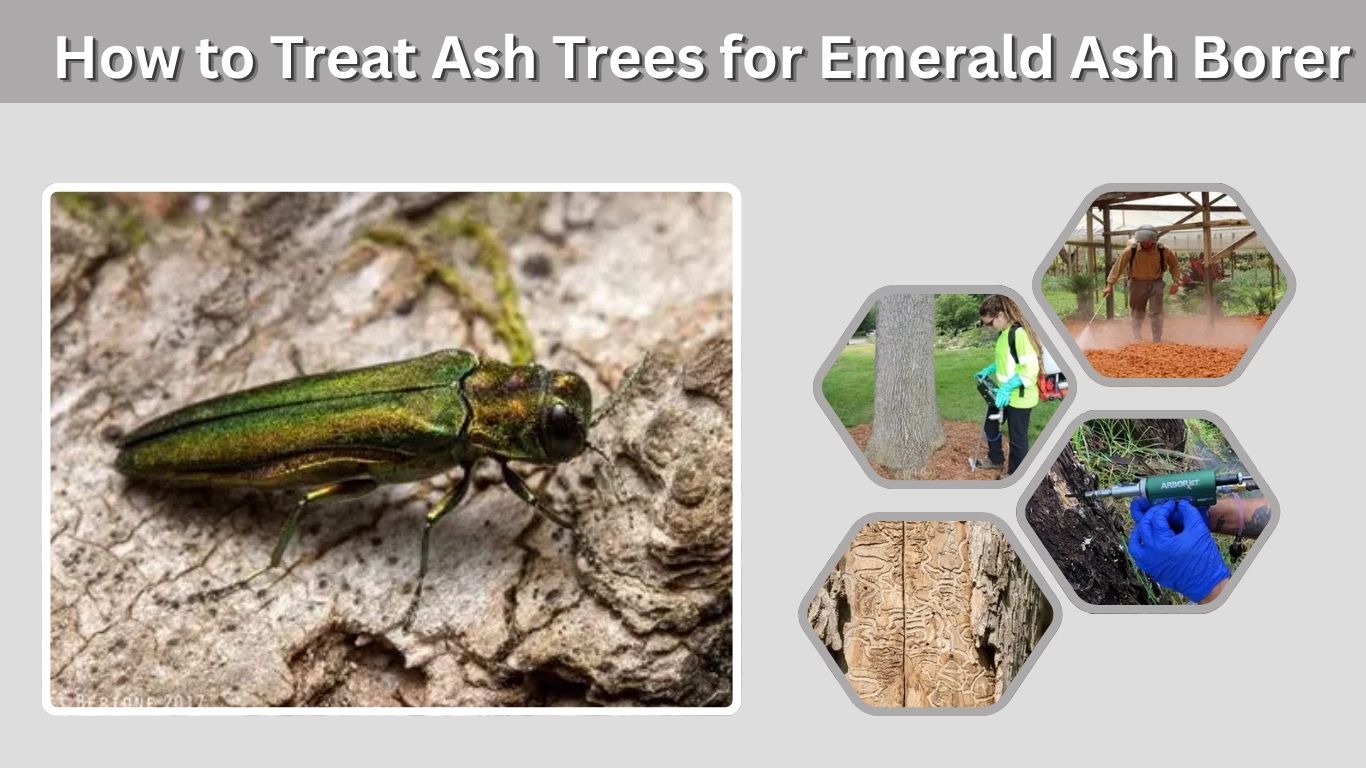
Emerald ash borer can kill an untreated ash tree by damaging the living tissue beneath its bark. Fortunately, healthy or lightly infested trees can often be protected with properly timed systemic insecticides. Successful treatment depends on the tree’s condition, size, location, and level of canopy decline. Homeowners must also decide whether the benefits of preserving a mature tree justify the cost of repeated applications. This guide explains how to treat ash trees for emerald ash borer, when to begin, and when removal may be more practical.
Can You Treat Ash Trees for Emerald Ash Borer?
Ash trees can be treated successfully when insecticides are applied before an infestation becomes severe. Treatment does not permanently eliminate emerald ash borer from the surrounding area. Instead, it protects the individual tree by killing beetles or larvae that attempt to feed on it.
Emerald ash borer larvae tunnel through the tissues beneath the bark that transport water and nutrients. As the number of tunnels increases, branches die and the canopy becomes thin. An untreated tree can eventually be girdled and killed.
Systemic insecticides are the primary treatment for valuable landscape ash trees. These products move through the tree and reach the tissues where emerald ash borer adults or larvae feed.
Treatment is most successful when:
- The tree is correctly identified as an ash.
- The trunk and major branches are structurally sound.
- Canopy thinning is less than approximately 30%.
- The tree is receiving adequate water.
- Treatment begins before the local infestation becomes severe.
- The owner is willing to continue treatment as required.
Some trees with up to 30% canopy thinning may recover when professionally injected with emamectin benzoate. Trees with extensive canopy loss, major trunk damage, or advanced decline are much less likely to respond.
Is Your Ash Tree Worth Treating?
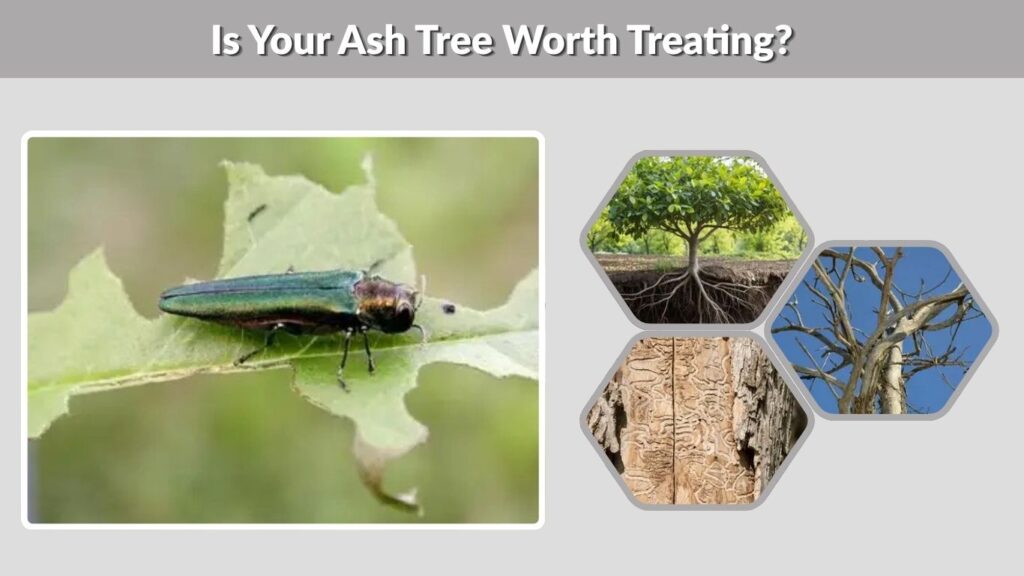
Not every ash tree should be saved. Treatment is generally more worthwhile for healthy, mature trees that provide substantial shade, improve the landscape, or would be expensive and difficult to replace.
Signs a Tree May Be Worth Saving
A good treatment candidate usually has:
- A full or nearly full canopy
- Fewer than 30% dead or thinning branches
- No large cavities or serious trunk cracks
- A desirable position in the landscape
- Enough space for normal root and canopy growth
- No major conflicts with buildings or power lines
A large, healthy shade tree may deliver benefits for decades. In that situation, repeated treatment may be preferable to immediate removal and replacement.
Signs Removal May Be Better
Removal may be the safer choice when the tree has:
- More than 30–50% canopy decline
- Numerous dead limbs
- Loose bark and extensive larval galleries
- Major structural defects
- Severe storm or construction damage
- Roots damaged by excavation or soil compaction
- Become a hazard to people or buildings
Highly declined ash trees can become brittle and dangerous to remove. Delaying removal may therefore increase both the difficulty and cost of the work.
Treatment Options for Emerald Ash Borer
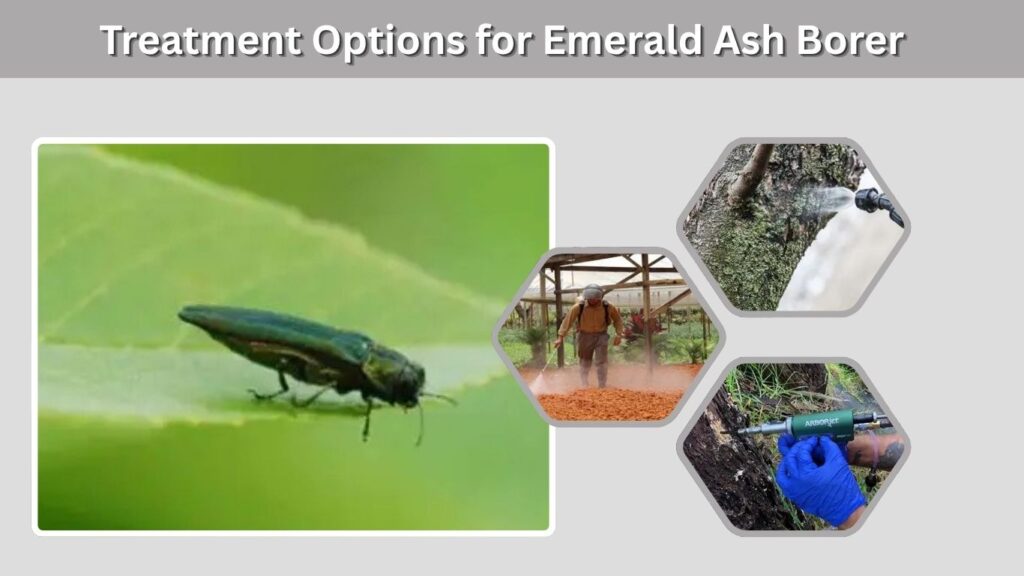
Several systemic insecticides can protect ash trees. Common active ingredients include emamectin benzoate, imidacloprid, dinotefuran, and azadirachtin. The appropriate product depends on the tree’s size, health, infestation level, environmental conditions, and local regulations.
| Treatment method | How it works | Best suited for | Typical frequency |
| Soil treatment | Insecticide is absorbed through the roots | Smaller, healthy trees | Usually annually |
| Basal bark spray | Product penetrates the bark and moves systemically | Small to medium trees | Usually annually |
| Trunk injection | Insecticide is placed directly into the tree | Medium to large or lightly infested trees | Every one to three years, depending on the product |
| Canopy spray | Applied to foliage or bark to target adults | Limited situations | Varies by label |
Soil Treatments
Soil drenches or soil injections are placed around the base of the ash tree. The roots absorb the insecticide and transport it upward.
These treatments generally work best on smaller, healthy trees with functioning root systems. Dry, compacted, waterlogged, or damaged soil can reduce absorption. Extra caution is necessary near wells, streams, ponds, drainage channels, and flowering plants.
Homeowner products may be available, but the product must specifically list emerald ash borer and ash trees on its label.
Basal Bark Sprays
Dinotefuran can be applied to the lower trunk using certain labeled products. It penetrates the bark and moves into the tree.
Because dinotefuran moves relatively quickly, a basal bark treatment may be useful when rapid uptake is needed. Application requirements, protective equipment, trunk coverage, and environmental restrictions vary by product.
Trunk Injections
Trunk injection places insecticide directly into the tree’s vascular system. It avoids applying the product to surrounding soil and is commonly used on large or high-value ash trees.
Emamectin benzoate is one of the most effective injection treatments. It generally provides at least two years of protection, and some evidence suggests that protection may sometimes last three years. It can also help lightly damaged trees recover when canopy loss has not progressed too far.
Injection requires specialized equipment and should be performed by a qualified tree-care professional. Repeated, poorly placed injection wounds can damage the trunk.
When to Treat Ash Trees for Emerald Ash Borer
The best time to treat ash trees for emerald ash borer depends on the active ingredient, application method, climate, and product label. In general, systemic treatments perform best when the tree is actively moving water from its roots into its canopy.
Best Seasonal Timing
Spring and early summer are commonly preferred because:
- Leaves have emerged.
- The tree is actively transporting water.
- Insecticide can move through the vascular system.
- Treatment can reach the tree before peak larval feeding.
For many locations, applications begin shortly after leaf emergence. However, certain trunk injections may also be applied later in summer or early fall. Minnesota Extension, for example, identifies May through late September as its primary treatment window, while noting that timing varies with tree condition and local climate.
Always follow the timing stated on the specific product label rather than relying only on a general seasonal recommendation.
When to Begin Preventive Treatment
Treatment is often recommended when emerald ash borer has been detected nearby and the tree is worth preserving. Some extension guidance recommends considering preventive treatment when an infestation is within approximately 15–30 miles.
Starting too early can result in years of unnecessary expense. Starting after the canopy has substantially declined may leave too little healthy vascular tissue to move the insecticide effectively.
How to Treat an Ash Tree for Emerald Ash Borer
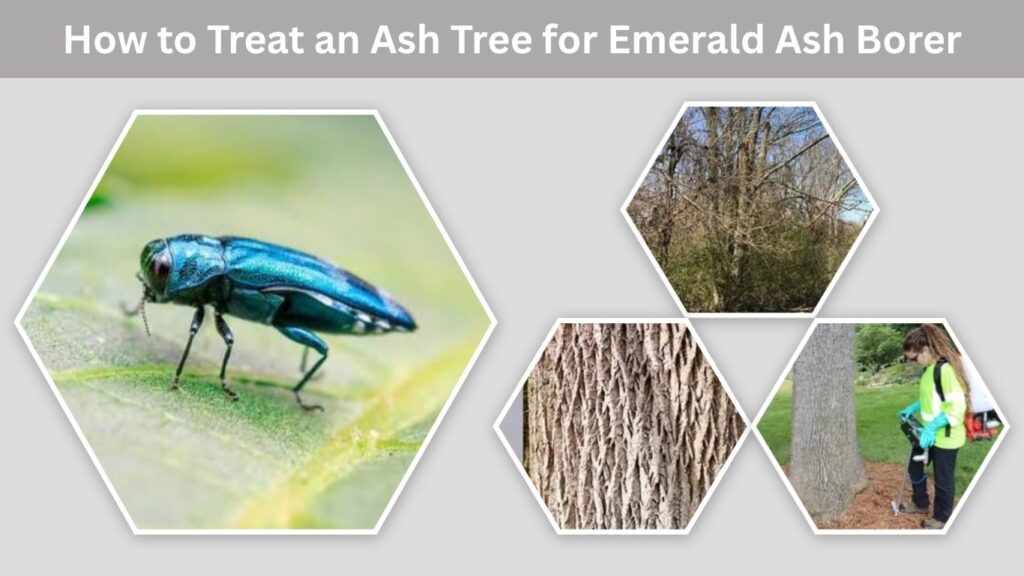
A professional assessment is the safest approach for large trees or any tree showing visible decline.
1. Confirm That It Is an Ash Tree
Ash trees normally have opposite branches and compound leaves. Common North American species include green ash, white ash, black ash, and blue ash.
Mountain ash is not a true ash and is not considered a host for emerald ash borer.
2. Inspect the Tree’s Condition
Look for:
- Thinning at the top of the canopy
- Dead branches
- D-shaped exit holes
- Splits in the bark
- S-shaped galleries beneath loose bark
- New shoots growing from the trunk
- Increased woodpecker activity
These symptoms can also be associated with other problems, so they do not always confirm emerald ash borer by themselves.
3. Measure the Trunk
Measure the trunk diameter at approximately 4.5 feet above the ground. Arborists call this diameter at breast height, or DBH.
Tree size affects the amount of product required, available application methods, treatment cost, and whether a homeowner product is suitable.
4. Select an Appropriate Treatment
Small, healthy trees may qualify for a labeled homeowner soil treatment. Larger trees, trees near sensitive areas, and trees showing infestation symptoms are better evaluated by a certified arborist.
Never estimate an application rate or use a product intended for another pest. Pesticide labels provide legally enforceable directions covering application rates, equipment, timing, protective clothing, and environmental restrictions.
5. Maintain Tree Health
Treatment works best when the tree can transport the insecticide effectively. During extended dry periods, water the root zone deeply when local restrictions allow.
Avoid damaging roots, piling mulch against the trunk, compacting the soil, or fertilizing a severely stressed tree without professional advice.
Cost to Treat an Ash Tree for Emerald Ash Borer
The cost to treat an ash tree varies considerably. Arborists may calculate pricing according to trunk diameter, treatment method, active ingredient, number of trees, site access, travel distance, and required retreatment interval.
A small soil-treated tree may cost less per visit than a large tree requiring professional injection. However, annual treatments can accumulate over time, while a longer-lasting injection may require fewer service visits.
Before deciding, request a written estimate that shows:
- The active ingredient
- Application method
- Treatment interval
- Price per treatment
- Expected level of protection
- Total projected cost over five or ten years
- Estimated removal and replacement cost
Compare long-term treatment expenses with the value of the tree and the cost of safely removing it. A small, poorly positioned ash may be more economical to replace. A healthy mature tree providing significant shade may justify continued protection.
FAQs
Can an ash tree recover from emerald ash borer?
An ash tree may recover when infestation is detected early and canopy thinning remains below approximately 30%. Trunk injection with emamectin benzoate is commonly used for lightly infested trees. Recovery becomes much less likely after severe canopy loss or extensive damage to the tree’s vascular tissue.
How often should ash trees be treated?
Treatment frequency depends on the active ingredient and product label. Many soil and basal bark products require annual application. Emamectin benzoate trunk injections commonly provide about two years of protection, although some trees may remain protected for longer under certain conditions.
Can I treat an ash tree myself?
Some insecticide products are labeled for homeowner use on smaller ash trees. Large trees and visibly infested trees should generally be treated by a qualified arborist. Never use professional injection products without the required training, equipment, licensing, and label authorization.
Is it too late to treat my ash tree?
Treatment may still work when canopy thinning is limited and the trunk remains structurally sound. A tree with extensive branch death, severe bark loss, or more than approximately 50% canopy decline is generally a poor candidate and may require removal.
Do ash trees need treatment for the rest of their lives?
In areas where emerald ash borer remains active, protected trees usually require ongoing retreatment. Treatment intervals vary by product. Local beetle populations may decline after many untreated ash trees die, but surviving trees can still be attacked and should continue to be monitored.