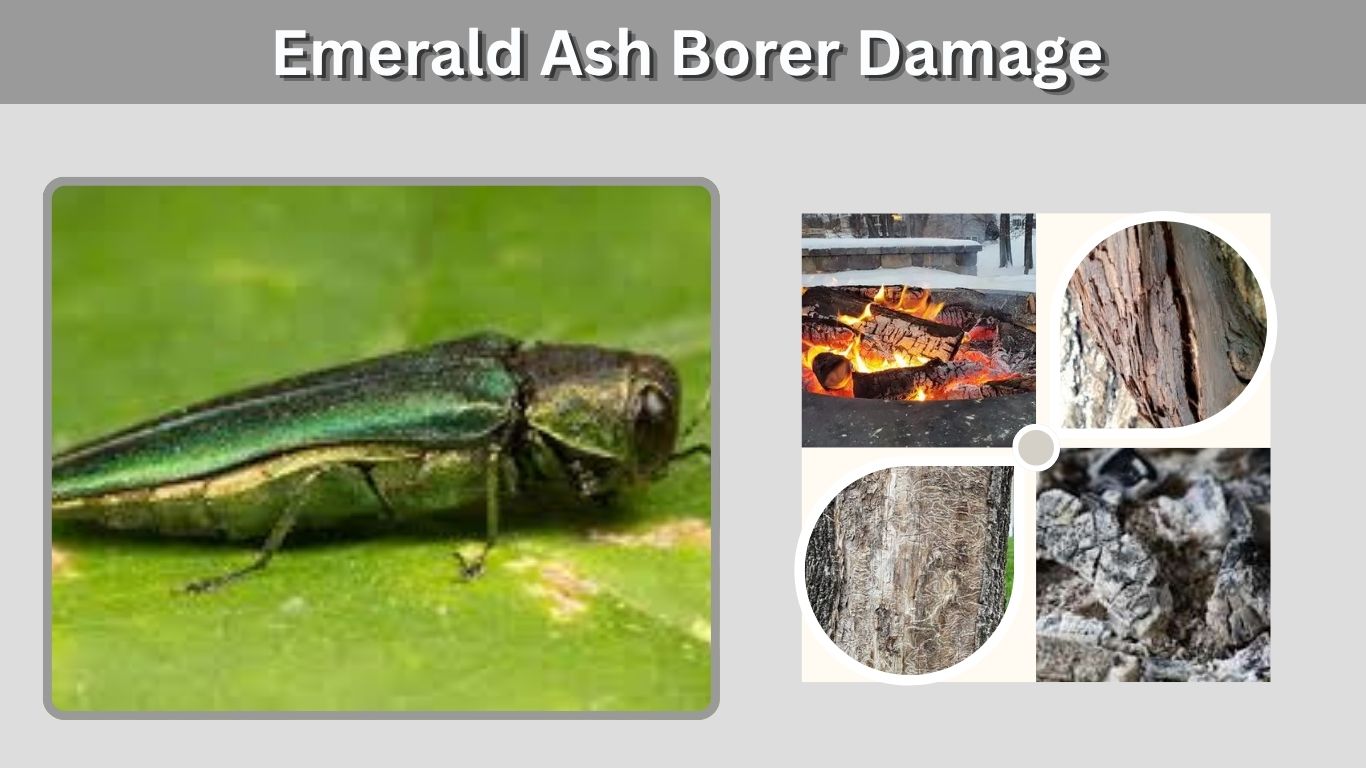
Emerald ash borer damage can remain hidden for years because most of it occurs beneath an ash tree’s bark. The beetle’s larvae create winding tunnels through tissues that transport nutrients, slowly cutting off support to the roots and canopy. Visible symptoms eventually include thinning foliage, dead branches, splitting bark, woodpecker activity and small D-shaped holes. Recognizing these warning signs early is important because lightly affected trees may respond to treatment, while severely damaged ash trees often become brittle and require removal.
What Damage Does the Emerald Ash Borer Cause?
The emerald ash borer, scientifically called Agrilus planipennis, is an invasive metallic-green beetle that attacks ash trees. Adult beetles eat small amounts of foliage, but this leaf feeding rarely causes serious harm. Nearly all fatal tree damage comes from larvae living beneath the bark.
After hatching from eggs laid in bark crevices, larvae enter the tree and feed on the inner bark and phloem. These tissues transport carbohydrates produced by the leaves to the roots and other growing parts of the tree. Larval feeding creates S-shaped galleries that gradually interrupt this movement. As galleries overlap, branches and trunks become girdled, roots weaken and the canopy begins dying.
Signs of Emerald Ash Borer Damage
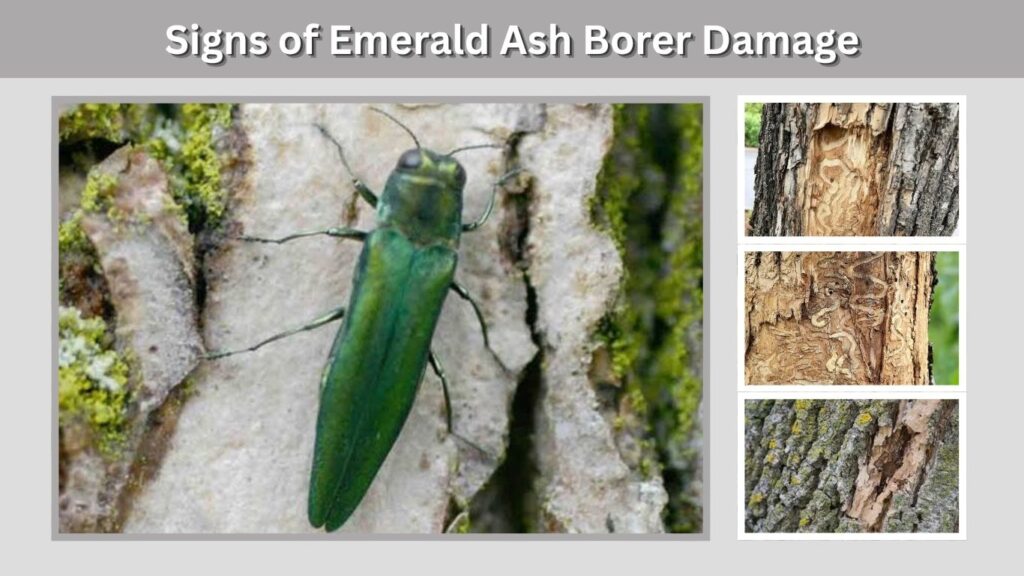
An infestation often starts in the upper canopy, where early symptoms are difficult to see from the ground. One symptom alone may not confirm emerald ash borer because drought, disease, root injury and other insects can produce similar decline. Multiple characteristic signs provide stronger evidence.
Canopy Thinning and Dieback
The upper canopy may become thin, uneven or transparent as branches produce fewer leaves. Foliage can appear smaller or lighter than normal, while individual branches may fail to leaf out.
As damage progresses, branch death spreads downward from the top of the tree. Advanced infestations can leave large sections of the crown bare.
D-Shaped Exit Holes
Adult emerald ash borers chew through the bark when emerging from the tree. This creates a small D-shaped exit hole with one flat side and one curved side.
Exit holes are generally about one-eighth inch across. They may initially occur high in the canopy, making them easy to overlook. Finding these characteristic holes provides strong physical evidence that emerald ash borers have completed development inside the tree.
S-Shaped Larval Galleries
Removing naturally loose bark may reveal winding S-shaped or serpentine tunnels. These galleries are produced as larvae feed back and forth through the inner bark.
The tunnels become wider as larvae grow and are commonly packed with frass, a fine mixture of sawdust and insect waste. Heavy gallery formation prevents the tree from transporting nutrients effectively.
Splitting Bark
Vertical cracks may appear along the trunk or large branches. Bark splitting occurs partly because the tree forms callus tissue around larval galleries beneath the surface.
A split may reveal pale wood, larvae or winding tunnels. However, bark can also crack because of frost, sunscald, mechanical injury or rapid temperature changes. Look for additional symptoms before assuming emerald ash borer is responsible.
Woodpecker Damage
Woodpeckers search beneath the bark for emerald ash borer larvae. As they remove small pieces of outer bark, they expose lighter-colored areas that contrast with the surrounding dark bark.
This symptom is known as bark blonding or flecking. Scattered pale patches may be among the earliest noticeable signs, particularly during fall and winter when woodpeckers actively search for overwintering larvae.
Epicormic Shoots
A heavily stressed ash tree may produce leafy shoots from its trunk, lower branches or base. These shoots, called epicormic sprouts, are an emergency response to canopy decline.
They indicate that the tree is attempting to replace lost foliage. Although epicormic growth does not prove an infestation, it becomes suspicious when combined with canopy dieback, exit holes or bark galleries.
Early Versus Advanced Damage
Emerald ash borer damage becomes progressively more visible as the insect population inside the tree increases.
| Damage stage | Common visible symptoms | Recommended response |
| Early | Light canopy thinning, minor woodpecker flecking | Confirm the tree species and arrange an inspection |
| Moderate | Bark splitting, exit holes, sprouts and branch dieback | Discuss systemic treatment with an arborist |
| Advanced | Major canopy loss, loose bark and extensive galleries | Evaluate safety and possible removal |
| Dead tree | No healthy foliage, brittle limbs and weakened trunk | Arrange professional removal promptly |
Early Damage
During the early stage, the tree may still have a mostly full canopy. Small areas of thinning, subtle bark flecking or a few dead twigs may be the only visible warnings.
Treatment generally has the greatest chance of success before extensive canopy loss occurs because the tree must still transport systemic insecticide through its tissues.
Advanced Damage
Later-stage symptoms include extensive crown dieback, large patches of loose bark, overlapping galleries and numerous dead branches. The tree may also produce heavy sprouting along the trunk.
Severely affected ash trees can become structurally weak and brittle. Large dead branches may break unexpectedly, especially during wind, storms or snow.
What Does Emerald Ash Borer Leaf Damage Look Like?
Adult emerald ash borers may create small, irregular notches along ash leaf edges. This feeding is usually minor and is not the main reason infested trees decline.
More important leaf symptoms result from internal vascular damage. Leaves may become sparse, undersized, pale or prematurely yellow. Some branches may produce no foliage at all.
Because drought, root damage and disease can cause similar leaf symptoms, foliage alone cannot reliably diagnose an infestation. Inspect the trunk and branches for galleries, splitting bark, woodpecker flecking and D-shaped holes.
Before and After Emerald Ash Borer Damage
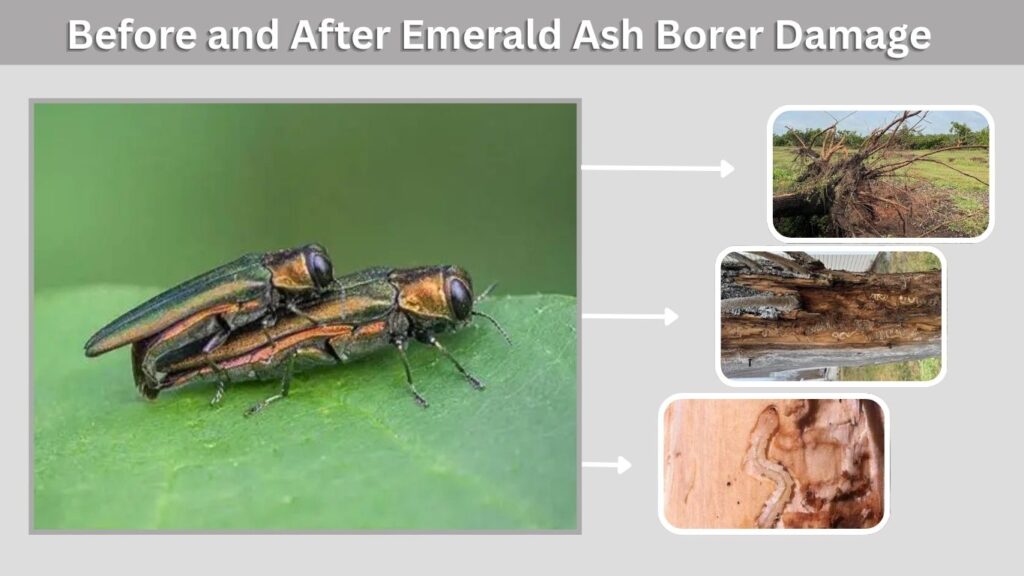
A healthy ash tree normally has a full, evenly distributed canopy during the growing season. Its bark remains largely intact, and the trunk does not produce clusters of emergency shoots.
After an infestation develops, the upper crown begins thinning. Woodpecker flecking and bark cracks may then appear, followed by branch death and trunk sprouts. In the final stage, much of the canopy is bare, bark loosens and the underlying wood reveals extensive larval galleries.
The progression can be summarized as:
- Larvae begin feeding beneath the bark.
- Subtle thinning develops near the crown.
- Woodpecker activity and bark splitting increase.
- Branch dieback spreads downward.
- Shoots emerge from the trunk or base.
- The canopy collapses and the tree dies.
How to Identify Emerald Ash Borer Damage
Begin by confirming that the affected tree is a true ash tree in the genus Fraxinus. Ash trees typically have opposite branches and compound leaves composed of several leaflets. Mountain ash and prickly ash are not true ash trees.
Next, inspect the tree for a combination of symptoms:
- Thinning or dead branches near the top
- Pale woodpecker flecking on the bark
- Vertical trunk or branch cracks
- Small D-shaped exit holes
- S-shaped galleries beneath loose bark
- Sprouts emerging from the trunk
- Premature yellowing or leaf loss
Avoid stripping healthy bark to search for larvae, as this creates additional injury. A certified arborist or local forestry professional can confirm the cause without unnecessarily damaging the tree.
Can Emerald Ash Borer Damage Be Treated?
Systemic insecticides can protect some ash trees, particularly when treatment begins before serious canopy decline. These products move through the tree’s tissues and kill larvae as they feed.
Available active ingredients may include emamectin benzoate, imidacloprid, dinotefuran and azadirachtin. Application methods include professional trunk injections, soil treatments and basal bark treatments, depending on the product label. Healthy trees with full canopies are generally the strongest treatment candidates.
Insecticide cannot reconnect vascular tissue that larvae have already destroyed. It may prevent further feeding and give a lightly damaged tree time to recover, but it cannot restore dead branches.
When Should a Damaged Ash Tree Be Removed?
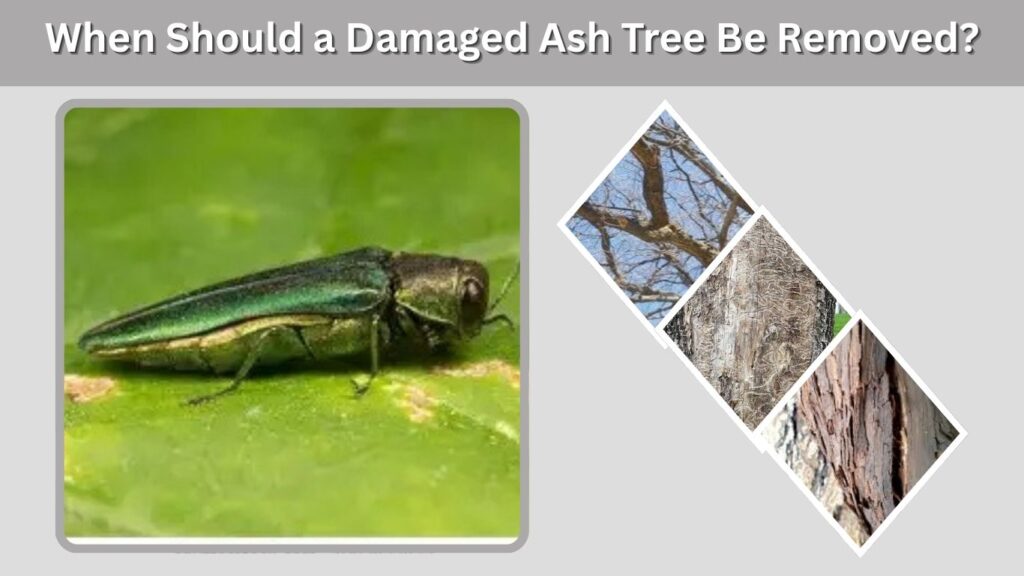
Removal may be safer than treatment when the tree has extensive crown loss, large dead limbs, severe trunk damage or structural defects.
Consider removal when:
- Much of the canopy is already dead.
- Bark is loose across large areas.
- The trunk has major cracks or cavities.
- Large branches hang over buildings or roads.
- The tree is declining despite treatment.
- Long-term treatment costs exceed its landscape value.
Dead ash trees become increasingly brittle, making delayed removal more difficult and potentially more expensive. Trees near homes, sidewalks, driveways, utility lines or public areas should be assessed promptly.
How to Prevent Further Damage
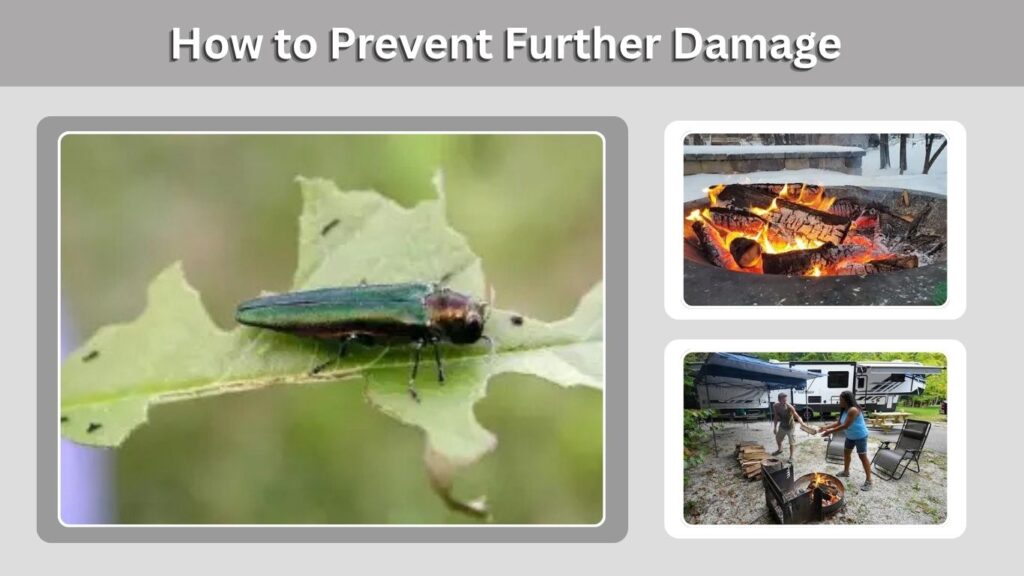
Emerald ash borers spread naturally over short distances, but infested firewood, logs and other ash materials can move them much farther. Preventing human-assisted movement helps slow new infestations.
Buy local or certified heat-treated firewood, follow local wood-movement regulations and dispose of infested ash material according to regional guidance. Inspect remaining ash trees regularly and plant several different replacement species rather than replacing every lost tree with the same species.
FAQs
What is the first visible sign of emerald ash borer damage?
Early signs may include light thinning in the upper canopy and pale bark flecking caused by woodpeckers. Because an infestation often begins high in the tree, these symptoms can be difficult to notice without binoculars or a professional inspection.
Does bark splitting confirm emerald ash borer?
Bark splitting alone does not confirm an infestation. Frost, sunscald and physical damage can also crack bark. Emerald ash borer becomes more likely when a split exposes S-shaped galleries and occurs alongside canopy thinning, exit holes or woodpecker feeding.
Can an ash tree recover after being damaged?
A lightly affected ash tree may recover when effective treatment stops further larval feeding. Recovery is less likely after extensive canopy loss because large areas of the tree’s nutrient-transport system have already been destroyed.
Is woodpecker damage harmful to the ash tree?
Woodpeckers remove small pieces of bark while searching for larvae, but they are not the primary cause of the tree’s decline. Their feeding usually reveals an existing emerald ash borer infestation and can help homeowners detect hidden damage.
How quickly can emerald ash borer damage kill a tree?
The rate varies with tree size, condition and infestation pressure. Decline often becomes severe within several years after infestation begins. Visible symptoms may appear late because larvae can feed unnoticed beneath the bark before significant canopy damage develops.