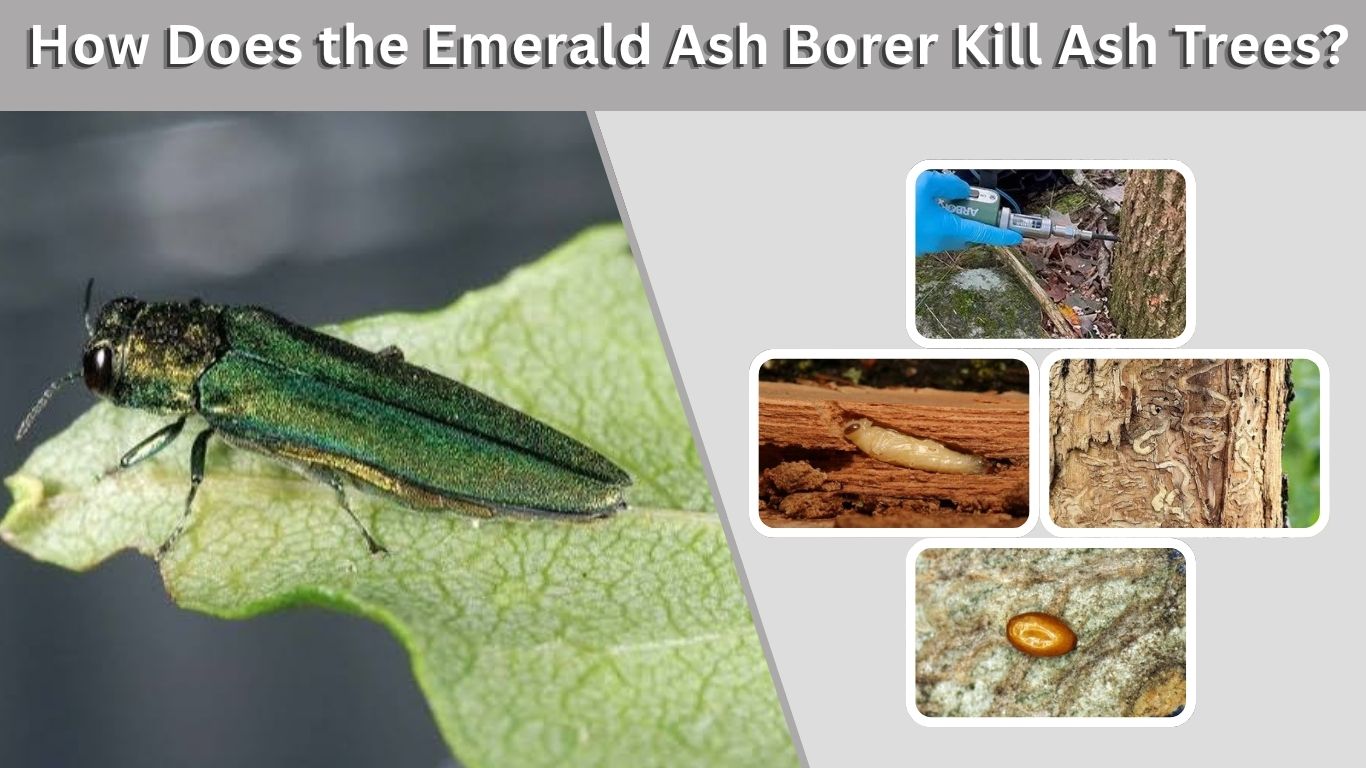
The emerald ash borer kills ash trees by feeding on the living tissues beneath their bark. Although the adult beetle eats small amounts of foliage, the larvae cause nearly all the serious damage. They tunnel through the inner bark, creating galleries that interrupt the movement of water, sugars, and nutrients. As more galleries overlap, branches become girdled, the canopy thins, roots lose their food supply, and the tree eventually dies. Understanding this process helps homeowners recognize infestations and choose treatment before the damage becomes irreversible.
What Is the Emerald Ash Borer?
The emerald ash borer, or Agrilus planipennis, is a small metallic-green beetle originally from Asia. It is an invasive pest in North America and primarily attacks ash trees belonging to the genus Fraxinus.
Adults are narrow, bullet-shaped beetles measuring roughly one-third to one-half inch long. They are easy to overlook because they spend only a short part of their life outside the tree.
The damaging larvae are cream-colored, flattened, and segmented. They remain beneath the bark, where they are protected from many predators, weather conditions, and surface-applied pest-control products.
How Does the Emerald Ash Borer Kill an Ash Tree?
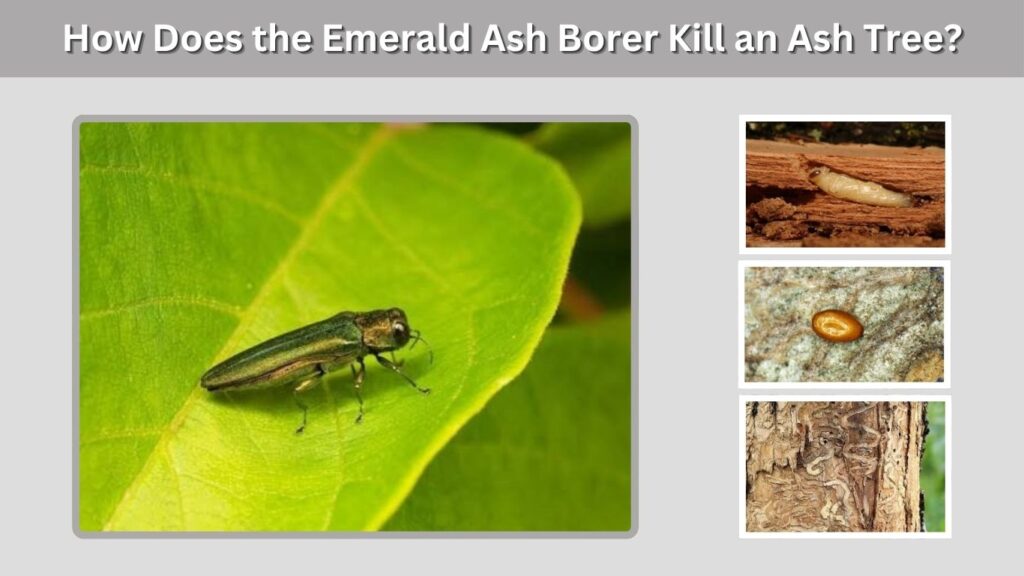
The beetle does not normally kill the tree by eating its leaves. Death results from the cumulative damage caused by larvae feeding beneath the bark.
Eggs Are Deposited on the Bark
Female emerald ash borers lay eggs in bark cracks, branch crotches, and rough areas on the trunk and major branches. The eggs are tiny and difficult to detect during a normal visual inspection.
After hatching, the young larvae chew through the outer bark and enter the tree.
Larvae Feed on the Phloem and Cambium
The larvae feed primarily on the phloem and cambial region. These tissues are essential to the tree’s internal transport and growth systems.
Phloem carries sugars produced by the leaves to the roots and other growing tissues. The cambial area produces new conductive tissue. When larvae destroy these layers, the tree can no longer distribute food efficiently.
Galleries Girdle the Tree
As larvae feed, they create long, winding tunnels commonly described as S-shaped or serpentine galleries. These galleries widen as the larvae grow and become packed with sawdust-like waste called frass.
A few galleries may affect only a small part of a branch. However, large numbers of overlapping galleries can form a nearly continuous band of damaged tissue around a branch or trunk.
This is called girdling. Once a branch is girdled, nutrients cannot pass through the damaged area effectively.
Roots Begin to Starve
Leaves produce carbohydrates through photosynthesis and send them through the phloem to the roots. Emerald ash borer larvae interrupt that downward movement.
Without enough carbohydrates, the roots gradually weaken and die. Damaged roots then become less able to absorb water and minerals from the soil.
The tree is attacked from both directions: the canopy loses support from the roots, while the roots lose food from the canopy.
The Canopy Declines
As the vascular system fails, branches in the upper crown begin producing fewer leaves. Branch dieback usually progresses downward through the canopy.
The tree may respond by producing clusters of new shoots from its trunk or lower branches. These emergency shoots cannot compensate for extensive internal damage.
Eventually, most of the canopy dies, the trunk becomes brittle, and the entire tree fails.
| Stage of attack | What happens inside the tree | Visible result |
| Egg laying | Eggs are placed in bark cracks | Usually no visible symptoms |
| Early larval feeding | Larvae enter the phloem | Minor or hidden damage |
| Gallery development | Tunnels interrupt nutrient movement | Canopy thinning begins |
| Girdling | Galleries overlap around branches or trunk | Branch dieback and bark splitting |
| Vascular failure | Roots and canopy lose support | Extensive crown loss |
| Tree death | Most conductive tissue stops functioning | Brittle branches and dead trunk |
How Fast Does Emerald Ash Borer Kill Trees?
The speed of decline depends on the tree’s size, health, species, infestation level, and local climate. Many infested ash trees die within approximately two to four years, although heavily attacked or stressed trees may decline more rapidly.
Early infestations may remain unnoticed because they often begin in the upper canopy. By the time obvious symptoms appear at ground level, larvae may have been feeding inside the tree for more than one season.
Young trees can be girdled relatively quickly because they have less trunk circumference. Mature trees contain more tissue but can support larger beetle populations.
Signs That Emerald Ash Borer Is Killing a Tree
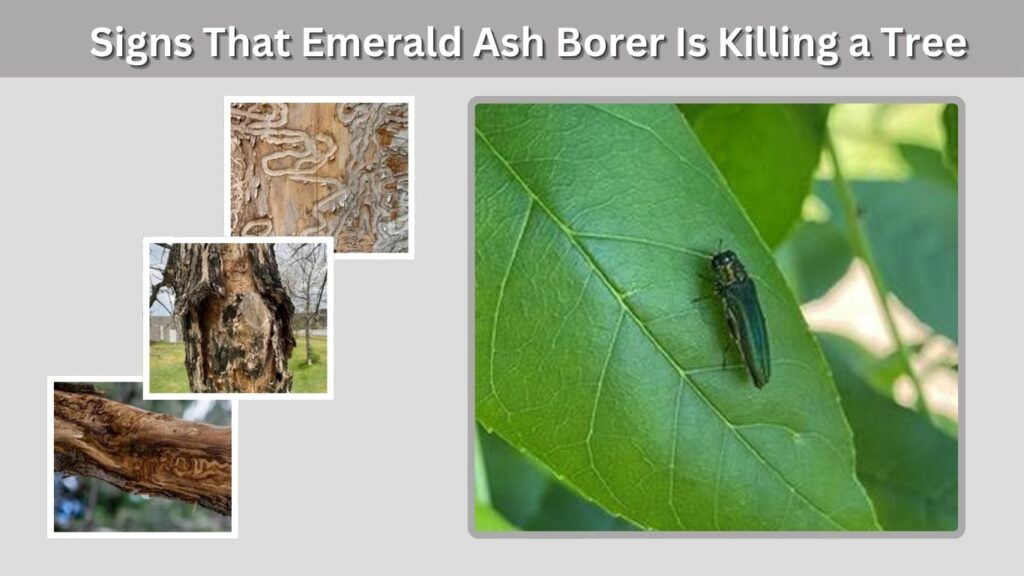
Finding one symptom does not always confirm an infestation. Drought, disease, root damage, and other insects can cause similar decline. Several signs appearing together provide stronger evidence.
Common Damage Signs
- Thinning leaves near the top of the canopy
- Dead upper branches
- Small D-shaped exit holes
- Vertical splits in the bark
- S-shaped galleries under loose bark
- Increased woodpecker feeding
- Pale areas where woodpeckers removed bark
- New shoots growing from the trunk
- Premature leaf yellowing or leaf drop
- Loose bark and brittle branches
Adult beetles produce D-shaped holes as they emerge from the tree. These holes are usually only about 3 to 4 millimeters wide and may be difficult to see on thick or rough bark.
Why Does Emerald Ash Borer Mostly Kill Ash Trees?
Emerald ash borer larvae are biologically adapted to feed and develop in ash tissues. North American ash species lack the strong defenses found in some Asian ash trees that evolved alongside the beetle.
The pest can infest all 16 North American ash species, including green, white, black, blue, pumpkin, and Oregon ash. White fringetree and cultivated olive have also been identified as reproductive hosts under some conditions, although the effects on these plants are less understood.
Trees with “ash” in their common names are not necessarily hosts. Mountain ash, for example, is not a true member of the Fraxinus genus.
What Kills Emerald Ash Borer?
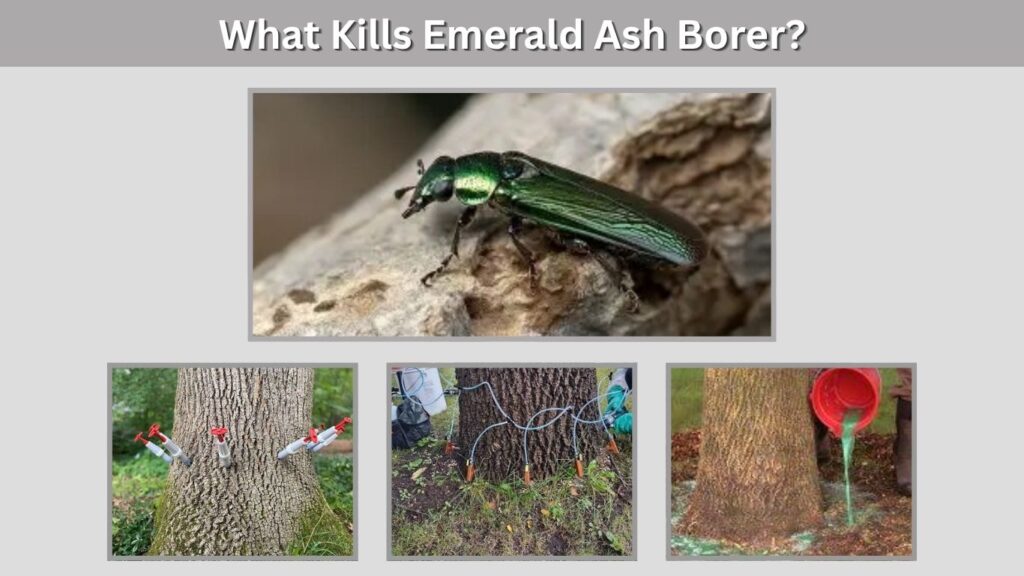
No single method has eradicated emerald ash borer from North America. However, systemic insecticides can protect individual trees, while predators and introduced parasitoid wasps can reduce populations over larger areas.
Systemic Insecticides
Systemic insecticides are absorbed into a tree and transported through its tissues. Larvae are exposed when they feed under the bark, while adults may be exposed when feeding on treated foliage.
| Active ingredient | Common application | General purpose |
| Emamectin benzoate | Trunk injection | Professional protection of valuable trees |
| Imidacloprid | Soil treatment or trunk injection | Preventive or early-stage management |
| Dinotefuran | Soil application or basal bark spray | Faster systemic uptake |
| Azadirachtin | Trunk injection | Systemic management in treatment programs |
Emamectin benzoate trunk injections can provide excellent control for at least two years when applied correctly, even in areas with high beetle pressure.
Treatment products and schedules vary by location and tree condition. Pesticide labels must be followed exactly, and trunk injections should generally be performed by a qualified tree-care professional.
Parasitoid Wasps
Several tiny, non-stinging parasitoid wasps attack emerald ash borer eggs or larvae. A female wasp deposits an egg in or on the pest, and the developing wasp eventually kills its host.
USDA biological-control programs use several approved species to reduce emerald ash borer populations and support the long-term survival of ash trees. These programs are designed for landscape-level management rather than treating a single backyard tree.
Woodpeckers and Other Predators
Woodpeckers remove bark and eat larvae during fall and winter. Heavy woodpecker activity can destroy substantial numbers of larvae and may also provide an early sign of infestation.
However, predators generally cannot eliminate the population or reliably protect an untreated tree during a serious outbreak.
Does Cold Weather Kill Emerald Ash Borer?
Extremely cold temperatures can kill larvae beneath the bark, but normal winter weather does not reliably eliminate an infestation.
Research from Minnesota indicates that temperatures around −20°F can cause substantial larval mortality, while temperatures approaching −30°F may kill most larvae. Actual survival depends on the temperature beneath the bark, tree diameter, sun exposure, snow cover, duration of the freeze, and the larvae’s cold acclimation.
Even after severe cold, some larvae may survive and reproduce. Cold weather can slow population growth but should not be treated as a dependable cure for an infested tree.
Can You Kill Emerald Ash Borers With Home Remedies?
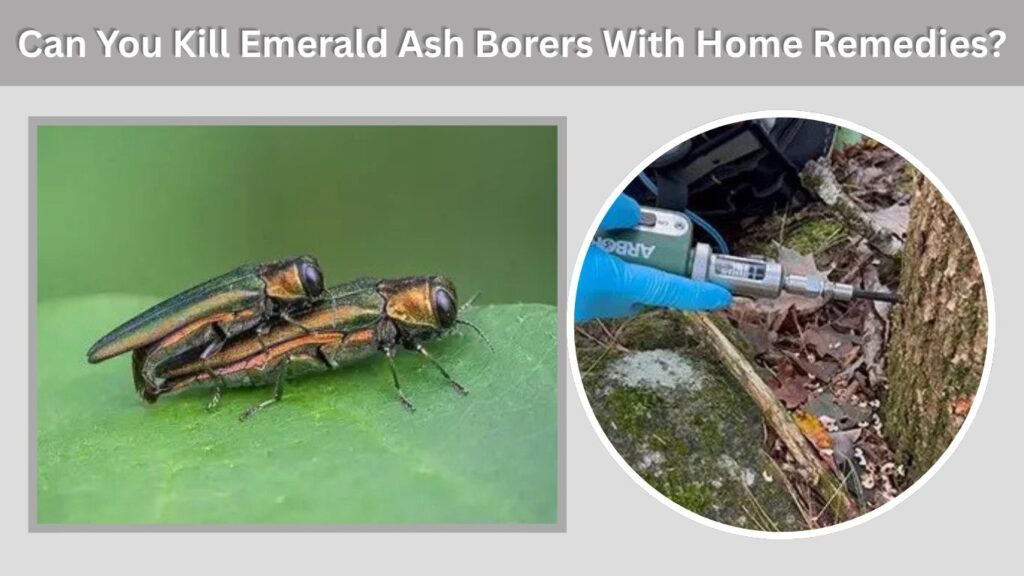
Boiling water, borax, bug lights, tree wraps, and general surface sprays are not reliable emerald ash borer treatments. The destructive larvae are protected beneath the bark, where most improvised treatments cannot reach them.
Cutting visible galleries from the trunk also does not remove larvae elsewhere in the tree and may cause additional injury.
Use only products specifically labeled for emerald ash borer and the intended application method. Large trees, declining trees, and trees near buildings should be evaluated by a certified arborist.
Can an Infested Ash Tree Be Saved?
An ash tree may be saved when treatment begins before extensive canopy decline. The best candidates are structurally sound trees with healthy trunks and most of their foliage still intact.
Treatment may be worthwhile when the tree:
- Has only limited canopy thinning
- Provides valuable shade or landscape benefits
- Does not have major cracks or cavities
- Can receive repeat treatments
- Is not already a safety hazard
Insecticide kills or suppresses insects; it does not restore dead branches or reconnect tissues already destroyed by larval galleries.
Removal is usually more practical when much of the canopy is dead, the trunk is splitting, large branches are brittle, or the tree threatens a house, road, sidewalk, or utility line.
FAQs
Will emerald ash borer kill every ash tree?
The insect can infest all North American ash species, but not every individual tree dies at the same rate. Treatment, tree condition, local beetle pressure, natural resistance, predators, and climate can affect survival. Untreated susceptible ash trees in heavily infested areas face a very high risk.
What insecticide kills emerald ash borer larvae?
Emamectin benzoate, imidacloprid, dinotefuran, and azadirachtin are among the active ingredients used in emerald ash borer management. Effectiveness depends on tree size, infestation stage, application method, dosage, timing, and proper distribution through the tree.
Can emerald ash borer kill a healthy tree?
Yes. Unlike many wood-boring insects that mainly attack stressed trees, emerald ash borer can infest and kill apparently healthy ash trees. Healthy trees may survive longer initially, but repeated larval feeding can eventually girdle the trunk and major branches.
How do I know whether larvae are under the bark?
Possible signs include bark splitting, woodpecker blonding, D-shaped exit holes, canopy thinning, and new shoots on the trunk. Removing loose bark may reveal cream-colored larvae or S-shaped galleries, but healthy bark should not be stripped from the tree unnecessarily.
Should I treat or remove my ash tree?
Treat a valuable tree while its canopy and structure are still mostly healthy. Consider removal when canopy loss is extensive, the trunk is weakened, large branches are dead, or the tree presents a safety risk. An arborist can compare treatment costs with removal and replacement.