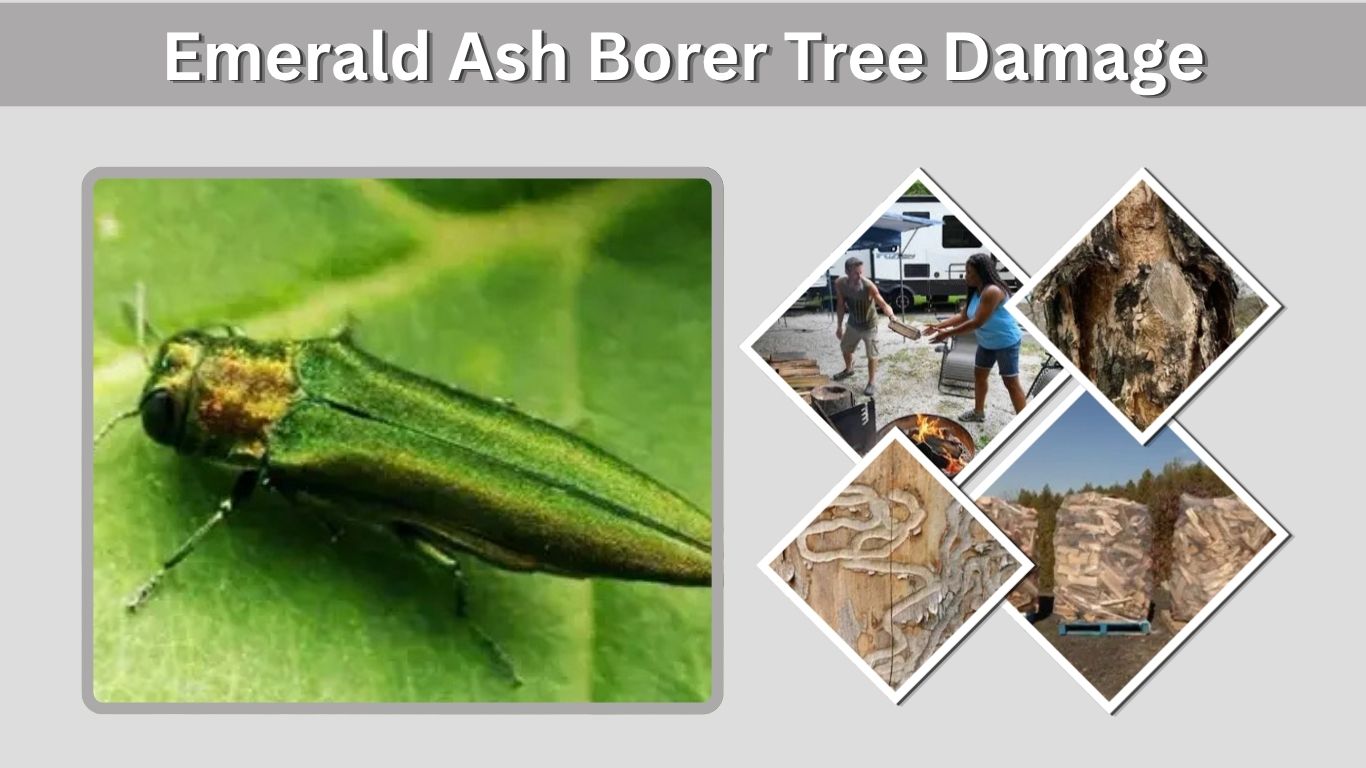
Emerald ash borer tree damage often begins beneath the bark, making an infestation difficult to notice during its early stages. As larvae feed on the tissues that carry water and nutrients through an ash tree, the canopy gradually thins, branches die, and the bark may split open. Recognizing these symptoms early can improve the chances of saving a valuable tree. This guide explains what emerald ash borer damage looks like, how it progresses, and when treatment or tree removal may be necessary.
How Does the Emerald Ash Borer Damage Trees?
The emerald ash borer is a small, metallic-green beetle that attacks true ash trees in the genus Fraxinus. Adult beetles cause relatively little harm when they feed on leaves. Most serious ash tree damage is caused by their larvae.
After eggs hatch on the bark, the larvae tunnel into the tree and feed on the inner bark and phloem. These tissues transport sugars and nutrients from the leaves to the roots. As larval feeding increases, the winding tunnels gradually interrupt this flow.
Eventually, the damage can girdle branches or the trunk. Water and nutrients can no longer move efficiently through the tree, causing canopy decline, root starvation, branch death, and complete tree failure.
Early Signs of Emerald Ash Borer Damage
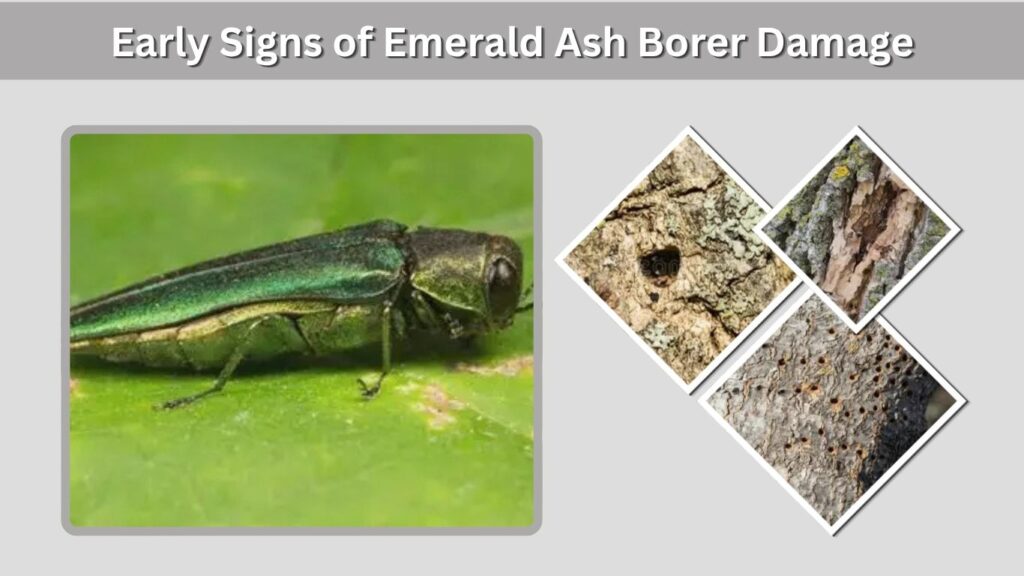
Early detection is difficult because infestations often begin in the upper canopy. A tree may appear healthy from the ground while larvae are already feeding beneath the bark.
Canopy Thinning
One of the earliest visible symptoms is thinning foliage near the top of the tree. The upper crown may produce fewer leaves, and individual branches may appear bare.
Canopy thinning can also result from drought, root injury, soil compaction, or disease, so it should not be used as the only sign of emerald ash borer activity.
D-Shaped Exit Holes
Adult emerald ash borers create small D-shaped holes when they emerge through the bark. These holes are usually about one-eighth inch wide and have one flat side with a rounded outer edge.
Exit holes may be difficult to find because they can occur high in the tree. Their presence is a strong sign that emerald ash borers have completed development inside the trunk or branches.
Bark Splitting
Vertical bark splitting is another important symptom of emerald ash borer damage. As larvae feed and grow beneath the surface, the bark may crack open over their galleries.
The splits can expose pale wood and winding tunnels. However, bark can also split because of frost, sunscald, mechanical injury, or rapid temperature changes.
What Does Advanced Emerald Ash Borer Damage Look Like?
As an infestation progresses, the symptoms become more severe and easier to recognize. By this stage, however, saving the tree may be more difficult.
| Damage level | Common symptoms | Possible action |
| Early | Light canopy thinning and a few exit holes | Evaluate for treatment |
| Moderate | Bark splitting, woodpecker activity and branch dieback | Professional inspection |
| Severe | Extensive canopy loss and loose bark | Removal may be necessary |
| Dead tree | No leaves, brittle branches and major decay | Prompt removal recommended |
S-Shaped Larval Galleries
When loose bark falls away or is carefully removed from an affected area, winding S-shaped galleries may be visible in the wood.
These tunnels are created by larvae feeding back and forth beneath the bark. They are often packed with sawdust-like waste called frass.
The galleries become wider as the larvae grow. Large numbers of tunnels can overlap and prevent the tree from transporting nutrients effectively.
Woodpecker Damage
Woodpeckers feed on emerald ash borer larvae beneath the bark. Increased woodpecker activity can therefore be an indirect sign of infestation.
Woodpeckers may remove patches of outer bark, producing light-colored or blond areas on the trunk and upper branches. This symptom is sometimes called bark blonding.
Although woodpeckers can kill some larvae, they usually cannot stop a serious infestation.
Epicormic Shoots
A stressed ash tree may produce clusters of new shoots from the trunk, base, or lower branches. These are known as epicormic shoots or water sprouts.
The tree produces them as an emergency response when the upper canopy is no longer receiving enough water or nutrients. Their appearance often indicates that the tree is already under substantial stress.
Extensive Branch Dieback
As larval galleries cut off nutrient movement, large branches begin dying from the top downward. The tree may lose leaves early, produce smaller foliage, or fail to leaf out in spring.
Dead branches on an emerald ash borer-damaged tree can become brittle and fall without warning.
How Quickly Does Emerald Ash Borer Damage Kill a Tree?
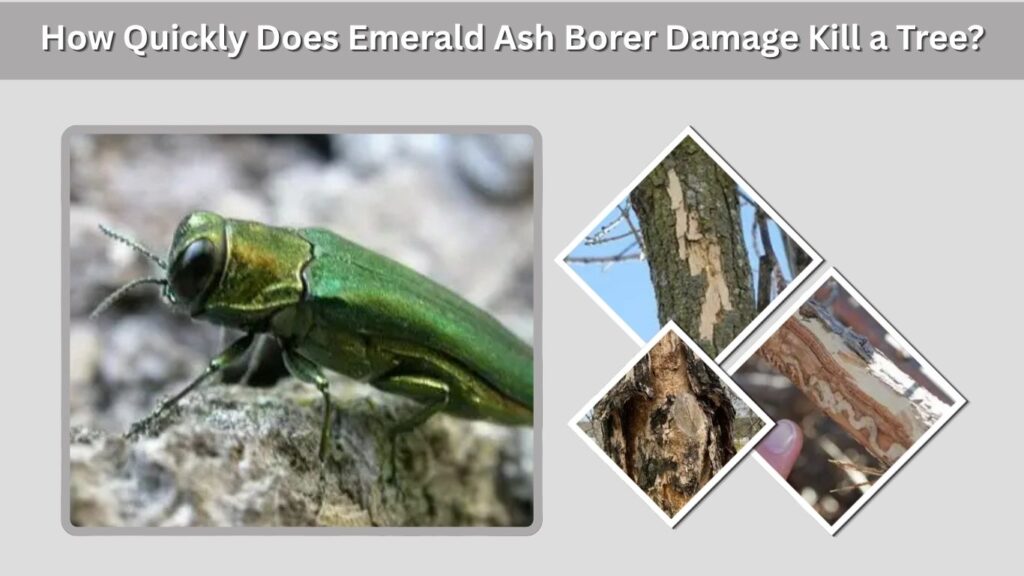
The rate of decline depends on the size and health of the tree, local beetle populations, climate, and when the infestation began. A healthy mature ash tree may survive for several years after being attacked, but smaller or heavily infested trees can decline faster.
A typical progression may look like this:
- The infestation begins in the upper branches.
- Light canopy thinning develops.
- Bark splits and exit holes become visible.
- Branch dieback spreads through the crown.
- Shoots appear along the trunk.
- Most of the canopy dies.
- The tree becomes brittle and structurally dangerous.
Once a tree has lost a large percentage of its canopy, treatment may no longer be practical.
How to Confirm Emerald Ash Borer Tree Damage
Several problems can produce symptoms that resemble emerald ash borer damage. Proper identification is important before applying insecticides or removing the tree.
Confirm That It Is an Ash Tree
True ash trees usually have opposite branches and compound leaves. The leaves are made of several leaflets arranged along a central stem.
Mountain ash, prickly ash, and some trees with “ash” in their common names are not true ash trees and are generally not affected in the same way.
Look for Multiple Symptoms
A single symptom may not provide enough evidence. Stronger confirmation comes from finding several signs together, such as:
- Upper canopy thinning
- D-shaped exit holes
- S-shaped larval galleries
- Bark splitting
- Woodpecker feeding
- Epicormic shoots
- Progressive branch dieback
A certified arborist can inspect the canopy, trunk, bark, and structural condition of the tree.
Can an Emerald Ash Borer-Damaged Tree Be Saved?
Some ash trees can be saved when the infestation is detected early. Treatment is most successful when the tree is structurally sound and has lost only a small portion of its canopy.
Systemic insecticides move through the tree and kill larvae feeding beneath the bark. Common professional treatments include trunk injections containing emamectin benzoate. Other products may contain imidacloprid, dinotefuran, or azadirachtin.
Treatment is generally more appropriate when:
- Most of the canopy remains healthy
- The trunk is structurally sound
- The tree provides valuable shade
- Damage is limited
- The owner can continue scheduled treatments
Insecticide treatment does not repair dead branches or destroyed vascular tissue. It stops or reduces future feeding so the tree can recover.
When Should a Damaged Ash Tree Be Removed?
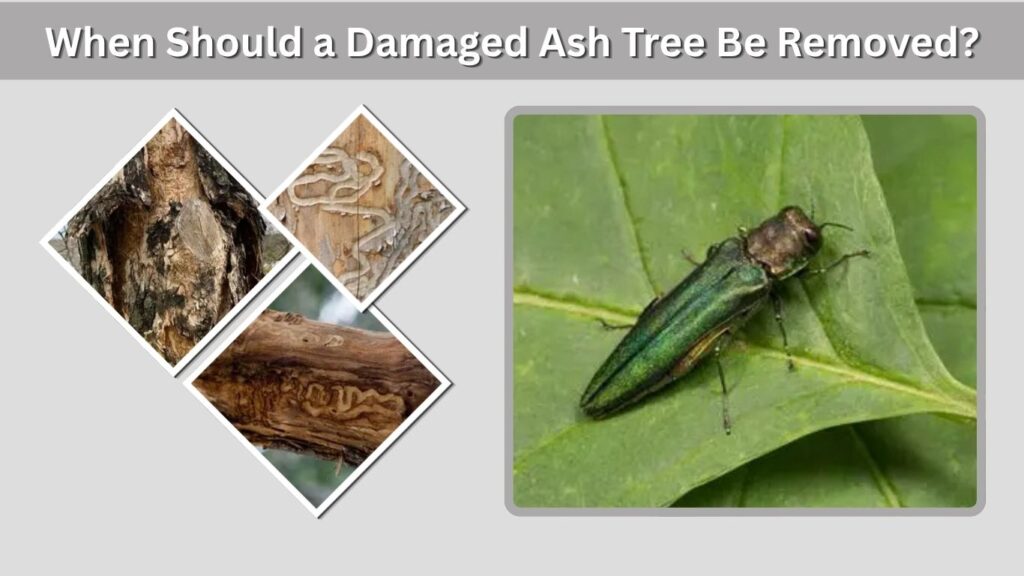
Tree removal may be the safest option when damage is advanced. Dead ash trees can become extremely brittle because emerald ash borer galleries weaken the tissues beneath the bark.
Removal should be considered when the tree has:
- Lost a large portion of its canopy
- Developed major dead branches
- Severe trunk splitting
- Extensive loose or falling bark
- Structural cracks or cavities
- No realistic chance of recovery
- A location near homes, roads, or power lines
Waiting too long can make removal more dangerous and expensive. Climbers may not be able to work safely in a severely weakened tree, requiring cranes or specialized equipment.
Treatment Versus Removal
| Factor | Treatment may be suitable | Removal may be better |
| Canopy condition | Mostly healthy | Extensive dieback |
| Tree structure | Strong and stable | Cracked or hazardous |
| Infestation stage | Early | Advanced |
| Landscape value | High-value shade tree | Poorly located tree |
| Long-term cost | Repeated treatment is affordable | Removal and replacement are more practical |
Homeowners should compare the cost of ongoing treatment with the cost of removal, stump grinding, and replacement planting.
Preventing Additional Emerald Ash Borer Damage
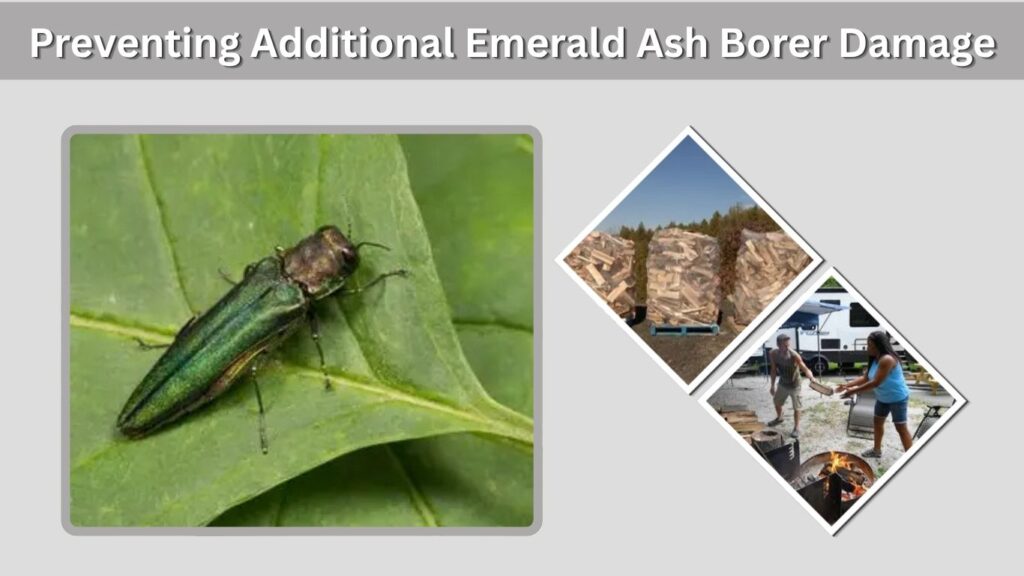
Emerald ash borers can spread naturally, but people often move them much greater distances through infested wood.
To reduce their spread:
- Do not transport untreated ash firewood.
- Buy firewood near the location where it will be burned.
- Follow local firewood and quarantine regulations.
- Dispose of infested ash wood properly.
- Inspect nearby ash trees regularly.
- Avoid storing ash logs for long periods.
- Plant several different tree species when replacing ash trees.
Planting a diverse selection of trees reduces the risk that one future pest will destroy an entire landscape.
FAQs
What is the first sign of emerald ash borer damage?
The first visible sign is often thinning foliage in the upper canopy. Small D-shaped exit holes, bark splitting, and increased woodpecker activity may appear later. Because early infestations often begin high in the tree, symptoms can remain unnoticed for several years.
What does emerald ash borer damage look like under the bark?
Under the bark, emerald ash borer larvae create winding S-shaped galleries. These tunnels become wider as the larvae grow and may contain sawdust-like waste. Heavy gallery formation disrupts the tissues responsible for carrying nutrients through the tree.
Does bark splitting always mean emerald ash borer damage?
No. Bark splitting can result from frost, sunscald, drought, rapid growth, or mechanical injury. Emerald ash borer damage is more likely when bark splitting occurs with D-shaped holes, S-shaped galleries, canopy thinning, and woodpecker feeding.
How much canopy loss is too much for treatment?
Treatment success decreases as canopy loss increases. Trees with limited dieback may respond well, while those that have lost around half or more of their canopy often have extensive internal damage. A qualified arborist should evaluate the tree before treatment.
Are emerald ash borer-damaged trees dangerous?
Yes. Severely damaged or dead ash trees can become brittle and drop branches unexpectedly. Their trunks may also fail as internal damage progresses. Trees near homes, driveways, sidewalks, roads, or power lines should be evaluated and removed promptly when necessary.