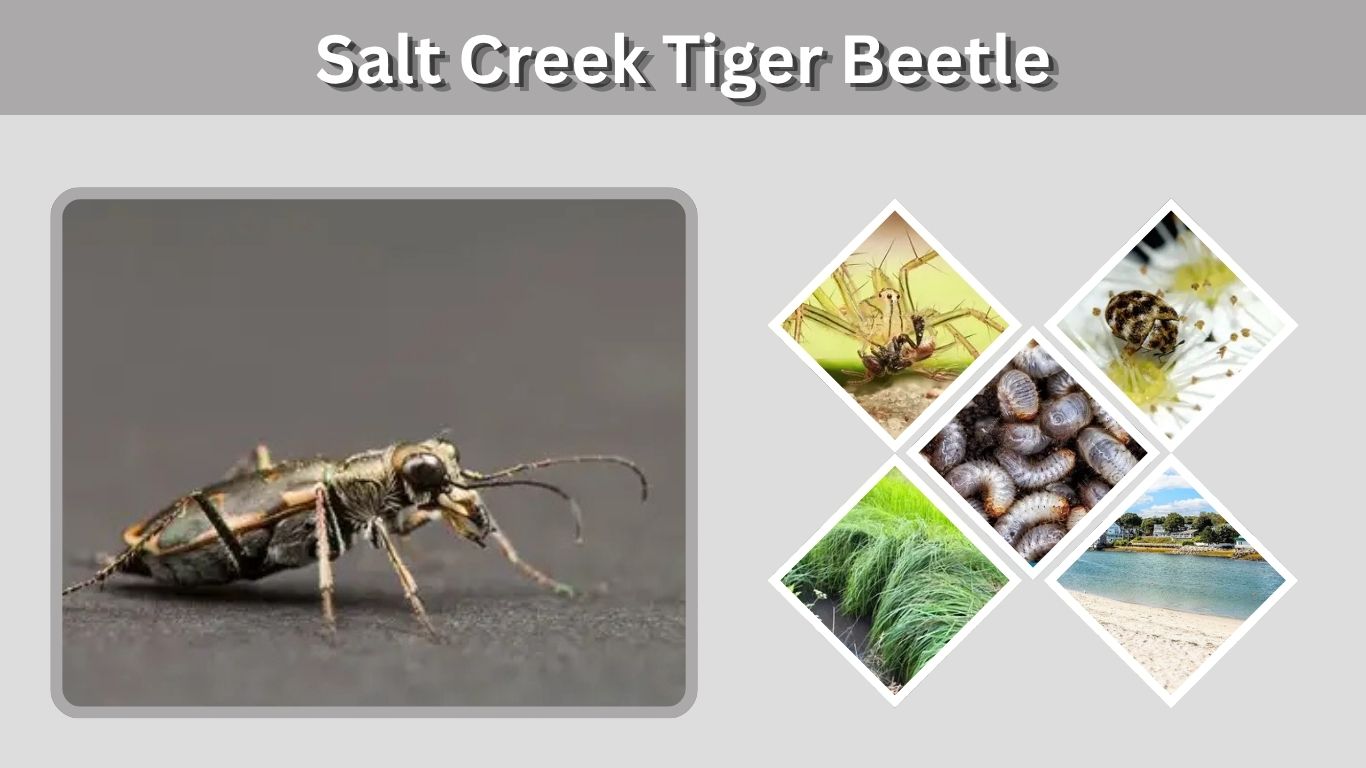
The Salt Creek tiger beetle is one of the rarest insects in North America. This tiny, fast-moving predator survives only in a few saline wetlands near Lincoln, Nebraska. Its metallic body, pale markings, large eyes, and powerful jaws make it an impressive hunter, but its highly specialized habitat has left it vulnerable to development and environmental change. The beetle is federally listed as endangered, and conservationists are restoring wetlands, raising beetles in controlled facilities, and releasing them into protected areas to prevent extinction.
What Is a Salt Creek Tiger Beetle?
The Salt Creek tiger beetle is a subspecies of tiger beetle adapted to Nebraska’s inland saline wetlands. Its commonly accepted scientific name is Cicindela nevadica lincolniana, although it may also be classified as Ellipsoptera nevadica lincolniana in newer taxonomic treatments.
It belongs to the ground beetle family, Carabidae, and the tiger beetle subfamily, Cicindelinae. Like other tiger beetles, it is an active predator that runs rapidly across open ground and captures prey with curved mandibles.
The beetle was federally listed as endangered in 2005 because of its extremely small population, restricted range, and continuing habitat loss.
Salt Creek Tiger Beetle Identification
Adult Salt Creek tiger beetles are small, slender insects with long legs and a body designed for running across exposed mud.
Main Characteristics
- Metallic dark green, brown, or olive upper body
- Cream or pale markings along the wing covers
- Large, prominent compound eyes
- Long, thin antennae
- Six slender legs covered with fine hairs or spines
- Strong, curved jaws for catching prey
- Approximately half an inch long
- Ability to run and fly in quick bursts
The beetle’s dark green and brown coloration helps it blend into the moist, salt-encrusted mud of its habitat. Its large eyes allow it to detect small prey and approaching predators.
Where Does the Salt Creek Tiger Beetle Live?
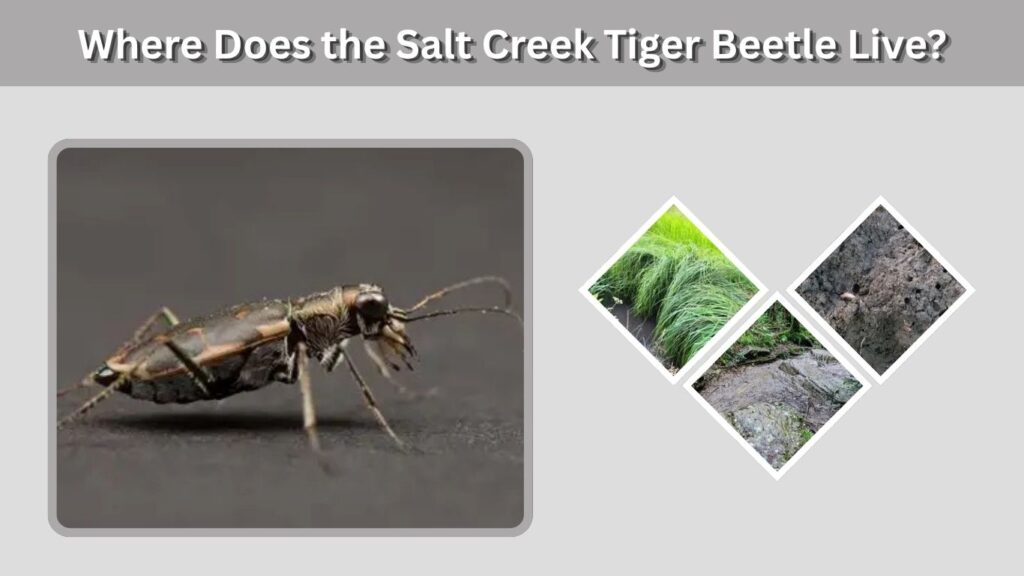
The Salt Creek tiger beetle is endemic to eastern Nebraska, meaning it occurs naturally nowhere else in the world. Its remaining populations are associated with saline wetlands and streams north of Lincoln, principally in Lancaster County. Historical records also connect it with the southern edge of Saunders County.
Saline Wetland Habitat
These wetlands are salty because groundwater passes through underground salt deposits before rising to the surface. When the water evaporates, salt accumulates on the exposed soil.
The beetles depend on habitat containing:
- Moist, salty mudflats
- Sparsely vegetated stream banks
- Exposed ground for hunting
- Stable soil for larval burrows
- Natural groundwater movement
- Suitable moisture during breeding and development
They generally cannot survive in heavily vegetated freshwater marshes or dry upland environments. Their dependence on a specific combination of salinity, moisture, and exposed soil is one reason their distribution is so limited.
What Does the Salt Creek Tiger Beetle Eat?
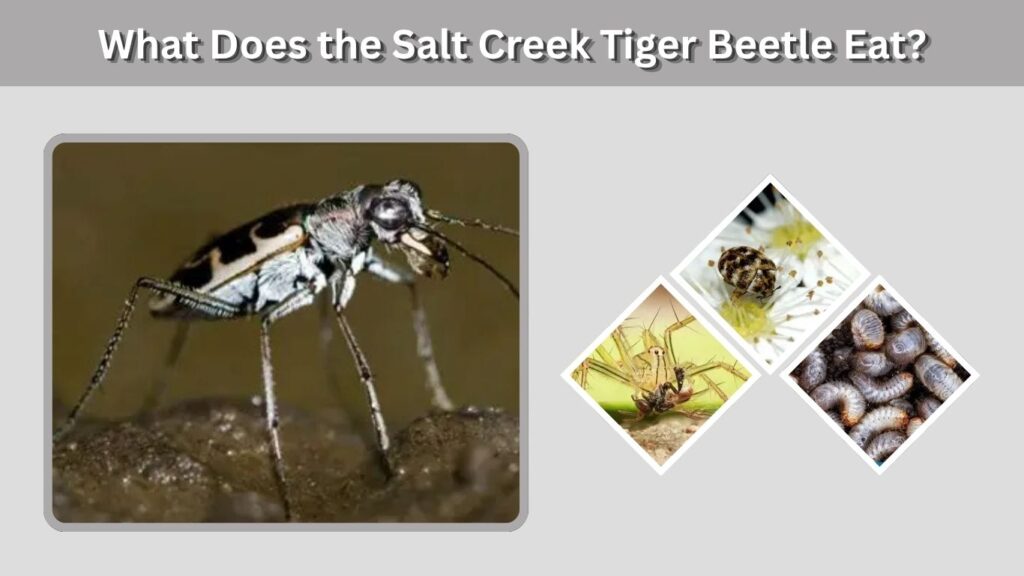
Salt Creek tiger beetles are predators during both their adult and larval stages. Adults actively chase small invertebrates across the surface of saline mudflats.
Adult Diet
Their prey may include:
- Small flies
- Ants
- Springtails
- Tiny beetles
- Spiders
- Insect larvae
- Other small wetland invertebrates
Tiger beetles are named for their aggressive hunting behavior. Adults move quickly, stop to locate prey, and then rush forward. Their large mandibles allow them to seize animals that may be nearly as large as themselves.
Larval Diet
Larvae are also predators, but they hunt from permanent burrows. A larva waits near the opening with its head and jaws positioned at the surface. When a small insect passes, it lunges outward, captures the animal, and pulls it underground.
Salt Creek Tiger Beetle Life Cycle
The beetle undergoes complete metamorphosis with four stages: egg, larva, pupa, and adult.
Eggs and Larvae
Females deposit eggs in moist saline soil. After hatching, each larva digs a narrow vertical burrow. Hook-like structures on its body help anchor it inside the tunnel when struggling prey attempts to escape.
The larva grows through several developmental stages. It may spend considerably more time underground than the beetle spends as an adult.
Pupation and Adult Emergence
When fully developed, the larva closes its burrow and creates a chamber where it changes into a pupa. The adult later emerges and begins hunting, mating, and dispersing across suitable habitat.
Adults are most noticeable during warm weather. They often run on open mud and may fly short distances when approached.
Why Is the Salt Creek Tiger Beetle Endangered?
The Salt Creek tiger beetle became endangered primarily because most of Nebraska’s eastern saline wetlands were destroyed, drained, or severely altered.
Estimates indicate that roughly 90 percent of the saline wetland habitat around Lincoln has disappeared since European settlement. Urban development, agriculture, road construction, drainage projects, and altered streams have reduced the remaining habitat to scattered fragments.
Habitat Loss and Fragmentation
Housing, commercial buildings, roads, and agricultural fields have replaced many former wetlands. The surviving areas are often small and separated, making it difficult for beetles to move between populations.
Changes in Water and Salinity
Urban runoff introduces freshwater and sediment into saline wetlands. This can dilute the salt concentration and encourage dense vegetation to grow over the exposed ground needed by the beetles.
Stream channelization may deepen waterways and lower nearby groundwater levels. Without consistently moist saline soil, adult feeding areas and larval burrows disappear.
Pollution and Pesticides
Pollutants and pesticide runoff may directly harm beetles or reduce the abundance of their prey. Because the population is already extremely small, the loss of even a modest number of adults or larvae can be significant.
Small Population Size
Surviving populations naturally fluctuate from year to year. A recent scientific study reported estimated abundance ranging from 93 to 374 individuals during a 17-year monitoring period, although different counts and estimates may vary according to survey methods and locations. A small population is particularly vulnerable to drought, flooding, disease, pollution, and accidental habitat destruction.
Salt Creek Tiger Beetle Critical Habitat
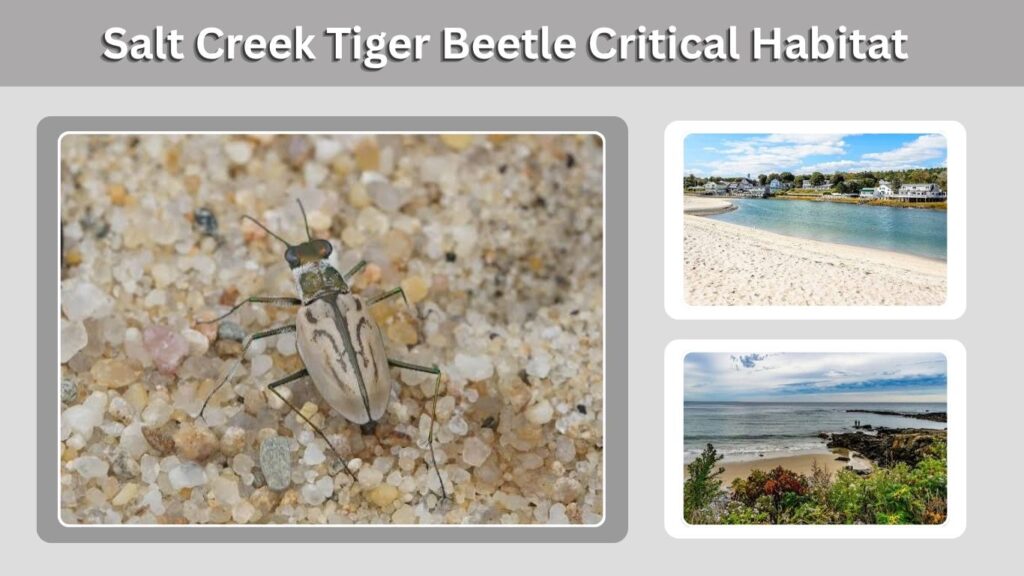
Critical habitat consists of areas considered essential to the beetle’s conservation. The U.S. Fish and Wildlife Service designated critical habitat in 2010, focusing protection on saline wetlands and stream corridors in Lancaster County.
Critical habitat designation does not automatically close private property or prohibit every development activity. It requires federal agencies to consider whether projects they fund, authorize, or carry out could destroy or seriously alter essential habitat. At the time of designation, the beetle was described as surviving in only a few populations along a single drainage system.
Conservation and Recovery Efforts
Protecting the Salt Creek tiger beetle requires preserving the complete saline wetland ecosystem rather than focusing only on individual insects.
Habitat Restoration
Conservation teams remove excessive vegetation, reconnect wetlands with groundwater, restore stream banks, and create exposed saline mudflats. Protected land can also provide space for populations to expand and move between sites.
Captive Breeding and Release
Omaha’s Henry Doorly Zoo and other partners have participated in captive propagation programs. Eggs and larvae are raised under carefully managed conditions, and resulting beetles are released into suitable restored habitat. The zoo reports that its teams work with local agencies to monitor, breed, and return beetles to Nebraska wetlands.
Population Monitoring
Researchers count adults, inspect larval burrows, evaluate vegetation, and measure habitat conditions. This information helps managers decide where restoration and releases are most likely to succeed.
The federal recovery plan also emphasizes protecting existing populations, increasing suitable habitat, establishing additional populations, and maintaining long-term monitoring.
Why Is the Salt Creek Tiger Beetle Important?
The beetle helps control populations of small insects and contributes to the saline wetland food web. It may also serve as an indicator of habitat quality because it requires exposed, moist, naturally functioning saline ground.
Protecting the beetle benefits rare plants, birds, amphibians, and other invertebrates that depend on the same wetlands. Conservation therefore preserves not only one insect but also one of Nebraska’s rarest natural ecosystems.
FAQs
Is the Salt Creek tiger beetle endangered?
Yes. The Salt Creek tiger beetle has been federally listed as endangered since 2005. It is also considered endangered in Nebraska because it survives in only a few small saline wetland areas near Lincoln.
Where can Salt Creek tiger beetles be found?
They occur naturally only in eastern Nebraska. Remaining wild populations are concentrated in saline wetlands and stream corridors north of Lincoln, mainly within Lancaster County.
Can a Salt Creek tiger beetle bite people?
It has strong jaws for capturing small animals and might pinch if handled. However, it does not attack people, transmit known diseases, or infest homes. Endangered beetles should never be captured or disturbed.
What does a Salt Creek tiger beetle need to survive?
It needs moist, salty soil, open mudflats, appropriate groundwater conditions, abundant insect prey, and undisturbed places for larval burrows. Excessive vegetation, freshwater runoff, pollution, and development can make habitat unsuitable.
How many Salt Creek tiger beetles remain?
The exact number changes annually and depends on survey methods. Recent research indicates that monitored abundance has sometimes fluctuated between fewer than 100 and several hundred individuals, confirming that the wild population remains extremely small.