
The bombardier beetle is a ground-dwelling predator famous for firing a hot, irritating chemical spray from the tip of its abdomen. When threatened, the beetle triggers a rapid reaction inside specialized abdominal chambers and aims the discharge toward its attacker. The spray may be released in quick pulses accompanied by an audible popping sound. Bombardier beetles are not aggressive toward people, but handling one can result in painful skin or eye irritation.
Bombardier Beetle Quick Facts
“Bombardier beetle” does not refer to one species. It describes numerous ground beetles in the family Carabidae that possess related chemical-defense systems.
| Feature | Information |
| Family | Carabidae |
| Common groups | Brachinini and several related tribes |
| Typical size | Varies; many are under 1 inch |
| Color | Black, brown, orange, yellow or patterned |
| Diet | Insects, larvae, eggs and other small animals |
| Habitat | Soil, leaf litter, riverbanks and grasslands |
| Activity | Mainly nocturnal |
| Defense | Hot, quinone-rich chemical spray |
| Spray temperature | Around 100°C in studied Brachinus species |
| Human danger | Usually limited to painful irritation or burns |
One well-studied South American species, Pheropsophus aequinoctialis, measures approximately 15–20 millimetres long. However, appearance and size differ considerably among species.
What Does a Bombardier Beetle Look Like?
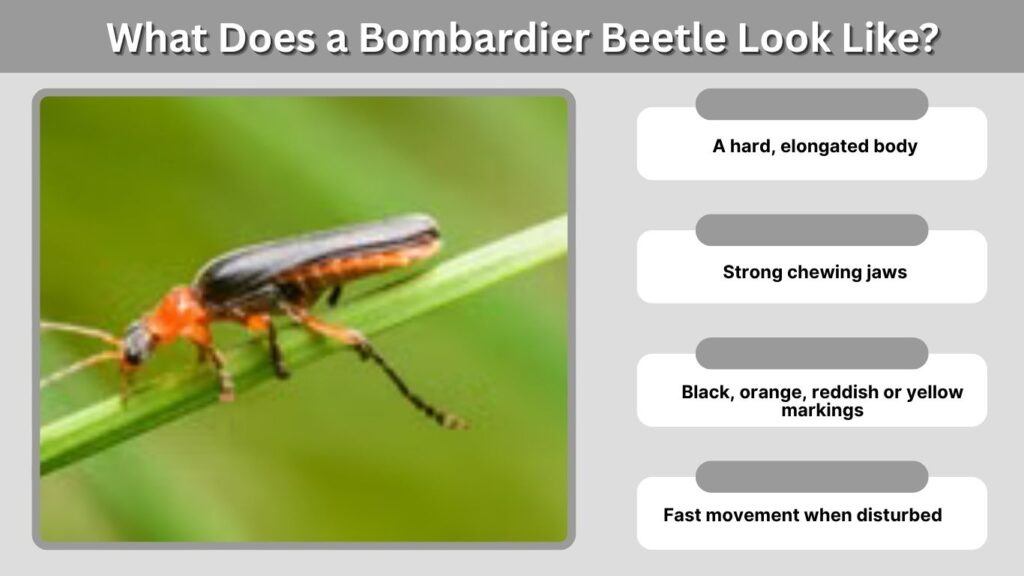
Bombardier beetles have the general appearance of predatory ground beetles. Their bodies are elongated or oval, with hardened wing covers, long running legs and threadlike antennae.
Identification Features
Common characteristics include:
- A hard, elongated body
- Long legs adapted for running
- Strong chewing jaws
- Narrower thorax than abdomen
- Grooved or patterned wing covers
- Black, orange, reddish or yellow markings
- Fast movement when disturbed
- A flexible abdominal tip used to aim the spray
Many species have an orange or reddish head and thorax with dark wing covers. Others display yellow-and-black patterns or are almost completely dark.
Ground beetles usually hide during daylight beneath stones, logs, mulch and leaf litter. They emerge after dark to hunt on the soil surface or among low vegetation.
How Does a Bombardier Beetle Protect Itself?
The beetle’s defense system is located in paired glands near the rear of its abdomen. A reservoir holds hydroquinones and hydrogen peroxide, while a separate hardened reaction chamber contains enzymes that rapidly activate the chemical reaction.
The Chemical Reaction
When danger approaches, the beetle allows a small amount of stored material into the reaction chamber. Enzymes accelerate the breakdown and oxidation of the chemicals, producing:
- Quinones
- Oxygen
- Water vapor
- Pressure
- Considerable heat
The resulting mixture is expelled as a hot, irritating jet. Research using high-speed synchrotron X-ray imaging showed that specialized valves and flexible structures repeatedly interrupt and restart the reaction, creating rapid pulses rather than one uncontrolled discharge.
Is the Spray Really Boiling?
Classic experiments on Brachinus found that the defensive discharge reached approximately 100°C, the boiling point of water under ordinary atmospheric conditions. The heat, pressure and irritating quinones make it highly effective against small predators.
The beetle does not breathe fire, and the discharge does not contain flames. Descriptions of a “fiery” or “explosive” beetle refer to the hot exothermic reaction and audible popping sound.
How Does the Beetle Avoid Injuring Itself?
The reaction occurs inside a reinforced chamber rather than throughout the body. Valves regulate how much material enters, while repeated pressure changes help stop and restart the process.
This pulsing system prevents pressure from increasing continuously and allows the beetle to release a controlled series of blasts. The hot liquid is directed rapidly outward through a movable abdominal opening.
Can a Bombardier Beetle Aim Its Spray?
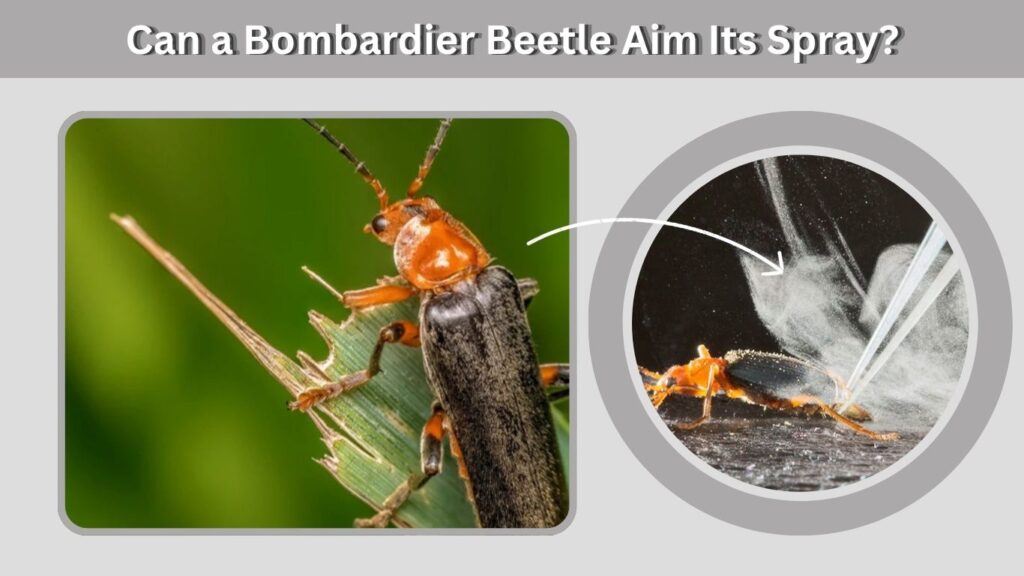
Yes. Some species can rotate or bend the abdominal tip to aim in almost any direction. An African species studied with high-speed photography could direct its spray toward different parts of its body, including attackers approaching from the side or front.
This ability is valuable when ants, spiders, frogs or other predators attack at close range. Research has shown that the chemical blast can discourage mantises and frogs. Some beetles swallowed by toads have even sprayed inside the predator, causing it to vomit them back up.
Are Bombardier Beetles Dangerous to Humans?
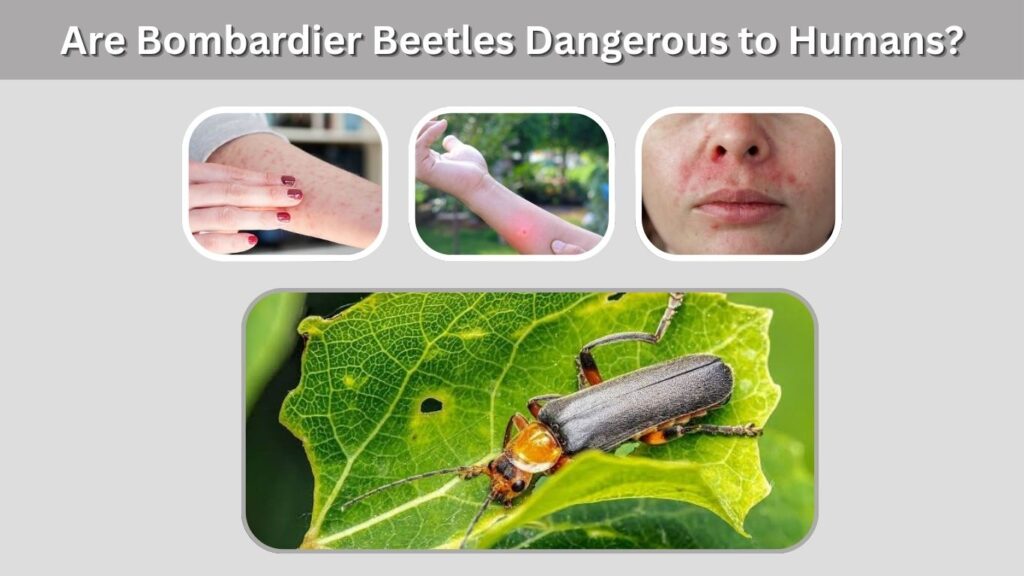
Bombardier beetles do not chase or deliberately attack people. They spray only when threatened, trapped or handled.
Contact may cause:
- Immediate burning or stinging
- Redness and skin irritation
- Temporary discoloration
- A small heat-related burn
- Contact dermatitis
- More serious irritation if the eyes are exposed
Rare medical reports include dermatitis and eye injury. The risk is greatest when someone picks up the beetle and holds it close to the face.
What to Do After Being Sprayed
Wash affected skin promptly with plenty of soap and water. Remove contaminated clothing and avoid rubbing the area.
When spray enters an eye, immediately flush it with a gentle stream of clean water for at least 15 minutes. Remove contact lenses if they do not wash out, and seek medical attention promptly, especially when pain, redness or blurred vision persists.
Do Bombardier Beetles Bite?
Bombardier beetles have strong jaws for capturing prey, but they do not normally bite people. A beetle trapped against the skin might pinch defensively.
The chemical spray is a much more important defense than the jaws. Avoid handling the insect with bare fingers. Use a container and a piece of stiff paper to move it safely.
Where Do Bombardier Beetles Live?
Bombardier beetles occur in numerous warm, temperate and tropical regions. Different species occupy different environments, including:
- Grasslands
- Forest edges
- Agricultural fields
- Riverbanks and sandbars
- Wetlands
- Gardens
- Open woodland
- Soil beside freshwater
Many prefer moist locations where they can shelter beneath stones, bark, logs and ground debris. Some species gather in large groups under shared daytime shelters before emerging at night. Arizona research documented several Brachinus species resting together beneath objects in riparian habitats.
The South American Pheropsophus aequinoctialis is associated with riverbanks, sandbars and moist soil near freshwater.
What Do Bombardier Beetles Eat?
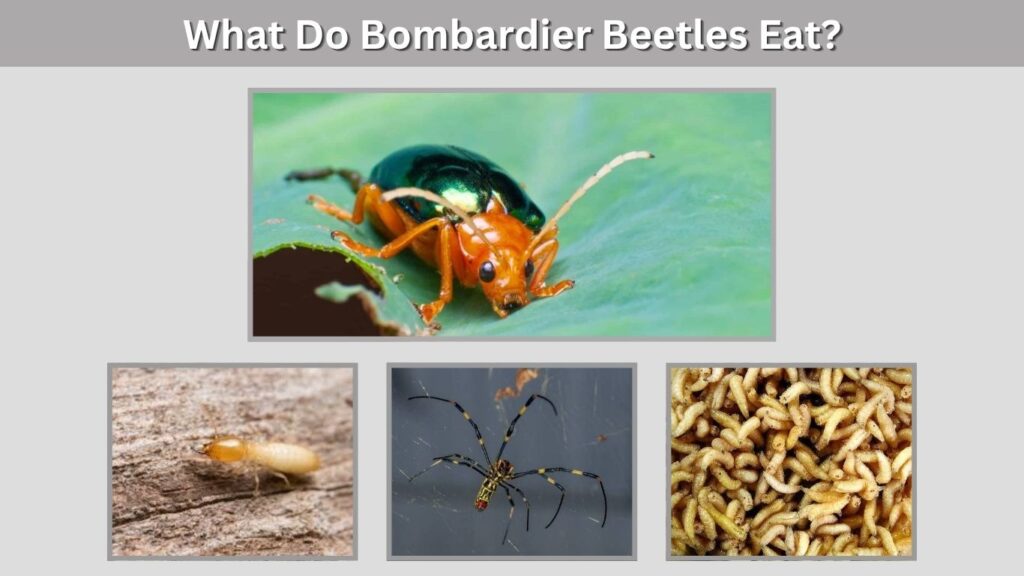
Adults are generally predators or scavengers. Depending on the species, they may eat:
- Small insects
- Caterpillars
- Insect larvae
- Eggs
- Worms
- Other ground-dwelling invertebrates
- Dead animal material
- Occasional plant or fruit material
Ground beetles can be beneficial in gardens and agricultural areas because many consume crop-damaging insects.
Larval diets may be highly specialized. For example, larvae of Pheropsophus aequinoctialis enter mole-cricket egg chambers and feed almost entirely on their eggs. One developing larva may consume dozens of eggs before pupating.
Bombardier Beetle Life Cycle
Bombardier beetles undergo complete metamorphosis:
- Egg
- Larva
- Pupa
- Adult
Females generally place eggs in soil or protected damp areas. The larvae are elongated predators with visible legs, large heads and curved jaws. After completing several growth stages, a larva forms a chamber in the soil and becomes a pupa.
Development time varies considerably among species and climates. Ground beetles may require several months to more than one year to complete their development, and some adults live for two years or longer.
False Bombardier Beetle vs. True Bombardier Beetle
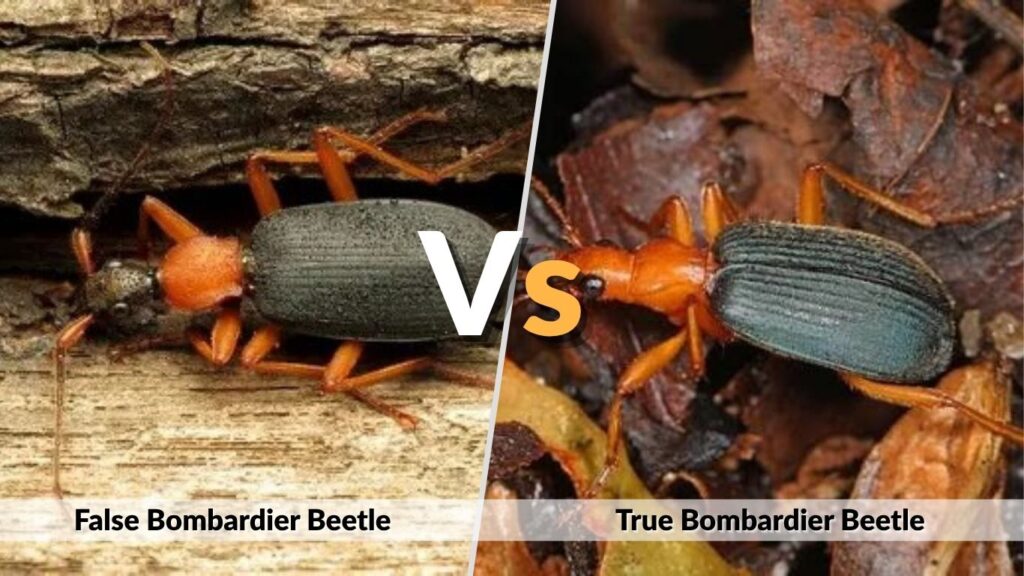
False bombardier beetles belong mainly to the genus Galerita. They resemble true bombardier beetles but have a less powerful chemical-defense system.
| Feature | True bombardier beetle | False bombardier beetle |
| Common group | Often Brachinus or related tribes | Usually Galerita |
| Head color | Frequently reddish or orange | Commonly black |
| Thorax | Often orange or reddish | Often orange or reddish |
| Spray | Hot, pulsed, quinone-rich discharge | Cooler defensive secretion |
| Sound | May produce audible pops | No explosive pulse-jet |
| Diet | Predatory or scavenging | Predatory, especially caterpillars |
A useful North American field clue is that many Brachinus species have reddish heads, whereas Galerita species have black heads. False bombardier beetles are commonly ¾–1 inch long and are beneficial predators.
Bombardier Beetle in the House
A bombardier beetle found indoors has usually wandered through an open door, ground-level window or foundation gap. It does not damage wood, clothing or stored food and is unlikely to reproduce indoors.
Place a container over it, slide paper underneath and release it outside in a sheltered area. Avoid squeezing it, since pressure may trigger its defensive spray.
FAQs
Can a bombardier beetle kill a human?
A bombardier beetle is not considered capable of killing a healthy person under normal circumstances. Its spray can cause pain, irritation or a localized burn, with eye exposure posing the greatest concern.
What acid does a bombardier beetle spray?
The spray is not simply an acid. It is a hot mixture rich in irritating quinones, produced through reactions involving hydroquinones and hydrogen peroxide inside a specialized chamber.
How hot is bombardier beetle spray?
In well-studied Brachinus beetles, the discharge reaches approximately 100°C. Temperature and spray characteristics may vary among the many species called bombardier beetles.
How many times can a bombardier beetle spray?
A beetle can produce multiple rapid pulses during one defensive event and may discharge again if the threat continues. The exact number varies with species, body condition and how much chemical material remains.
Should I kill a bombardier beetle?
Usually not. Bombardier beetles are predators that may help control other insects. When one enters a house, it can generally be captured in a container and released outside.