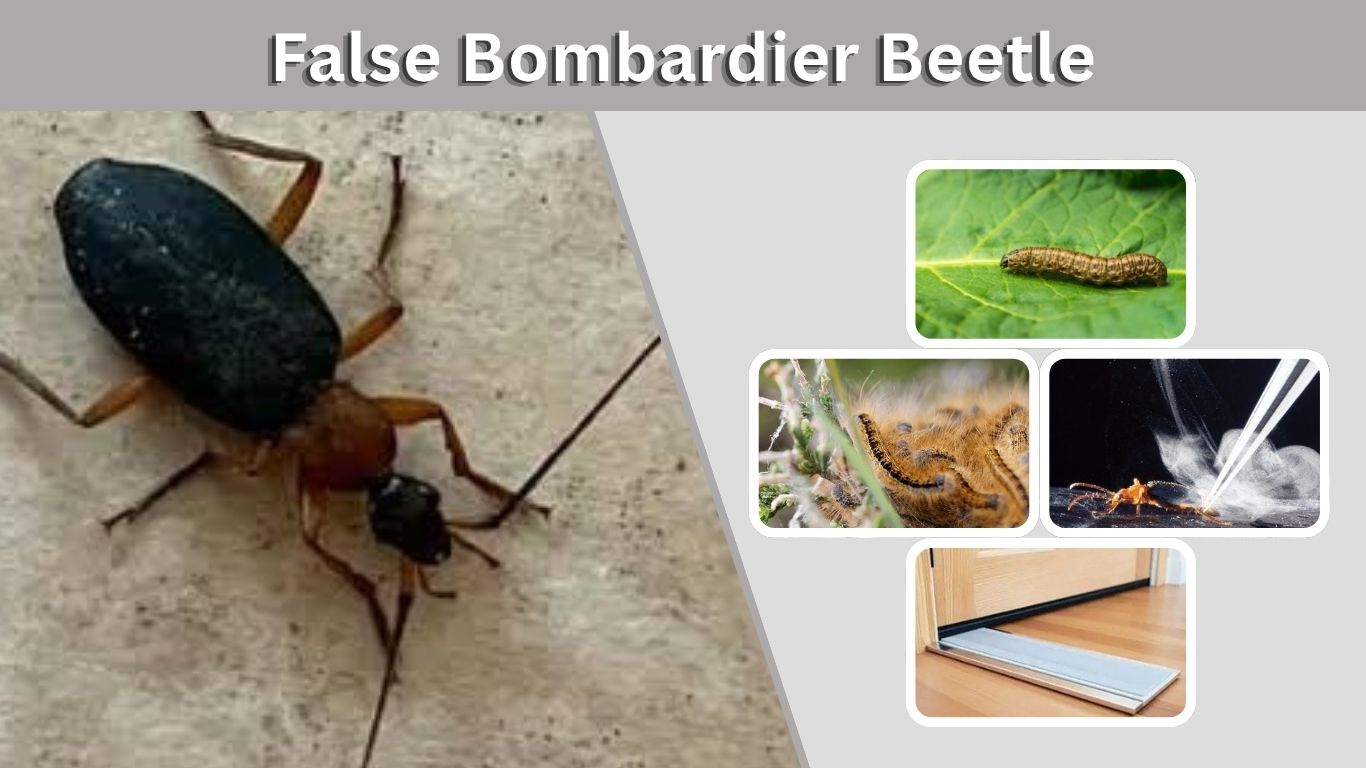
The false bombardier beetle is a large, fast-moving ground beetle commonly recognized by its black head, orange-red thorax and dark wing covers. These beetles belong to the genus Galerita and are beneficial predators of caterpillars and other insects. They sometimes wander into houses, basements and garages, but they do not infest buildings or damage household materials. Although they resemble true bombardier beetles, their chemical defense is less powerful and does not produce the same boiling, explosive spray.
False Bombardier Beetle Quick Facts
False bombardier beetles are members of the ground beetle family Carabidae. Galerita bicolor and Galerita janus are among the species commonly encountered in eastern North America.
| Feature | Information |
| Scientific name | Galerita species |
| Common species | Galerita bicolor and Galerita janus |
| Family | Carabidae |
| Adult size | Approximately 5/8–1 inch |
| Color | Black head and wings with orange-red thorax |
| Diet | Caterpillars and other small insects |
| Activity | Mainly nocturnal |
| Habitat | Leaf litter, woodland, fields and gardens |
| Human danger | Generally harmless |
| Indoor damage | None |
What Does a False Bombardier Beetle Look Like?
The false bombardier beetle has an elongated body, long running legs and large jaws. Its distinctive two-tone coloration makes it easier to recognize than many other ground beetles.
Identification Features
Look for the following characteristics:
- A glossy black head
- An orange or reddish-brown thorax
- Dark black, grooved wing covers
- Orange, reddish or brown legs
- Long, threadlike antennae
- A narrow neck behind the head
- An elongated body measuring roughly 17–25 millimetres
- Quick running behavior when disturbed
North Carolina State Extension describes false bombardier beetles as having a black head and wing covers, a red pronotum and legs, and a body length of approximately 17–22 millimetres. Some individuals may approach one inch long.
Can False Bombardier Beetles Fly?
False bombardier beetles have hardened wing covers with functional flying wings underneath. However, like many ground beetles, they are more commonly seen running rapidly across soil, floors or walls than flying.
Ground beetles are mainly nocturnal and may be attracted to outdoor lights. Their movement near illuminated doors and windows sometimes leads them indoors.
False Bombardier Beetle vs. True Bombardier Beetle
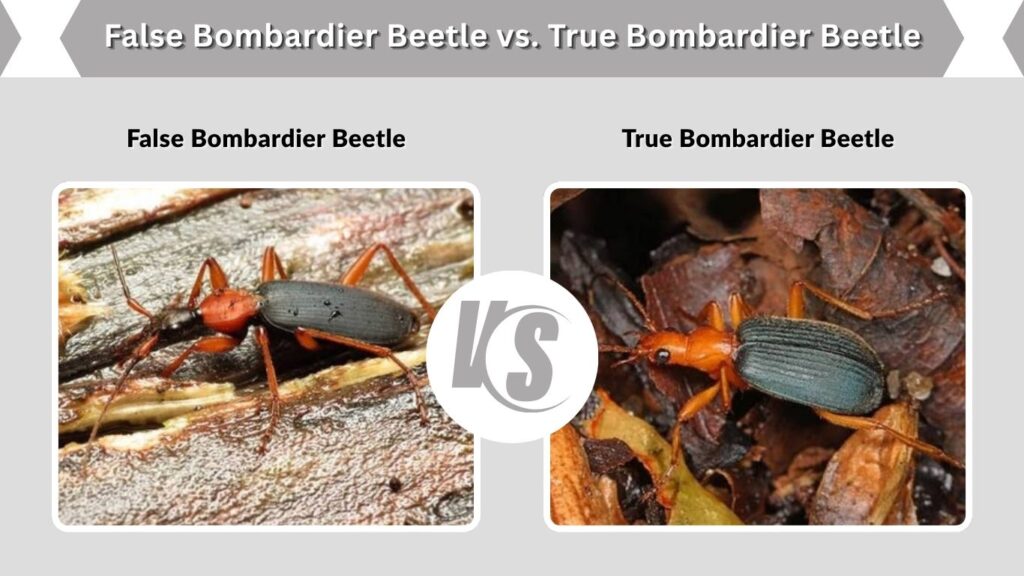
The false bombardier beetle received its name because its shape and coloration resemble those of true bombardier beetles. Both belong to the ground beetle family, but their defensive systems are different.
| Feature | False bombardier beetle | True bombardier beetle |
| Common group | Galerita species | Often tribe Brachinini |
| Head | Usually black | Frequently reddish or orange |
| Thorax | Orange or reddish | Often orange or reddish |
| Defense | Odorous chemical secretion | Hot, rapidly pulsed spray |
| Spray temperature | Not heated to boiling | Can approach 100°C |
| Sound | No explosive popping | May produce audible pops |
| Human risk | Mild irritation or pinching | Hot spray can cause pain |
False bombardier beetles release a defensive secretion containing concentrated formic acid and other compounds. They can aim the secretion toward a threat, but they lack the specialized pulse-jet system that makes the true bombardier beetle’s spray extremely hot.
Do False Bombardier Beetles Spray?
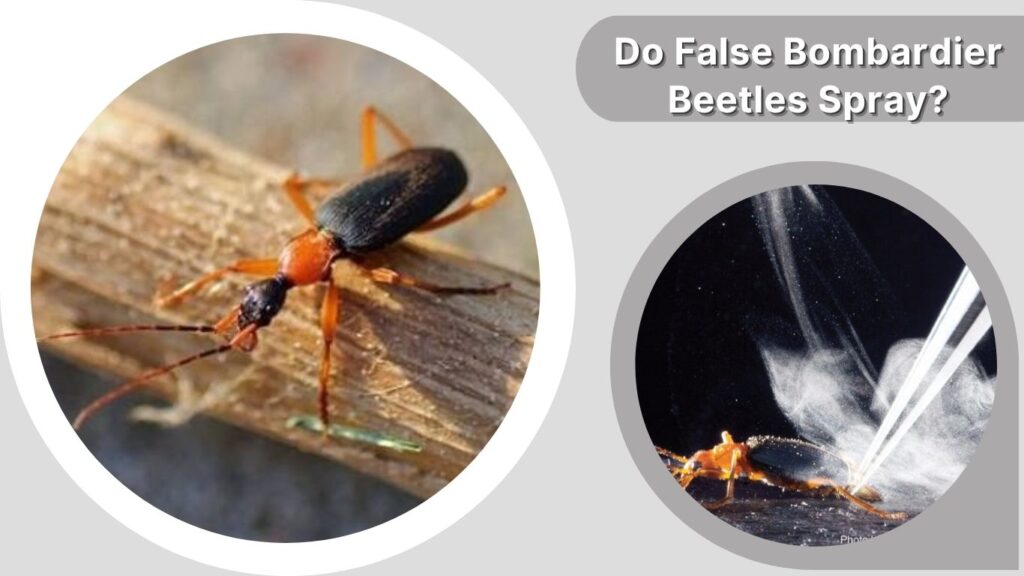
Yes. A threatened false bombardier beetle may release a strong-smelling defensive liquid from glands near the tip of its abdomen. This secretion helps discourage spiders, birds, mammals and other predators.
The spray is not boiling and does not create the explosive reaction associated with true bombardier beetles. However, it may have a sharp odor and can potentially irritate sensitive skin, eyes or the mouth. Avoid squeezing or handling the beetle close to your face.
What Does the Beetle Smell Like?
People describe the odor in different ways, including acidic, vinegary, smoky or unpleasantly chemical. The smell comes from defensive compounds rather than waste or decaying material.
Crushing the beetle can release more odor than simply allowing it to walk into a container. Capture and release is therefore preferable to squashing it indoors.
Do False Bombardier Beetles Bite?
False bombardier beetles do not feed on blood and do not actively pursue people. They have strong jaws for capturing insects, however, and may pinch when trapped against the skin or handled roughly.
A defensive pinch may cause brief pain but is not normally medically significant. Ground beetles are considered harmless to people, although mishandled individuals can occasionally pinch the skin.
What to Do After a Pinch or Spray
Wash the affected skin with soap and water. Avoid rubbing the eyes until your hands have been cleaned.
When defensive liquid enters an eye, rinse it immediately with clean, lukewarm water for at least 15 minutes. Seek medical advice when burning, redness, swelling or vision changes continue.
Are False Bombardier Beetles Poisonous?
False bombardier beetles are not poisonous, venomous or dangerous household pests. They do not inject toxins, spread through beds or feed on humans and pets.
Their defensive secretion is intended to repel predators rather than cause serious injury. Pets should still be prevented from chewing the beetles because the secretion may irritate the mouth or cause drooling.
False bombardier beetles do not contain cantharidin, the blistering chemical associated with blister beetles. The two groups have different appearances, behaviors and defensive systems.
What Do False Bombardier Beetles Eat?
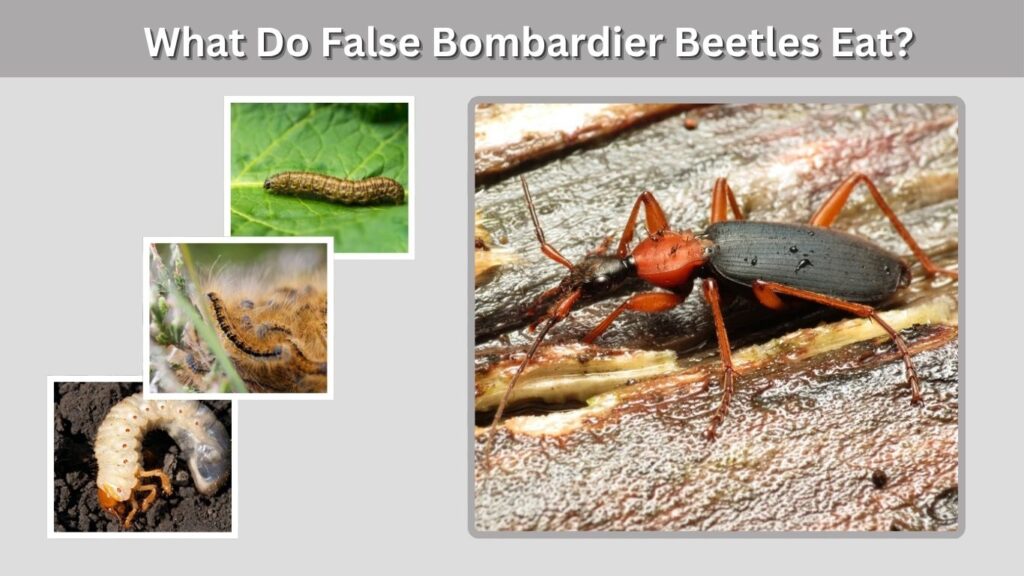
False bombardier beetles are primarily predators. They hunt insects and other small invertebrates on the soil surface and within leaf litter.
Common Foods
Their diet may include:
- Caterpillars
- Cutworms
- Moth larvae
- Beetle larvae
- Small ground-dwelling insects
- Insect eggs
- Other soft-bodied invertebrates
- Occasional grass seeds
The University of Minnesota identifies false bombardier beetles as important predators, particularly of caterpillars. North Carolina State Extension describes their feeding habits as predatory or omnivorous, including caterpillars and some grass seeds.
Because they consume potential plant pests, finding these beetles outdoors is generally beneficial. They do not normally damage flowers, vegetables, lawns or trees.
False Bombardier Beetle Larvae
False bombardier beetle larvae are elongated, dark and segmented. They have six legs near the front of the body, a hardened head and strong jaws for capturing prey.
The larvae live primarily in soil, under stones or within decaying leaves. Like adults, they are predators of smaller insects and larvae. They should not be confused with soft, curved white grubs that feed on plant roots.
False bombardier beetles undergo complete metamorphosis through four stages:
- Egg
- Larva
- Pupa
- Adult beetle
The eggs and pupae remain protected in soil or other sheltered ground-level locations. Adults emerge and continue hunting on the surface.
Where Do False Bombardier Beetles Live?
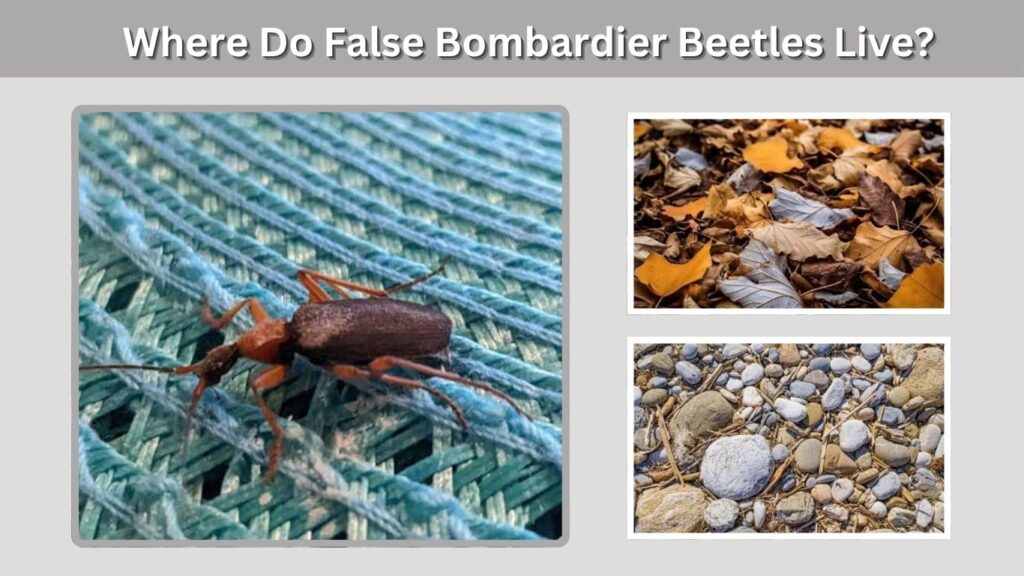
These beetles commonly inhabit wooded areas, fields, gardens, meadows and agricultural landscapes. During the day, they hide beneath protective cover and emerge after dark to hunt.
Typical hiding places include:
- Fallen leaves
- Stones
- Logs and loose bark
- Garden mulch
- Boards and outdoor debris
- Compost areas
- Brush piles
- Dense vegetation
False bombardier beetles are generally found on the ground beneath leaves and other cover during spring and summer. They may also remain active into autumn in warmer regions.
Why Is a False Bombardier Beetle in My House?
A false bombardier beetle usually enters a house accidentally while searching for shelter or prey. It may pass through gaps beneath doors, basement windows, foundation cracks or spaces around utility lines.
Indoor sightings are commonest in:
- Basements
- Garages
- Ground-floor rooms
- Bathrooms
- Utility rooms
- Attics accessible through exterior gaps
- Areas beneath boxes or stored objects
University of Minnesota Extension notes that false bombardier beetles may be found throughout homes during spring and summer, especially in August. They do not harm people or property and are primarily a temporary nuisance.
Finding one beetle does not indicate an infestation. Ground beetles are short-lived indoors and generally cannot reproduce successfully inside buildings.
How to Get Rid of False Bombardier Beetles
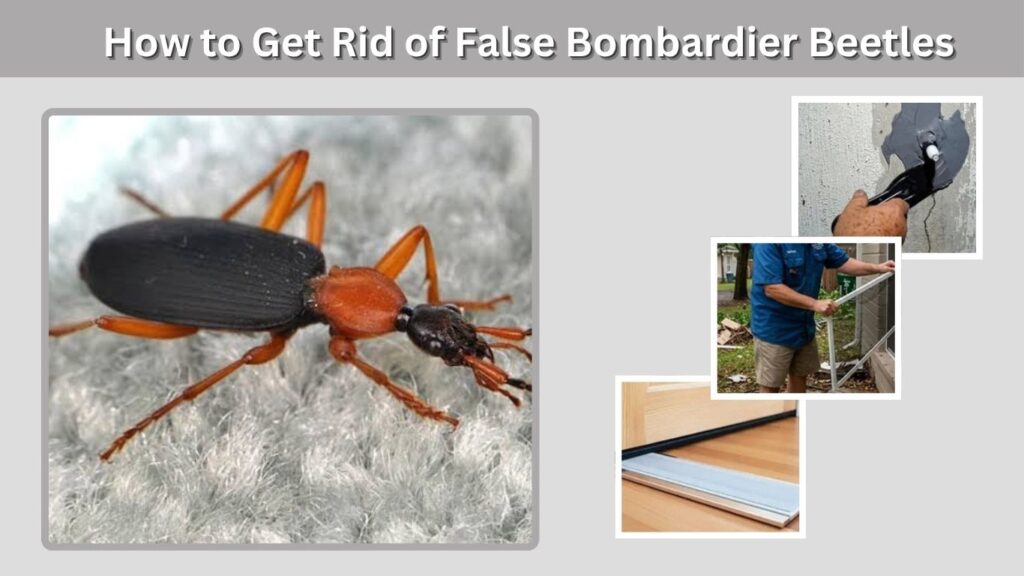
Chemical treatment is rarely necessary. Place a cup or container over the beetle, slide stiff paper underneath and release it outside beneath vegetation or leaf litter.
For repeated indoor sightings:
- Install door sweeps
- Repair damaged window screens
- Seal foundation cracks
- Close gaps around pipes and cables
- Remove leaves and boards beside the house
- Keep firewood away from exterior walls
- Reduce bright outdoor lighting
- Trim grass and weeds around the foundation
Vacuuming can remove several beetles, but empty the vacuum outdoors because disturbed beetles may release their defensive odor. Pesticides are generally unnecessary when only a few ground beetles enter.
FAQs
Are false bombardier beetles dangerous to humans?
No. They are generally harmless and do not attack people. A mishandled beetle may pinch or release an irritating, foul-smelling secretion, but serious injury is unlikely.
Can false bombardier beetles burn your skin?
Their defensive secretion may produce temporary irritation or a mild burning sensation, especially on sensitive skin. However, it is not heated to the near-boiling temperature produced by true bombardier beetles.
Do false bombardier beetles infest houses?
No. They normally live outdoors and enter buildings accidentally. They do not damage structures, stored food, clothing or furniture and generally cannot establish permanent indoor populations.
Why am I finding false bombardier beetles in my basement?
Basements provide cool, dark and sometimes damp hiding places. The beetles may enter through foundation cracks, door gaps or basement windows while searching for shelter.
Should I kill a false bombardier beetle?
Usually not. It is a beneficial predator that consumes caterpillars and other insects. Capture it without touching or squeezing it and release it outside in a sheltered location.