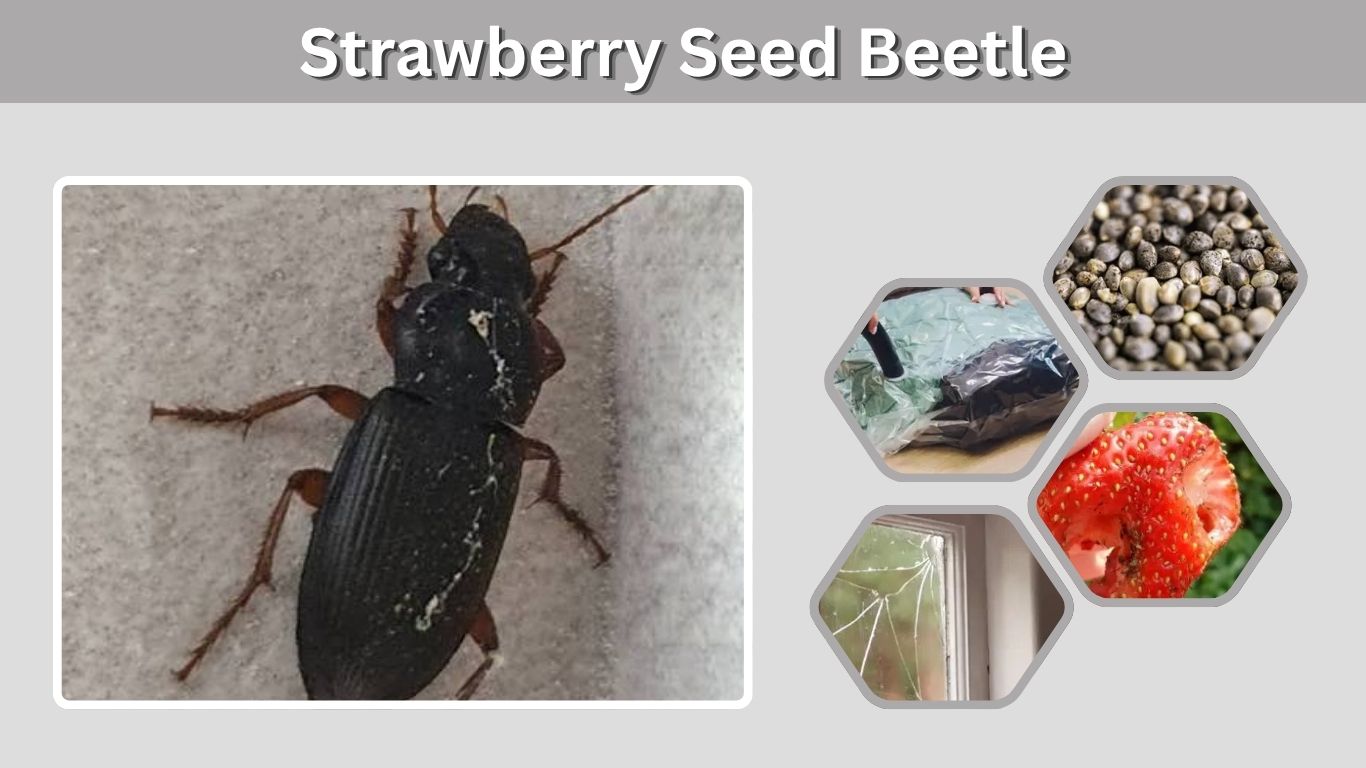
The strawberry seed beetle (Harpalus rufipes) is a dark-colored ground beetle commonly found in fields, gardens and other open habitats. It sometimes damages ripe strawberries by removing their surface seeds and surrounding flesh. Adults may also wander into houses, where their fast movement and dark bodies cause them to be mistaken for cockroaches. However, strawberry seed beetles do not normally reproduce indoors, damage buildings or infest stored food.
Strawberry Seed Beetle Overview
The strawberry seed beetle belongs to the ground beetle family Carabidae. It is also known as the strawberry ground beetle and is common and widespread in Britain. Despite its name, it does not live exclusively around strawberry plants.
| Feature | Description |
| Scientific name | Harpalus rufipes |
| Order | Coleoptera |
| Family | Carabidae |
| Adult size | Approximately 11–16 mm |
| Color | Dark brown or black |
| Legs and antennae | Reddish brown |
| Main food | Seeds, small invertebrates and strawberry seeds |
| Indoor risk | Accidental visitor |
| Bite risk | Very low |
Adults are usually active on or close to the ground. They often shelter beneath stones, logs, weeds and garden debris, particularly in open and relatively dry places.
Strawberry Seed Beetle Identification
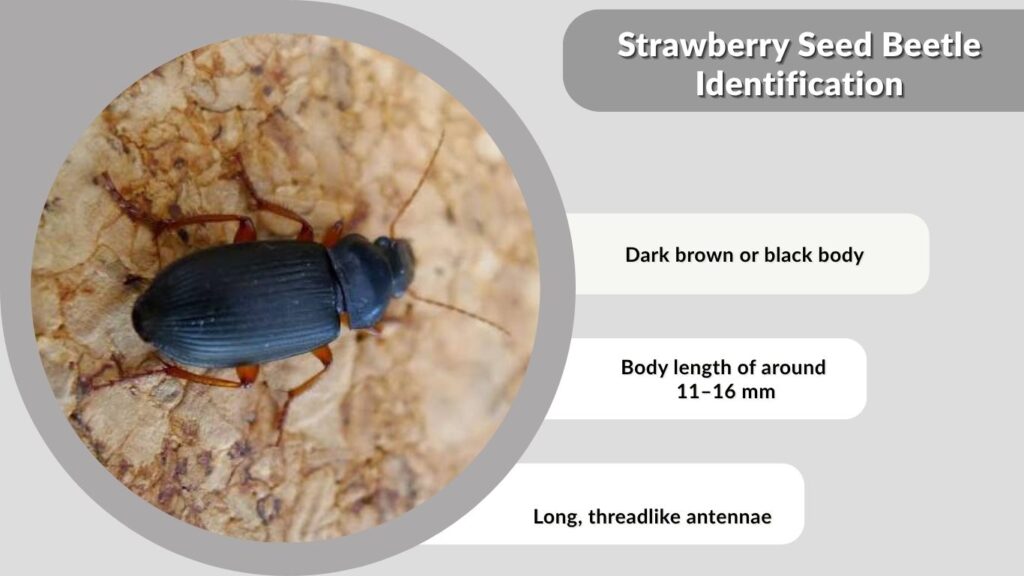
Strawberry seed beetles have the streamlined body and long legs typical of ground beetles. They are quick runners and often become active at night.
Main Identification Features
Look for the following characteristics:
- Dark brown or black body
- Body length of around 11–16 mm
- Reddish-brown legs and antennae
- Long, threadlike antennae
- Hardened wing covers with visible grooves
- Fine, short golden hairs on the wing covers
- Narrower front section and rounded abdomen
- Long legs adapted for running
The golden hairs can make the wing covers appear slightly dull rather than completely glossy. Identification can still be difficult because several related ground beetles have similar shapes and colors.
Male vs Female Strawberry Seed Beetles
Male and female strawberry seed beetles look very similar. Both have dark bodies, reddish legs and grooved wing covers. Females may appear slightly broader when carrying eggs, but body shape alone is not a dependable way to determine sex.
Accurate separation generally requires close examination of the legs, abdominal tip or reproductive structures. For homeowners and gardeners, identifying the species is usually more useful than determining whether an individual is male or female.
Strawberry Seed Beetle vs Cockroach
A strawberry seed beetle found indoors can initially look like a small cockroach. Examining the body shape and wings should help distinguish them.
| Feature | Strawberry Seed Beetle | Cockroach |
| Body shape | Elongated and firm | Broad, oval and flattened |
| Wing covers | Hard, grooved and meet in a straight line | Softer and may overlap |
| Legs | Long but relatively slender | Spiny and spread outward |
| Head | Clearly visible from above | Often partly covered by the thorax |
| Rear appendages | No obvious pair of cerci | Usually has two visible cerci |
| Indoor breeding | Unlikely | Possible |
| Movement | Fast ground runner | Fast, often hiding in cracks |
Finding one or two strawberry seed beetles does not indicate a cockroach infestation. Ground beetles usually enter buildings accidentally and cannot establish a lasting indoor population.
Strawberry Seed Beetle in the House
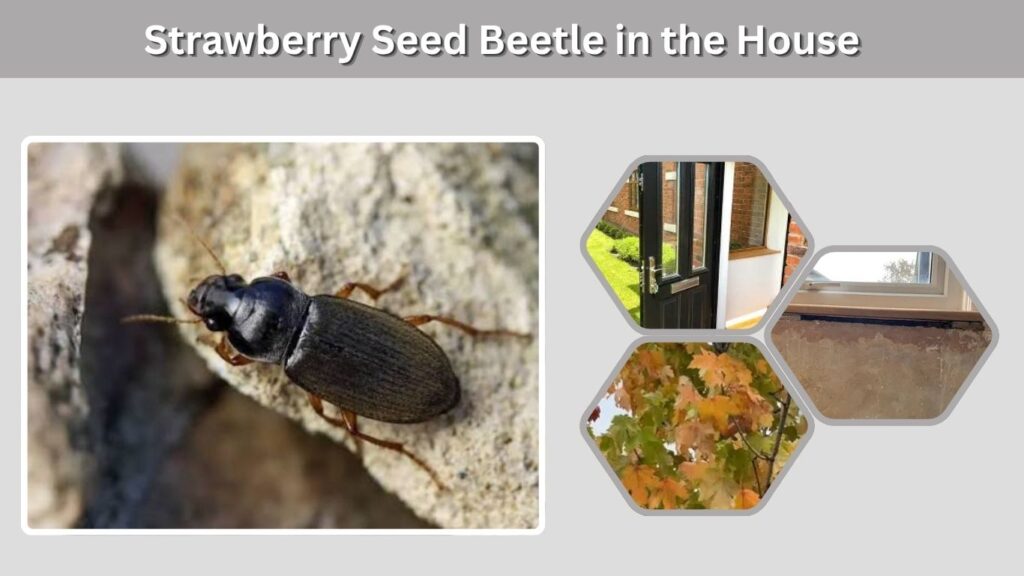
These beetles normally live outdoors. They can enter through open doors, windows, gaps beneath exterior doors or cracks around foundations.
Why Are They Coming Inside?
Indoor appearances may increase when:
- Outdoor temperatures become extremely hot or dry
- Heavy rain disturbs their normal shelter
- Outdoor lighting attracts flying adults
- Weeds or dense vegetation grow against the building
- Gaps exist around doors, windows or utility lines
- Numerous beetles are active in nearby fields or gardens
They may be found on ground-floor carpets, along skirting boards, near doors or around windows. They do not eat clothing, timber, furniture or stored food, and they generally survive indoors for only a short period.
Is It an Indoor Infestation?
A group of beetles entering over several nights may look like an infestation, but they are usually independent outdoor insects using the same entry point. Ground beetles do not normally reproduce inside homes. Continued appearances therefore suggest an exterior entry problem rather than an indoor breeding colony.
Do Strawberry Seed Beetles Bite?
Strawberry seed beetles do not seek out people, drink blood or behave like biting household pests. They possess chewing mouthparts, so a beetle handled roughly could produce a slight pinch. Such incidents are uncommon and are not considered medically important.
They are not venomous and do not sting. The easiest approach is to avoid picking one up with bare fingers. Capture it beneath a cup, slide paper underneath and release it outdoors.
What Do Strawberry Seed Beetles Eat?
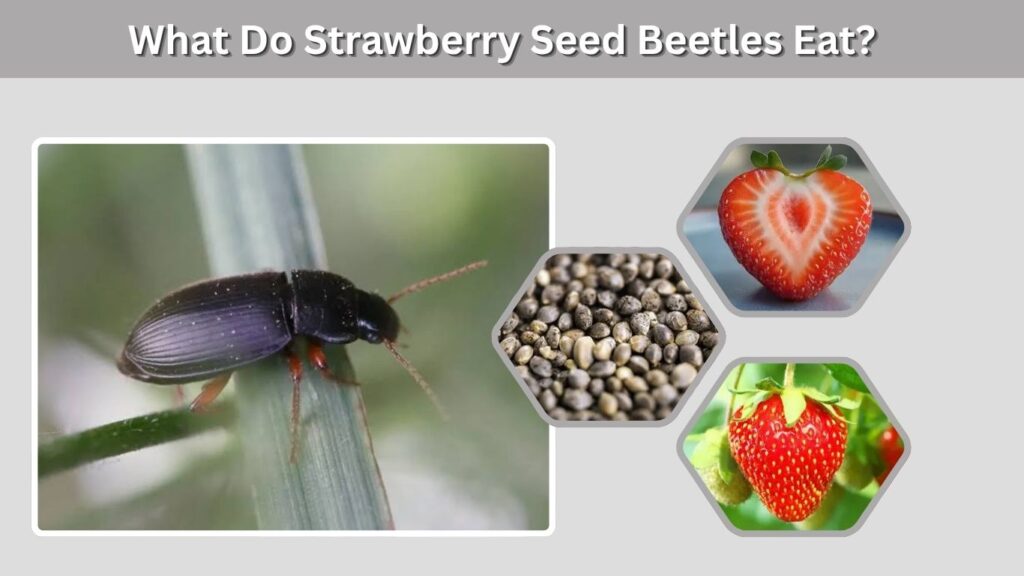
The strawberry seed beetle is an omnivorous ground beetle. It consumes plant seeds and may also eat small insects or other invertebrates.
Strawberry and Plant Foods
Its plant-based foods can include:
- Strawberry seeds
- Flesh surrounding strawberry seeds
- Weed seeds
- Seeds lying on the soil surface
- Fallen or overripe fruit
- Other available plant material
The species’ association with strawberries comes from its habit of visiting fruiting fields and feeding on the seeds embedded in the fruits. At other times, it commonly occupies weedy fields and grassy habitats.
Beneficial Feeding Behavior
Strawberry seed beetles are not always harmful. Like other ground beetles, they may consume weed seeds and small crop pests. Ground beetles can contribute to natural pest control by feeding on insect eggs, larvae, slugs and seeds.
This mixed role means gardeners should control them only when actual strawberry damage is occurring rather than killing every ground beetle they encounter.
Strawberry Seed Beetle Damage
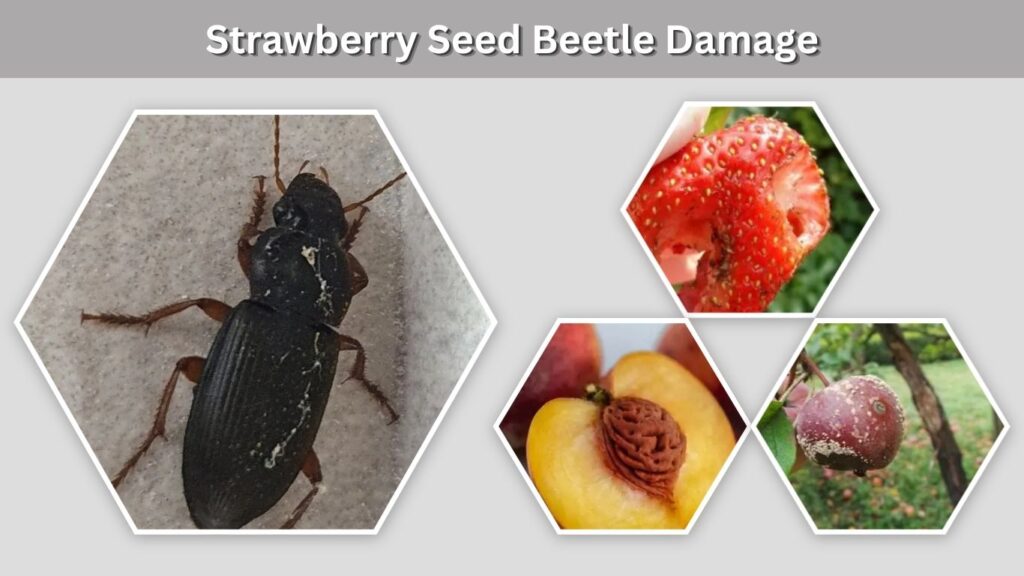
Adults usually damage strawberries during the fruiting period. They remove the small external seeds and may gouge the flesh surrounding them.
Damage commonly appears as:
- Missing surface seeds
- Small pits in the fruit
- Irregular holes beneath the strawberry
- Larger areas of eaten flesh
- Damage concentrated where fruit touches the soil
- Secondary decay entering injured areas
Because beetles commonly feed on the hidden underside, damage may not be noticed until the fruit is harvested. The injury may be mistaken for slug, bird or rodent feeding. Unlike vine weevils, strawberry seed beetles do not usually create obvious feeding notches along the leaves.
Strawberry Seed Beetle Larvae and Life Cycle
The species undergoes complete metamorphosis through egg, larval, pupal and adult stages.
Eggs and Larvae
Females deposit eggs in soil, commonly in weedy ground during late summer. The larvae are elongated and have three pairs of legs, visible jaws and flattened heads.
Young larvae may remain active near the surface during autumn before moving deeper into the ground to overwinter. Research in strawberry-growing areas found larvae spending winter deep in the soil and resuming development during spring.
Pupae and Adults
Mature larvae pupate underground, and new adults emerge later in the growing season. Adults move into strawberry fields mainly when fruit is available, while grassy and weedy habitats are preferred during other periods.
Laboratory observations found that adults could survive for more than one season, overwintering and becoming active again during warmer weather.
How to Get Rid of Strawberry Seed Beetles
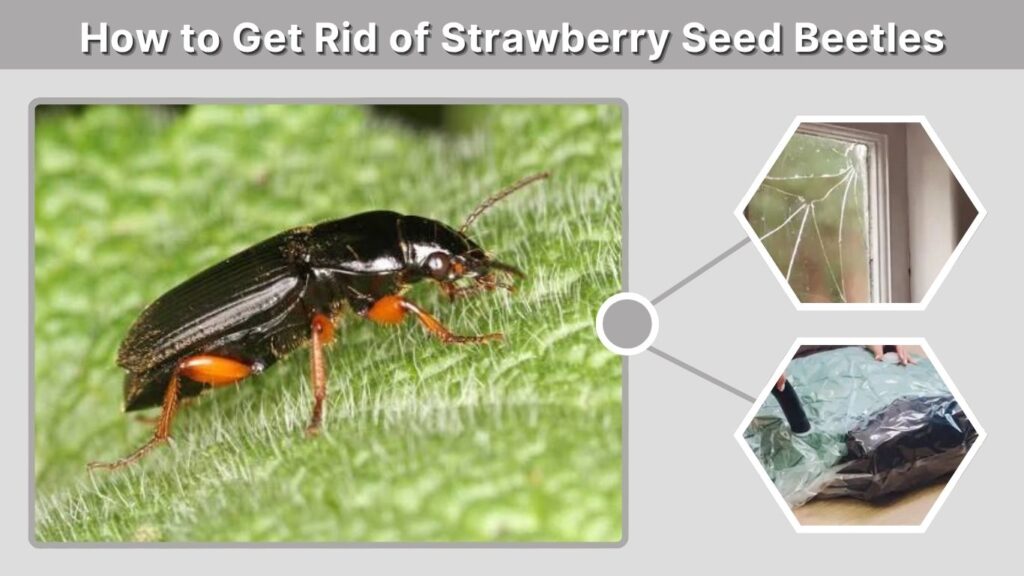
Control depends on whether the beetles are indoors or damaging strawberries outside.
Control Inside the House
For indoor beetles:
- Vacuum them or capture and release them outside.
- Install weatherstripping beneath exterior doors.
- Repair damaged window and door screens.
- Seal cracks around pipes, cables and foundations.
- Reduce bright exterior lighting near entrances.
- Remove leaves, stones and debris touching the foundation.
- Trim dense vegetation growing directly against the house.
Indoor insecticide treatment is rarely necessary because the beetles do not reproduce inside. Concentrating on entry points offers better long-term control.
Control Around Strawberry Plants
Reduce damage by harvesting ripe fruit promptly and removing damaged or overripe berries. Keep fruit from resting directly on bare soil by using clean straw or another suitable support.
Remove excessive weeds and heavy debris immediately surrounding strawberry beds, but remember that completely eliminating ground-beetle habitat can also reduce beneficial species. Inspect fruit after dark, when the beetles are more likely to be active.
Small containers sunk level with the soil can act as pitfall traps, but they may also catch beneficial insects. Check them frequently and use them only when damage is confirmed. Avoid broad, unnecessary insecticide applications because many ground beetles contribute to natural pest control.
FAQs
Are strawberry seed beetles harmful to people?
Strawberry seed beetles are not considered dangerous. They do not sting, spread through beds or feed on people. A mishandled beetle might produce a minor pinch with its jaws, but this is unusual. Their main importance is occasional strawberry damage and accidental entry into houses.
Why do I keep finding strawberry seed beetles indoors?
Repeated appearances usually mean beetles are entering through the same exterior gap. Check door thresholds, window screens, foundation cracks and openings around utility lines. Outdoor lights and vegetation touching the building may also increase activity. They are unlikely to be breeding inside the house.
Can strawberry seed beetles damage my home?
No. They do not consume timber, carpets, clothing, furniture or stored food. Adults that enter homes are temporary nuisance invaders searching for shelter or wandering accidentally. Removing them and sealing the entry points is normally enough to solve the problem.
How can I tell strawberry seed beetle damage from slug damage?
Strawberry seed beetles often remove individual seeds and gouge the surrounding flesh, particularly on the underside of fruit touching the ground. Slug damage is usually more irregular and may be accompanied by slime. Inspecting the plants after dark can help identify the responsible pest.
Should I kill strawberry seed beetles in my garden?
Control is unnecessary unless the beetles are clearly damaging ripe strawberries. They may also eat weed seeds and small invertebrates, giving them a beneficial role. Use targeted sanitation, prompt harvesting and fruit support before considering stronger measures that could kill other useful ground beetles.