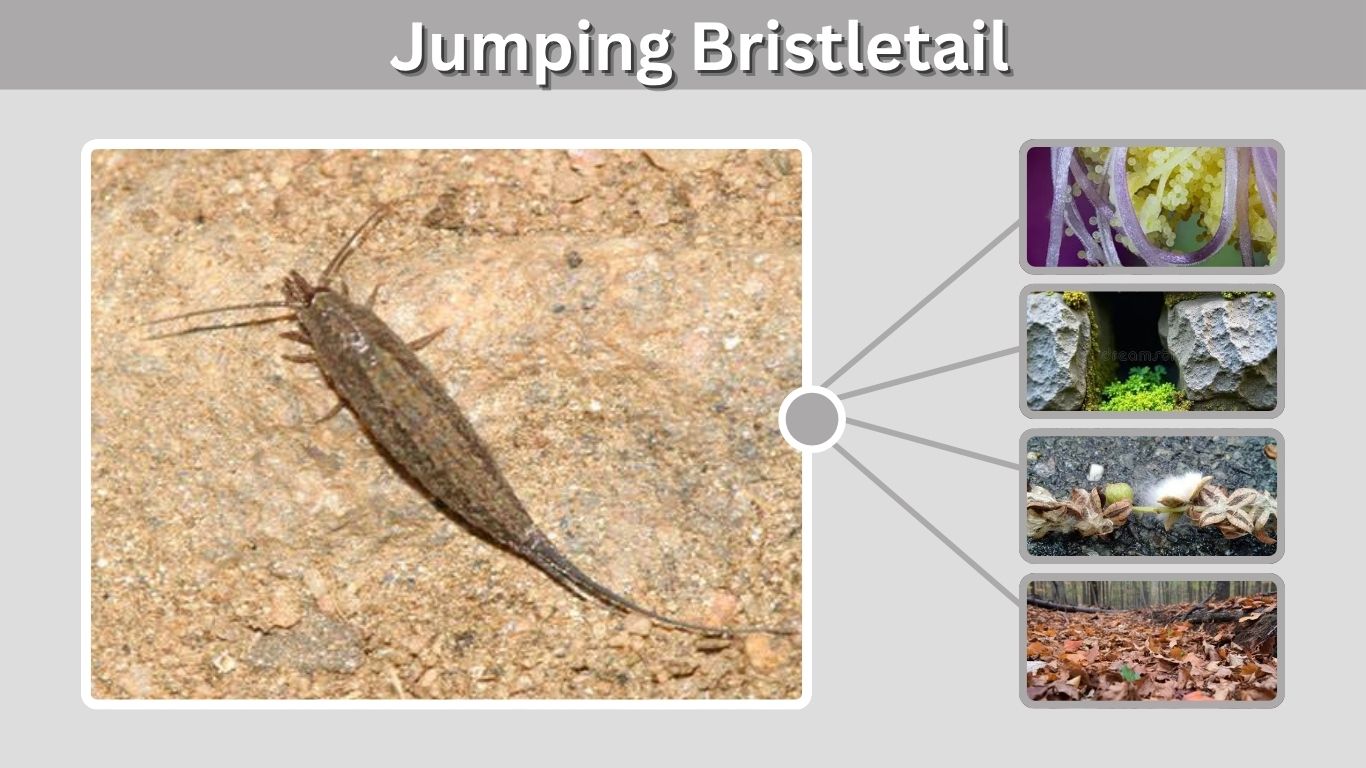
The jumping bristletail is a small, wingless insect commonly found beneath rocks, tree bark, fallen leaves, and other damp outdoor materials. Its curved body, long antennae, reflective scales, and three tail-like filaments often cause people to mistake it for a silverfish. However, jumping bristletails belong to a separate insect group and can leap several times their body length when disturbed. They do not normally damage homes, bite people, spread disease, or require chemical pest control.
What Is a Jumping Bristletail?
Jumping bristletails are primitive wingless insects belonging to the order Archaeognatha. The name refers to their ancient jaw structure and their ability to escape predators by jumping. Most familiar species belong to the family Machilidae, although Archaeognatha also includes the family Meinertellidae. Approximately 350 species are recognized worldwide.
Jumping Bristletail Scientific Name and Taxonomy
The term “jumping bristletail” describes a group rather than one individual species. Its basic classification is:
- Kingdom: Animalia
- Phylum: Arthropoda
- Class: Insecta
- Order: Archaeognatha
- Main family: Machilidae
- Other family: Meinertellidae
- Example genus: Pedetontus
Machilidae is officially recognized as a family of jumping bristletails within the order Archaeognatha. A specimen described as Pedetontus sp. has been identified only to the genus level; “sp.” means its exact species has not been determined.
Are Jumping Bristletails Insects?
Yes, jumping bristletails are true insects. They have six legs, one pair of antennae, a head, a thorax, and a segmented abdomen. However, they differ from most familiar insects because they are primitively wingless rather than descending from winged ancestors that later lost their wings.
Young jumping bristletails resemble smaller versions of adults. They do not pass through larval or pupal stages, and they continue molting even after reaching maturity.
Jumping Bristletail Identification
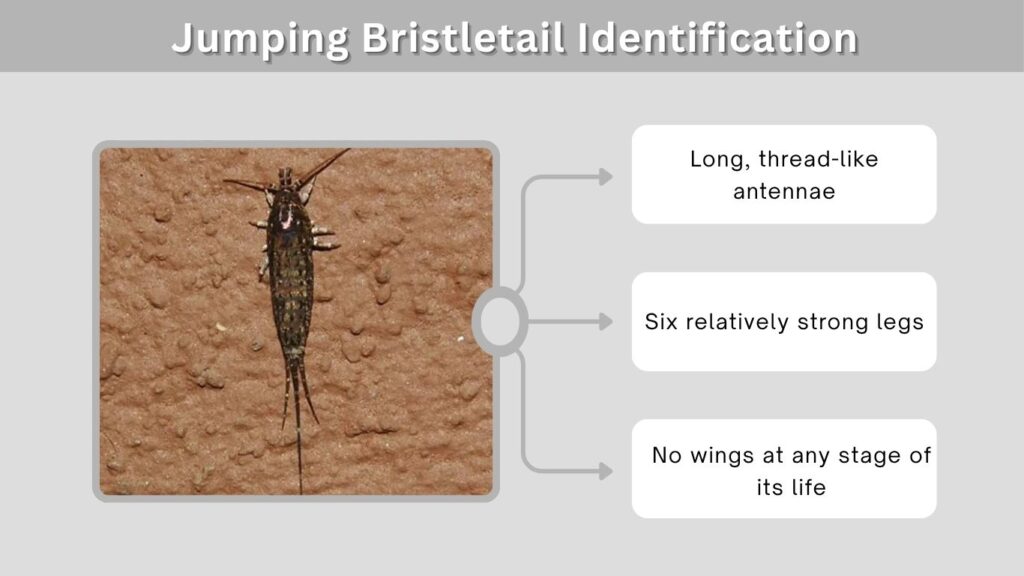
A jumping bristletail has an elongated body that narrows toward the rear. Its body is more cylindrical and arched than that of a silverfish, creating a noticeably humped appearance. Depending on the species, its scales may produce brown, grey, copper, silver, or striped patterns that help it blend into bark, stones, and leaf litter.
Main Identification Features
Look for the following characteristics:
- A body measuring approximately 7–15 millimetres
- A curved or humpbacked thorax
- Brown, grey, silver, or mottled scales
- Long, thread-like antennae
- Six relatively strong legs
- Large compound eyes that may touch each other
- Three filaments extending from the abdomen
- A central tail filament longer than the two side filaments
- Sudden jumping when touched or frightened
- No wings at any stage of its life
The three unequal tail filaments, arched body, and ability to jump are among the most useful identification clues. Some species can leap approximately 10 centimetres by forcefully snapping the abdomen against the surface.
Why Do Jumping Bristletails Jump?
Jumping is primarily an escape response. When a predator, person, or moving object approaches, the insect rapidly bends and strikes its abdomen against the ground. This action launches it into the air and makes its direction difficult for a predator to predict.
The legs are not solely responsible for the jump. The flexible, muscular abdomen produces much of the force. This behaviour separates jumping bristletails from silverfish, which run quickly but cannot make the same sudden leaps.
Jumping Bristletail Habitat
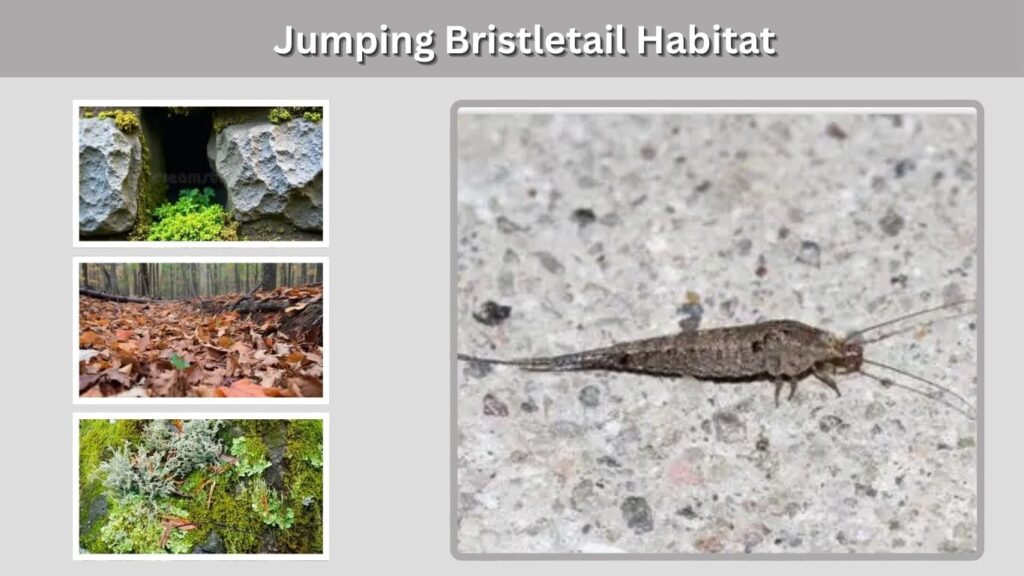
Jumping bristletails occur in many regions of the world, including parts of North America, Europe, Asia, Africa, and Australia. They prefer environments that provide moisture, shelter, organic material, and protection from direct sunlight.
Most are active at night and remain concealed during the day. Their small size and patterned scales allow them to disappear against soil, bark, moss, and stone.
Where Jumping Bristletails Live
Common hiding places include:
- Under rocks and stones
- Beneath loose tree bark
- Inside forest leaf litter
- Around moss and lichens
- In cracks in stone walls
- Beneath logs and decaying wood
- Along damp coastal rocks
- Near the upper tidal line
- Around shaded garden borders
- Under outdoor flowerpots
- Near damp foundations
They are particularly common in grassy and wooded habitats. Their natural outdoor lifestyle explains why they are rarely established as serious indoor pests.
What Do Jumping Bristletails Eat?
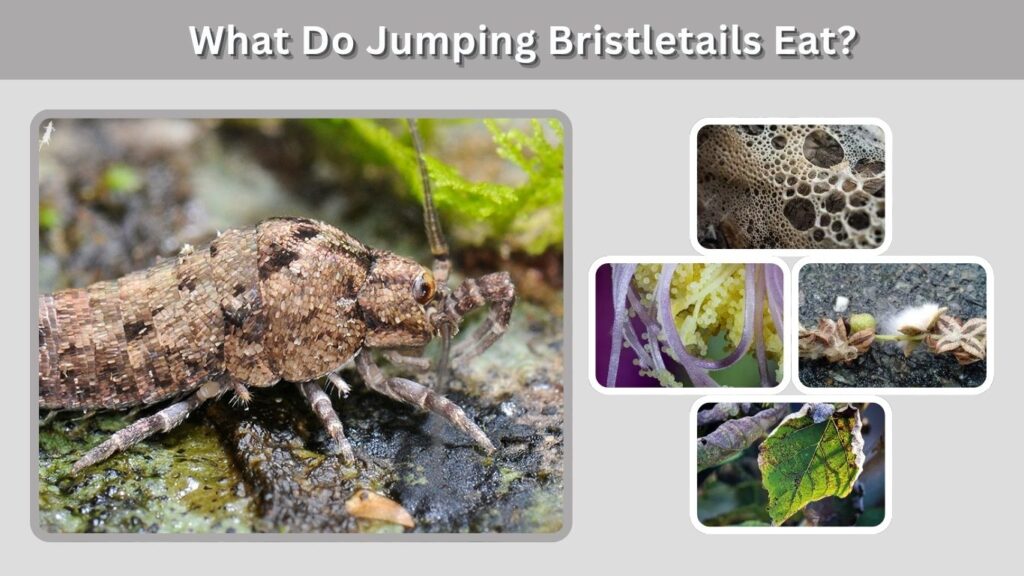
Jumping bristletails are primarily scavengers and plant-material feeders. They graze on small organisms and decomposing matter found on rocks, bark, soil, and fallen vegetation. Their feeding contributes to the breakdown and recycling of organic nutrients in natural habitats.
Common Foods
Their diet may include:
- Green algae
- Lichens
- Mosses
- Decaying leaves
- Fungal material
- Plant fragments
- Pollen
- Organic debris
- Microscopic material growing on rocks or bark
They do not normally feed on people, pets, stored food, furniture, or structural wood. Unlike silverfish, they are not commonly associated with damage to books, wallpaper, photographs, or clothing.
Do Jumping Bristletails Bite?
Jumping bristletails are not known to bite people. They do not possess a stinger, venom, or defensive jaws capable of producing a medically significant human injury. Their normal response to danger is to jump away or hide rather than attack.
Reports of a “jumping bristletail bite” are usually connected to misidentification. A flea, biting midge, small beetle, or another household arthropod may be responsible for an unexplained skin mark.
Are Jumping Bristletails Dangerous?
Jumping bristletails are considered harmless to people and pets. They are not known to transmit human diseases or infest the body. They also do not damage buildings, crops, or household possessions under normal conditions. NC State’s entomology resource states that members of Archaeognatha are not considered pests.
Their sudden jump can be surprising, but it is simply a defensive behaviour. Handling one gently may cause it to leap, lose some scales, or escape into a nearby crack.
Jumping Bristletail in the House
Finding one jumping bristletail indoors does not necessarily indicate an infestation. Because these insects normally live outside, an indoor specimen probably entered accidentally through a doorway, window, foundation gap, vent, or crack.
They may become more noticeable after heavy rain, changes in temperature, landscaping work, or movement of firewood and flowerpots.
Why They May Enter Homes
Indoor sightings may be associated with:
- Damp basements or crawl spaces
- Gaps beneath exterior doors
- Cracked foundations
- Poorly sealed windows
- Firewood stored against the house
- Leaf litter touching exterior walls
- Moss or heavy vegetation near foundations
- Leaking pipes or poor ventilation
- Outdoor lights near open windows
A large number of sightings may indicate excessive moisture or easy entry points. However, jumping bristletails are unlikely to reproduce successfully throughout dry living areas because their natural habitats provide much more suitable food and humidity.
Jumping Bristletail vs. Silverfish
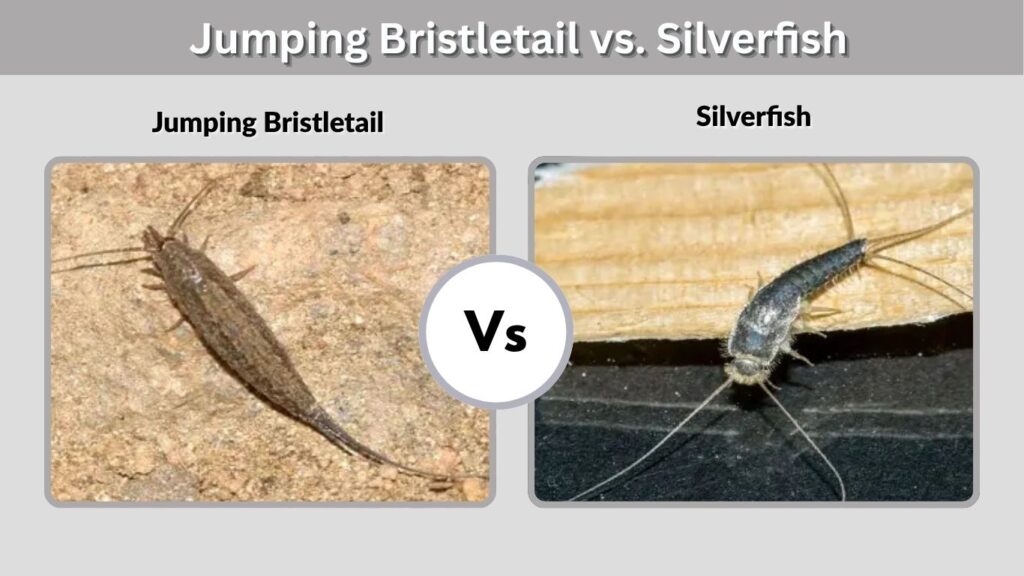
Jumping bristletails and silverfish are both wingless insects with long antennae and three rear filaments. Despite this superficial resemblance, they belong to different orders. Jumping bristletails belong to Archaeognatha, while silverfish belong to Zygentoma.
| Feature | Jumping Bristletail | Silverfish |
| Body shape | Cylindrical and arched | Flat and tapered |
| Movement | Runs and jumps | Runs but does not jump |
| Eyes | Large and often touching | Small or widely separated |
| Main habitat | Outdoor rocks and leaf litter | Indoor and outdoor sheltered areas |
| Household damage | Rarely causes damage | May damage paper and fabrics |
| Classification | Archaeognatha | Zygentoma |
| Pest status | Generally not a pest | Can become a household pest |
The easiest field test is movement. An insect that suddenly launches itself into the air is more likely to be a jumping bristletail. A flat, silvery insect that rapidly runs across a bathroom or bookshelf is more likely to be a silverfish.
How to Get Rid of Jumping Bristletails
Chemical insecticides are usually unnecessary because these insects do not normally establish destructive indoor populations. Removing individual insects and correcting moisture or entry problems is generally sufficient.
Safe Removal Methods
- Capture the insect with a cup and release it outdoors.
- Vacuum visible specimens and empty the vacuum outside.
- Repair leaking pipes, drains, or air-conditioning units.
- Use a dehumidifier in persistently damp rooms.
- Seal cracks around foundations, windows, pipes, and doors.
- Install or repair door sweeps and window screens.
- Move firewood, stones, and flowerpots away from exterior walls.
- Clear wet leaves and decaying vegetation from foundations.
- Improve ventilation in basements and crawl spaces.
- Reduce moss growth and heavy shade beside the house.
Because they naturally seek damp leaf litter, bark, and stones, reducing moisture and sheltered material near a building makes accidental indoor entry less likely.
FAQs
How big is a jumping bristletail?
Most jumping bristletails have bodies measuring around 7–15 millimetres, excluding their antennae and tail filaments. Their long appendages can make them appear larger. Size varies by species, age, and geographical region.
Do jumping bristletails damage homes?
No, they are not normally destructive household pests. They mainly feed on algae, lichens, moss, and decaying organic matter outdoors. They do not commonly damage books, clothes, furniture, stored food, or structural wood.
Can jumping bristletails infest a house?
A few may wander inside, especially in damp rooms near exterior walls. However, a permanent indoor infestation is uncommon. Repeated sightings are more likely to indicate high moisture, gaps in the building, or suitable outdoor habitat immediately beside the foundation.
Are jumping bristletails found in the UK?
Yes. Jumping bristletails occur in the UK, where several species live beneath stones, among leaf litter, and on coastal rocks. The Oxford University Museum of Natural History lists seven species for the UK.
What are jumping bristletail stripes?
The striped appearance comes from patterned scales covering the insect’s body. These scales may form brown, grey, cream, or metallic bands. The pattern provides camouflage against bark, stones, moss, and decomposing leaves rather than serving as a warning sign.