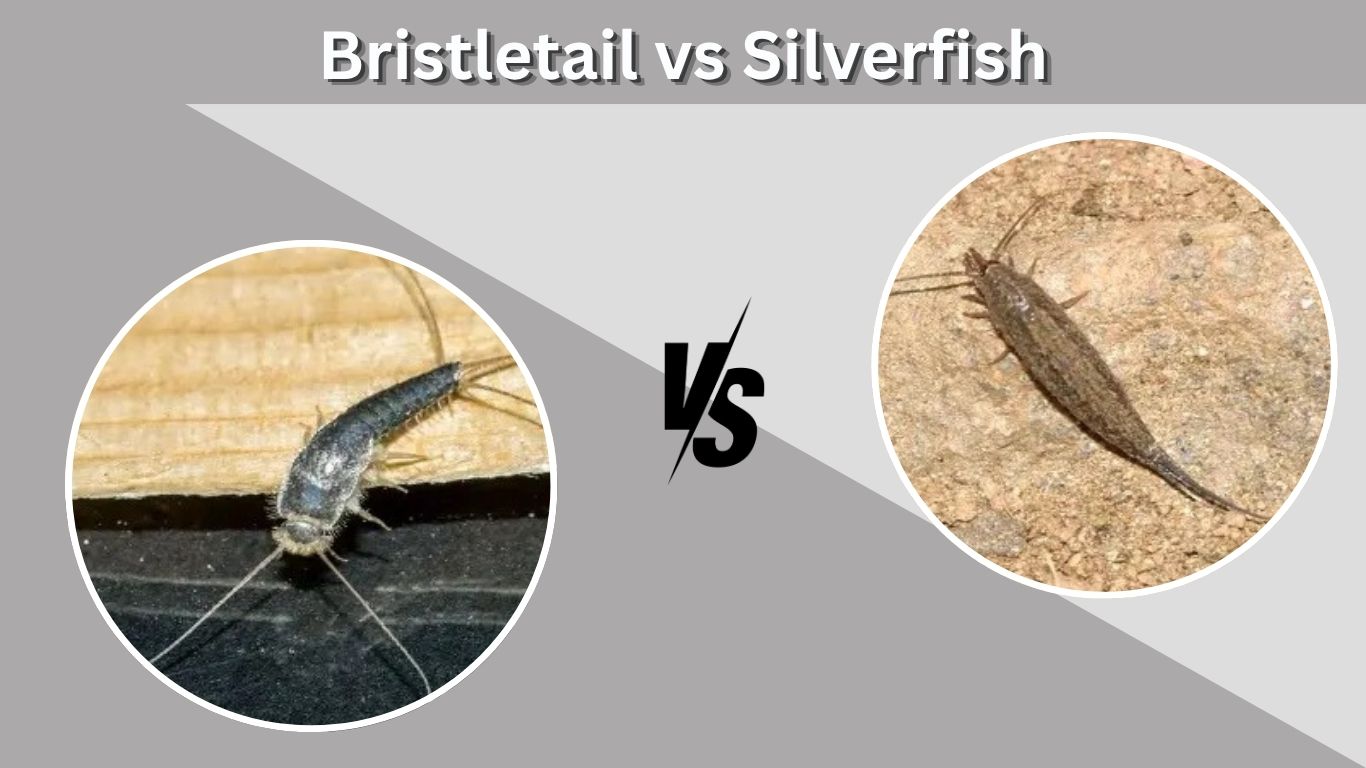
Bristletails and silverfish are small, wingless insects with long antennae and three tail-like filaments. Their similar appearance often causes confusion, but they belong to separate insect orders and behave very differently. A jumping bristletail usually lives outdoors and escapes by leaping, while a silverfish commonly inhabits damp buildings and may damage paper, wallpaper, clothing, and stored foods. Understanding their body shape, movement, habitat, and feeding habits makes identification much easier.
Bristletail vs Silverfish: Quick Comparison
In this comparison, “bristletail” refers to a jumping bristletail in the order Archaeognatha. Silverfish belong to the order Zygentoma. Some pest-control resources also use “bristletail” as a general name for silverfish because of their three rear filaments, so checking the insect’s movement and body shape is more reliable than using its common name alone.
| Feature | Jumping Bristletail | Silverfish |
| Insect order | Archaeognatha | Zygentoma |
| Body shape | Cylindrical and strongly arched | Flat and carrot-shaped |
| Typical color | Brown, grey or mottled | Silver or metallic grey |
| Eyes | Large and often close together | Small and widely separated |
| Movement | Runs and jumps | Runs quickly but cannot jump |
| Main habitat | Outdoor rocks, bark and leaf litter | Damp indoor rooms and storage areas |
| Household damage | Normally none | May damage paper and other materials |
| Pest status | Accidental indoor visitor | Potential household pest |
What Is the Biggest Difference?
The easiest difference to observe is jumping ability. A jumping bristletail can launch itself into the air by snapping its abdomen against the surface. Silverfish move rapidly with a fish-like, side-to-side motion, but they do not jump.
Body shape provides another useful clue. Bristletails have rounded, cylindrical bodies with noticeably arched thoraxes. Silverfish are flatter, broader near the head and gradually tapered toward the rear.
How to Identify a Jumping Bristletail
Jumping bristletails are ancient, primitively wingless insects. Most familiar species belong to the family Machilidae. They generally measure about 7–15 millimetres, although their long antennae and rear filaments can make them look larger. They are usually active at night and hide in sheltered outdoor locations during the day.
Main Bristletail Features
- Curved or humpbacked body
- Brown, grey, copper or mottled scales
- Large compound eyes, often touching or nearly touching
- Two long antennae
- Three rear filaments
- Central rear filament longer than the side filaments
- Six strong legs
- No wings
- Ability to jump when disturbed
A jumping bristletail may leap several times its body length. This sudden escape behaviour is usually the fastest way to separate it from an ordinary silverfish.
How to Identify a Silverfish
The common silverfish, Lepisma saccharinum, is a wingless insect covered with silvery or metallic scales. Its body is flattened and shaped somewhat like a carrot or teardrop. It moves quickly and often disappears beneath cabinets, baseboards or stored objects when exposed to light.
Main Silverfish Features
- Flattened, tapered body
- Silver, grey or metallic scales
- Two long antennae
- Three long tail filaments
- Small, widely separated eyes
- Fast, wiggling movement
- No jumping ability
- No wings
- Commonly discovered indoors
Young silverfish resemble smaller, paler adults. They develop a more obvious metallic appearance after several molts.
Habitat and Indoor Sightings
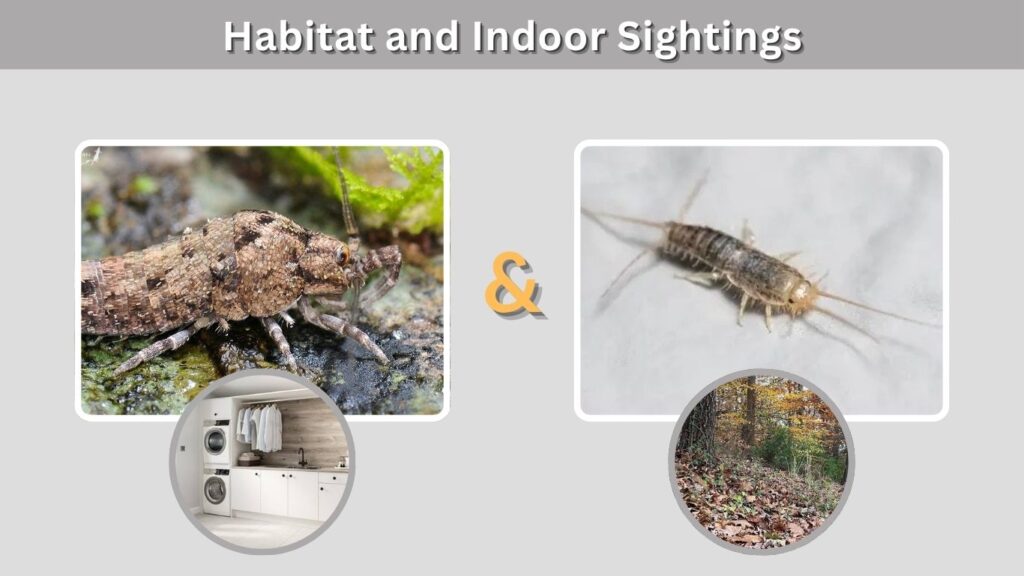
Habitat is one of the most dependable clues when comparing a bristletail vs silverfish. Jumping bristletails are primarily outdoor insects, while silverfish are well adapted to living and reproducing inside buildings.
Where Do Bristletails Live?
Jumping bristletails commonly live:
- Beneath rocks and stones
- Inside leaf litter
- Under loose tree bark
- Around moss and lichens
- Beneath logs and decaying vegetation
- In rocky coastal environments
- Near damp garden walls
- Under outdoor pots and containers
They feed as scavengers or herbivores on algae, lichens, mosses and decaying organic matter. They are part of natural decomposition processes and are not normally household pests.
A bristletail found in a house probably entered through an open door, window, foundation crack or object brought indoors. A single sighting does not usually mean that the insect is breeding inside.
Where Do Silverfish Live?
Silverfish prefer dark, sheltered and humid locations. They are frequently discovered in bathrooms, basements, kitchens, laundry rooms, attics, libraries and storage areas. They hide during the day and become more active at night.
Repeated sightings may indicate that suitable moisture, shelter and food are available inside the building. Silverfish can hide behind baseboards, beneath flooring, inside wall spaces, around pipes and among cardboard boxes.
Diet and Household Damage
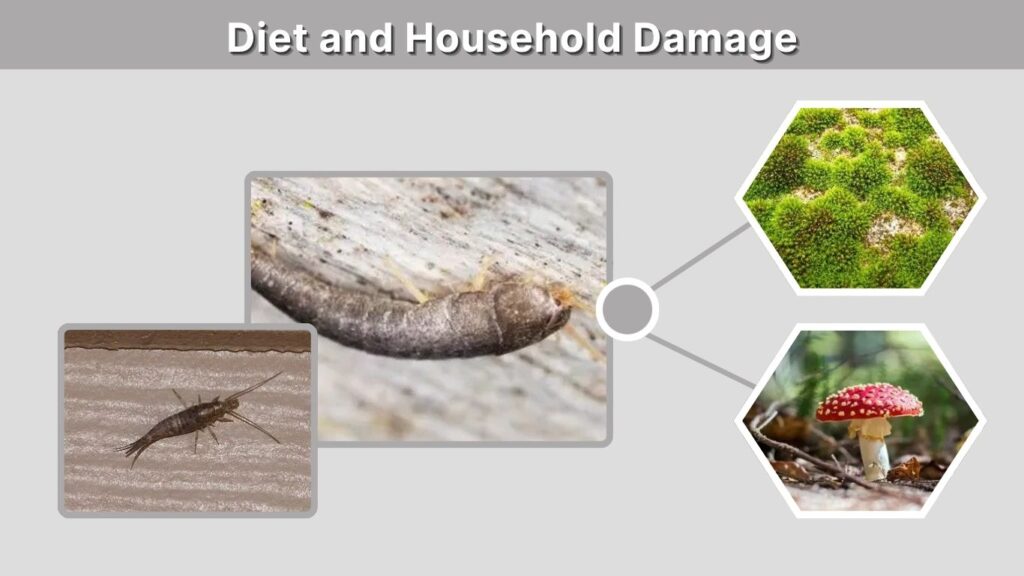
Jumping bristletails and silverfish both consume organic material, but their feeding habits have very different consequences. Bristletails normally graze on natural materials outdoors. Silverfish can feed on starches and carbohydrates found in household belongings.
Do Bristletails Cause Damage?
Jumping bristletails are not known for damaging houses, furniture, books, clothes or stored food. Their normal diet consists of:
- Algae
- Lichens
- Mosses
- Fungi
- Decaying leaves
- Plant debris
- Other decomposing organic matter
Finding one indoors is generally a nuisance rather than a sign of property damage.
What Damage Do Silverfish Cause?
Silverfish may feed on paper, book bindings, wallpaper paste, glue, photographs, cardboard, natural fabrics and starchy food products. Damage usually develops slowly, but established populations can harm stored documents and valuable books.
Possible signs include irregular holes, scraped surfaces, notched paper edges, shed scales, yellow stains and tiny dark droppings. Silverfish damage does not always prove that an active infestation remains, so the surrounding area should be inspected carefully.
Do Bristletails or Silverfish Bite?
Neither jumping bristletails nor silverfish normally bite people. They do not sting, inject venom or transmit recognized human diseases. Their appearance may be unsettling, but their defensive response is to run, jump or hide rather than attack.
Which One Is Dangerous?
Jumping bristletails are essentially harmless accidental visitors. Silverfish are also not dangerous to people or pets, but they can become property pests because of their feeding habits.
An unexplained skin mark blamed on one of these insects probably has another cause. Fleas, mosquitoes, bed bugs and other biting arthropods should be considered when bites continue to appear.
How to Get Rid of Bristletails and Silverfish
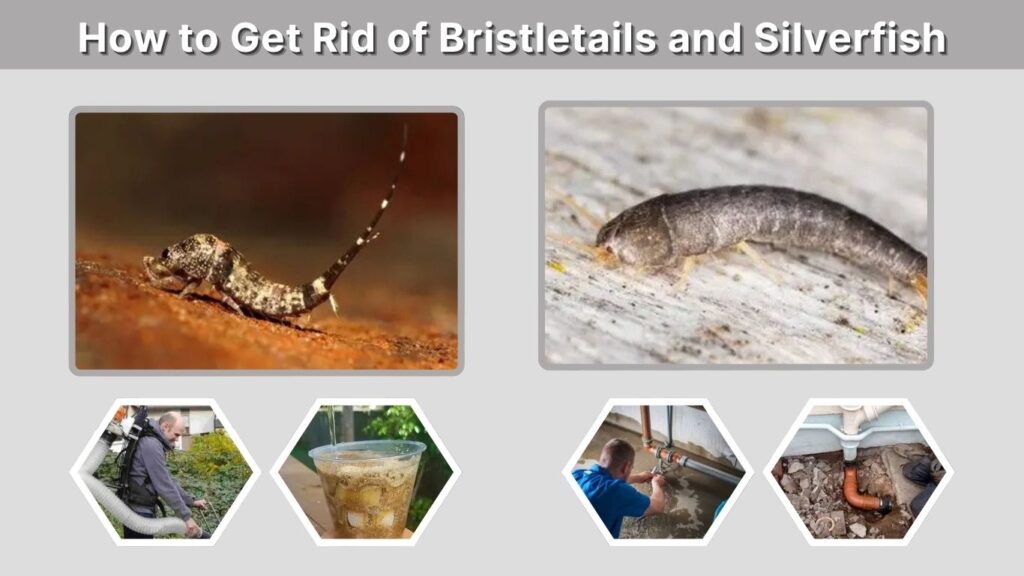
Correct identification should come before treatment. A wandering outdoor bristletail rarely requires pest control, while repeated silverfish sightings may justify moisture correction, sanitation and targeted management.
Removing a Bristletail From the House
- Capture it beneath a cup and release it outdoors.
- Vacuum individual insects.
- Seal gaps around windows, doors and foundations.
- Move damp leaves, stones and firewood away from exterior walls.
- Repair screens and install door sweeps.
- Reduce excessive moisture near the foundation.
Spraying an entire room for one bristletail is unnecessary because these insects rarely establish indoor infestations.
Controlling Silverfish
- Repair leaking pipes, drains and roofs.
- Improve airflow in bathrooms and basements.
- Use a dehumidifier in persistently humid rooms.
- Store flour, cereal and similar foods in sealed containers.
- Remove unnecessary cardboard, magazines and paper piles.
- Vacuum cracks, shelves and storage spaces.
- Seal openings around pipes, baseboards and doors.
- Store valuable documents in dry, sealed containers.
Reducing humidity and eliminating accessible food and shelter are central parts of silverfish management. A widespread or continuing infestation may require inspection by a qualified pest-management professional.
FAQs
Is a bristletail the same as a silverfish?
Not in modern classification. Jumping bristletails belong to Archaeognatha, while silverfish belong to Zygentoma. However, silverfish are sometimes informally called bristletails because three bristle-like filaments extend from the rear of their bodies.
Can silverfish jump like bristletails?
No. Silverfish can run quickly but cannot produce the sudden leaps associated with jumping bristletails. An insect that repeatedly jumps when disturbed is more likely to be a jumping bristletail, springtail or another jumping insect.
Which insect is more likely to infest a house?
Silverfish are much more likely to establish indoor populations. They find suitable humidity, food and shelter in bathrooms, basements, kitchens, attics and storage rooms. Jumping bristletails normally remain outdoors and enter buildings accidentally.
Are bristletails harmful to plants?
Jumping bristletails mainly consume algae, mosses, lichens and decaying plant material. They are not usually important garden pests and do not normally require control around healthy plants.
Why am I finding silverfish in my bathroom?
Bathrooms provide the darkness, cracks and elevated humidity silverfish prefer. Improve ventilation, repair leaks, dry wet surfaces and seal openings around pipes or baseboards. These steps make the room less suitable for silverfish.