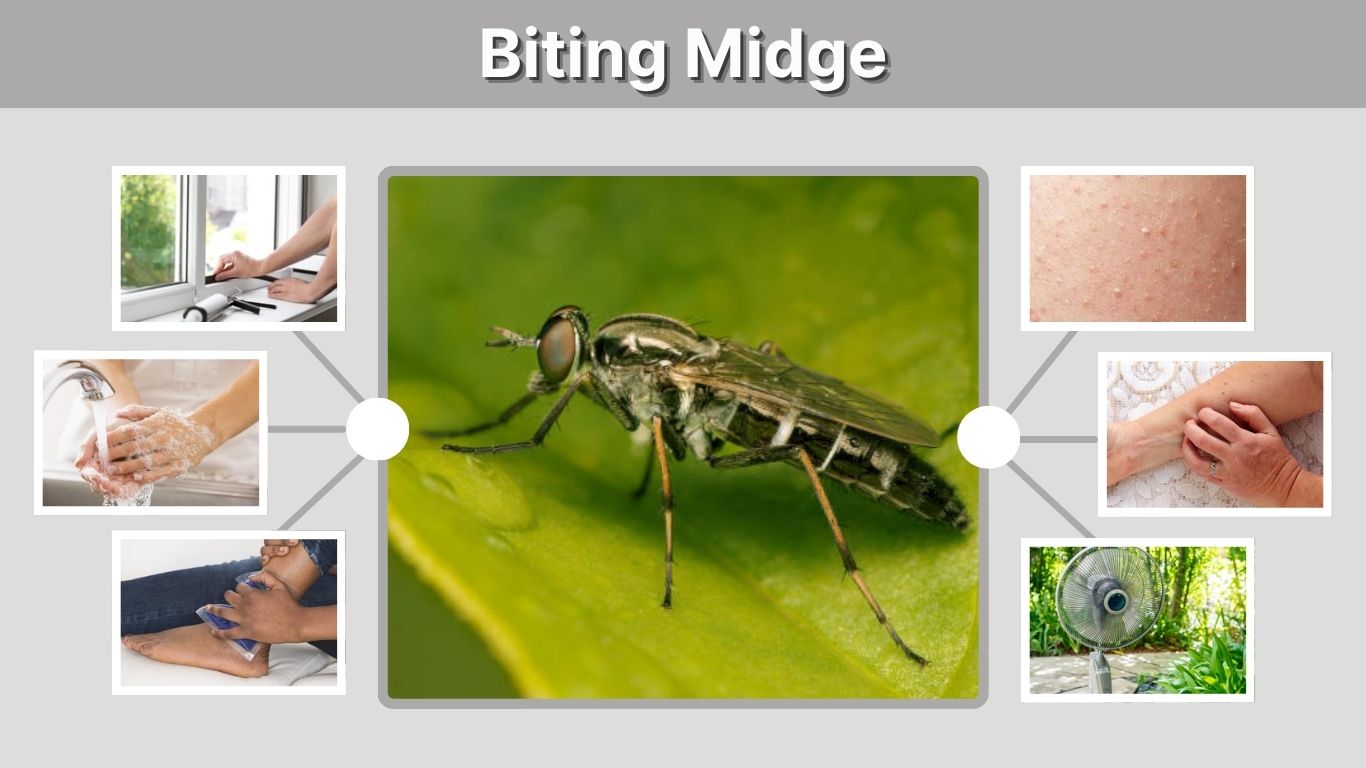
A biting midge is a tiny fly that can deliver an irritating bite despite being much smaller than a mosquito. Often called no-see-ums, these insects are easy to overlook until itchy red bumps appear on exposed skin. Biting midges commonly live around wetlands, damp soil, marshes, ponds, and other moist habitats. Understanding what a biting midge looks like, where its larvae develop, how its bites affect humans, and how it differs from a non-biting midge makes prevention and control much easier.
What Is a Biting Midge?
Biting midges are tiny flies belonging to the family Ceratopogonidae. Several genera occur worldwide, with Culicoides containing many of the species important to people and animals. Adults are extremely small—often roughly 1–3 mm long—which explains the common name “no-see-um.” Many blood-feeding species are most noticeable around moist outdoor habitats.
What Does a Biting Midge Look Like?
Important identifying features include:
- Very small body, usually only a few millimeters long
- Shorter, more compact appearance than many mosquitoes
- One pair of functional wings
- Some Culicoides species have patterned or spotted wings
- Six slender legs
- Small head with piercing mouthparts in blood-feeding females
- Grayish, brown, or dark coloration depending on species
Their extremely small size makes close identification difficult without magnification.
Where Are Biting Midges Found?
Biting midges occur in many parts of the world. Their immature stages favor moist environments, including marshes, pond edges, wet soil, muddy areas, tree holes, decaying vegetation, and other aquatic or semi-aquatic habitats.
Adults commonly remain relatively close to suitable breeding habitat. Consequently, people living or spending time near wetlands, shorelines, marshes, and other consistently damp environments may encounter larger numbers.
Biting Midge Bites on Humans
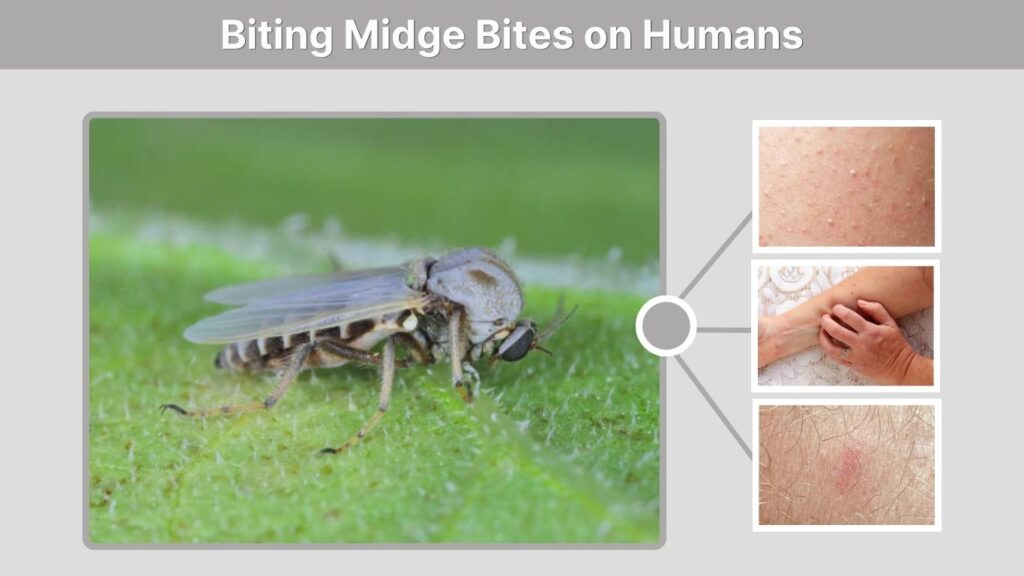
Biting midge bites can be surprisingly uncomfortable given the insect’s tiny size. Blood-feeding females pierce the skin and introduce saliva while feeding. The body’s reaction to components of that saliva can cause itching, redness, swelling, and other localized symptoms. Reactions vary considerably from person to person.
What Do Biting Midge Bites Look Like?
Common symptoms include:
- Small red bumps or welts
- Intense itching
- Localized redness
- Swelling around the bite
- Burning or painful sensations
- Clusters of bites on exposed skin
- Occasional blisters in stronger reactions
Itching may begin immediately or be delayed for several hours. Some sensitive individuals develop relatively large swollen areas.
Where Do Midges Usually Bite?
Midges can attack almost any exposed area of skin. The legs, ankles, arms, neck, face, and hands are common targets.
Multiple small bites may occur because several insects can be active in the same area. However, appearance alone does not always identify the responsible insect because mosquito, flea, black fly, and other arthropod bites can look similar.
Are Biting Midge Bites Dangerous?
Most bites result mainly in local irritation, but scratching can damage the skin and increase the risk of secondary bacterial infection.
Disease risk depends on the species and geographic region. Some biting midges can transmit pathogens. For example, certain biting midges are capable of transmitting Oropouche virus to humans in affected regions, while Culicoides species are also important vectors of several animal diseases.
How to Treat Biting Midge Bites
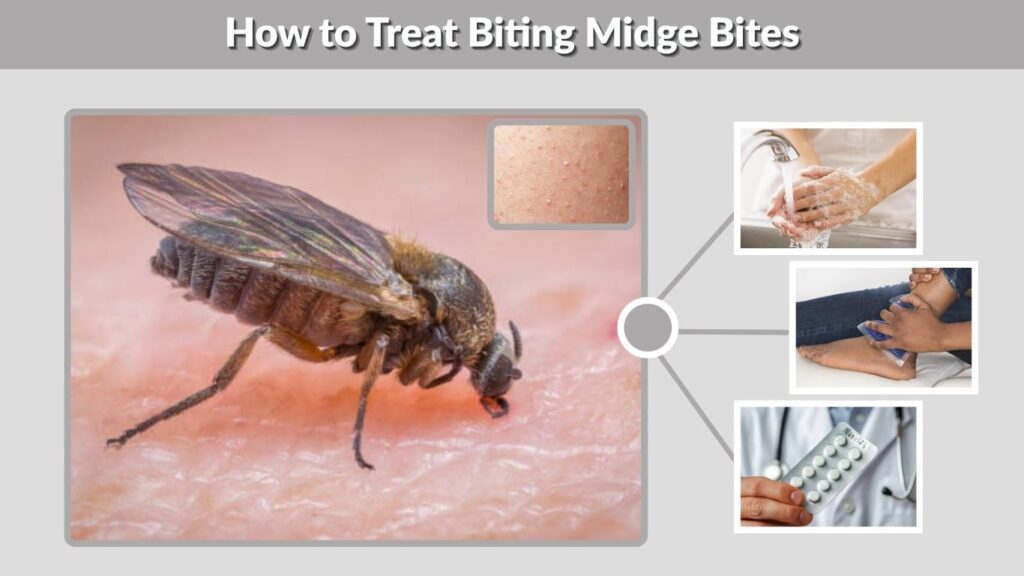
Most uncomplicated biting midge bites can be managed with basic care. The main goals are controlling itching and swelling while preventing skin damage from scratching. Severe swelling, signs of infection, breathing difficulty, or illness following travel to a region with insect-borne diseases warrants medical attention.
Biting Midge Bite Treatment
Helpful measures include:
- Wash the skin: Gently clean affected areas with soap and water.
- Apply a cold compress: Cold can reduce swelling, discomfort, and itching.
- Avoid scratching: Broken skin increases the chance of infection.
- Consider an antihistamine: Antihistamines may help reduce itching in some people.
- Use an appropriate anti-itch treatment: Products such as hydrocortisone may provide relief when suitable for you.
Health guidance also recommends medical attention for unusually severe reactions or signs of secondary infection.
Biting Midge Life Cycle
Like other true flies, biting midges undergo complete metamorphosis. Their life cycle consists of egg, larva, pupa, and adult stages. Moisture is particularly important during immature development, which is why populations are often associated with wetlands and damp environments.
Four Life Stages
The basic stages are:
- Egg: Females deposit tiny eggs in suitable moist habitats.
- Larva: Slender, worm-like larvae develop in aquatic, semi-aquatic, or very damp substrates.
- Pupa: Mature larvae transform into pupae before becoming adults.
- Adult: Adults emerge, mate, feed, and reproduce.
Development time varies considerably with species, habitat, and temperature.
What Do Biting Midge Larvae Look Like?
Biting midge larvae are generally very thin and worm-like. Mature Culicoides larvae are often only a few millimeters long and usually appear whitish or translucent with a darker head.
Depending on the species, larvae may develop in mud, wet soil, marsh margins, pond edges, or decaying organic material. Finding and treating every larval habitat can be difficult because breeding sites are often widespread.
Biting Midge vs. Non-Biting Midge
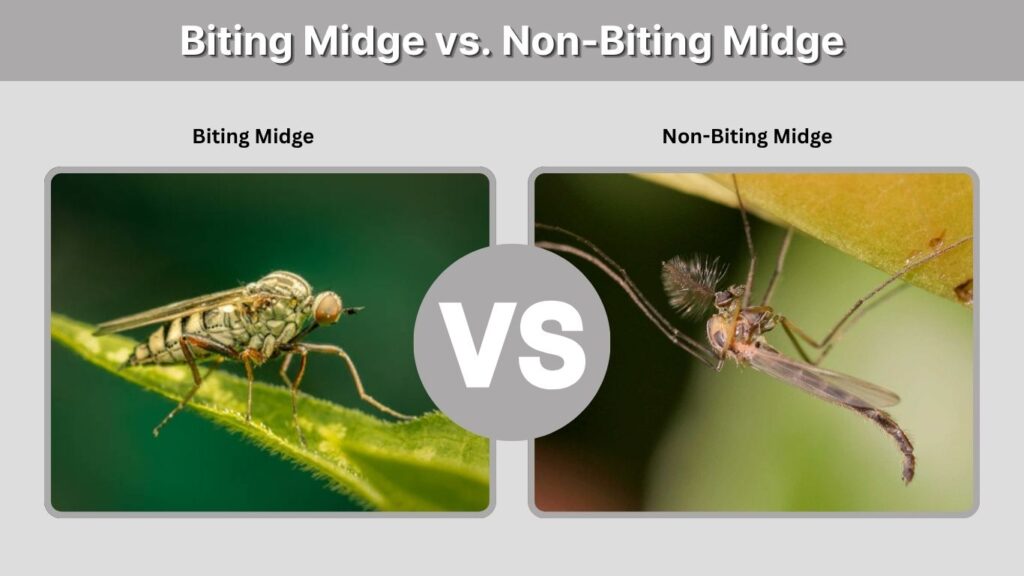
The word midge describes several groups of small flies, and not all of them bite. Non-biting midges usually belong to the family Chironomidae. They often resemble mosquitoes and may form large swarms around lakes, ponds, streams, and outdoor lighting, but they do not bite people.
How to Tell Them Apart
| Feature | Biting Midge | Non-Biting Midge |
| Common family | Ceratopogonidae | Chironomidae |
| Bites humans | Some species do | No |
| Typical size | Extremely tiny | Usually larger |
| Blood feeding | Females of many pest species | No |
| Larval habitat | Moist/aquatic habitats | Mainly aquatic sediments |
| Indoor nuisance | May enter through fine openings | Often attracted to lights |
Male non-biting midges frequently have conspicuous feathery antennae. Their aquatic larvae are also important food for fish, birds, amphibians, and other wildlife.
How to Prevent Biting Midge Bites
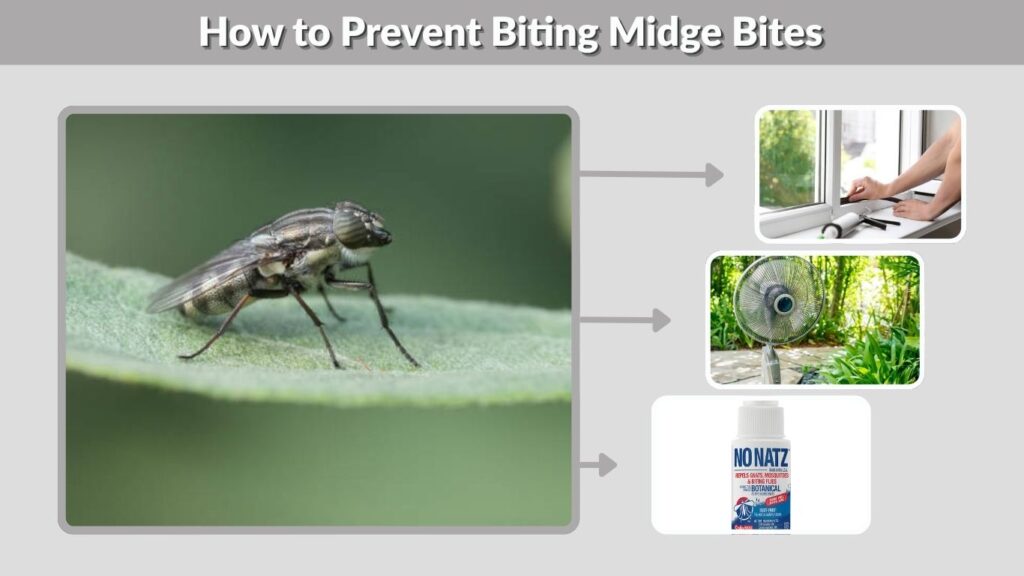
Completely eliminating biting midges from large natural habitats is often unrealistic. Personal protection and preventing adults from entering living spaces are usually more practical approaches.
Effective Prevention Methods
Consider these measures:
- Wear long sleeves and long pants in heavily infested areas.
- Use an insect repellent labeled for biting flies or no-see-ums.
- Avoid heavily infested outdoor locations when midge activity is high.
- Use fans around patios because these tiny flies are weak fliers.
- Repair gaps around windows and doors.
- Use sufficiently fine-mesh screens.
- Reduce unnecessary damp organic material around the property where practical.
CDC guidance notes that ordinary screens may have openings large enough for biting midges; finer 20×20 mesh can improve exclusion.
Biting Midges in the House
Finding a biting midge indoors does not necessarily mean it is breeding inside the house. Because these insects are extremely small, adults can pass through openings that would block larger flies and mosquitoes.
How to Reduce Midges Indoors
Check window and door screens, seal obvious gaps, and limit open doors when outdoor numbers are high. Fine screening is particularly useful in areas where biting midges are common.
Persistent indoor activity should also prompt an inspection for extremely damp organic material or other moisture problems. However, many household encounters occur when adults simply enter from nearby outdoor breeding habitats.
FAQs
1. Are biting midges the same as no-see-ums?
“No-see-um” is a common name used for several extremely small biting flies, particularly biting midges such as certain Culicoides species.
2. How big is a biting midge?
Many biting midges are only around 1–3 mm long, making them considerably smaller than typical mosquitoes.
3. Do non-biting midges bite humans?
No. Chironomid or non-biting midges do not bite people, even though their mosquito-like appearance frequently causes confusion.
4. How long do biting midge bites last?
Mild irritation may improve within several days, but stronger reactions can persist longer. Avoid scratching because damaged skin can become infected.
5. What is the best way to keep biting midges away?
Combining properly labeled insect repellent, protective clothing, fans, fine-mesh screening, and avoidance of highly active midge areas usually provides better protection than relying on a single method.