
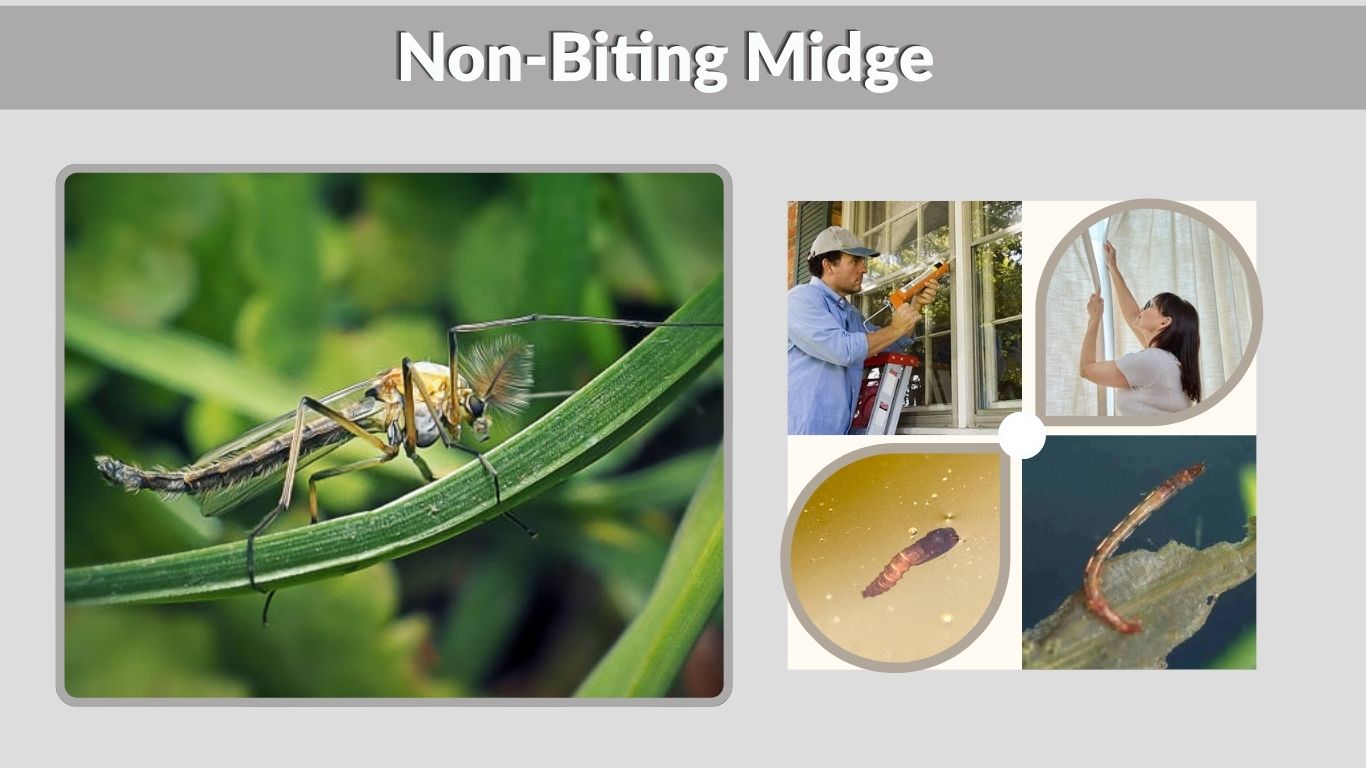
A non-biting midge is a small, mosquito-like fly commonly seen around ponds, lakes, wetlands, and other aquatic habitats. Although large swarms can be annoying, these insects do not bite or feed on human blood. Most belong to the family Chironomidae, and their aquatic larvae are important food for fish and other wildlife. Understanding their appearance, larvae, life cycle, and breeding habitat makes identification easier. This guide also explains non-biting midge control, indoor problems, swarms, and how they differ from mosquitoes.
What Is a Non-Biting Midge?
Non-biting midges are small flies in the insect order Diptera, with Chironomidae being the best-known family. Adults often resemble mosquitoes closely enough to cause concern, especially when hundreds gather near water or lights. However, they do not bite people or transmit mosquito-borne diseases. Adults commonly appear from spring through summer and are especially noticeable around dawn and dusk.
Non-Biting Midge Identification
Common identification features include:
- Small, slender mosquito-like body
- Usually about 1/16 to 1/2 inch long
- Colors ranging from pale tan or green to nearly black
- One functional pair of wings
- Long, delicate legs
- Males often have feathery antennae
- No blood-feeding mouthparts
- Frequently found close to water
- Strong attraction to lights at night
The feathery antennae of male chironomids are particularly noticeable and can help distinguish them from many female mosquitoes.
Are Non-Biting Midges Harmful?
Non-biting midges are primarily nuisance insects rather than biting pests. They do not suck human blood, and large outdoor swarms are usually associated with mating rather than feeding.
Problems arise mainly when enormous numbers collect on walls, windows, patios, vehicles, and outdoor furniture or enter homes around doors and screens. Freshwater midge emergences can sometimes be intense enough to noticeably affect homes near ponds and lakes.
Non-Biting Midge Eggs, Larvae, and Life Cycle
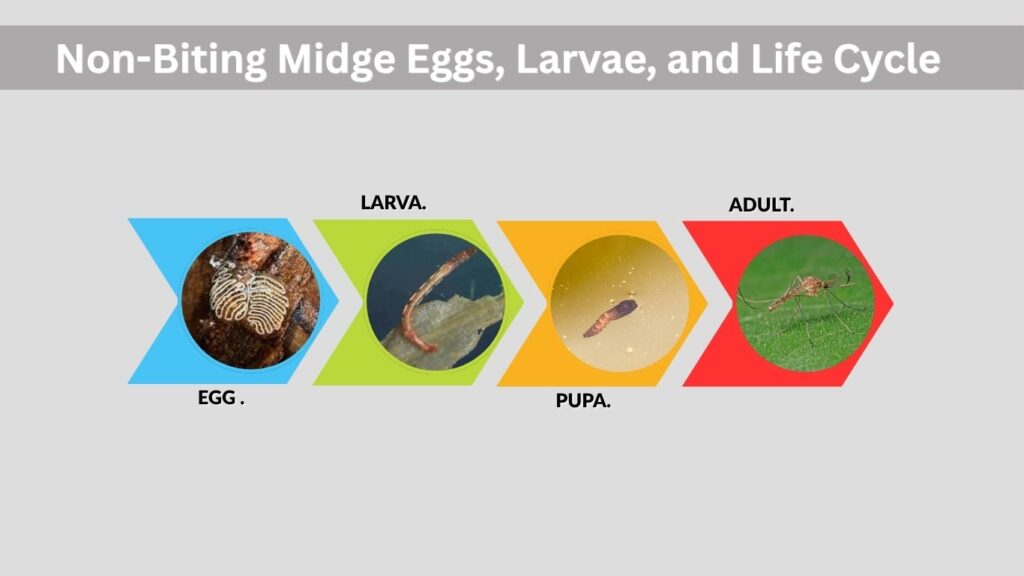
The non-biting midge life cycle includes four stages: egg, larva, pupa, and adult. Most immature development occurs in water or wet sediment. Depending on species and environmental conditions, larvae may live in ponds, lakes, streams, stormwater basins, and other aquatic habitats. Some species can tolerate water with relatively low oxygen levels.
Non-Biting Midge Eggs
Females generally deposit eggs on or near water. Eggs may occur in gelatinous masses or strings and can become attached to vegetation, sediment, or other submerged surfaces.
Temperature strongly influences how quickly eggs hatch. Once the young larvae emerge, they move into sediment or other protected aquatic locations where they begin feeding and developing.
How to Identify Non-Biting Midge Larvae
Midge larvae may have these characteristics:
- Slender, worm-like bodies
- Distinct dark head capsule
- No true jointed legs
- Small prolegs near the front and rear
- Often curved into a C-shape
- Found among sediment and aquatic vegetation
- Some species are bright red
- Frequently called “bloodworms”
The red coloration seen in certain species comes from hemoglobin-like pigments that help larvae obtain oxygen in low-oxygen water.
What Do Non-Biting Midge Larvae Eat?
Diet varies among species. Many consume algae, microorganisms, decomposing plant material, and fine organic particles found in bottom sediments.
Other species are collectors, filter feeders, scrapers, or predators. This feeding activity makes chironomid larvae an important part of aquatic food webs because they help process organic material while also serving as prey for fish and other animals.
From Pupa to Adult Midge
After completing several larval stages, a midge becomes a pupa. The pupa eventually moves toward the water surface, where the adult emerges.
Adult life is comparatively short and focuses mainly on reproduction. Large numbers may emerge at approximately the same time, producing the conspicuous swarms commonly seen above water, lawns, trees, and other landscape features.
Non-Biting Midge vs Mosquito and Biting Midge
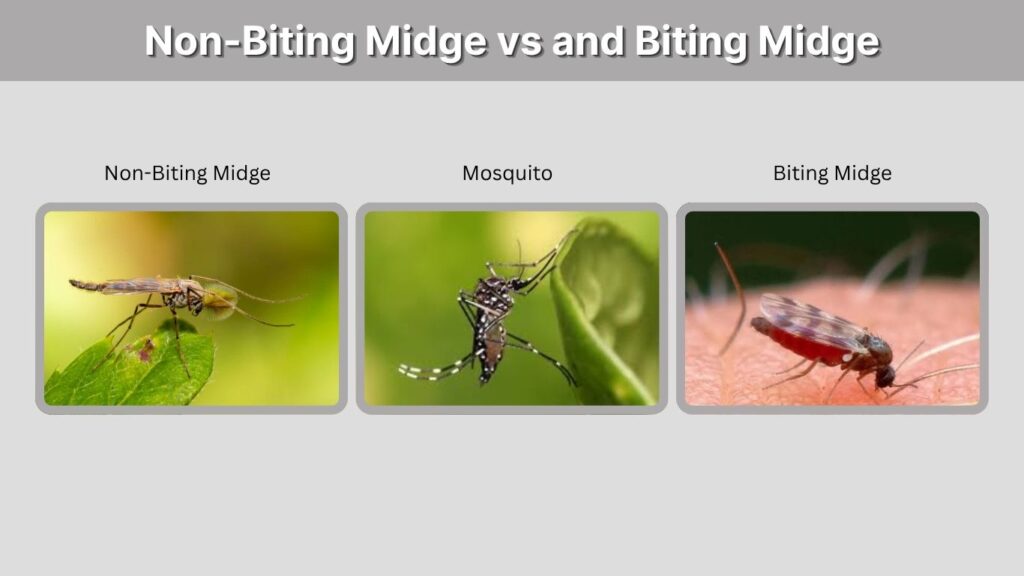
Because all three insects can be small and delicate, identification can be confusing. The most important difference is feeding behavior. Mosquito females of many species feed on blood, while biting midges can also bite humans and animals. Chironomid non-biting midges do neither. Mosquito-like swarms near ponds are therefore not automatically evidence of a mosquito problem.
Non-Biting Midge vs Mosquito
Key differences include:
- Non-biting midge: Does not bite people.
- Mosquito: Females of many species take blood meals.
- Non-biting midge: Male antennae are often very feathery.
- Mosquito: Has an obvious elongated proboscis.
- Non-biting midge: Frequently forms conspicuous mating swarms.
- Mosquito: Swarming behavior and resting habits differ by species.
- Both: Have aquatic immature stages.
- Both: May be attracted to lights.
Biting Midge vs Non-Biting Midge
Biting midges belong mainly to the family Ceratopogonidae, whereas the familiar non-biting aquatic midges belong to Chironomidae.
Biting midges are extremely small flies whose females can produce irritating bites. Non-biting midges may land on people or swarm nearby, but they are not attempting to obtain a blood meal.
Correct identification matters before choosing any control method.
Why Non-Biting Midges Form Large Swarms
Adult swarming is primarily connected with mating. Males may gather in visible groups above objects that serve as landscape markers, including bushes, rocks, vehicles, shorelines, and even people standing nearby. Swarms are especially noticeable when large numbers of larvae emerge from nearby aquatic habitat at approximately the same time.
Why Are Midges Attracted to Houses?
Adult non-biting midges are strongly attracted to artificial light. Homes beside ponds, lakes, retention basins, canals, and wetlands can therefore experience large numbers around illuminated windows, porches, entrances, and exterior walls.
Some adults eventually enter through doors, damaged screens, or other small openings. Their presence indoors usually represents accidental entry rather than an indoor breeding infestation.
Non-Biting Midge Swarms
A swarm may contain hundreds or thousands of adults but usually lasts only as long as favorable conditions and adult emergence continue.
Large seasonal emergences can repeatedly occur when a nearby pond supports abundant larvae. Killing individual adults provides only temporary relief because new adults may continue emerging from the water.
How to Get Rid of Non-Biting Midges
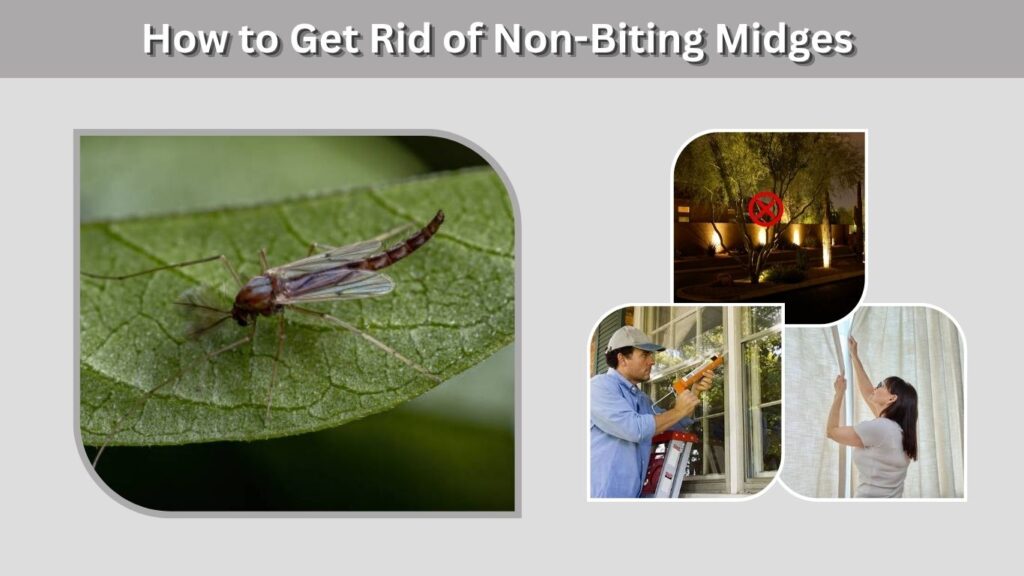
Effective non-biting midge control focuses first on reducing attraction to buildings and identifying nearby aquatic breeding sources. Because these insects are harmless and ecologically important, widespread pesticide treatment is generally unnecessary. Heavy problems around managed ponds may require professional aquatic management rather than repeatedly spraying adult midges around homes.
Control Midges Around the House
Practical steps include:
- Turn off unnecessary outdoor lights at night.
- Keep curtains or blinds closed around bright windows.
- Repair torn window and door screens.
- Seal gaps around doors and windows.
- Keep doors closed during heavy emergence periods.
- Vacuum midges that enter indoors.
- Move bright exterior lights away from entrances.
- Use lighting that is less attractive to flying insects where practical.
Since adults originate mainly outdoors, indoor pesticide applications rarely address the actual source.
Outdoor and Pond Control
Managing the larval habitat can reduce major recurring outbreaks, but treating natural ponds or lakes without professional guidance can harm aquatic ecosystems.
Some registered larvicides containing Bacillus thuringiensis israelensis (Bti) or insect growth regulators can affect aquatic midge larvae. However, chironomid larvae are also important food for fish, amphibians, birds, and other wildlife, so indiscriminate treatment can affect the food web. Only products specifically labeled for the intended site and pest should be used.
For severe problems from retention ponds or managed water bodies, consult an aquatic pest-management professional or appropriate local authority.
Importance of Non-Biting Midges in Nature
Despite their nuisance reputation, chironomids are extremely important aquatic organisms. Larvae occur in freshwater habitats worldwide and can be among the most abundant bottom-dwelling invertebrates. They help transfer nutrients from aquatic sediments into the broader food web when adults emerge and become prey for terrestrial animals.
Their Role in Aquatic Ecosystems
Larvae consume algae, microorganisms, detritus, and other organic materials while being eaten by fish, aquatic insects, amphibians, and other predators.
Adults provide food for birds, bats, spiders, dragonflies, and numerous other animals. For this reason, a moderate population around healthy aquatic habitat is normal and often beneficial. Control is most appropriate when exceptional numbers are causing a genuine nuisance rather than simply because a few adults are present.
FAQs
Non-biting midges create confusion because they closely resemble mosquitoes and can suddenly appear in enormous numbers. Knowing where they breed, whether they bite, and how their aquatic larvae develop helps determine whether control is actually necessary. The following answers address several common questions about chironomid midges around homes, ponds, and outdoor living areas.
1. Do non-biting midges bite humans?
No. Chironomid midges do not feed on human blood and are considered non-biting insects. They may swarm around or land on people, but they do not bite like mosquitoes or biting midges.
2. Why do I have non-biting midges in my house?
Adults are commonly attracted to lights and may accidentally enter through doors, windows, or damaged screens. They generally developed in an outdoor aquatic habitat rather than breeding inside the house.
3. Are non-biting midge larvae harmful?
Usually not. The larvae are normal components of aquatic ecosystems and serve as important food for many animals. Some may appear bright red and are commonly called bloodworms.
4. Does Bti kill non-biting midge larvae?
Bti can affect certain aquatic Diptera, including midges, depending on the formulation, species, dose, and product label. Because midge larvae have ecological value, aquatic treatments should be used carefully and only according to approved label directions.
5. Do mosquito repellents work on non-biting midges?
Repellent is generally unnecessary because chironomid midges do not bite. When large numbers are causing a nuisance, reducing outdoor lighting, improving screens, and addressing the nearby breeding source are more useful approaches.
