
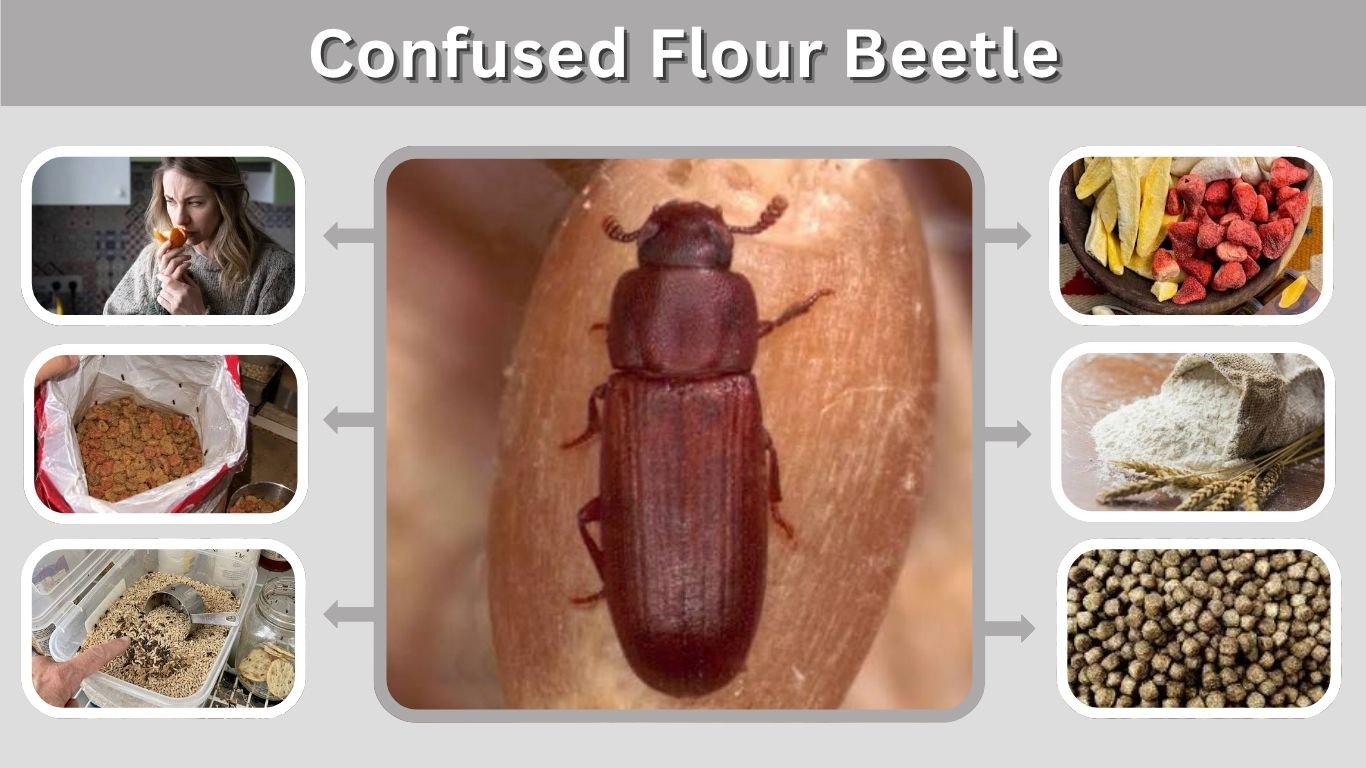
The confused flour beetle (Tribolium confusum) is a common stored-product pest that infests flour, cereals, grains, spices, and other dried foods. These small reddish-brown insects are frequently found in pantries, food warehouses, and flour mills. Although they do not bite humans, their feeding activity can contaminate stored products and create unpleasant odors. They are closely related to red flour beetles and can be difficult to distinguish without examining their antennae. Understanding their appearance, life cycle, feeding habits, and control methods helps prevent household infestations.
What Is a Confused Flour Beetle?
The confused flour beetle is a small insect belonging to the family Tenebrionidae. Its scientific name is Tribolium confusum, and it is widely recognized as a pest of stored grain products. It commonly occurs in flour mills, grocery stores, warehouses, and residential kitchens. Both adults and larvae feed on stored food materials, particularly flour, grain dust, and broken kernels.
Confused Flour Beetle Scientific Classification
- Scientific name: Tribolium confusum
- Common name: Confused flour beetle
- Family: Tenebrionidae
- Order: Coleoptera
- Class: Insecta
- Genus: Tribolium
- Species: T. confusum
Why Is It Called a Confused Flour Beetle?
The name comes from the difficulty of distinguishing this insect from the closely related red flour beetle (Tribolium castaneum). Both species have similar reddish-brown bodies, sizes, feeding habits, and life cycles.
Their physical similarities frequently cause identification confusion, particularly when examining large numbers of beetles in stored food products.
Confused Flour Beetle Identification and Appearance
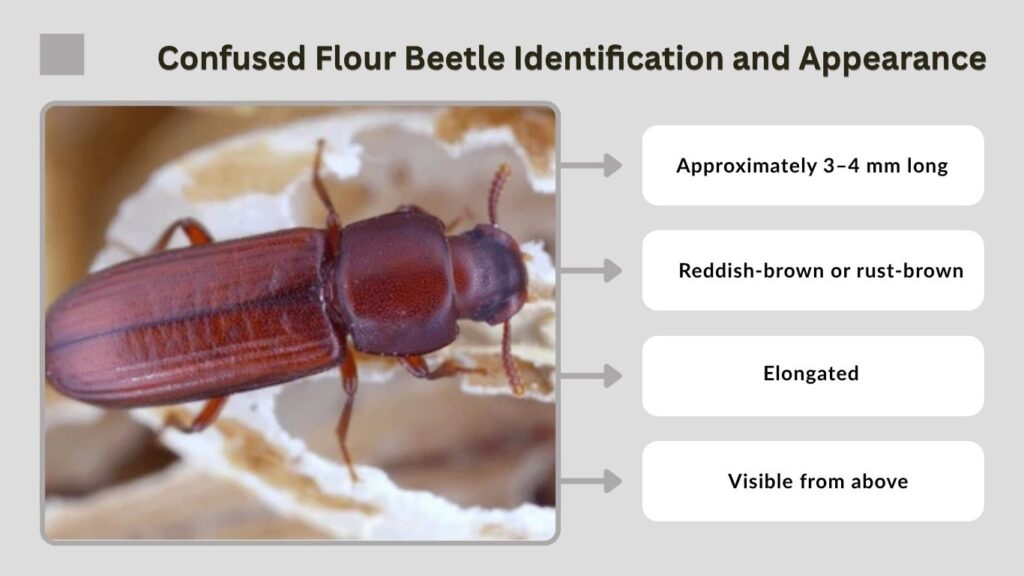
Confused flour beetles are small, elongated insects with flattened bodies and reddish-brown coloration. They have chewing mouthparts and move quickly through flour, grain dust, and other stored food materials. Their antennae and body shape are important identification features. Examining these characteristics can help distinguish them from red flour beetles and other pantry insects.
Confused Flour Beetle Size and Characteristics
- Size: Approximately 3–4 mm long (around 1/8 inch).
- Color: Reddish-brown or rust-brown.
- Body shape: Elongated, narrow, and flattened.
- Head: Visible from above, with chewing mouthparts.
- Antennae: Gradually enlarge toward the tips without a distinct three-segmented club.
- Wings: Adults have wing covers but cannot fly.
- Movement: Active crawlers that move through stored food products.
Confused Flour Beetle vs. Red Flour Beetle
The confused flour beetle and red flour beetle are closely related and often mistaken for each other. However, their antennae provide the most reliable external identification difference.
The confused flour beetle has antennae that gradually increase in size toward the tips. The red flour beetle has a more noticeable three-segmented antennal club.
The confused flour beetle also has relatively straight, parallel thorax sides, while the red flour beetle has slightly curved sides. Another important difference is that confused flour beetles cannot fly, whereas red flour beetles can fly.
What Do Confused Flour Beetles Eat?
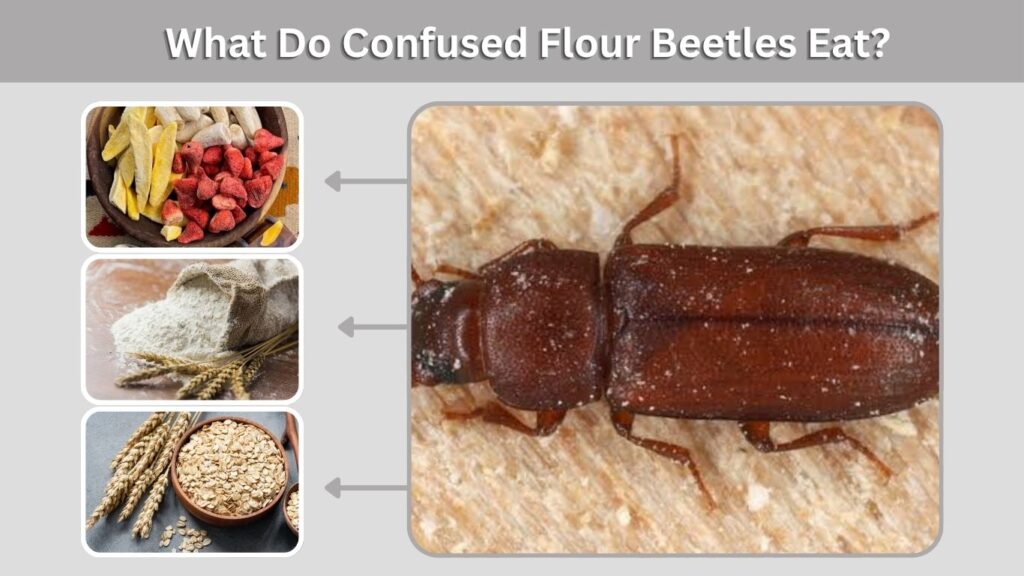
Confused flour beetles primarily feed on processed grain products, flour, and broken kernels. They are considered secondary pests of whole grains because they generally cannot penetrate healthy, undamaged kernels. Instead, they take advantage of damaged grains and food particles that accumulate during storage and processing. Both adults and larvae consume suitable food materials.
Common Foods That Attract Confused Flour Beetles
- Flour: Wheat flour, cornmeal, and other milled grain products.
- Cereals: Oatmeal, breakfast cereals, and grain-based snacks.
- Grains: Broken rice, damaged wheat, and other processed grains.
- Spices: Dried herbs, ginger, cayenne pepper, and seasoning powders.
- Nuts and seeds: Peanuts, sunflower seeds, and other stored seeds.
- Dried foods: Chocolate, dried fruits, crackers, and cake mixes.
- Pet food: Dry dog food, cat food, and birdseed.
They may also feed on dried plant materials, dead insects, and preserved museum specimens when suitable food is available.
Confused Flour Beetle Life Cycle
The confused flour beetle undergoes complete metamorphosis through four developmental stages: egg, larva, pupa, and adult. Its life cycle generally takes one to four months under favorable conditions, although temperature, humidity, and food availability influence development. All four stages may occur together inside an infested food package.
Egg Stage
Female confused flour beetles lay tiny white eggs loosely among flour, grain dust, and other stored food materials. A female can produce several hundred eggs during her lifetime.
The eggs are extremely small and may become coated with flour particles, making them difficult to identify during routine inspections.
Larval Stage
After hatching, the larvae begin feeding on stored food products. They have slender, creamy-white to light brown bodies with darker heads and six legs.
Mature larvae can reach approximately 8–13 mm in length, depending on their developmental conditions. They pass through several growth stages before becoming pupae.
Pupal Stage
The mature larvae transform into pale white or yellowish pupae within the stored food material. During this stage, they remain relatively inactive while their bodies develop into adult beetles.
The pupae do not require a separate protective cocoon.
Adult Stage
Adult confused flour beetles emerge with reddish-brown bodies and fully developed antennae. They begin feeding and reproducing after reaching maturity.
Adults can live for approximately two years or longer under favorable conditions, allowing populations to persist when infested food remains available.
Confused Flour Beetle Infestation and Damage
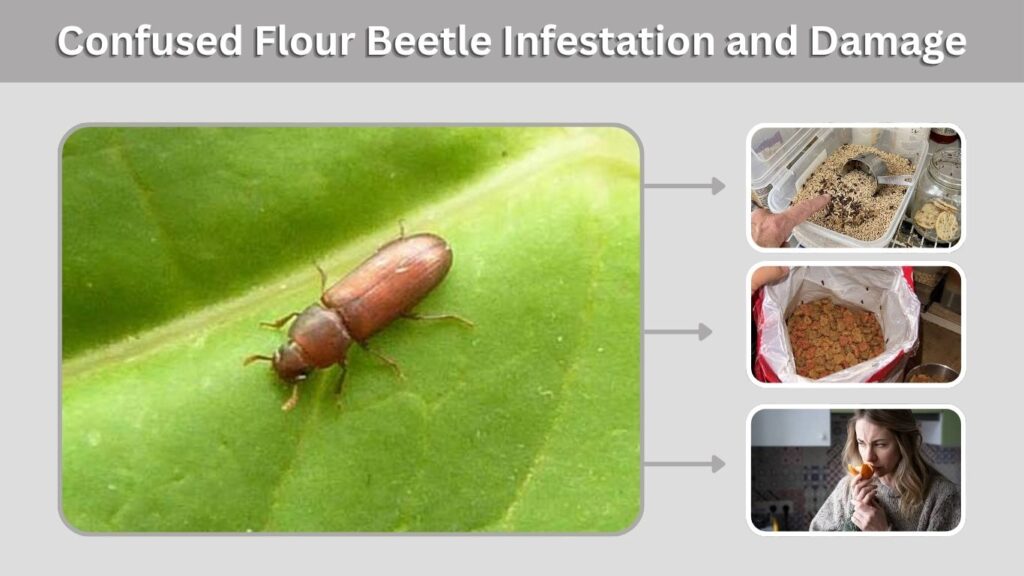
Confused flour beetles are particularly problematic in flour mills, warehouses, grocery stores, and household pantries. Their feeding activity contaminates stored products with insect fragments, shed skins, waste, and chemical secretions. Large infestations may produce a strong, unpleasant odor and reduce the quality of flour and other food materials.
Signs of a Confused Flour Beetle Infestation
Common signs include:
- Live beetles: Small reddish-brown insects crawling inside food packages.
- Larvae: Cream-colored insects moving through flour and grain products.
- Disturbed flour: Small tunnels, movement marks, and disturbed food particles.
- Unpleasant odor: Infested products may develop a pungent smell.
- Discoloration: Large infestations can give flour a pinkish or grayish appearance.
- Food contamination: Dead beetles, shed skins, and waste may accumulate.
Are Confused Flour Beetles Harmful?
Confused flour beetles do not bite or sting humans. They are not blood-feeding insects and do not normally attack household pets.
However, heavily infested food can become unsuitable for consumption. Their secretions, dead bodies, and waste contaminate stored products and may contribute to unpleasant odors and food-quality problems.
How to Get Rid of Confused Flour Beetles
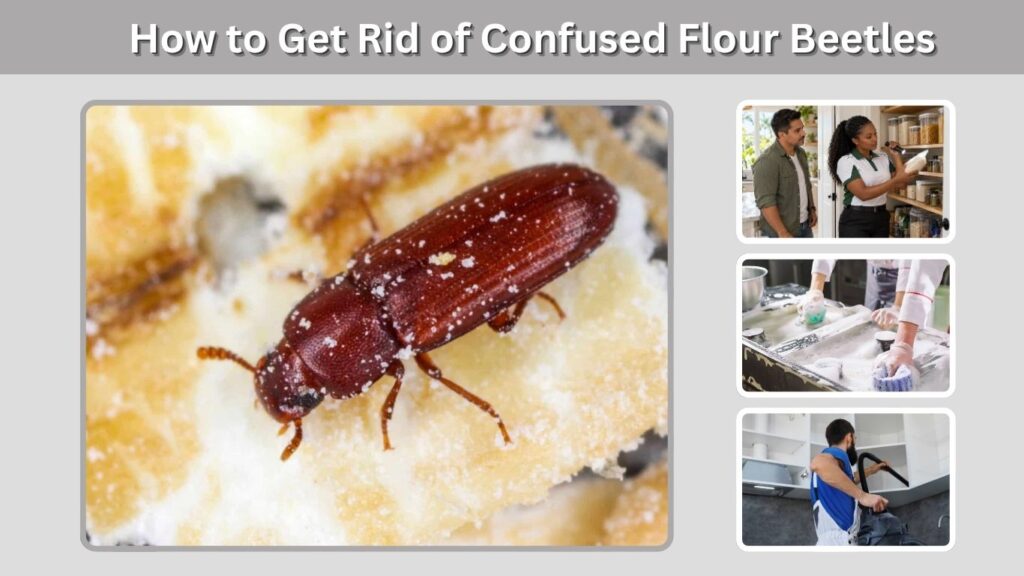
Removing confused flour beetles requires identifying and eliminating the infested food source. Killing visible adults alone is insufficient because eggs, larvae, and pupae may remain hidden inside stored products. Thorough cleaning, food disposal, and proper storage are essential for controlling an established infestation.
Effective Confused Flour Beetle Control Methods
- Inspect stored products: Examine flour, cereals, spices, rice, and pet food for beetles and larvae.
- Discard infested food: Place contaminated products in sealed bags and remove them from the house.
- Vacuum cabinets: Clean shelf corners, cracks, joints, and other hidden areas.
- Wash storage surfaces: Remove food particles and insect remains with soap and water.
- Freeze suitable products: Freezing at 0°F (-18°C) for several days can kill hidden insects when the entire product reaches the required temperature.
- Use airtight containers: Store unaffected food in tightly sealed glass, metal, or heavy-duty plastic containers.
- Monitor activity: Use suitable stored-product beetle traps to detect remaining adults.
Do Confused Flour Beetle Traps Work?
Yes. Appropriate stored-product beetle traps can help monitor adult confused flour beetles. Some monitoring systems use attractants or pheromones to capture insects on sticky surfaces.
However, traps cannot eliminate eggs and larvae hidden inside infested food. They should be used alongside source removal and thorough cleaning rather than as the only treatment.
How to Prevent Future Infestations
Inspect newly purchased flour, cereals, spices, and pet food before storing them. Keep pantry shelves clean and avoid leaving food in open packaging. Regularly check older products and transfer susceptible ingredients into airtight containers.
Why Are Confused Flour Beetles in My House?
Confused flour beetles usually enter homes through infested food packages, especially flour, cereals, grains, and dry pet food. They may also arrive in contaminated products purchased from grocery stores or warehouses.
Once inside, adults and larvae can develop in stored food, cabinet cracks, and areas where food particles accumulate. Beetles found in bedrooms or bathrooms may have wandered away from their original food source.
They do not normally breed in mattresses, clothing, or bathroom drains. Finding them in unexpected rooms is a reason to inspect nearby food storage areas rather than assume the room itself is their breeding site.
FAQs
1. Can Confused Flour Beetles Fly?
No. Adult confused flour beetles cannot fly because they lack functional flight ability. They move by crawling and can spread between nearby food storage areas. Red flour beetles, their close relatives, can fly, which is one of the easiest ways to distinguish the two species.
2. Do Confused Flour Beetles Bite Humans?
No. Confused flour beetles do not bite humans or feed on blood. Their chewing mouthparts are adapted for consuming flour, grain dust, and other stored food materials. They are pantry pests rather than insects that attack people or pets.
3. How Long Do Confused Flour Beetles Live?
Adult confused flour beetles can live for approximately two years under favorable conditions. Females can lay hundreds of eggs during their lifetime. Their relatively long lifespan and continuous reproduction make established infestations difficult to eliminate without removing the original food source.
4. Are Confused Flour Beetles Harmful to Dogs?
They are not known as biting or venomous insects, but infested dog food should not be fed to pets. Contaminated products may contain insect fragments, waste, and other debris. Discard heavily infested food and store replacement pet food in airtight containers.
5. What Is the Difference Between Confused and Red Flour Beetles?
Both species are reddish-brown and approximately 3–4 mm long. Confused flour beetles have gradually enlarged their antennae and cannot fly. Red flour beetles have a distinct three-segmented antennal club and can fly. Their similar appearance explains why they are frequently confused.
