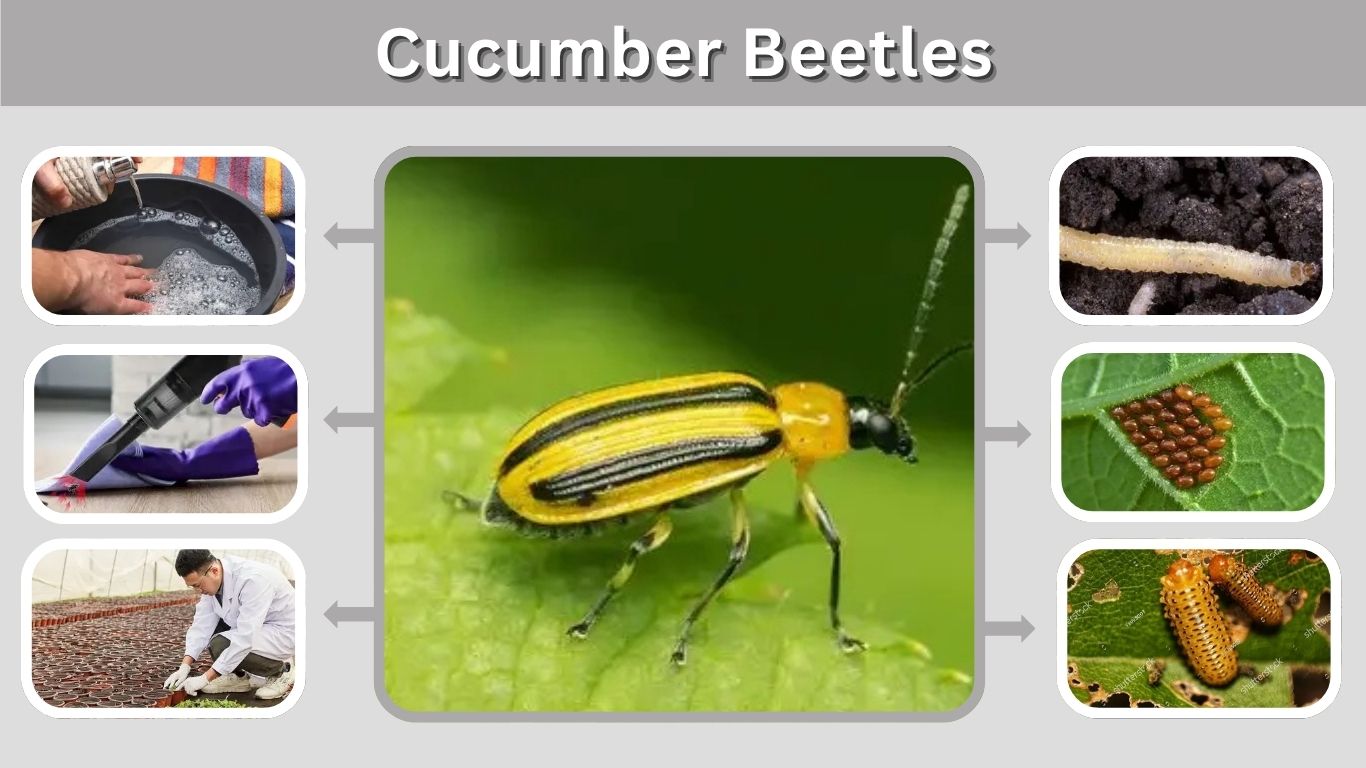
Cucumber beetles are garden pests that damage cucumbers, squash, pumpkins, melons, and other cucurbit crops. Their feeding creates holes in leaves, injures flowers, scars fruit, and may weaken young seedlings. More importantly, some cucumber beetles can spread bacterial wilt, a serious disease that causes vines to collapse. Learning how to identify striped and spotted cucumber beetles, understand their life cycle, and use row covers, traps, natural treatments, and prevention methods can help protect plants before infestations become severe.
What Are Cucumber Beetles?
Cucumber beetles are leaf beetles that commonly attack plants in the cucurbit family. The two types most often found in gardens are the striped cucumber beetle and spotted cucumber beetle. Although both are small yellow insects with black markings, they differ in appearance, preferred plants, and larval behavior. Adults feed above ground, while larvae usually develop beneath the soil.
Striped Cucumber Beetle
The striped cucumber beetle has a yellow body with three black stripes along its wing covers. Its head is black, and its narrow body is about one-quarter inch long. Adults commonly feed on cucumbers, melons, squash, pumpkins, and gourds. Their larvae remain in soil and mainly feed on cucurbit roots.
Striped cucumber beetles are especially concerning because they can carry and spread bacterial wilt while moving between plants.
Spotted Cucumber Beetle
The spotted cucumber beetle is yellow or yellow-green with 12 black spots on its wing covers. It has a black head, long antennae, and an elongated body. Adults feed on cucurbits as well as beans, corn, flowers, and other plants.
Its larvae are sometimes called southern corn rootworms because they often feed on corn and grass roots. The adult may resemble a ladybug, but its body is less rounded and its antennae are longer.
How to Identify Cucumber Beetles
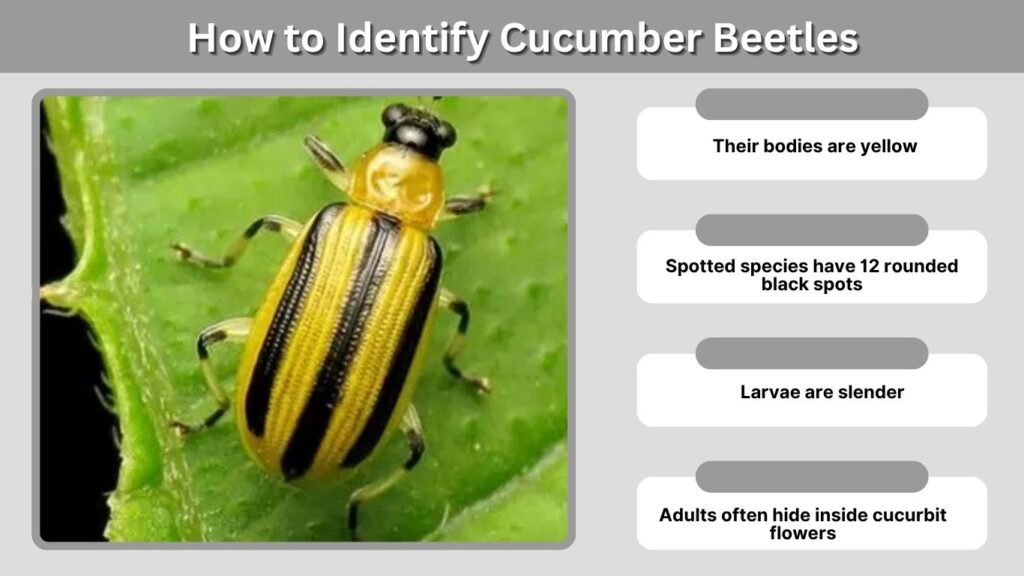
Correct identification prevents gardeners from accidentally harming ladybugs and other beneficial insects. Cucumber beetles are small, active, and likely to fly or drop when disturbed. They are commonly found on seedlings, beneath leaves, inside yellow flowers, and near plant stems. Their markings, antennae, body shape, feeding location, and surrounding plant damage provide the best identification clues.
Key Identification Features
- Adults are approximately one-quarter inch long.
- Their bodies are yellow, yellow-green, or pale orange.
- Striped species have three lengthwise black stripes.
- Spotted species have 12 rounded black spots.
- Both types have dark heads and long antennae.
- Their bodies are narrower than typical ladybugs.
- Larvae are slender, pale, and wormlike.
- Adults often hide inside cucurbit flowers.
Cucumber Beetle vs. Ladybug
Cucumber beetles have relatively long bodies and threadlike antennae. Ladybugs are usually rounder, strongly domed, and equipped with shorter antennae. Color alone is unreliable because both groups may appear yellow, orange, or black.
Their behavior also differs. Cucumber beetles chew leaves, flowers, stems, and fruit, while most garden ladybugs hunt aphids and other soft-bodied pests. A beetle beside fresh chewing damage is therefore more likely to be a cucumber beetle.
Cucumber Beetle Damage
Damage may begin soon after seedlings emerge. Adult beetles chew leaves, stems, flowers, pollen, and developing fruit, while larvae may feed on roots. Older squash and pumpkin plants often tolerate light feeding, but young cucumbers and melons can decline rapidly. The problem becomes more serious when beetles introduce bacterial wilt into healthy plants.
Common Signs of Damage
- Small or irregular holes appear in leaves.
- Leaf edges become ragged or skeletonized.
- Seedlings grow slowly or lose their first leaves.
- Beetles gather inside yellow blossoms.
- Flowers are damaged before fruit develops.
- Young fruit develops scars or shallow pits.
- Stems near the soil show chewing marks.
- Leaves or complete vines suddenly wilt.
- Beetles fly away when plants are disturbed.
Bacterial Wilt
Bacterial wilt is one of the most serious problems connected with cucumber beetles. A beetle can acquire the bacteria from an infected plant and spread it through feeding wounds. Cucumbers and muskmelons are especially vulnerable.
An infected plant may wilt during warm afternoons and briefly recover overnight. Eventually, the wilting becomes permanent, leaves turn yellow or brown, and the vine dies. There is no cure once the disease is established. Remove severely wilted plants promptly to reduce further spread.
Cucumber Beetle Life Cycle
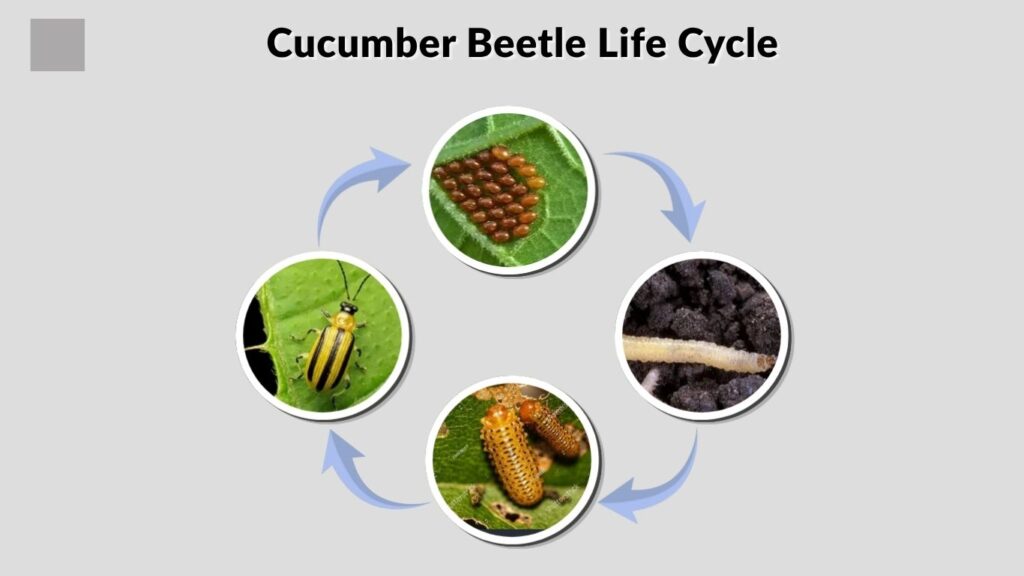
Cucumber beetles develop through egg, larval, pupal, and adult stages. Seasonal timing varies by species and climate, but adults commonly become active when temperatures rise and host plants begin growing. Understanding each stage is useful because adults damage visible plant parts, while eggs, larvae, and pupae remain largely hidden in the soil.
Eggs and Larvae
Females deposit yellowish or orange eggs in soil cracks near host plants. After hatching, the pale larvae begin feeding underground. Striped cucumber beetle larvae usually feed on cucurbit roots, while spotted cucumber beetle larvae may develop on corn, grasses, and other plants.
Gardeners rarely notice the larvae because they remain below ground. Heavy feeding can weaken roots, although adult feeding and disease transmission usually cause the most visible damage.
Pupae and Adults
Mature larvae form pupae inside small soil chambers. Adults later emerge and feed on leaves, blossoms, stems, pollen, and fruit. More than one generation may occur in warm regions.
Some adults survive winter beneath plant debris, weeds, woodland litter, or other protected materials. They become active in spring and quickly locate young cucurbits. This early arrival explains why seedlings should be monitored or covered immediately after planting.
How to Get Rid of Cucumber Beetles
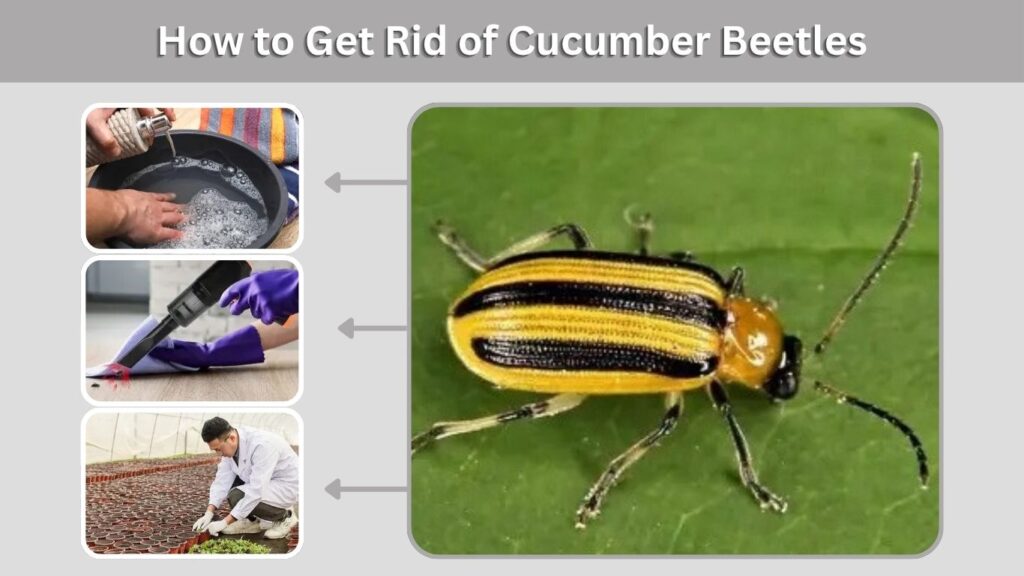
Effective control combines several methods rather than depending on one spray. Protection should begin before beetle numbers become high, particularly around cucumbers and melons. Physical barriers, frequent inspection, hand removal, sanitation, traps, and selected treatments can work together. The main goals are preventing severe seedling damage and reducing bacterial wilt transmission.
Immediate Control Steps
- Inspect seedlings, leaves, and flowers every few days.
- Handpick beetles during the cool early morning.
- Knock adults into a container of soapy water.
- Remove plants showing severe bacterial wilt symptoms.
- Vacuum small infestations with a handheld vacuum.
- Clear weeds and unused cucurbit vines nearby.
- Replace destroyed seedlings after controlling beetles.
- Use sprays only when damage justifies treatment.
Row Covers, Sticky Traps, and Lures
Install floating row covers immediately after planting and secure every edge so beetles cannot crawl underneath. Remove the covers when flowering begins to allow bees to pollinate, unless flowers are hand-pollinated.
Yellow sticky traps can capture adults and reveal when beetles arrive, but they rarely control a large infestation alone. Lure-based traps may attract beetles from surrounding areas, so place them away from vulnerable plants and combine them with barriers, sanitation, and hand removal.
Natural Control and Prevention
Natural control works best before plants suffer major damage. Preventive barriers and garden management are usually more dependable than repeatedly treating a large adult population. Even natural sprays can harm pollinators when misused. Apply products according to their labels, avoid spraying open flowers, and combine treatments with regular monitoring and physical exclusion.
Natural Prevention Methods
- Use row covers or insect netting over seedlings.
- Plant Blue Hubbard squash as a managed trap crop.
- Apply kaolin clay to discourage landing and feeding.
- Remove weeds, fallen fruit, and dead vines.
- Rotate cucurbits to another garden location.
- Encourage spiders and predatory ground beetles.
- Choose vigorous transplants instead of weak seedlings.
- Inspect leaf undersides and flowers regularly.
Neem Oil, Soap, and Diatomaceous Earth
Neem oil may discourage feeding and suppress a small infestation when it contacts adult beetles. Insecticidal soap also works through direct contact and provides little control after drying. Because adults have hard bodies, neither treatment should be expected to eliminate a severe infestation alone.
Diatomaceous earth works only while dry and may affect beneficial insects. Avoid dusting flowers. Kaolin clay is often a better preventive option because it coats leaves with a mineral film that makes feeding less attractive.
FAQs
Gardeners commonly ask whether cucumber beetles bite, which natural treatments work, and whether damaged plants can recover. The answers depend on infestation severity and whether bacterial wilt is present. Young plants require the fastest response. Combining barriers, monitoring, sanitation, and targeted treatment usually works better than relying on a single trap or spray.
Do Cucumber Beetles Bite People?
Cucumber beetles are not considered human-biting pests. Their mouthparts are designed for chewing plant tissue rather than attacking people or pets. Their main importance comes from crop damage and spreading plant diseases. A beetle may crawl on a gardener, but it does not normally cause a harmful bite.
What Kills Cucumber Beetles Naturally?
Handpicking, floating row covers, trap crops, kaolin clay, sanitation, and natural predators can reduce cucumber beetles. Neem oil or insecticidal soap may help against small populations when applied directly. Combining several methods is generally more effective than depending entirely on one natural product.
Does Neem Oil Kill Cucumber Beetles?
Neem oil may repel cucumber beetles, discourage feeding, or kill some adults contacted by the wet spray. It often provides incomplete control during a large infestation. Use only a product labeled for the crop, follow application instructions, and avoid treating open blossoms while pollinators are active.
Do Yellow Sticky Traps Work?
Yellow sticky traps can capture adult cucumber beetles and help monitor their arrival. However, they rarely protect an entire crop during a serious outbreak. Use traps with row covers, hand removal, sanitation, and other controls. Place them carefully to avoid trapping beneficial insects unnecessarily.
Can Plants Recover From Bacterial Wilt?
A plant with true bacterial wilt generally does not recover because the bacteria interfere with water movement inside the vine. Remove confirmed infected plants and dispose of them away from the garden. Controlling cucumber beetles is the main preventive strategy because sprays cannot cure bacterial wilt after it becomes established.