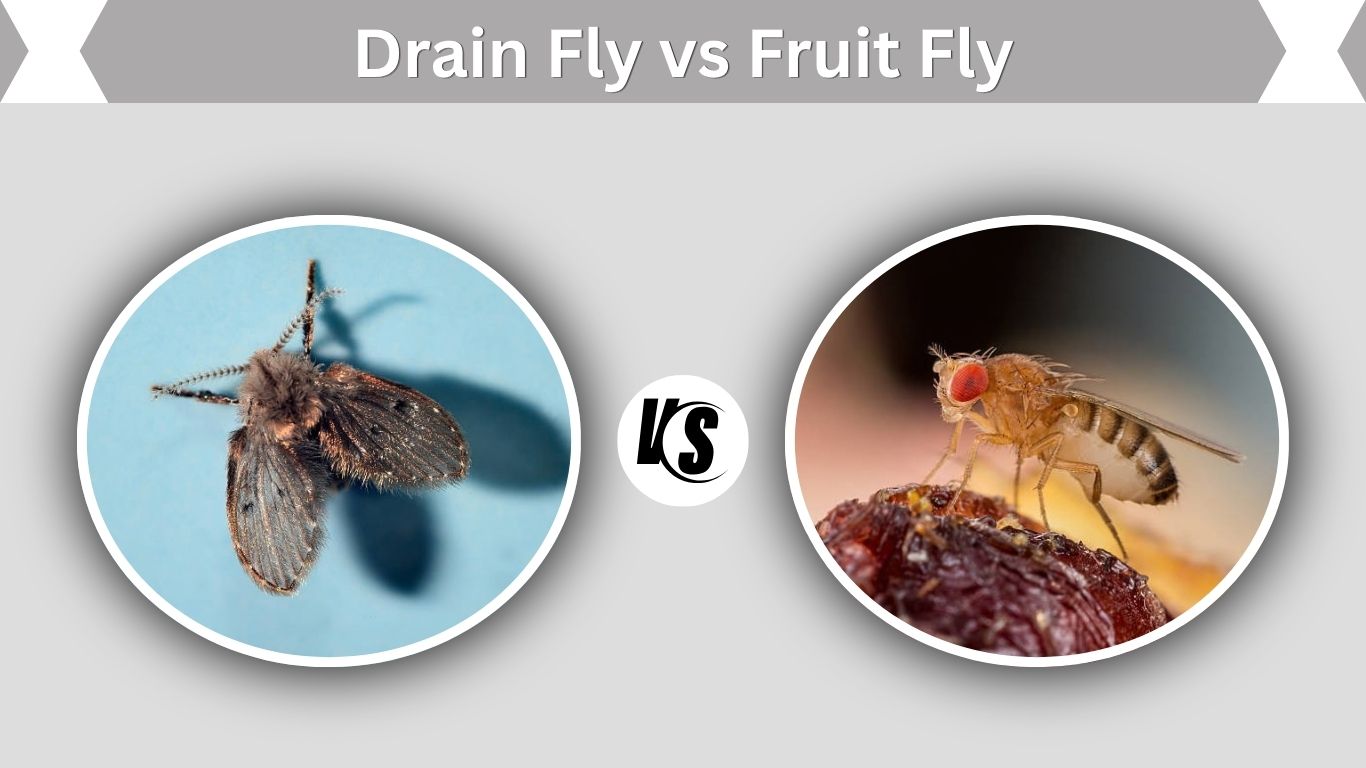
Drain flies and fruit flies are both tiny indoor flies, but they differ noticeably in appearance, breeding habitat, behavior, and control. Drain flies are fuzzy, moth-like insects that usually develop in organic buildup inside drains and other wet areas. Fruit flies are smoother-bodied, commonly have reddish eyes, and gather around fermenting fruit, vegetables, drinks, and food waste. Correctly identifying drain fly vs fruit fly activity helps you locate the breeding source and choose a control method that actually stops the infestation.
Drain Fly vs Fruit Fly: Key Differences
At first glance, both insects can look like tiny dark specks flying through a kitchen or bathroom. A closer look usually separates them quickly. Drain flies have fuzzy bodies and broad, hairy wings, while fruit flies have smoother tan or brown bodies. Where you consistently see the flies is often an even better identification clue than size alone.
Quick Identification Differences
- Drain fly: Fuzzy, moth-like appearance
- Fruit fly: Smooth, tan or yellow-brown body
- Drain fly size: Around 1/12 to 1/8 inch for many common indoor moth flies
- Fruit fly size: Around 1/16 to 1/8 inch
- Drain fly wings: Broad, hairy and often held roof-like
- Fruit fly wings: Clear and relatively narrow
- Drain fly location: Sinks, showers, floor drains and other damp areas
- Fruit fly location: Fruit bowls, trash, recycling and fermenting liquids
- Drain fly movement: Often rests on nearby walls and makes short flights
- Fruit fly movement: Frequently flies around food and containers
Fruit flies commonly have prominent red eyes, although eye color alone should not be used as the only identification feature.
What Does a Drain Fly Look Like?
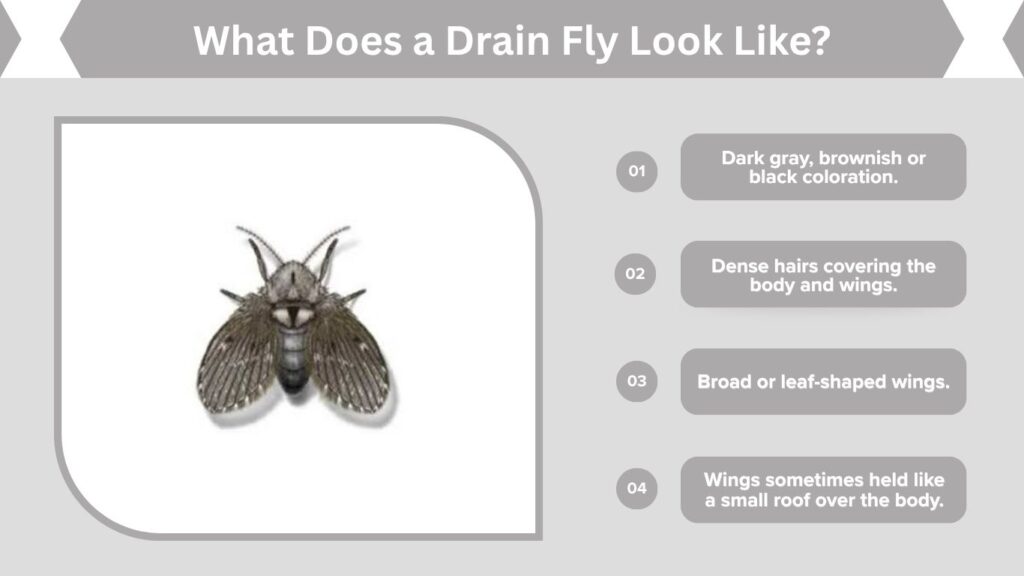
Drain flies are also called moth flies because adults resemble extremely small moths. Their hairy bodies and wings give them a fuzzy appearance that is quite different from the smoother body of a typical fruit fly. They are particularly common in bathrooms, kitchens and basements where continuously moist organic material provides suitable conditions for their immature stages.
Drain Fly Identification
Look for these characteristics:
- Dark gray, brownish or black coloration
- Dense hairs covering the body and wings
- Broad or leaf-shaped wings
- Wings sometimes held like a small roof over the body
- Tiny adult size, generally around 1/8 inch
- Adults resting on bathroom or kitchen walls
- Concentrated activity near sinks, showers or floor drains
University of Minnesota Extension describes moth flies as dark, hairy insects whose pointed wings may be held roof-like over the body.
Where Drain Flies Breed
Drain flies reproduce in wet organic material rather than in clean water itself. A drain can become an ideal breeding site when a gelatinous layer of organic debris develops inside the pipe.
Eggs are laid in moist decomposing material, and the larvae feed within that material. Suitable sites may include sink drains, shower drains, sewage-contaminated areas and other consistently damp places containing organic residue. Removing that material is therefore much more important than simply killing visible adult flies.
What Does a Fruit Fly Look Like?
Fruit flies are another common small household fly, particularly in kitchens. Unlike fuzzy drain flies, they generally have compact, smooth-looking bodies. Many common Drosophila fruit flies are tan to yellow-brown with darker abdomens and conspicuous reddish eyes. Their presence usually corresponds with fermenting foods or liquids rather than the gelatinous drain film preferred by drain flies.
Fruit Fly Identification
Typical fruit fly features include:
- Approximately 1/16 to 1/8 inch long
- Tan, yellowish-brown or brown body
- Darker abdomen
- Often prominent red eyes
- Clear wings
- Frequent hovering around food
- Strong attraction to fermenting fruit and vegetables
- Activity around beverage containers and trash
Penn State Extension notes that fruit flies are especially associated with ripened fruits and vegetables but may also occur around garbage disposals, trash containers and other moist areas containing fermenting material.
What Attracts Fruit Flies?
Fruit flies are strongly attracted to fermenting organic material. A forgotten piece of fruit, spilled juice, empty beer or wine containers, recycling residue or damp food waste can support an infestation.
Because the flies can develop quickly, removing only the adults provides temporary relief. The fermenting material where eggs and larvae are developing must also be discarded or thoroughly cleaned. Refrigerating ripe produce, cleaning spills and keeping trash containers clean can greatly reduce available breeding sites.
Fruit Fly vs Gnat vs Drain Fly
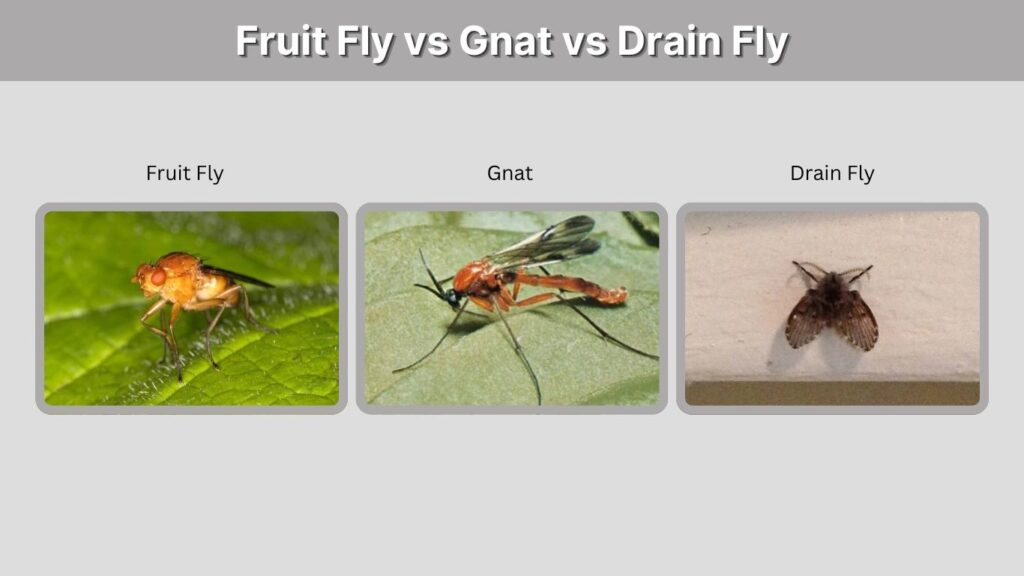
The word “gnat” is often used loosely for almost any tiny flying insect, which creates confusion when identifying an infestation. Fungus gnats, fruit flies and drain flies are different insects with different breeding requirements. The easiest approach is to examine body shape and then determine whether the insects are concentrated around plants, fermenting foods or wet drains.
How to Tell All Three Apart
- Drain fly: Fuzzy and moth-like; usually associated with drains and wet organic residue.
- Fruit fly: Tan or brown, often red-eyed; usually associated with fermenting food or beverages.
- Fungus gnat: Slender and mosquito-like with long legs and antennae; usually associated with moist houseplant soil.
- Drain fly wings: Broad and hairy.
- Fruit fly wings: Clear and relatively compact.
- Fungus gnat wings: Clear to grayish; common Bradysia species have a characteristic Y-shaped wing vein.
- Most useful location clue: Drain, kitchen food source, or potted plant soil.
Fungus gnats are typically about 1/16 to 1/8 inch long and often stay near moist potting media where their larvae feed on fungi, decaying material and sometimes plant roots.
Drain Fly vs Fruit Fly Infestation
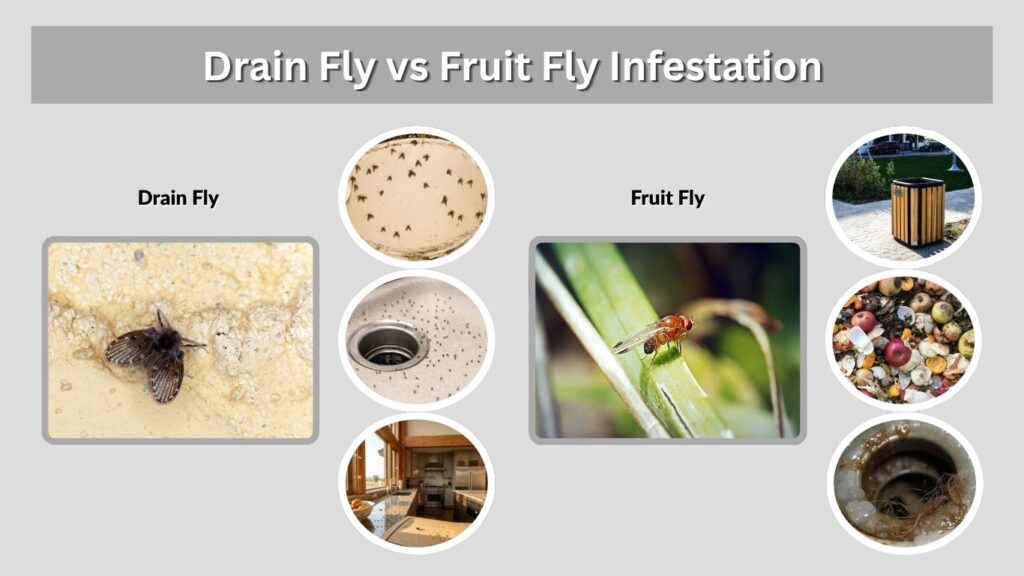
The location of repeated adult activity provides one of the strongest clues to the infestation source. Fruit flies normally point toward fermenting foods or liquids, while drain flies suggest persistent moisture and organic accumulation. However, both insects can occasionally occur around drains, so identifying the adult itself is important before deciding that the drain is responsible.
Signs of a Drain Fly Infestation
Drain flies frequently rest close to where they developed. Seeing several fuzzy adults repeatedly around one particular sink, bathtub or floor drain can indicate breeding inside or near that location.
A simple monitoring approach is to partially cover a suspected drain with sticky tape without completely sealing it. Adults emerging from the drain may become trapped on the adhesive. Persistent activity can also justify checking for plumbing leaks or sewage-related moisture problems.
Signs of a Fruit Fly Infestation
Fruit flies commonly become most noticeable around ripe fruit, vegetables, trash cans and recycling containers. They may also gather around spilled sugary drinks or residues from beer and wine.
If numbers decrease rapidly after fermenting materials are removed, fruit flies are a likely explanation. When tiny flies continue appearing despite thorough food sanitation, drains, garbage disposals and houseplants should also be inspected for other small fly species.
How to Get Rid of Drain Flies and Fruit Flies
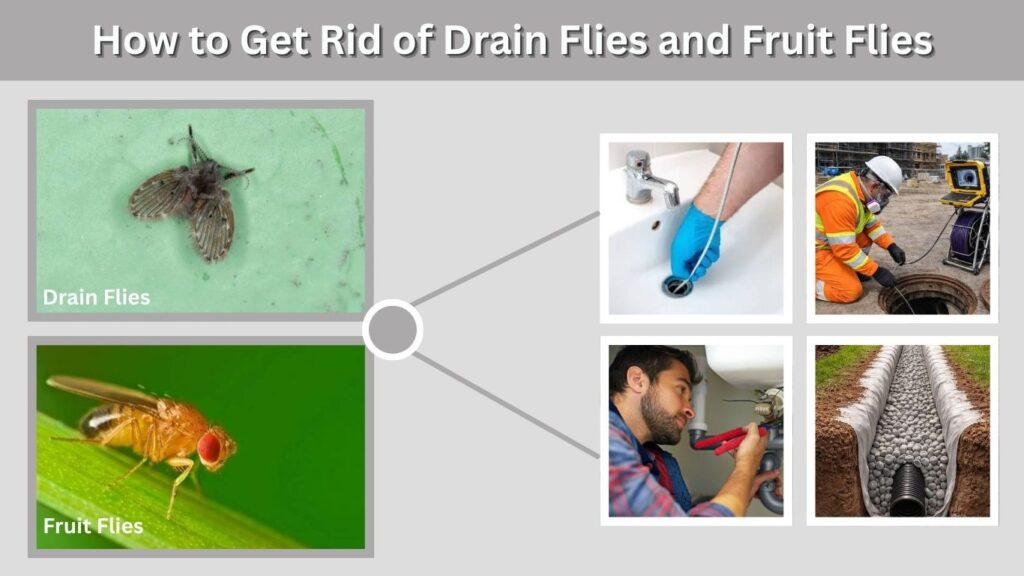
The best treatment depends on which fly is present. Traps can reduce or monitor adults, but lasting control requires eliminating the larval breeding material. This is especially important with drain flies because spraying visible adults will not remove the organic film inside plumbing where larvae may continue developing.
Getting Rid of Drain Flies
Use these steps:
- Identify which drain or wet location is producing adults.
- Inspect the inside of the drain for organic buildup.
- Physically scrub accessible pipe surfaces and drain openings.
- Remove accumulated slime and debris.
- Correct plumbing leaks and standing-water problems.
- Consider an appropriate biological or enzyme drain-cleaning product when needed.
- Continue monitoring until new adults stop appearing.
Penn State and University of Minnesota Extension both emphasize physically removing organic breeding material. UMN specifically notes that pouring boiling water, bleach or conventional chemical drain cleaner into a drain is not an effective substitute for removing the buildup.
Getting Rid of Fruit Flies
Fruit fly control starts with sanitation rather than insecticide. Dispose of overripe produce, refrigerate fruit when practical, clean food spills and rinse recycling containers.
Vinegar-based traps can capture adults and help reduce nuisance numbers, but they should accompany source removal rather than replace it. Check underneath appliances and inside trash or recycling containers for forgotten food residue if the flies keep returning.
FAQs
The similarities between these insects lead to several common identification questions. Size alone is rarely enough because drain flies, fruit flies and fungus gnats overlap considerably in length. Appearance, movement and breeding location provide much stronger clues. The following answers address the distinctions homeowners most frequently need when dealing with small indoor flies.
1. Are drain flies and fruit flies the same?
No. Drain flies belong to the moth fly family Psychodidae and have fuzzy, hairy wings. Common fruit flies belong to Drosophila and related groups and usually have smoother tan or brown bodies.
2. Which is bigger, a drain fly or fruit fly?
Their sizes overlap considerably. Common drain flies are around 1/8 inch, while fruit flies commonly range from about 1/16 to 1/8 inch. Body shape is therefore more useful than size for identification.
3. Can fruit flies live in drains?
Fruit flies can occur around drains when fermenting organic matter is present there. However, consistently seeing fuzzy, moth-like adults around a drain is more characteristic of drain flies.
4. How can I tell a fungus gnat from a fruit fly?
Fungus gnats have slender mosquito-like bodies, long legs and long antennae and are usually found around moist potting soil. Fruit flies are stockier, often have red eyes and are more strongly associated with fermenting food.
5. What kills drain flies and fruit flies permanently?
No single trap or spray provides permanent control if the breeding source remains. For drain flies, remove organic buildup and correct moisture or plumbing problems. For fruit flies, eliminate fermenting foods, liquids and contaminated waste. Source removal breaks the breeding cycle and provides the most reliable long-term control.