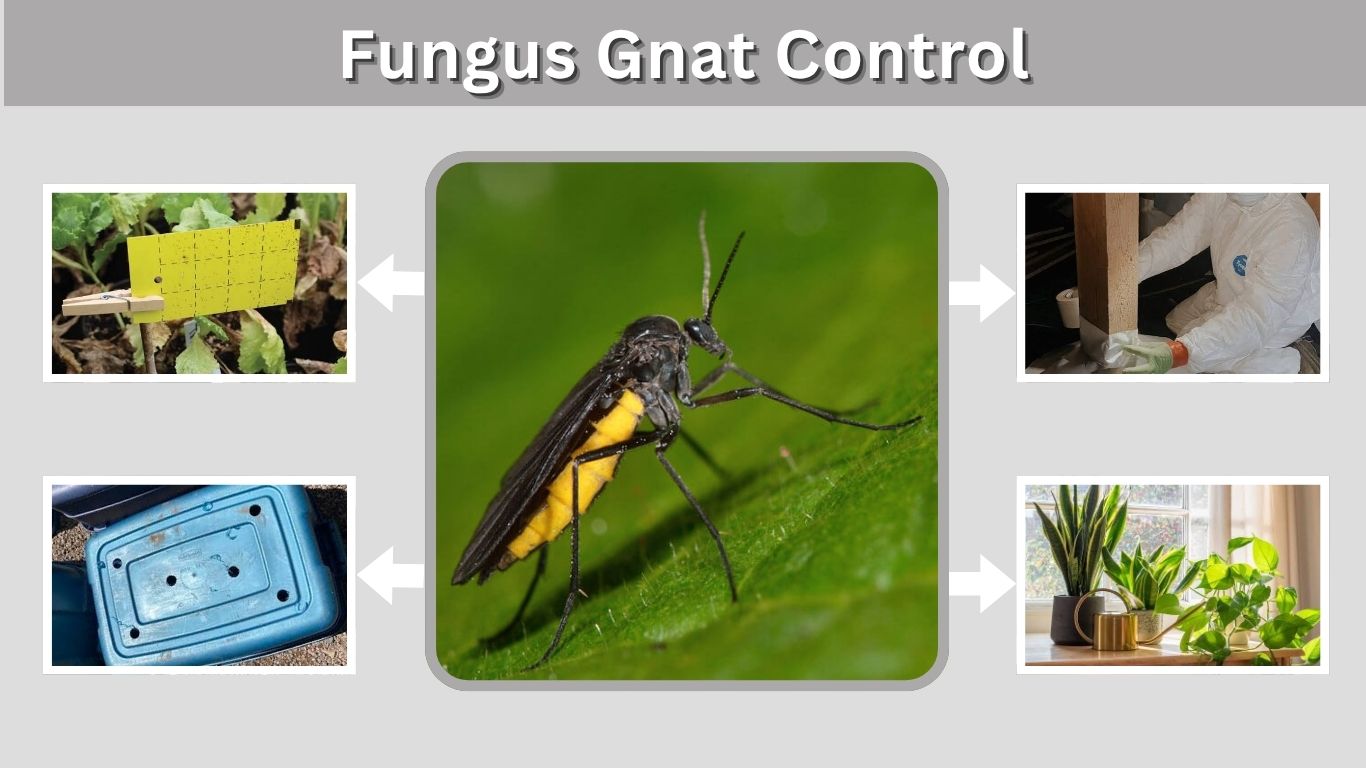
Effective fungus gnat control requires more than killing the small flies you see around your plants. Adult fungus gnats are mostly a nuisance, but their larvae live in moist growing media and can feed on fungi, decaying organic matter, and tender roots. The best control program targets both adults and larvae while reducing the wet conditions that allow them to reproduce. Whether you have fungus gnats in houseplants, a greenhouse, or an indoor growing area, combining moisture management, traps, and biological controls usually gives the best long-term results.
What Causes Fungus Gnats?
Fungus gnats are strongly associated with damp soil and decaying organic material.
Adult females look for moist growing media where they can lay their eggs. After hatching, the larvae remain in the soil and feed for several days before developing into pupae and eventually emerging as new adults.
Infestations are especially common when:
- Plants are overwatered
- Soil drains poorly
- Organic matter remains constantly moist
- Dead leaves accumulate on the soil
- Water collects in saucers
- New plants arrive already infested
- Greenhouses maintain consistently humid conditions
Controlling moisture is therefore the foundation of most fungus gnat management programs.
Best Fungus Gnat Control Methods
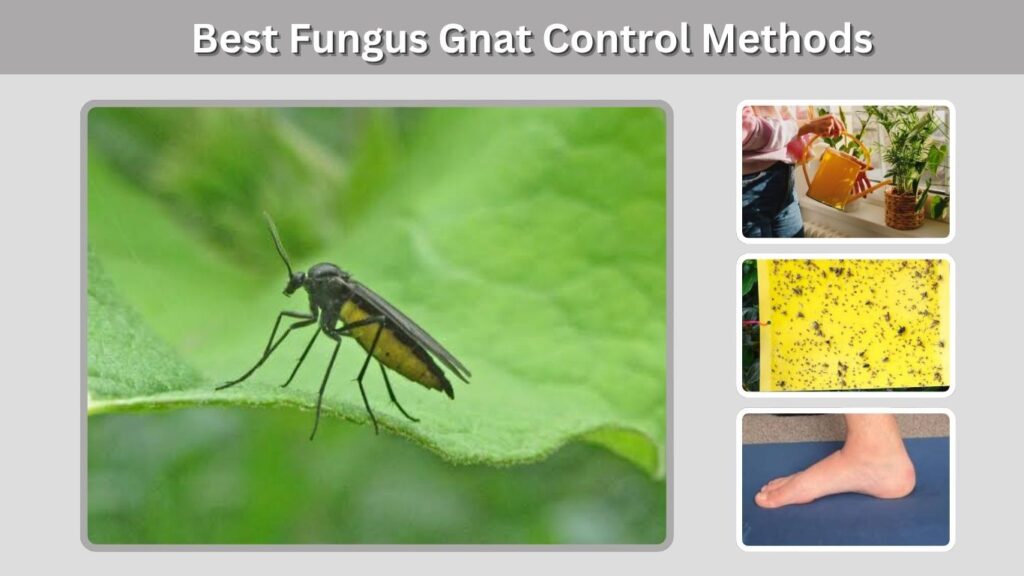
The most reliable approach is an integrated method that attacks several stages of the insect’s life cycle at the same time.
1. Reduce Excessive Watering
Letting the upper portion of the growing medium dry appropriately between waterings makes the soil less attractive to egg-laying females and less favorable to young larvae.
For houseplants that tolerate it, allow the upper 1 to 2 inches of soil to dry before watering again.
Do not deliberately dehydrate plants that require consistently moist conditions. Instead, improve drainage and avoid unnecessary saturation.
Bottom watering can also help keep the soil surface drier.
2. Use Yellow Sticky Traps
Yellow sticky cards are useful for controlling adult fungus gnats.
Place traps:
- Just above the soil surface
- Beside infested containers
- Around greenhouse benches
- Near propagation areas
Sticky traps will not eliminate larvae, but they reduce the number of breeding adults and help monitor whether your control program is working.
If trap catches gradually decline, the infestation is usually moving in the right direction.
3. Remove Decaying Material
Dead leaves, algae, decomposing roots, and organic debris provide food and moisture for fungus gnat larvae.
Regularly remove:
- Fallen leaves
- Dead flowers
- Decaying stems
- Moldy material
- Standing water
Greenhouse benches and floors should also be kept reasonably clean.
Fungus Gnat Larvae Control
Controlling larvae is critical because killing only the flying adults allows another generation to emerge.
Several biological options are particularly useful.
Bti for Fungus Gnat Control
Bacillus thuringiensis israelensis, usually called Bti, is a naturally occurring bacterium used to control certain fly larvae.
When fungus gnat larvae consume Bti, proteins produced by the bacterium disrupt their digestive system.
Bti products may be applied through irrigation water according to the product label.
Advantages include:
- Targets larvae directly
- Useful for houseplants and greenhouse crops
- Compatible with many integrated pest management programs
- Can be combined with sticky traps
Repeated applications may be necessary because Bti does not necessarily affect every life stage at once.
Mosquito-control products containing Bti are sometimes used against fungus gnats, but only use products in ways permitted by their labels.
Beneficial Nematodes for Fungus Gnat Control
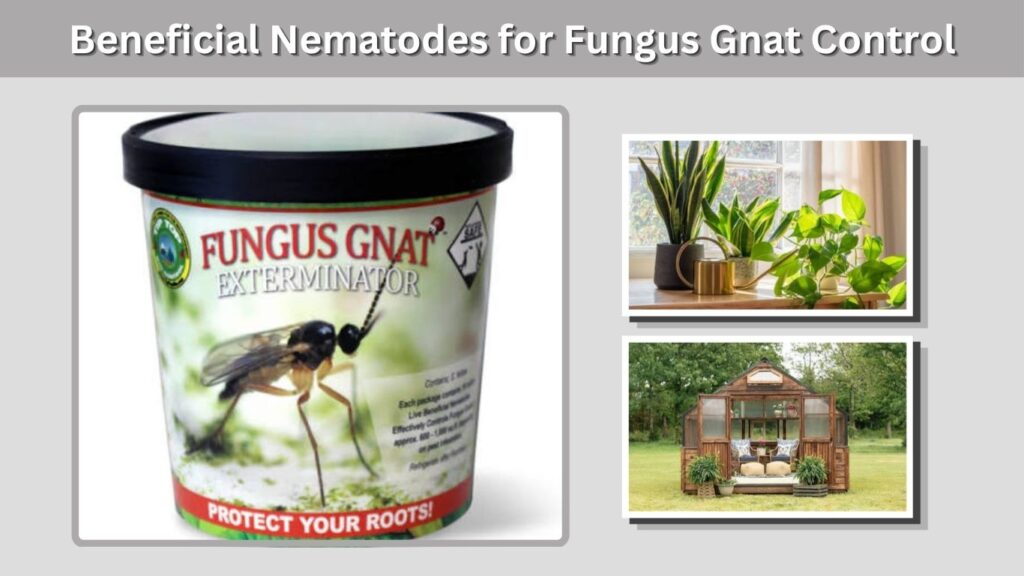
The beneficial nematode Steinernema feltiae is one of the most widely used biological controls for fungus gnat larvae.
These microscopic roundworms move through moist growing media and locate susceptible larvae.
They enter the insect and release symbiotic bacteria that kill the host.
Beneficial nematodes can be effective for:
- Houseplants
- Greenhouses
- Propagation trays
- Seedlings
- Indoor gardens
For best results, the growing medium should remain moist enough for the nematodes to move through it.
Avoid applying them to extremely dry soil.
Storage and application temperatures are also important because nematodes are living organisms.
Stratiolaelaps Scimitus for Fungus Gnat Control
Stratiolaelaps scimitus, formerly commonly sold as Hypoaspis miles, is a beneficial predatory mite used in greenhouse and indoor growing systems.
These mites live near the surface of the growing medium and prey on small soil-dwelling organisms, including fungus gnat larvae.
They can also attack some thrips pupae and other small pests.
Stratiolaelaps works best as a preventive or early-intervention biological control rather than as an instant treatment for a massive infestation.
The mites can establish in suitable growing media and provide ongoing suppression when environmental conditions are appropriate.
Rove Beetles for Fungus Gnat Control
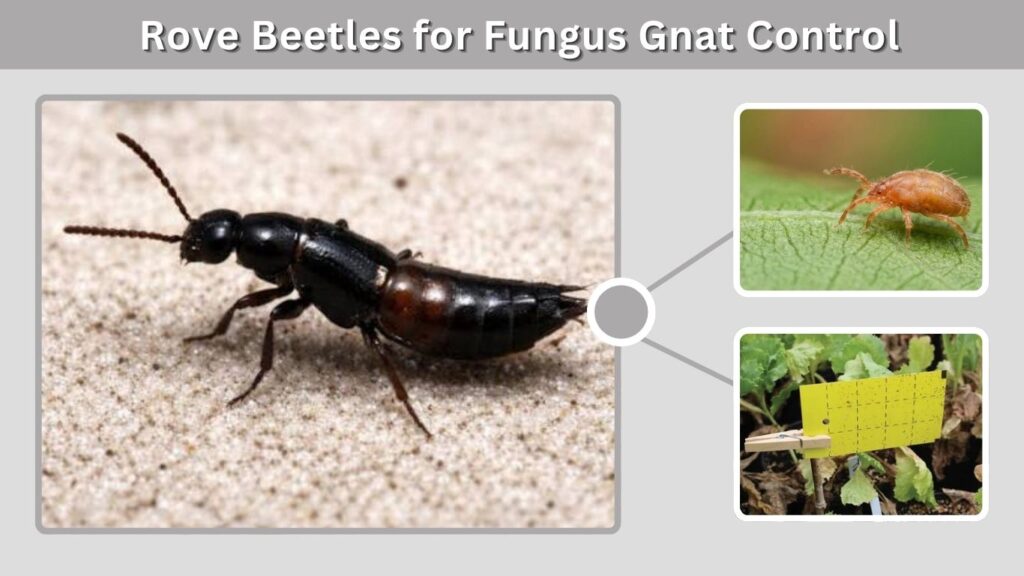
The rove beetle Dalotia coriaria is another biological control used in commercial greenhouse production.
Adults and larvae are predators that search the growing medium for fungus gnat larvae and other small pests.
Rove beetles are especially useful in larger greenhouse environments where they can move among containers and establish populations.
They are often combined with:
- Beneficial nematodes
- Predatory mites
- Sticky cards
- Proper irrigation management
Using several compatible biological controls can provide more consistent suppression.
Organic Fungus Gnat Control
Many effective fungus gnat control methods fit well within an organic or low-chemical management program.
Useful options include:
- Bti
- Beneficial nematodes
- Predatory mites
- Rove beetles
- Yellow sticky cards
- Moisture management
- Sanitation
The advantage of biological control is that it targets pest populations without relying entirely on conventional insecticides.
For severe infestations, combining two or more methods often works better than repeatedly applying a single product.
Fungus Gnat Control for Houseplants
For houseplants, a simple three-part approach is usually effective.
First, reduce unnecessary watering and improve drainage.
Second, place yellow sticky traps near the affected pots.
Third, use a soil treatment such as Bti or beneficial nematodes to target larvae.
Also inspect nearby plants because adults can easily move from one container to another.
If one plant has badly degraded or constantly waterlogged soil, repotting into fresh, well-draining growing medium may help.
Fungus Gnat Control in Greenhouses
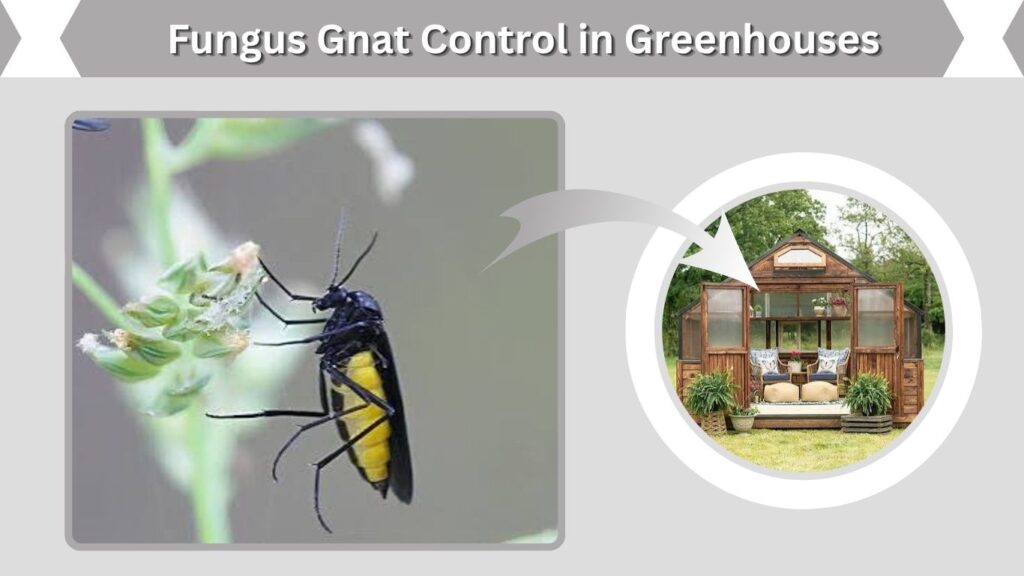
Greenhouses can experience persistent fungus gnat problems because they provide ideal conditions: warmth, humidity, moist growing media, and large numbers of plants.
A greenhouse control program should include:
Monitoring
Use yellow sticky cards to track adult populations.
Check cards regularly and record whether numbers are increasing or decreasing.
Irrigation Management
Avoid leaving floors, benches, and containers constantly wet.
Correct leaking irrigation lines and improve drainage wherever possible.
Biological Control
Beneficial organisms commonly used include:
- Steinernema feltiae
- Stratiolaelaps scimitus
- Dalotia coriaria
- Bti
Introducing biological controls early is often more effective than waiting until fungus gnat populations become extremely large.
Sanitation
Remove algae, plant debris, weeds, old growing media, and other material that can provide breeding sites.
Does Sand Control Fungus Gnats?
A layer of coarse sand over potting soil is sometimes recommended because it creates a drier surface that may make egg laying more difficult.
However, sand alone is rarely enough to eliminate an established infestation.
If the growing medium underneath remains saturated, larvae can continue developing.
Sand is best viewed as an additional preventive measure rather than the main control method.
Does Diatomaceous Earth Control Fungus Gnats?
Food-grade diatomaceous earth can damage insects that crawl through it while the material remains dry.
Its effectiveness decreases greatly when it becomes wet.
Because plant soil needs regular watering, maintaining a consistently dry diatomaceous earth layer can be difficult.
It may help suppress some adults or larvae near the surface but usually works better as part of a broader control program.
Avoid inhaling the dust when applying it.
Does Cinnamon Control Fungus Gnats?
Cinnamon is frequently suggested as a home remedy because it has antifungal properties.
However, sprinkling cinnamon on potting soil is not a dependable treatment for an established fungus gnat infestation.
It may affect some fungal growth but does not reliably eliminate eggs, larvae, pupae, and adults.
Proven methods such as Bti, beneficial nematodes, sticky traps, and moisture management are usually more effective.
Chemical Fungus Gnat Control
Chemical insecticides may be used when infestations cannot be controlled through sanitation and biological methods.
However, the product must be specifically labeled for:
- Fungus gnats
- The intended plant
- Indoor or greenhouse use, when applicable
Different products target different life stages.
Using an adult insecticide without addressing larvae in the soil often produces only temporary results.
Repeated unnecessary pesticide applications can also interfere with beneficial insects and biological controls.
Always follow label directions exactly.
How Long Does Fungus Gnat Control Take?
A fungus gnat infestation usually cannot be eliminated overnight.
Adults may begin disappearing within several days, but eggs and larvae already in the soil can continue developing.
Complete control commonly requires several weeks.
Continue monitoring even after adult numbers decline.
The best signs that control is working include:
- Fewer adults on sticky traps
- Fewer gnats flying around plants
- No larvae visible near the soil surface
- Reduced emergence after watering
How to Prevent Fungus Gnats
Prevention is easier than controlling a large infestation.
Follow these practices:
- Avoid overwatering plants
- Use containers with drainage holes
- Empty standing water
- Remove dead plant material
- Inspect new plants before bringing them indoors
- Store potting soil in dry conditions
- Keep greenhouse areas clean
- Monitor plants with sticky traps
- Use biological controls preventively when appropriate
FAQs
What is the best fungus gnat control?
The best approach combines moisture management, yellow sticky traps, and a larval treatment such as Bti or beneficial nematodes.
What kills fungus gnat larvae?
Bti, Steinernema feltiae nematodes, predatory mites, and rove beetles can all help control larvae.
Are beneficial nematodes effective against fungus gnats?
Yes. Steinernema feltiae is widely used to control fungus gnat larvae in soil and greenhouse growing media.
Can fungus gnats be controlled naturally?
Yes. Biological controls, sticky traps, sanitation, and proper watering can manage fungus gnats without relying heavily on conventional insecticides.
Why do fungus gnats keep coming back?
Recurring infestations usually mean that moist breeding sites remain available or larvae are still developing in the soil. Treating both adults and larvae while correcting excessive moisture provides the best long-term control.