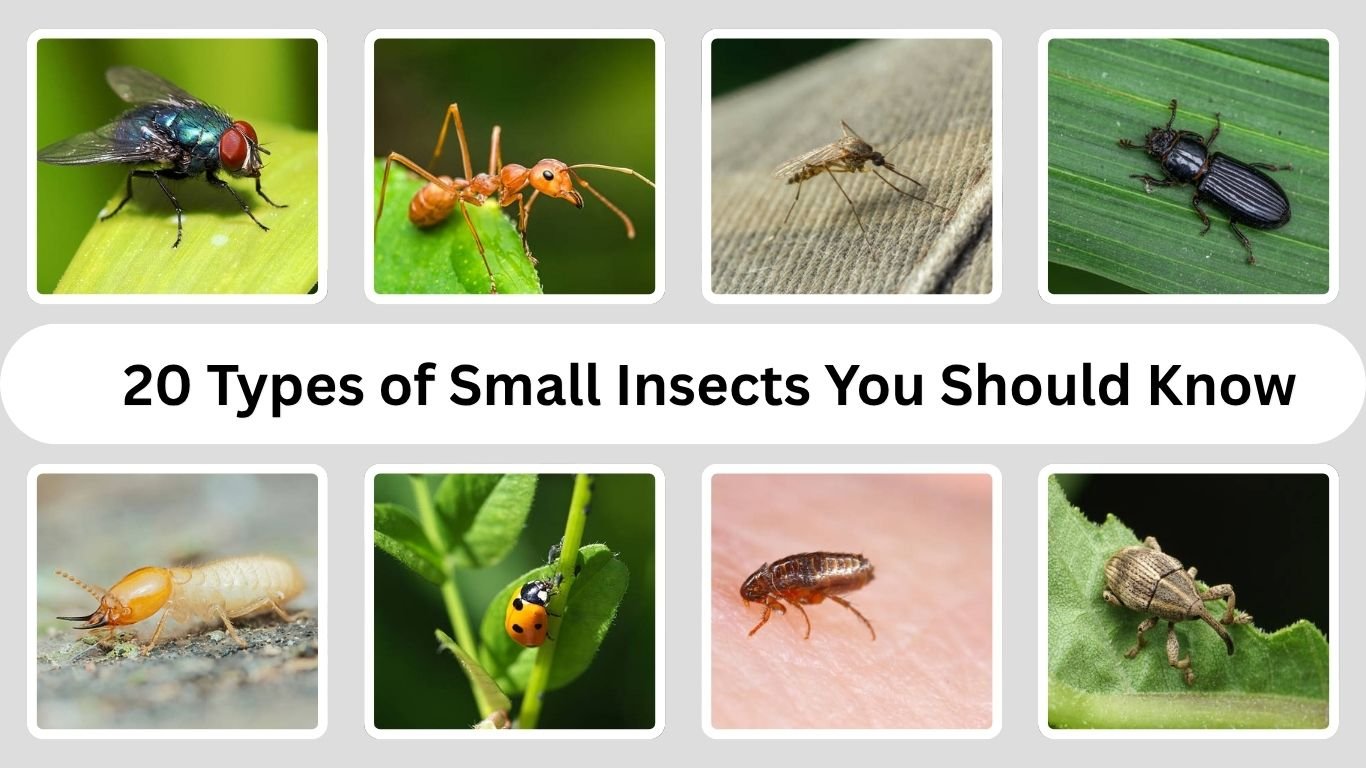
Small insects are everywhere—around your home, in gardens, and across natural environments. Despite their tiny size, they play important roles in ecosystems, from pollination and decomposition to pest control. Some are beneficial, while others can be harmful to humans, animals, or plants.
In this list, you’ll find 20 common types of small insects, each with simple details about their identification, habitat, diet, and behavior. This guide helps you recognize these insects easily and understand their impact on daily life and the environment.
1. Ant

Ants are small, social insects found almost everywhere in the world. They live in organized colonies and are known for their teamwork, strength, and ability to adapt to different environments. Ants play an important role in ecosystems by helping with soil aeration and decomposition.
Identification
- Small body divided into three parts: head, thorax, and abdomen
- Usually black, brown, or red in color
- Elbowed antennae
- Six legs
- Some species have wings during reproductive stages
Habitat
Ants can be found in a wide variety of habitats, including forests, grasslands, deserts, and urban areas. They often build nests underground, in soil, wood, or even inside walls and structures. Some species prefer moist environments, while others thrive in dry conditions. Their ability to adapt allows them to survive in both natural and human-made surroundings.
Diet
Ants are omnivorous and have a very flexible diet. They feed on sugars, seeds, fungi, and other insects. Many ants are attracted to sweet substances like nectar or food scraps, while others hunt small insects for protein. Some species even farm aphids to collect honeydew, a sugary liquid they produce.
Behavior
Ants are highly social insects that live in colonies with a clear division of labor. Each colony typically includes a queen, workers, and sometimes soldiers. Workers gather food, care for young, and maintain the nest, while the queen’s primary role is reproduction. Ants communicate using chemical signals called pheromones, which help them coordinate activities efficiently.
2. Fly

Flies are small, fast-moving insects commonly found around homes, gardens, and waste areas. They are known for their ability to fly quickly and reproduce rapidly. While some flies play a role in decomposition, others can spread diseases by carrying germs from one place to another.
Identification
- Small, soft-bodied insect
- Usually gray or black in color
- One pair of wings
- Large compound eyes
- Short antennae
Habitat
Flies are highly adaptable and can live in both rural and urban environments. They are often found near garbage, animal waste, decaying matter, and food sources. Flies prefer warm environments and are especially active during hot seasons. Indoors, they are commonly seen in kitchens and near uncovered food.
Diet
Flies feed on a wide range of organic materials. They are attracted to sugary substances, rotting food, and waste. Since they cannot chew, flies use their mouthparts to liquefy food before consuming it. This feeding habit often brings them into contact with harmful bacteria, which they can transfer to surfaces and food.
Behavior
Flies are known for their quick movements and strong flying ability. They are active during the day and tend to rest at night. Flies have a short life cycle, allowing them to reproduce quickly under favorable conditions. Their behavior often makes them difficult to catch, and they rely on their sharp vision to detect movement and escape danger.
3. Mosquito

Mosquitoes are tiny flying insects well known for their biting habit and ability to transmit diseases. They are commonly found in warm and humid environments. Only female mosquitoes bite, as they require blood to develop their eggs, making them a nuisance to humans and animals.
Identification
- Slender, small-bodied insect
- Long legs and narrow wings
- Proboscis (needle-like mouthpart) for biting
- Usually gray or brown in color
- Produces a buzzing sound while flying
Habitat
Mosquitoes thrive in areas with standing water, as it is essential for their breeding. They are commonly found near ponds, lakes, drains, and even small water containers like buckets or flower pots. Warm and humid climates support their rapid growth, and they are especially active during rainy seasons.
Diet
Male mosquitoes feed mainly on plant nectar and juices. Female mosquitoes also consume nectar but require blood meals to produce eggs. They are attracted to body heat, carbon dioxide, and certain body odors, which help them locate their hosts.
Behavior
Mosquitoes are most active during dawn and dusk. They use their sharp sense of smell to find hosts and can detect movement from a distance. After feeding, females lay eggs in water, continuing their life cycle. Their ability to spread diseases makes them one of the most harmful insects to humans.
4. Beetle

Beetles are one of the most diverse groups of insects, found in almost every environment on Earth. They vary greatly in size, shape, and color, but all share common features. Many beetles are harmless, while some can be pests or beneficial to agriculture.
Identification
- Hard outer wing covers (elytra)
- Strong, compact body
- Six legs
- Antennae of varying shapes
- Wide range of colors and sizes
Habitat
Beetles can live in forests, grasslands, deserts, and even aquatic environments. They are often found under rocks, in soil, inside wood, or on plants. Some species prefer dark, damp places, while others are active in open, sunny areas.
Diet
Beetles have diverse feeding habits depending on the species. Some feed on plants, leaves, and crops, while others consume insects or decaying organic matter. This makes them important for both agriculture and natural ecosystems, as they can act as pests or helpful decomposers.
Behavior
Beetles display a wide range of behaviors. Some are active during the day, while others are nocturnal. Many species use their hard wing covers for protection against predators. Certain beetles can fly, while others rely on crawling. Their adaptability helps them survive in many different environments.
5. Termite

Termites are small insects known for feeding on wood and causing damage to buildings and furniture. They live in large colonies and are often called “silent destroyers” because they can go unnoticed for long periods while causing significant structural harm.
Identification
- Small, soft-bodied insect
- Usually white or light brown
- Straight antennae
- Thick waist (no narrow segment)
- Some have wings during swarming stage
Habitat
Termites prefer warm, moist environments and are commonly found in soil, wood, and underground colonies. They build tunnels and mud tubes to travel safely between their nests and food sources. Termites are often present in wooden structures, especially in damp conditions.
Diet
Termites mainly feed on cellulose, which is found in wood, paper, and plant materials. They rely on special microorganisms in their digestive system to break down this tough material. This diet makes them important in nature for recycling dead plants but harmful in human structures.
Behavior
Termites are social insects that live in organized colonies with workers, soldiers, and a queen. Workers gather food and maintain the nest, while soldiers defend it. They communicate using chemical signals and work together efficiently, often remaining hidden inside wood or soil.
6. Aphid

Aphids are tiny, soft-bodied insects that feed on plant sap. They are common garden pests and can damage crops and plants by weakening them and spreading plant diseases. Aphids reproduce quickly, making infestations grow rapidly if not controlled.
Identification
- Very small, pear-shaped body
- Usually green, black, or yellow
- Soft-bodied with long antennae
- Some have wings
- Found in clusters on plants
Habitat
Aphids are commonly found on the leaves, stems, and buds of plants. They prefer warm conditions and are often seen in gardens, farms, and greenhouses. They tend to gather on the underside of leaves where they are protected from predators.
Diet
Aphids feed by sucking sap from plants using their needle-like mouthparts. This feeding reduces plant strength and can cause leaves to curl or yellow. They also produce a sticky substance called honeydew, which can attract ants and lead to mold growth.
Behavior
Aphids reproduce rapidly, often without mating, which allows their population to increase quickly. They tend to live in groups and can spread easily from one plant to another. Their relationship with ants is notable, as ants protect aphids in exchange for honeydew.
7. Flea

Fleas are tiny, wingless insects known for their jumping ability and parasitic lifestyle. They commonly live on animals such as dogs and cats, feeding on blood. Fleas can also bite humans and may cause itching and irritation.
Identification
- Very small, dark brown body
- Wingless insect
- Flattened body from side to side
- Strong hind legs for jumping
- Hard outer body
Habitat
Fleas are usually found on animals or in places where animals rest, such as bedding, carpets, and furniture. They prefer warm and humid environments, which help them reproduce quickly. Outdoors, they may live in soil or shaded areas where hosts are present.
Diet
Fleas feed on the blood of mammals and birds. Both male and female fleas require blood meals for survival, but females need it to produce eggs. Their bites often cause itching and allergic reactions in their hosts.
Behavior
Fleas are excellent jumpers and can move quickly between hosts. They spend most of their life cycle off the host, laying eggs in the environment. Fleas reproduce rapidly, and infestations can spread quickly if not controlled.
8. Louse

Lice are tiny parasitic insects that live on the bodies of humans and animals. They are commonly found in hair, clothing, or on the skin, where they feed on blood. Lice infestations are common, especially in crowded conditions.
Identification
- Very small, pale or grayish insect
- Wingless body
- Flattened shape
- Six legs with claws for gripping
- Slow-moving
Habitat
Lice live directly on their host, such as the scalp, body, or clothing. They cannot survive long away from a host. Human lice are often found in hair (head lice) or clothing seams (body lice), depending on the type.
Diet
Lice feed exclusively on blood. They bite the skin and draw small amounts of blood several times a day. This feeding can cause itching and discomfort, especially in sensitive individuals.
Behavior
Lice spread mainly through direct contact, such as sharing personal items or close physical interaction. They lay eggs, called nits, which stick firmly to hair or fabric. Lice do not jump or fly; instead, they crawl from one host to another.
9. Weevil

Weevils are small beetles known for their long snouts and plant-feeding habits. Many species are considered pests because they damage crops, stored grains, and food products. Despite their small size, they can cause significant agricultural and storage losses.
Identification
- Small, oval-shaped body
- Distinct long snout (rostrum)
- Usually brown or black
- Six legs
- Hard outer shell
Habitat
Weevils are commonly found in fields, gardens, and storage areas. Some species live outdoors on plants, while others infest stored grains like rice, wheat, and corn. They prefer warm environments and can easily spread in food storage conditions.
Diet
Weevils primarily feed on plant material. Many species consume seeds, grains, and crops, while others feed on leaves and stems. Stored grain weevils can infest food supplies, making them a common household and agricultural pest.
Behavior
Weevils are slow-moving insects that often hide inside food materials. They use their snouts to bore into seeds and lay eggs. Their larvae develop inside the food source, which makes infestations difficult to detect early.
10. Gnat

Gnats are tiny flying insects often seen in groups, especially in moist environments. They are commonly found around plants, water, and decaying matter. Some gnats are harmless, while others can bite or become a nuisance.
Identification
- Very small, delicate body
- Long legs and wings
- Usually black or dark-colored
- Weak flying ability
- Often seen in swarms
Habitat
Gnats prefer damp and humid environments. They are commonly found near standing water, houseplants, drains, and compost areas. Indoors, they are often seen around potted plants where the soil remains moist.
Diet
The diet of gnats varies by species. Many feed on organic matter, fungi, or plant roots, especially in their larval stage. Some adult gnats feed on nectar, while a few species may bite and feed on blood.
Behavior
Gnats are known for flying in groups, often forming small swarms. They are attracted to light, moisture, and organic material. Their life cycle is short, allowing populations to grow quickly under suitable conditions, especially in indoor plant environments.
11. Midge

Midges are very small flying insects that are often mistaken for mosquitoes. Most species do not bite, but some can cause irritation to humans and animals. They are commonly found near water and tend to gather in large swarms.
Identification
- Very tiny, delicate body
- Slender shape with long legs
- Usually gray or black
- One pair of wings
- Often seen flying in groups
Habitat
Midges are commonly found near lakes, rivers, ponds, and other water sources. They prefer moist environments where their larvae can develop. You may also see them around lights at night, especially in areas close to water bodies.
Diet
Most adult midges feed on nectar and other plant-based substances. Their larvae usually consume organic matter, algae, or microorganisms found in water or damp soil. Some biting species feed on blood, but many are harmless.
Behavior
Midges are known for forming large swarms, especially during the evening. These swarms are often part of mating behavior. They are attracted to light and moisture, and their short life cycle allows them to reproduce quickly in suitable conditions.
12. Thrips

Thrips are tiny insects that feed on plants and can cause damage to crops and garden plants. They are difficult to notice due to their small size but can become serious pests when their population increases.
Identification
- Extremely small and slender body
- Usually yellow, brown, or black
- Narrow wings with fringes
- Short antennae
- Hard to see without close inspection
Habitat
Thrips are commonly found on plants, especially on leaves, flowers, and buds. They thrive in warm, dry environments and are often present in gardens, farms, and greenhouses. They tend to hide in tight spaces on plants.
Diet
Thrips feed by sucking the contents of plant cells. This feeding causes visible damage such as silvering, spotting, or distortion of leaves and flowers. Some species may also feed on fungi or small insects.
Behavior
Thrips are active and can move quickly despite their tiny size. They spread easily through wind or by attaching to clothing and plants. Their rapid reproduction can lead to large infestations, making them difficult to control once established.
13. Silverfish

Silverfish are small, wingless insects known for their shiny, silvery appearance and fish-like movements. They are commonly found in homes and feed on starchy materials, making them household pests.
Identification
- Small, elongated body
- Silvery-gray color
- Wingless insect
- Long antennae
- Three tail-like appendages
Habitat
Silverfish prefer dark, damp environments such as bathrooms, kitchens, basements, and storage areas. They hide in cracks, crevices, and behind objects during the day. High humidity levels make indoor spaces ideal for their survival.
Diet
Silverfish feed on carbohydrates, especially starches and sugars. Common food sources include paper, glue, book bindings, fabrics, and food crumbs. Their feeding habits can damage books, wallpaper, and clothing over time.
Behavior
Silverfish are nocturnal and move quickly in a wriggling motion. They avoid light and are most active at night. These insects can survive long periods without food, which makes them difficult to eliminate once they infest an area.
14. Earwig

Earwigs are small insects recognized by the pincers at the end of their abdomen. While they may look intimidating, they are mostly harmless to humans and are often found in gardens and damp outdoor areas.
Identification
- Elongated, brown or dark-colored body
- Pair of forceps-like pincers (cerci) at the rear
- Six legs
- Short wings (some can fly)
- Long antennae
Habitat
Earwigs prefer moist and dark environments. They are commonly found under rocks, logs, leaves, and in garden soil. Indoors, they may enter homes through cracks, especially during wet weather, seeking shelter.
Diet
Earwigs are omnivorous and feed on a variety of materials. They eat plant matter, fruits, and small insects. While they can damage plants, they also help by feeding on pests, making them both beneficial and harmful in gardens.
Behavior
Earwigs are mostly nocturnal and hide during the day. They use their pincers for defense and capturing prey. Despite common myths, they do not crawl into human ears. They are generally shy and avoid human contact.
15. Firefly

Fireflies, also known as lightning bugs, are small beetles famous for their ability to produce light. This glowing feature is used mainly for communication and attracting mates. They are commonly seen during warm evenings, creating a beautiful natural display.
Identification
- Small, soft-bodied beetle
- Usually black or brown with yellow markings
- Light-producing organ in the abdomen
- Soft wings
- Short antennae
Habitat
Fireflies are typically found in warm, humid environments such as forests, grasslands, and gardens. They prefer areas near water like ponds or streams. During the day, they rest in vegetation, becoming active in the evening and night.
Diet
Firefly larvae are often predatory and feed on small insects, snails, and slugs. Adult fireflies may feed on nectar, pollen, or sometimes do not eat at all, depending on the species.
Behavior
Fireflies are best known for their bioluminescence, which they use to attract mates. Each species has a unique flashing pattern. They are mostly active at night, and their light displays are a key part of their mating behavior.
16. Dragonfly

Dragonflies are fast-flying insects known for their long bodies and large wings. They are skilled predators and play an important role in controlling mosquito populations. Dragonflies are commonly found near water sources.
Identification
- Long, slender body
- Two pairs of large, transparent wings
- Large compound eyes
- Strong flying ability
- Bright or metallic colors
Habitat
Dragonflies are usually found near freshwater sources such as ponds, lakes, rivers, and wetlands. Their larvae live in water, so they depend on aquatic habitats for reproduction. Adults are often seen flying over water or resting on plants nearby.
Diet
Dragonflies are carnivorous and feed on other insects. They commonly eat mosquitoes, flies, and small flying insects. Their larvae also hunt aquatic organisms, making them effective predators both in water and air.
Behavior
Dragonflies are highly active and excellent fliers. They can hover, glide, and even fly backward. They hunt during the day and rely on their strong vision to catch prey in mid-air. Their life cycle includes both aquatic and aerial stages.
17. Damselfly

Damselflies are slender, delicate insects closely related to dragonflies. They are often found near water and are known for their graceful flight. Unlike dragonflies, they have a more fragile body and usually rest with their wings folded over their back.
Identification
- Slim, elongated body
- Two pairs of narrow wings
- Wings usually folded when at rest
- Large compound eyes (separated)
- Often brightly colored
Habitat
Damselflies are commonly found near freshwater environments such as ponds, lakes, and slow-moving streams. Their larvae develop in water, so they depend on aquatic habitats. Adults are often seen resting on plants or flying gently around water edges.
Diet
Damselflies are carnivorous and feed on small insects like mosquitoes, flies, and other tiny flying insects. Their larvae also hunt small aquatic organisms. This makes them helpful in controlling insect populations.
Behavior
Damselflies are active during the day and are known for their gentle, fluttering flight. They rely on their vision to hunt prey. During mating, they form a distinctive heart-shaped position. They are less aggressive and slower than dragonflies.
18. Cricket

Crickets are small insects best known for the chirping sound they produce, especially at night. They are commonly found in fields, gardens, and sometimes inside homes. Their sound is created by rubbing their wings together.
Identification
- Small to medium-sized body
- Usually brown or black
- Long antennae
- Strong hind legs for jumping
- Some species have wings
Habitat
Crickets live in a variety of environments, including grasslands, forests, gardens, and buildings. They prefer warm and dry places but can also be found in moist areas. Indoors, they hide in cracks, basements, and dark corners.
Diet
Crickets are omnivores and feed on plants, seeds, fungi, and small insects. They may also consume decaying organic matter. In homes, they sometimes feed on fabrics, paper, or food crumbs.
Behavior
Crickets are mostly nocturnal and are famous for their chirping, which males use to attract females. They are strong jumpers and can move quickly when disturbed. Their sound is more noticeable during warm nights.
19. Grasshopper

Grasshoppers are medium-sized insects known for their strong jumping ability and plant-feeding habits. They are commonly seen in fields and grassy areas, especially during warm seasons. Some species can become agricultural pests when present in large numbers.
Identification
- Medium-sized body
- Usually green or brown
- Strong hind legs for jumping
- Short antennae
- Two pairs of wings
Habitat
Grasshoppers are mostly found in open areas such as grasslands, fields, gardens, and meadows. They prefer warm and dry environments where vegetation is abundant. They are often seen resting on plants or jumping through tall grass.
Diet
Grasshoppers are herbivores and mainly feed on grasses, leaves, and crops. They can consume large amounts of plant material, which may cause damage to crops and vegetation when their population increases significantly.
Behavior
Grasshoppers are active during the day and are excellent jumpers. They use their powerful hind legs to escape predators quickly. Some species can also fly short distances. Their activity increases in warm weather, and they are usually solitary but may form groups.
20. Bedbug

Bedbugs are small parasitic insects that feed on human blood. They are commonly found in sleeping areas and are known for causing itchy bites. Bedbugs are difficult to detect and eliminate once they infest a space.
Identification
- Small, flat, oval-shaped body
- Reddish-brown color
- Wingless insect
- Six legs
- Swells after feeding
Habitat
Bedbugs are usually found in mattresses, bed frames, furniture, and cracks in walls. They prefer to stay close to their host, especially in sleeping areas. They can also hide in luggage, clothing, and other personal items.
Diet
Bedbugs feed exclusively on blood, mainly from humans. They come out at night to bite and feed for a few minutes before returning to their hiding spots. Their bites can cause itching and skin irritation.
Behavior
Bedbugs are nocturnal and remain hidden during the day. They are not able to fly or jump but move by crawling. They spread easily through travel and shared spaces. Their ability to hide and reproduce quickly makes them challenging pests to control.