Fruit flies are tiny household insects commonly seen around ripe fruit, garbage, drains, and other places containing fermenting organic material. They are usually only a few millimeters long, so identifying them can be difficult without looking closely. Adult fruit flies typically have tan or light-brown bodies, transparent wings, and noticeable red eyes, although some varieties have darker eyes. Understanding what fruit flies, their eggs, larvae, and young stages look like can help you distinguish them from gnats, drain flies, and other small insects found inside homes.
What Do Fruit Flies Look Like?
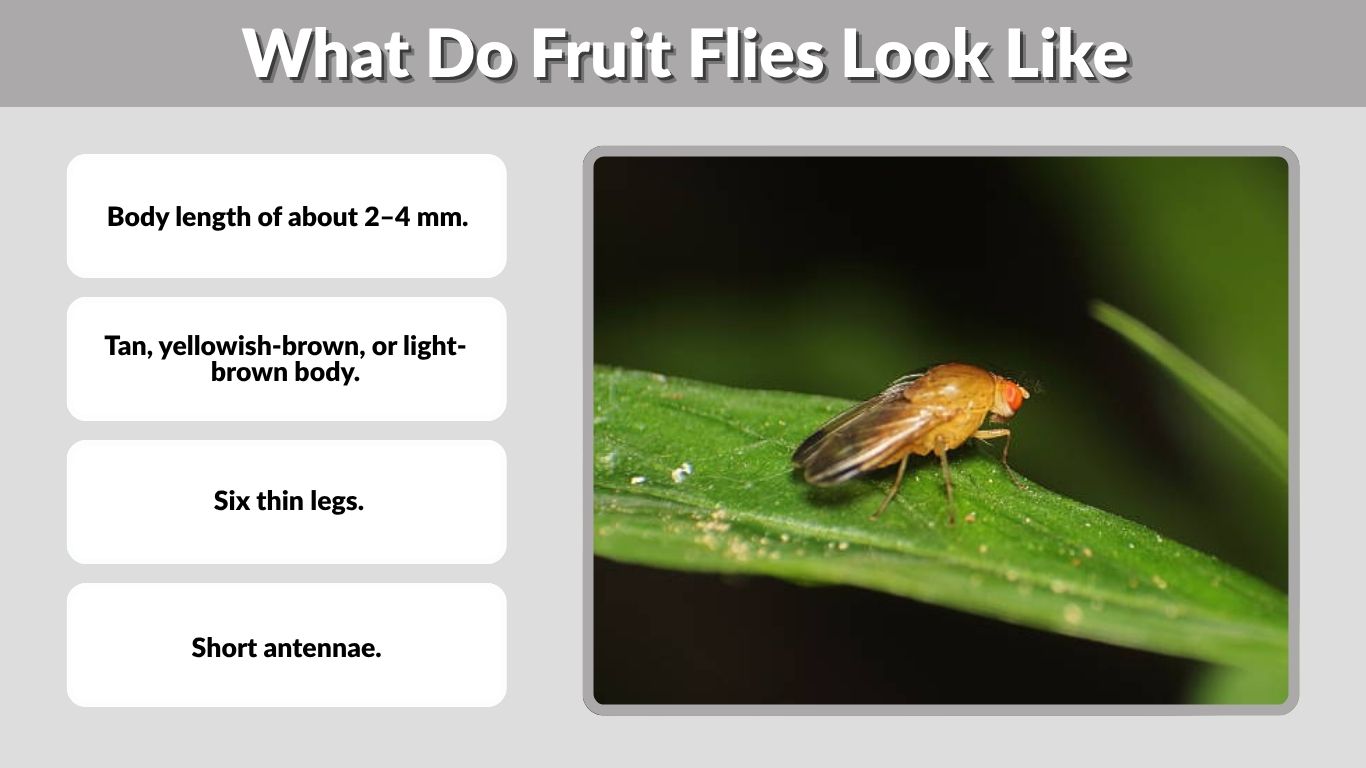
Fruit flies are extremely small flies belonging mainly to the family Drosophilidae. The common household fruit fly, Drosophila melanogaster, is one of the species people frequently notice around kitchens. Their small size means many of their distinguishing features are difficult to see without magnification, but several characteristics can still help homeowners identify them.
Adult Fruit Fly Identification
Typical adult fruit flies have:
- Body length of about 2–4 mm
- Tan, yellowish-brown, or light-brown body
- Large red or reddish eyes in many species
- Transparent wings
- Six thin legs
- Short antennae
- Rounded abdomen
- Compact body shape
Their bodies are usually more robust than the slender bodies of fungus gnats.
What Do Fruit Flies Look Like to the Human Eye?
To the naked eye, a fruit fly looks like a tiny tan or brown speck with wings. You may notice its reddish eyes only when viewing the insect closely.
When fruit flies move around a kitchen, they often appear as tiny flies hovering slowly around bananas, apples, tomatoes, wine glasses, garbage containers, or other food sources.
Their small size can make it difficult to see details while they are flying. Looking at one resting on a light-colored wall or window makes identification easier.
What Do Fruit Flies Look Like Up Close?
Under magnification, fruit flies have much more recognizable features. Their compound eyes occupy a noticeable portion of the head, while the body is divided into a head, thorax, and abdomen. Their wings extend over the back, and fine hairs can be visible across parts of the body and legs.
Fruit Fly Close-Up Appearance
When viewed closely, look for:
- Large compound eyes
- Short, bristle-like antennae
- Transparent wings with visible veins
- Fine body hairs
- Tan or yellowish thorax
- Darker markings across the abdomen
- Six jointed legs
The classic red eyes associated with fruit flies are particularly obvious under magnification.
Do All Fruit Flies Have Red Eyes?
No. Although the common laboratory and household species Drosophila melanogaster often has bright red eyes, not every fruit fly looks identical.
Different species can have darker, brownish, or nearly black-looking eyes. Body color also varies between species, so identification should not depend on eye color alone.
Where the insects are gathering and breeding can provide additional identification clues.
What Do Fruit Fly Eggs Look Like?
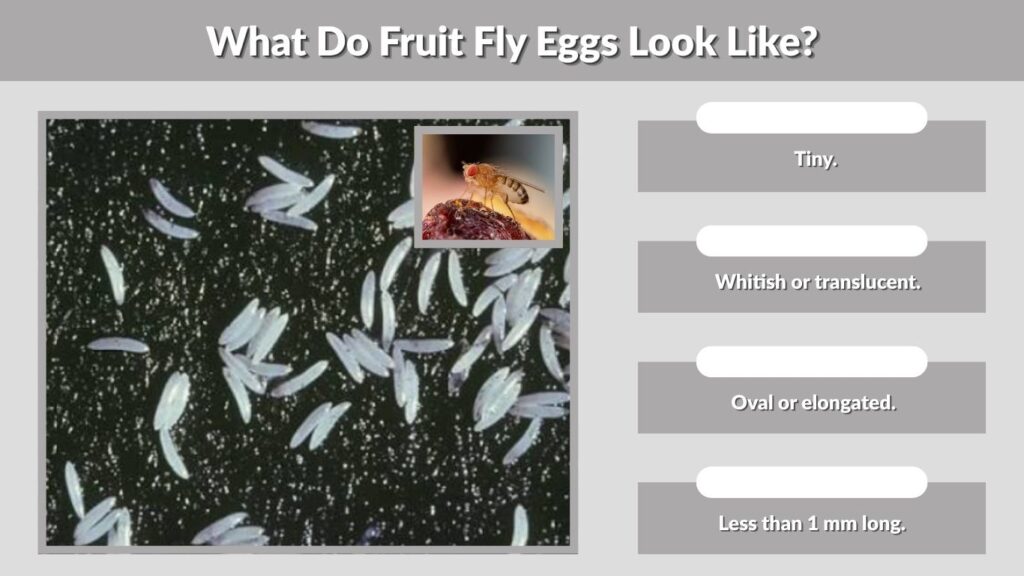
Fruit fly eggs are much too small to be easily noticed during an ordinary kitchen inspection. Females typically place their eggs directly on or close to fermenting organic material so newly hatched larvae immediately have access to food.
Appearance of Fruit Fly Eggs
Fruit fly eggs are generally:
- Tiny
- Whitish or translucent
- Oval or elongated
- Less than 1 mm long
- Difficult to see without magnification
Some eggs have tiny filament-like structures that are visible under magnification.
Because they are so small, homeowners usually notice adult flies before discovering eggs.
Where Are Fruit Fly Eggs Found?
Eggs may be deposited around fermenting or decaying materials such as overripe fruit, vegetable scraps, beverage residue, garbage, recycling containers, or compost.
Fruit flies do not usually create a visible nest. Instead, they lay eggs directly around suitable food and moisture.
This is why removing breeding material is more effective than simply killing adult flies.
What Do Baby Fruit Flies Look Like?
People searching for baby fruit flies are usually referring to fruit fly larvae. Fruit flies undergo complete metamorphosis, meaning they develop through egg, larval, pupal, and adult stages. Young fruit flies therefore do not look like miniature versions of the adults.
Fruit Fly Larvae
Larval fruit flies look like:
- Tiny whitish worms
- Legless maggots
- Pale or almost transparent bodies
- Narrow bodies that taper toward one end
- Very small moving larvae within moist food material
They normally remain close to the food source where they hatched.
Fruit fly larvae feed primarily on microorganisms such as yeast growing in decomposing or fermenting organic material.
What Do Fruit Flies Look Like Before They Fly?
Before becoming winged adults, fruit flies enter the pupal stage. The pupa looks very different from both the larva and adult.
A fruit fly pupa is small, oval or capsule-shaped, and generally becomes darker as development continues. Pupae may be found on relatively dry surfaces close to the original breeding material.
An adult eventually emerges from the pupal case with fully developed legs and wings.
What Do Fruit Flies Look Like in the House?
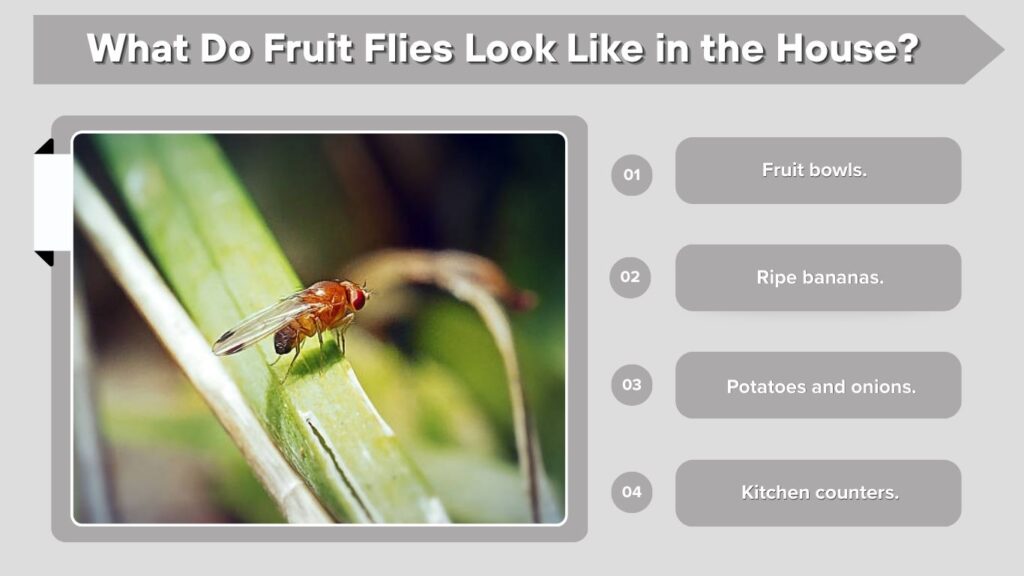
Fruit flies inside homes usually appear as groups of tiny flies repeatedly gathering around food or moisture. Kitchens are the most common location, although infestations can occur anywhere fermenting organic material is available.
Common Places to Find Fruit Flies
Look around:
- Fruit bowls
- Ripe bananas
- Potatoes and onions
- Kitchen counters
- Garbage cans
- Recycling bins
- Compost containers
- Wine or beer bottles
- Juice containers
- Garbage disposals
- Food spills beneath appliances
Seeing multiple tiny tan flies around these locations strongly suggests a fruit fly problem.
Do Fruit Flies Nest?
Fruit flies do not construct nests like ants, wasps, or some other insects.
Instead, females lay eggs individually or in groups near suitable breeding material. Therefore, what appears to be a fruit fly “nest” is usually simply an area containing fermenting food, eggs, larvae, and possibly pupae.
Removing that material interrupts their development.
Fruit Flies vs. Gnats: What Do They Look Like?
Fruit flies and gnats are frequently confused because both are very small flying insects commonly found indoors. However, their appearance and preferred breeding areas provide useful clues for telling them apart.
Fruit Fly vs. Fungus Gnat Appearance
Important differences include:
- Fruit flies: Usually tan or brown with compact bodies.
- Fungus gnats: Usually dark gray or black.
- Fruit flies: Often have prominent reddish eyes.
- Fungus gnats: Have less noticeable eyes.
- Fruit flies: Have relatively short legs and antennae.
- Fungus gnats: Have long legs and slender antennae.
- Fruit flies: Common around fermenting food.
- Fungus gnats: Common around moist houseplant soil.
Fungus gnats often resemble tiny mosquitoes, while fruit flies have a rounder, more typical fly-like appearance.
Fruit Flies vs. Drain Flies
Drain flies are another common source of confusion.
Drain flies have broad, fuzzy wings and bodies that can make them resemble miniature moths. They typically rest with their wings forming a roof-like shape over the body.
Fruit flies have clearer, smoother wings and lack the fuzzy appearance associated with drain flies.
Do Fruit Flies Bite?
Fruit flies are nuisance pests, but common household fruit flies are not known for biting people. Their mouthparts are adapted for feeding on liquids, microorganisms, and fermenting material rather than piercing human skin.
What Do Fruit Fly Bites Look Like?
Because common fruit flies do not normally bite humans, there is no characteristic fruit fly bite appearance.
If you have itchy bumps while small flies are present, another insect may be responsible. Biting midges, mosquitoes, fleas, or other pests can sometimes be confused with harmless small flies.
Correct identification is especially important before choosing a pest-control method.
Male vs. Female Fruit Flies
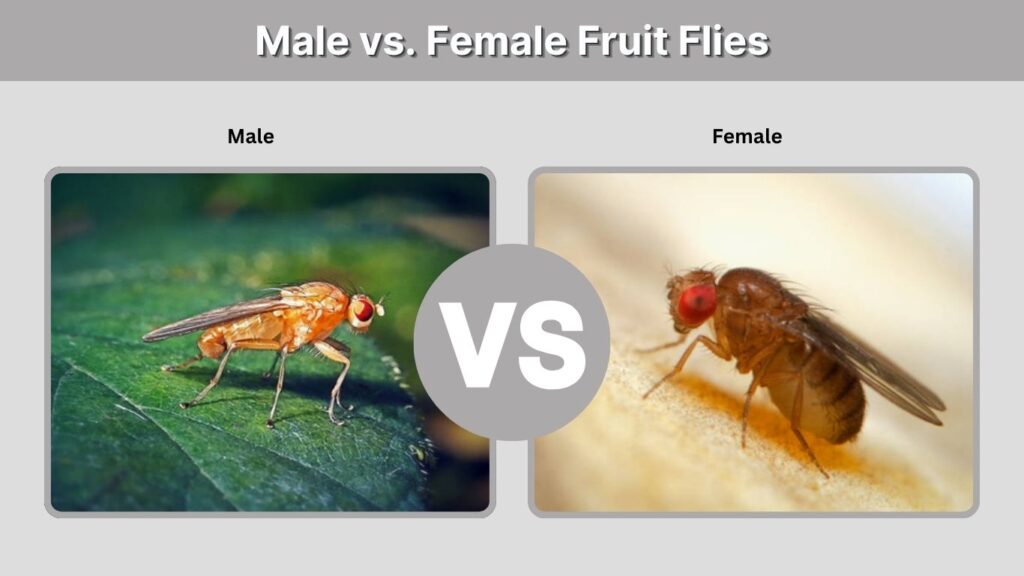
Male and female fruit flies look very similar to the naked eye. Differences become much easier to see under magnification.
What Do Female Fruit Flies Look Like?
Female fruit flies are generally slightly larger than males. Their abdomen may also appear more elongated and pointed.
Males often have a darker, more rounded tip on the abdomen. In some common Drosophila species, males also possess specialized structures on their front legs known as sex combs.
For household identification, however, distinguishing males from females is usually unnecessary.
How to Know If You Have Fruit Flies
Identifying the location where small flies gather is often just as important as studying their physical appearance. Fruit flies usually concentrate around fermenting produce and food residue, whereas similar pests may prefer drains or moist soil.
Signs of a Fruit Fly Infestation
Common signs include:
- Tiny tan flies around fruit
- Flies around garbage or recycling
- Several adults appearing near sugary drinks
- Flies returning soon after adults are killed
- Small larvae in spoiled produce
- Increased fly activity around fermenting food
Finding and removing the breeding source is important because adults represent only one stage of the infestation.
FAQs
What color are fruit flies?
Most common household fruit flies are tan, yellowish-brown, or light brown. Many have reddish eyes and darker markings on the abdomen, although appearance varies between species.
How small are fruit flies?
Adult fruit flies are generally about 2–4 mm long. Their tiny size makes individual features difficult to see without magnification.
What do baby fruit flies look like?
Baby fruit flies are larvae rather than miniature winged flies. They resemble tiny, pale, legless maggots living within or near fermenting organic material.
What do fruit fly eggs look like?
Fruit fly eggs are extremely small, whitish, and elongated or oval. They are generally less than one millimeter long and difficult to detect without magnification.
How can I tell fruit flies from gnats?
Fruit flies generally have compact tan bodies and may have noticeable red eyes. Fungus gnats are typically darker, slimmer, and have longer legs and antennae. Fruit flies usually gather around fermenting food, while fungus gnats commonly emerge from moist houseplant soil.