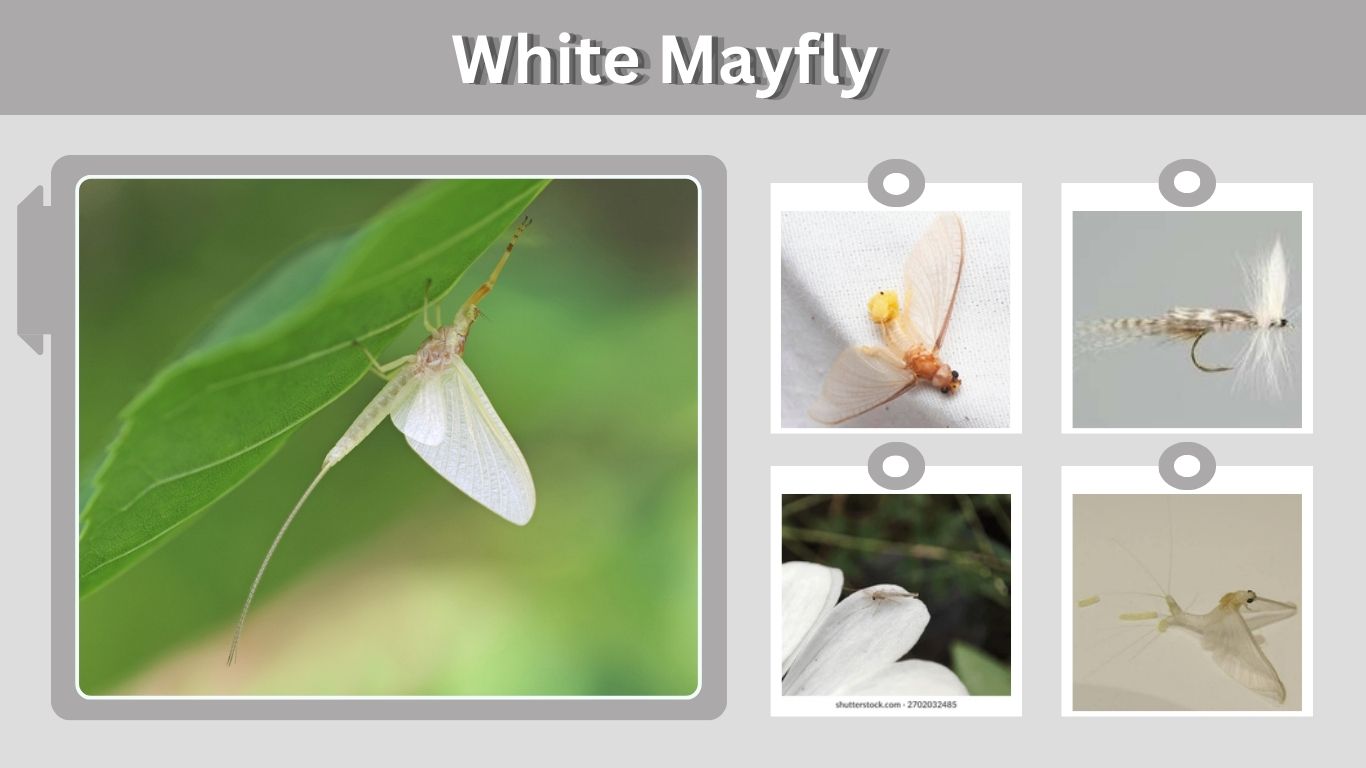
The white mayfly is a pale aquatic insect famous for creating dense late-summer hatches that can resemble snowstorms over rivers. In North America, the name most commonly refers to Ephoron leukon, although Ephoron album and other pale mayflies may also be called white flies.
These harmless insects spend most of their lives underwater as burrowing nymphs. Their winged adult stage is extremely brief and devoted almost entirely to mating and laying eggs.
White Mayfly Quick Facts
| Feature | Description |
| Common name | White mayfly or white fly |
| Main scientific name | Ephoron leukon |
| Family | Polymitarcyidae |
| Insect order | Ephemeroptera |
| Adult color | White, cream, or pale yellow |
| Nymph type | Burrowing mayfly |
| Habitat | Rivers with sand, clay, silt, or fine sediment |
| Typical hatch | Mid-to-late summer |
| Common fly sizes | Approximately 12–16 |
| Danger to people | Harmless; does not bite or sting |
Ephoron leukon is recognized as a North American pale burrowing mayfly, while the broader genus Ephoron includes several species commonly called white flies.
What Is a White Mayfly?
A white mayfly is a pale member of the mayfly order Ephemeroptera. The best-known North American species is Ephoron leukon, which belongs to the pale burrower family Polymitarcyidae. Another North American species, Ephoron album, may produce a similar white fly hatch.
The common name can therefore refer to more than one species. Anglers usually use it for pale mayflies that emerge in large numbers from warm rivers during summer.
In Europe, a related species called Ephoron virgo also produces spectacular nighttime emergencies. It is a different species from the North American white mayfly.
How to Identify a White Mayfly
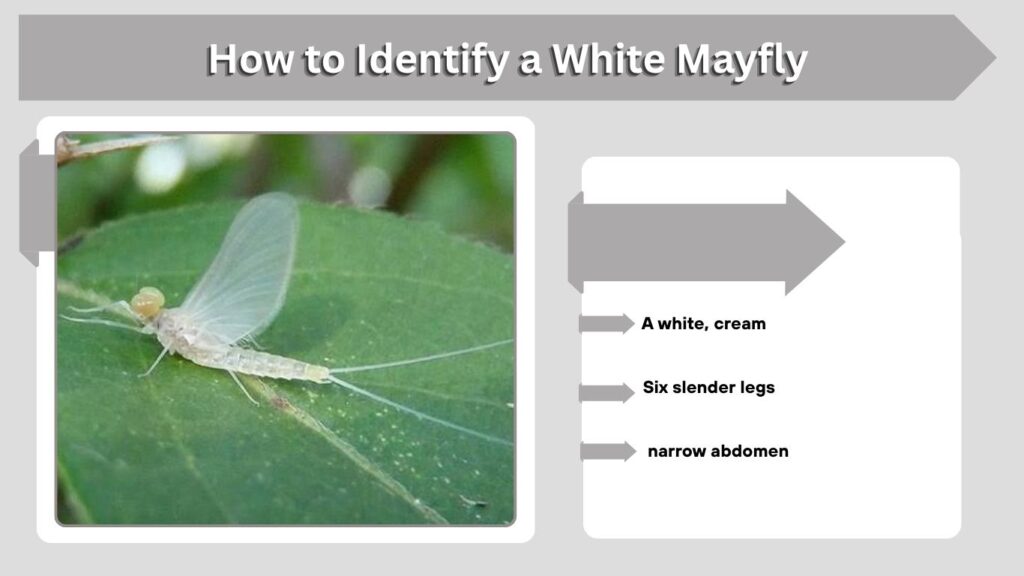
Adult white mayflies are delicate insects with pale bodies and nearly transparent wings. Their light coloration makes large nighttime swarms look like clouds of white dust or falling snow.
Adult Identification
Look for the following characteristics:
- A white, cream, or pale-yellow body
- Large triangular front wings
- Small hindwings behind the front pair
- Transparent or milky-white wings
- Two or three long tail filaments
- Six slender legs
- Wings held upright when resting
- A soft, narrow abdomen
Males may have particularly long tails and large eyes that help them locate females during mating flights. Adult mayflies have two pairs of wings, unlike true flies and midges, which have only one functional pair.
White Mayfly Size
White fly patterns are frequently tied on hooks from approximately sizes 12 to 16. However, the natural insect’s size varies with species, sex, location, and stage of development.
A white mayfly should not automatically be identified by color alone. Several cream-colored mayflies, caddisflies, and midges may appear white beneath artificial lights.
White Mayfly Nymph
The white mayfly nymph looks very different from the pale adult. It has a tan or brown body and spends most of its life hidden in soft sediment beneath flowing water.
Nymph Identification
A white mayfly nymph generally has:
- A long, pale-brown or tan body
- Three tail filaments
- Feathery abdominal gills
- Tusk-like mandibles near the head
- Strong legs for digging
- Dark wing pads when nearly mature
- A curved or cylindrical body shape
The tusks and legs help the nymph dig and maintain a burrow. These features separate it from flat-headed mayfly nymphs that cling to rocks in fast currents.
Nymph Habitat
Ephoron leukon nymphs occupy U-shaped burrows in sand, clay, or silt. They can occur in shallow areas with slow or relatively strong currents, provided the bottom is suitable for digging.
Water moves through the burrow as the nymph moves its body and gills. This supplies oxygen and carries small food particles within reach.
The nymph consumes suspended organic particles, microorganisms, algae, and decomposing material. It remains underwater until it is ready to emerge as a winged insect.
White Mayfly Life Cycle
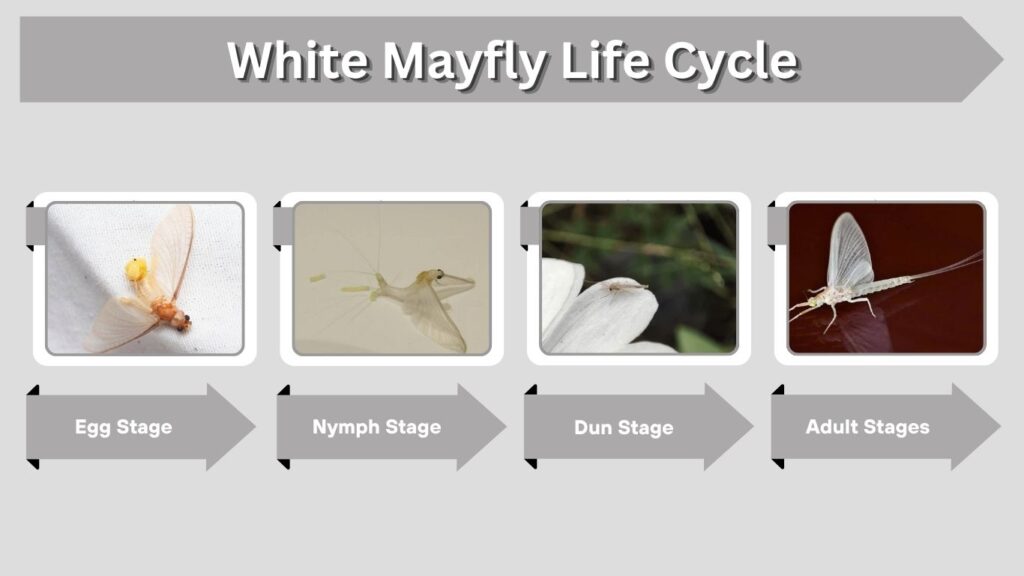
The white mayfly passes through egg, nymph, subimago, and adult stages. It does not have the pupal stage found in butterflies, beetles, and true flies.
Egg Stage
After mating, females release their eggs over the river. The eggs sink into the water and settle among bottom sediments.
In many populations, the eggs remain dormant through autumn and winter. They hatch when environmental conditions become suitable during the following spring.
Nymph Stage
After hatching, the small nymphs develop their mouthparts and abdominal gills. They grow rapidly while living within the riverbed and pass through repeated molts.
The nymph stage represents most of the active feeding and growth period. As emergence approaches, mature nymphs move upward from their burrows and enter the current.
Dun and Adult Stages
The nymph reaches the surface and molts into a winged subimago, also known to anglers as a dun. It then completes one more molt before becoming a sexually mature adult.
The winged stages may last only a few hours. Adults gather in mating swarms, females deposit eggs, and the insects die soon afterward. Adult mayflies do not feed.
When Does the White Mayfly Hatch?
White mayfly hatches generally occur during mid-to-late summer. Ephoron leukon frequently emerges from late July through August, although exact dates depend on latitude, weather, river temperature, and local conditions.
Emergence typically begins around or shortly after sunset. Many individuals may appear on the same evening, producing an exceptionally dense but brief hatch.
On rivers in Michigan, Wisconsin, Pennsylvania, and other parts of eastern or central North America, local anglers may refer to this event simply as the “white fly hatch.”
Why Do White Mayflies Form Huge Swarms?
Adult white mayflies have very little time to reproduce. Synchronized emergence allows males and females to find each other quickly.
A strong hatch can produce thousands or millions of pale adults over a short section of river. Artificial lighting may attract them toward houses, bridges, parking lots, and roads.
These swarms are harmless, but large numbers of dead insects can cover surfaces and become slippery. They also provide an enormous temporary food supply for fish, birds, bats, spiders, and other animals.
What Is a Tiny White Mayfly?
A very small white mayfly may not be Ephoron leukon. It could belong to the genus Caenis, whose members are commonly known as tiny square-gilled mayflies or “angler’s curses.”
Some Caenis species have bodies measuring only around one-eighth of an inch and are imitated with extremely small hooks. They often emerge in large numbers and can be difficult for anglers to match.
A tiny white flying insect could also be a midge or caddisfly. Checking its wings and tails is the easiest way to separate them.
White Midge vs. White Mayfly
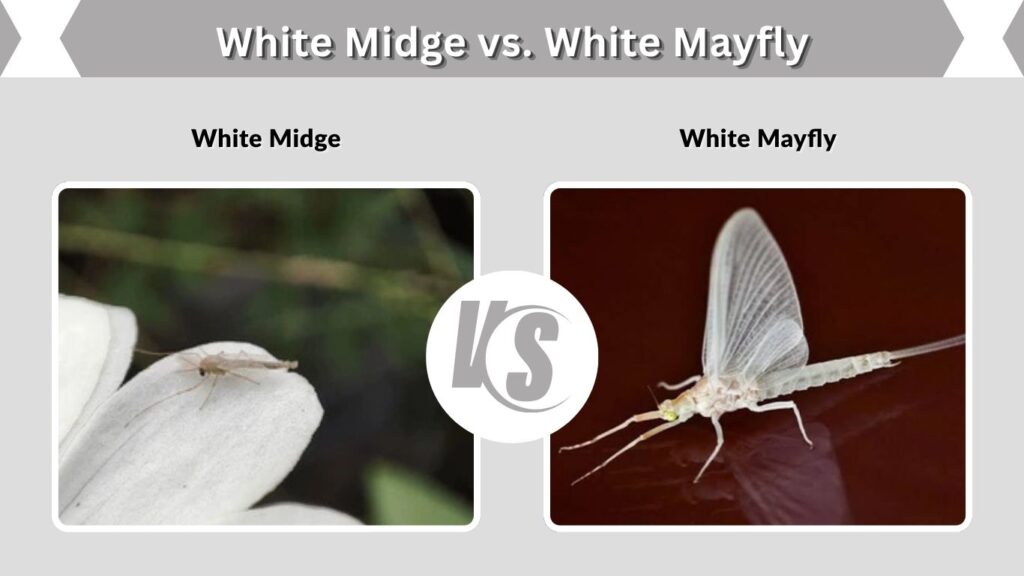
| Feature | White mayfly | White midge |
| Wings | Two pairs | One functional pair |
| Resting position | Wings usually upright | Wings lie along the body |
| Tails | Usually two or three | No long tails |
| Body | Delicate and tapered | Slender and mosquito-like |
| Adult feeding | Does not feed | Varies by species |
| Aquatic stage | Nymph | Worm-like larva |
A small white caddisfly also lacks the mayfly’s long tails and usually holds its wings like a roof over its back.
White Mayfly Fly Patterns
Anglers should carry patterns representing several stages because fish may focus on underwater nymphs, rising emergers, newly hatched adults, or spent spinners.
White Mayfly Nymph Pattern
The natural nymph is brown or tan rather than bright white. Useful characteristics include:
- A curved, segmented body
- Tan or light-brown dubbing
- Dark wing case
- Three tails
- Soft gill-like fibers
- A weighted body for bottom fishing
Fish the pattern close to sandy or silty bottoms before sunset. As the hatch approaches, allowing it to rise through the water can imitate a mature nymph leaving its burrow.
White Mayfly Emerger
An emerger should sit partly beneath the surface. A curved hook, cream body, trailing shuck, and small white wing create an effective profile.
Sizes 12–16 cover many white fly situations, although the best size is the one matching the insects on the water.
White Dun and Spinner Patterns
Effective adult patterns include:
- White Mayfly Dun
- White Fly Spinner
- White Miller
- Cream Comparadun
- White CDC Emerger
- White Parachute Mayfly
- Spent-wing White Fly
Use an upright-wing pattern when duns are emerging. Switch to a low-floating spinner with wings spread flat when dead or exhausted adults cover the surface.
How to Tie a Simple White Mayfly Pattern
Use a dry-fly hook in approximately size 12–16. Attach white or cream thread and add two or three pale tail fibers. Form a slim cream dubbing body, keeping the abdomen lightly tapered.
Add white synthetic yarn or CDC for the wings. Position the wings upright for a dun or horizontally for a spinner. Finish the dun with a pale-dun hackle around the thorax.
Avoid making the body or wings too bulky. Natural white mayflies are delicate, and a sparse pattern usually creates a more convincing silhouette.
FAQs
Do white mayflies bite?
No. Adult white mayflies do not bite or sting. Adult mayflies do not feed and lack functional biting mouthparts. Their large swarms may be inconvenient, but the insects are harmless to people and pets.
Where are white mayflies found?
Ephoron leukon occurs in North America, especially around rivers with sandy, clay, or silty bottoms. Related white mayfly species occur elsewhere, including Ephoron virgo in parts of Europe.
Why are white mayflies attracted to lights?
Bright artificial lights can disorient adult mayflies and pull them away from the river. During a large hatch, porch lights, streetlights, bridges, and illuminated buildings may attract enormous numbers.
Are white mayflies a sign of clean water?
Mayflies are often associated with healthy freshwater, although pollution tolerance varies among species. A strong population generally indicates that a river still provides suitable oxygen, sediment, food, and water conditions.
How long do adult white mayflies live?
The winged stages generally last only a few hours or part of one night. Adults emerge, molt, mate, lay eggs, and die within a remarkably short period. Most of the insect’s life is spent underwater.