
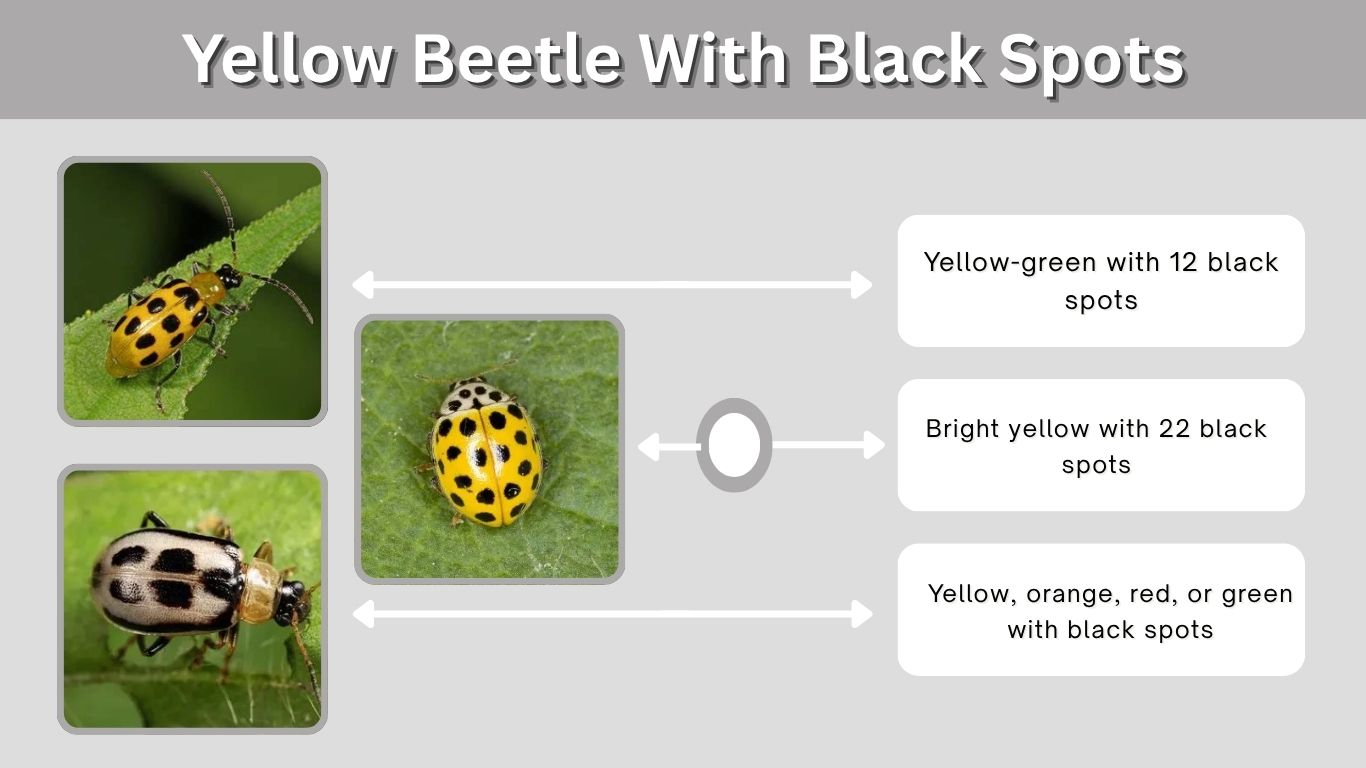
A yellow beetle with black spots can be several different species, so the best way to identify it is by checking its size, shape, location, and behavior. Some yellow-and-black beetles are harmless or even helpful, while others can damage vegetables, fruit, flowers, carpets, or stored items. Common possibilities include spotted cucumber beetles, 22-spot ladybirds, bean leaf beetles, spotted asparagus beetles, carpet beetles, and sap beetles.
What Is a Yellow Beetle With Black Spots?
A yellow beetle with black spots is not one single insect. Many beetles use yellow, orange, black, or cream-colored markings. These colors may help them blend into plants, warn predators, or mimic other insects.
In gardens, the most common yellow beetle with black spots is often the spotted cucumber beetle. It is yellow-green with 12 black spots on its back and feeds on cucumbers, squash, melons, pumpkins, and related plants. The University of Maryland Extension describes the spotted cucumber beetle as yellow-green with 12 black spots, while the striped cucumber beetle is yellow with three black lengthwise stripes.
Quick Identification Table
Use this table to narrow down what you found. Size, host plant, and body shape are more reliable than color alone.
| Beetle Type | Main Color Pattern | Common Location | Harmful or Harmless? |
| Spotted cucumber beetle | Yellow-green with 12 black spots | Cucumbers, squash, melons | Garden pest |
| 22-spot ladybird | Bright yellow with 22 black spots | Low plants, mildew-covered leaves | Mostly harmless/beneficial |
| Bean leaf beetle | Yellow, orange, red, or green with black spots | Beans, soybeans, legumes | Garden/crop pest |
| Spotted asparagus beetle | Orange-yellow with black spots | Asparagus plants | Garden pest |
| Varied carpet beetle | Black with yellow, white, and brown scales | Indoors, fabrics, carpets | Household pest |
| Four-spotted sap beetle | Black with four yellow-orange spots | Ripe fruit, berries, corn | Fruit nuisance pest |
1. Spotted Cucumber Beetle
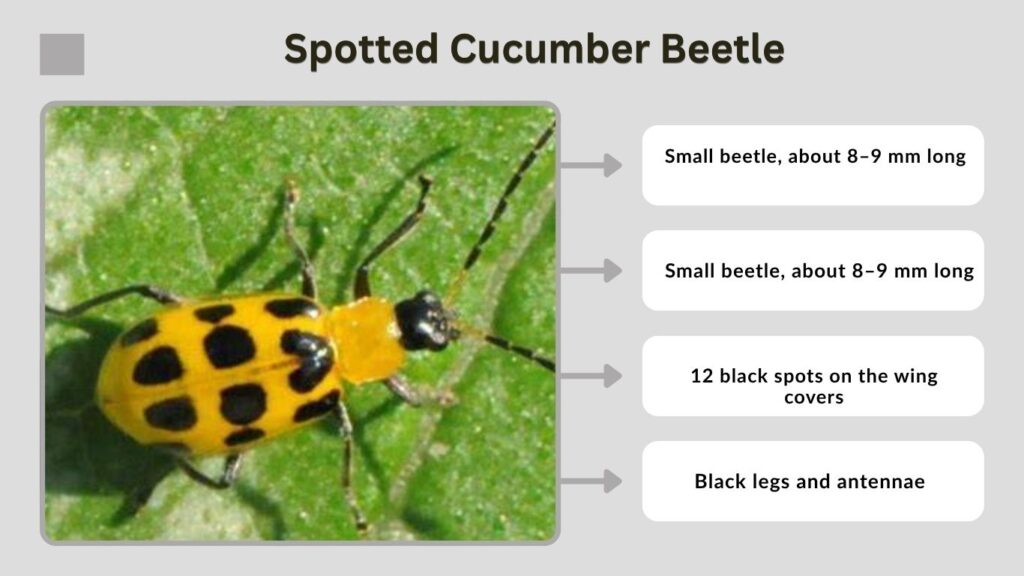
The spotted cucumber beetle is one of the most likely matches if you found a small yellow beetle with black spots in your vegetable garden. It has a black head, yellowish-green wing covers, and 12 dark spots.
Identification
- Small beetle, about 8–9 mm long
- Small beetle, about 8–9 mm long
- 12 black spots on the wing covers
- Black legs and antennae
- Often found on cucumbers, squash, pumpkins, melons, and gourds
Utah State University Extension notes that spotted cucumber beetles are about 8–9 mm long, with a black head, yellow prothorax, and 12 black spots on yellowish-green wings.
Plant Damage
Spotted cucumber beetles chew leaves, flowers, stems, and fruit. They are also important because cucumber beetles can spread bacterial wilt in cucurbit crops. Young seedlings are especially vulnerable because beetle feeding can stunt or kill them.
What to Do
Handpick beetles when numbers are low, use floating row covers before flowering, remove plant debris, and monitor young plants early. Avoid spraying during bloom when pollinators are active.
2. 22-Spot Ladybird
If you are in the UK and found a tiny yellow beetle with black spots, it may be the 22-spot ladybird. This beetle is bright yellow with many neat black spots and is often seen on low-growing plants.
Identification
- Bright yellow body
- 22 round black spots on wing cases
- Small, rounded ladybird shape
- Usually 3–5 mm long
- Often found on mildew-covered plants
The Wildlife Trusts describes the 22-spot ladybird as bright yellow with 22 round black spots on the wing cases, and notes that it can be separated from the 14-spot ladybird by its round spots that do not merge.
Is It Harmful?
The 22-spot ladybird is not a serious garden pest. Unlike many ladybirds that feed on aphids, this species feeds mainly on mildew. If you see it in the garden, it usually does not need control.
3. Bean Leaf Beetle
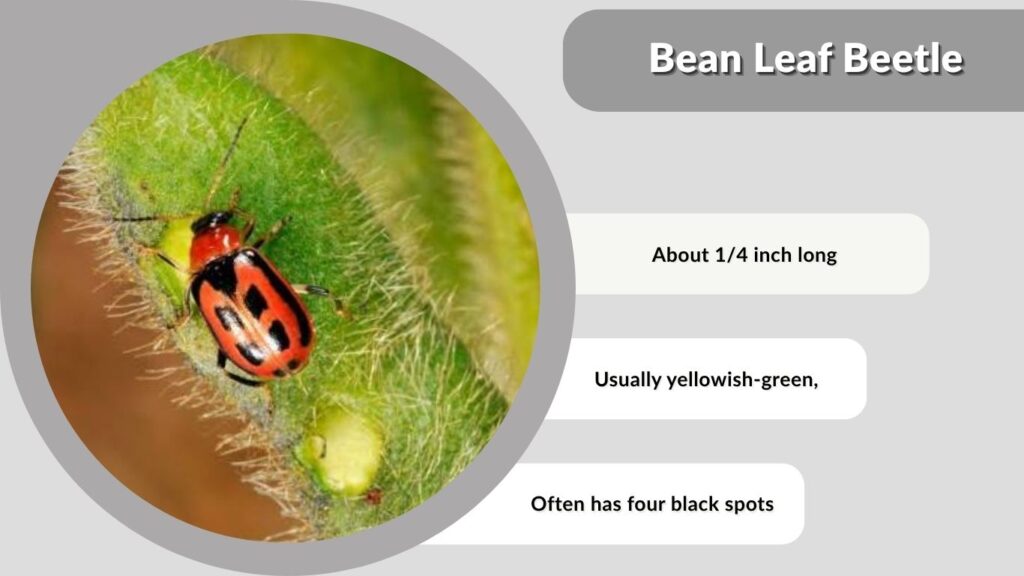
A yellow beetle with black spots on beans may be a bean leaf beetle. This beetle can vary in color, so it may look yellow, orange, red, tan, or greenish.
Identification
- About 1/4 inch long
- Oval body
- Usually yellowish-green, orange, red, or tan
- Often has four black spots
- Has a black triangle behind the thorax
The black triangle near the top of the wing covers is one of the best identification clues. Iowa State University Extension says bean leaf beetles are typically dark yellow with black markings, may also be green, yellow, orange, or red, and often have four large black markings on the wing covers.
Plant Damage
Bean leaf beetles chew rounded holes in bean leaves and may damage pods. They can also affect soybean crops. In home gardens, they are most noticeable on snap beans, lima beans, and other legumes.
4. Spotted Asparagus Beetle
A large yellow-orange beetle with black spots on asparagus may be the spotted asparagus beetle. This beetle is more orange than bright yellow, but many people describe it as yellow with black spots.
Identification
- Orange to yellow-orange body
- Black spots on the back
- Black legs, eyes, and antennae
- Found mainly on asparagus plants
- Usually about 6–8 mm long
Utah State University Extension describes the spotted asparagus beetle adult as mostly orange with black spots on the forewings, black legs, black eyes, black antennae, and black “knee caps.”
Plant Damage
Spotted asparagus beetles usually feed on asparagus ferns and berries. The common asparagus beetle is often more damaging to spears, but both types should be monitored if you grow asparagus.
5. Black Beetle With Yellow Spots
Some searches are the reverse: “black beetle with yellow spots.” In that case, the beetle may be a sap beetle, carpet beetle, longhorn beetle, or carrion beetle.
A common outdoor example is the four-spotted sap beetle, also called a picnic beetle. Adult sap beetles are small, oval beetles that are usually dark-colored and may have orange or yellow spots. The University of Minnesota Extension says adult sap beetles are between 1/8 and 1/4 inch long, oval, dark-colored, and sometimes marked with orange or yellow spots.
Common Black Beetles With Yellow Spots
- Four-spotted sap beetle: Black with four yellow-orange spots; attracted to ripe fruit.
- Varied carpet beetle: Tiny indoor beetle with yellow, white, brown, and black scales.
- Black-and-yellow longhorn beetle: Long antennae, yellow markings, often found outdoors.
- Carrion beetles: Some black species have yellow or orange patches and are found near dead animals.
Yellow Beetle With Black Spots in the House
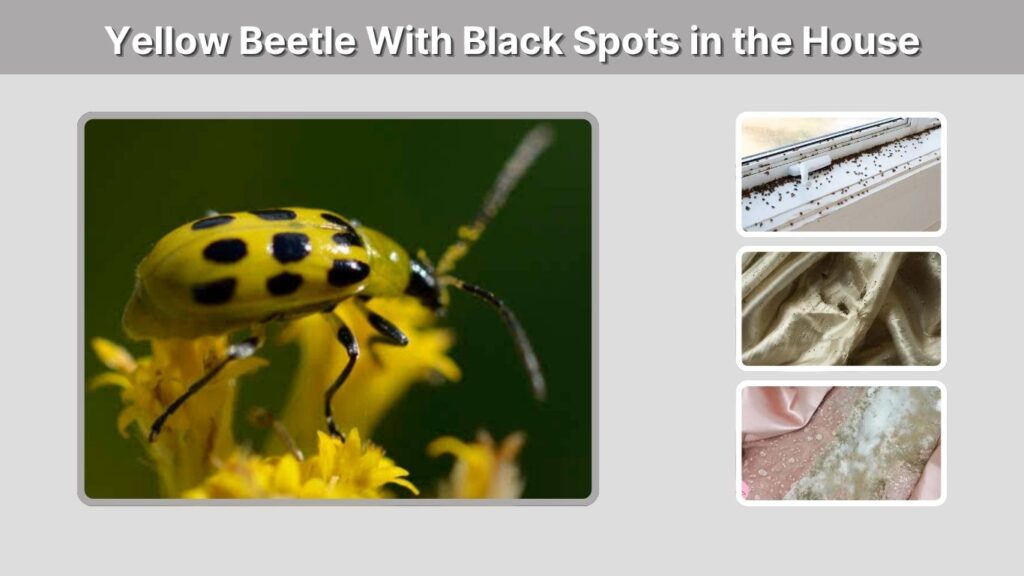
A yellow beetle with black spots in the house may be an accidental visitor, especially if it flew in from a garden. However, a tiny black beetle with yellow spots indoors may be a carpet beetle.
Varied carpet beetles are small, round beetles that can look dark with yellowish, white, and brown markings. Rutgers describes varied carpet beetles and similar species as 1/12 to 1/8 inch long with mixed white, brownish, black, orange, or yellowish scales.
Signs It May Be a Carpet Beetle
- Small beetles on walls or curtains
- Hairy larvae in closets, carpets, or drawers
- Damage to wool, silk, feathers, fur, or natural fabrics
- Shed larval skins in hidden areas
Adult carpet beetles often wander toward light, but the larvae cause the real damage. Vacuuming, washing fabrics, cleaning closet edges, and removing lint, pet hair, and dead insects can help reduce them.
Yellow Beetle With Black Spots on Roses or Flowers
If you find a yellow beetle with black spots on flowers, it may be a cucumber beetle, ladybird, longhorn beetle, or another flower-visiting beetle. Look at the plant type. If it is on roses, ornamentals, or wildflowers and not causing heavy damage, it may simply be feeding on pollen, mildew, or small insects.
What to Check
- Is it chewing holes in leaves?
- Is it feeding on flower petals?
- Are there many beetles or just one?
- Does it have a ladybird shape or a long narrow body?
- Is it on vegetable crops or ornamental flowers?
A few beetles on flowers may not need treatment. Heavy feeding on vegetables or repeated beetles on seedlings may require control.
Big Yellow Beetle With Black Spots
A big yellow beetle with black spots may be a larger cucumber beetle lookalike, longhorn beetle, or orange-yellow garden beetle. Size matters because many true ladybirds and cucumber beetles are small. If the insect is large and long-bodied, check for long antennae. It may be a longhorn beetle rather than a leaf beetle or ladybird.
Black-and-yellow longhorn beetles have long legs, long antennae, and yellow wing cases with black markings. The Wildlife Trusts describes the black-and-yellow longhorn beetle as having a black head and thorax, yellow wing cases with variable black markings, and antennae banded black and yellow.
Are Yellow Beetles With Black Spots Dangerous?
Most yellow beetles with black spots are not dangerous to people. They usually do not sting, and most do not bite unless handled roughly. The bigger concern is plant or household damage, depending on the species.
| Situation | Likely Concern | Action |
| On cucumber or squash plants | Cucumber beetle damage | Monitor and protect seedlings |
| On beans | Bean leaf beetle damage | Check leaves and pods |
| On asparagus | Asparagus beetle | Remove adults/eggs if needed |
| On mildew-covered leaves | 22-spot ladybird | Usually leave it alone |
| Indoors near windows | Carpet beetle or accidental visitor | Inspect fabrics and vacuum |
| On ripe fruit | Sap beetle | Remove damaged fruit |
How to Identify It Correctly
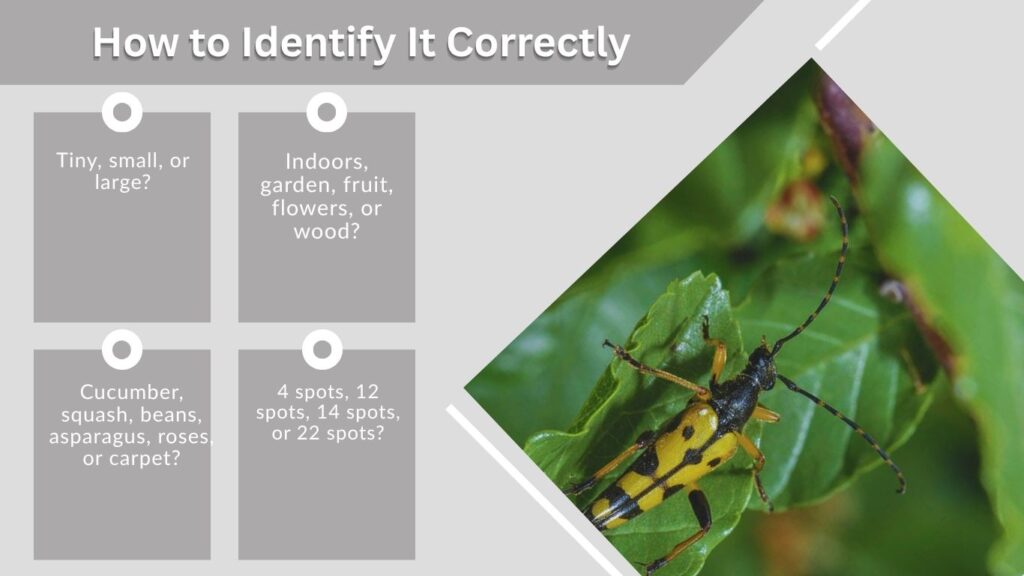
Color is helpful, but it is not enough. Many beetles are yellow, orange, black, or spotted. For accurate identification, use a few extra clues.
Best Identification Clues
- Size: Tiny, small, or large?
- Shape: Round like a ladybird or long like a cucumber beetle?
- Location: Indoors, garden, fruit, flowers, or wood?
- Plant: Cucumber, squash, beans, asparagus, roses, or carpet?
- Spot count: 4 spots, 12 spots, 14 spots, or 22 spots?
- Antennae: Short, clubbed, or very long?
Taking a clear photo from above is one of the easiest ways to compare markings.
FAQs
What is the yellow beetle with black spots in my garden?
It may be a spotted cucumber beetle, bean leaf beetle, 22-spot ladybird, or spotted asparagus beetle. Check the host plant first. Beetles on cucumbers or squash are often cucumber beetles, while beetles on beans may be bean leaf beetles.
Is a yellow beetle with black spots harmful?
Some are harmful to plants, but many are harmless to people. Spotted cucumber beetles, bean leaf beetles, and asparagus beetles can damage crops. Yellow ladybirds are usually harmless and may even be helpful in the garden.
What is a tiny black beetle with yellow spots in my house?
A tiny black beetle with yellow, white, or brown markings indoors may be a varied carpet beetle. Adults are often seen near windows, while larvae live in hidden areas and may damage wool, silk, fur, feathers, and other natural materials.
What beetle is yellow-green with 12 black spots?
That is likely a spotted cucumber beetle. It has a yellow-green body, black head, black legs, and 12 black spots on the wing covers. It commonly feeds on cucumber, squash, melon, pumpkin, and related plants.
Should I kill yellow beetles with black spots?
Identify the beetle first. Garden pests may need control if they are damaging crops, but harmless beetles like ladybirds should usually be left alone. Indoors, remove beetles with a vacuum or cup and inspect for carpet beetle larvae if they keep appearing.
