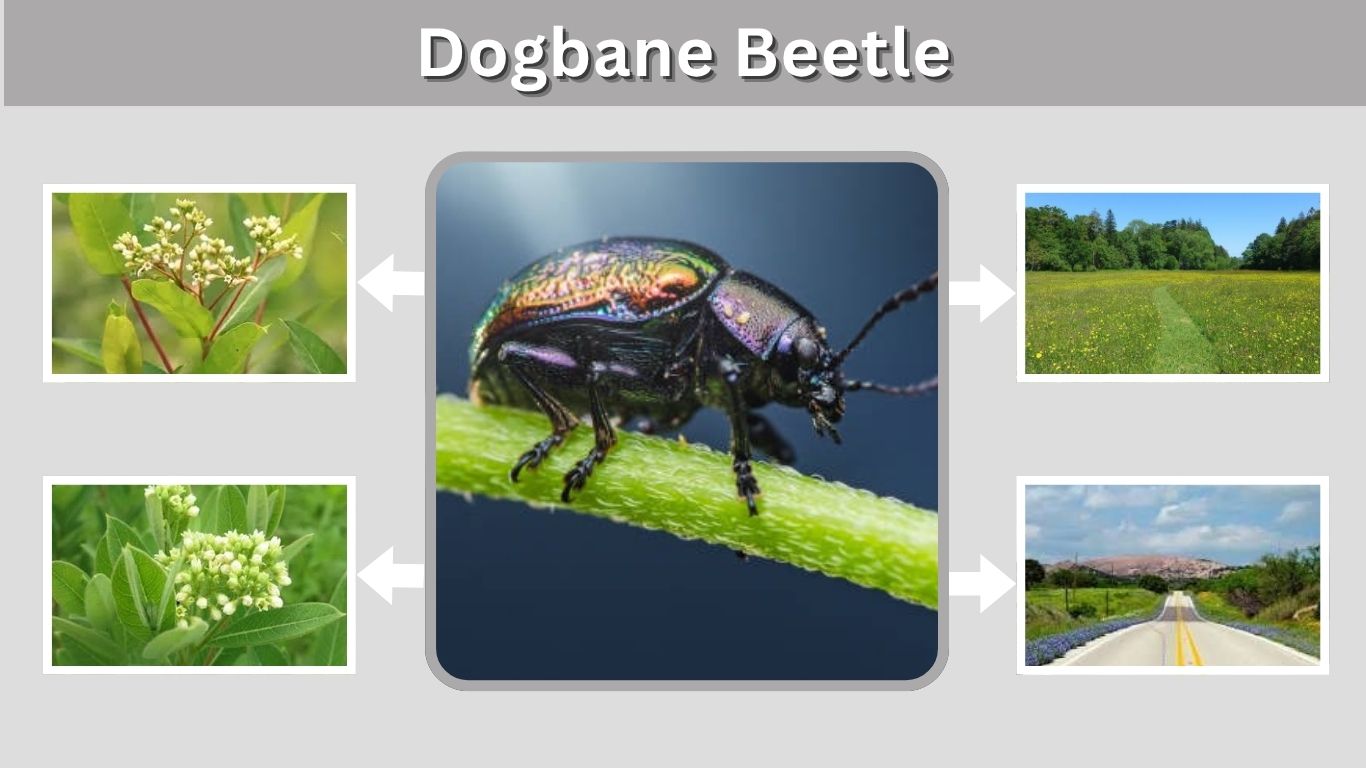
The dogbane beetle is a small North American leaf beetle admired for its brilliant metallic colors. Its body may appear green, blue, gold, copper, or crimson depending on the viewing angle and lighting. Adults spend much of the summer feeding and mating on dogbane plants, while their larvae develop underground and eat the plants’ roots. Despite their striking appearance and association with toxic plants, dogbane beetles are not considered dangerous to people, pets, or economically important crops.
Dogbane Beetle Quick Facts
| Feature | Description |
| Common names | Dogbane beetle, dogbane leaf beetle |
| Scientific name | Chrysochus auratus |
| Family | Chrysomelidae |
| Adult size | About 8–11 mm |
| Color | Iridescent blue-green with gold, copper, or red reflections |
| Primary food | Dogbane plants |
| Larval food | Dogbane roots |
| Habitat | Fields, roadsides, meadows, prairies and woodland edges |
| Adult season | Late spring through summer |
| Generations | Usually one per year |
The scientific name Chrysochus auratus includes the Latin-derived term auratus, meaning golden, which refers to the beetle’s reflective appearance. It belongs to the leaf beetle family Chrysomelidae.
What Does a Dogbane Beetle Look Like?
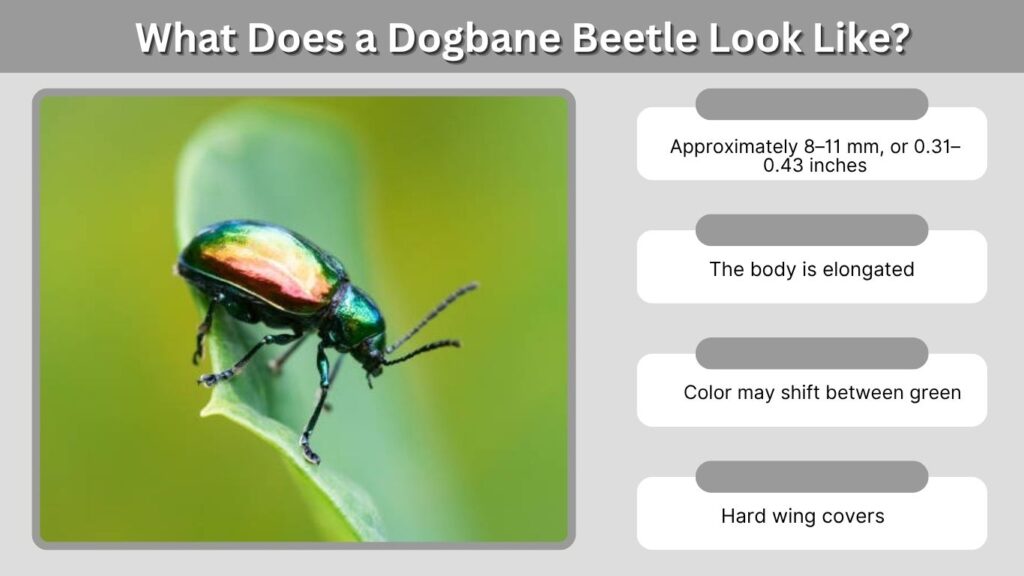
The dogbane leaf beetle has an oval, convex body covered by a highly reflective outer surface. Unlike beetles with fixed pigment colors, its appearance changes as light strikes the body from different directions.
Identification
- Adults measure approximately 8–11 mm, or 0.31–0.43 inches.
- The body is elongated, oval and strongly convex.
- Color may shift between green, blue, turquoise, gold, copper and crimson.
- The legs and segmented antennae are usually dark blue or black.
- Hard wing covers, called elytra, protect the flying wings underneath.
- The surface may show fine pits when examined closely.
- Larvae have pale bodies and darker brown heads.
Both males and females have a similar appearance. Their metallic surface may make one beetle appear differently colored when viewed from several angles.
Dogbane Beetle Habitat and Range
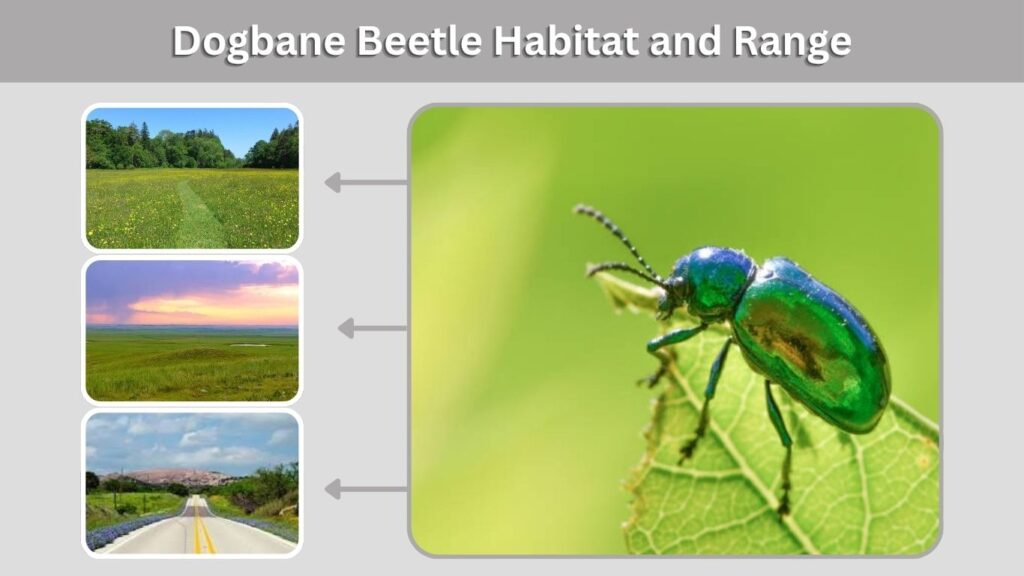
Dogbane beetles occur primarily throughout the eastern United States and southern Canada, extending westward toward the Rocky Mountains and parts of the southwestern United States. Their local distribution depends heavily on the presence of suitable host plants.
Where Do Dogbane Beetles Live?
They are usually found in open or partly open habitats containing dogbane, including:
- Roadsides
- Meadows
- Prairies
- Unmanaged fields
- Railroad edges
- Lakeshores
- Streambanks
- Woodland edges
- Disturbed land
Adults remain on or near host plants during their brief aboveground season. The larvae live underground near the roots, making them much less noticeable than the adults.
Are Dogbane Beetles Found in the UK or Germany?
The species Chrysochus auratus is native to North America. A metallic beetle found on dogbane-like plants in the UK, Germany, or elsewhere in Europe may be a related Chrysochus species or a different leaf beetle. Identification should be based on location and physical features rather than color alone.
What Do Dogbane Beetles Eat?
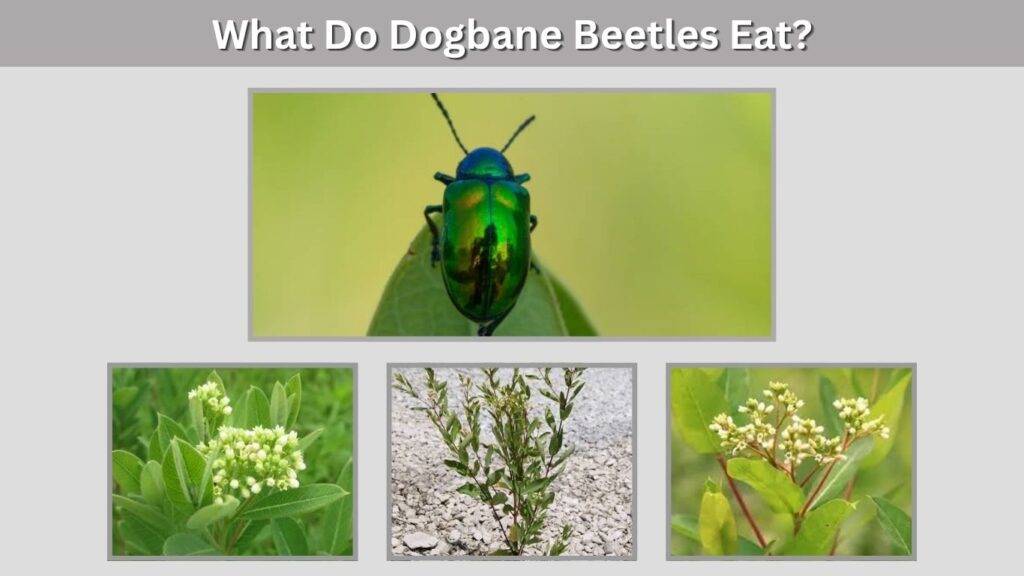
Dogbane beetles are specialist herbivores. Their main hosts are plants in the dogbane family, particularly Indian hemp dogbane and spreading dogbane. Adults chew along the edges of leaves, while the larvae feed externally on roots underground.
Common Host Plants
Adult dogbane beetles commonly feed on:
- Indian hemp dogbane
- Spreading dogbane
- Intermediate dogbane
- Occasionally related milkweed-family plants
Some sources report associations with milkweed, although dogbane species are their principal and most dependable hosts. Adults generally remain close to the plants on which their larvae can develop.
How They Handle Sticky Dogbane Sap
Dogbane leaves release sticky white latex containing defensive chemicals. This sap can clog the mouthparts of insects attempting to feed on the plant.
The dogbane beetle usually feeds near the outer portion of a leaf, where latex pressure is lower. When sap collects around its mouth, the beetle presses its mouthparts against the leaf and walks backward, scraping away the sticky substance without stepping into it.
Dogbane Beetle Life Cycle
Dogbane beetles undergo complete metamorphosis, passing through four stages: egg, larva, pupa and adult. They generally produce one generation each year.
Eggs
Adults mate during summer. Females deposit eggs on or near their host plants, sometimes enclosing them in small capsules covered with waste material. Depending on the population and source observed, eggs may occur on leaves, stems, nearby vegetation or around the base and roots of dogbane.
Larvae
After hatching, young larvae move into the soil and begin feeding on dogbane roots. They remain underground throughout their development and overwinter in the larval stage. Their hidden lifestyle means most people never see this stage.
Pupae
The mature larva creates a chamber in the soil and transforms into a pupa during spring. Inside the chamber, its body reorganizes into the adult form. The new adult remains protected until its outer body has hardened enough to reach the soil surface.
Adults
Adults normally emerge in late spring or early summer. They feed, fly between nearby host plants, mate and lay eggs throughout their relatively brief summer season. Adult lifespan has been estimated at approximately six to eight weeks.
Can Dogbane Leaf Beetles Fly?
Dogbane beetles have functional wings beneath their hardened wing covers and can fly. However, they tend to remain within patches of dogbane rather than regularly travelling long distances.
They may fly from one plant to another when searching for food or mates. Their close dependence on dogbane contributes to small, scattered local populations wherever suitable plant patches occur.
Are Dogbane Beetles Poisonous or Dangerous?
Dogbane beetles obtain cardenolides and other defensive compounds from their host plants. They can store these substances and release them from specialized glands when threatened. Their vivid metallic coloring may warn potential predators that they are unpleasant or toxic to eat.
Are They Poisonous to Humans?
The beetles’ chemical protection is primarily a defense against predators. Dogbane beetles are not recognized as a human health threat, and simply seeing one or allowing it to crawl on a surface is not considered dangerous.
However, they should not be eaten, and unnecessary handling is best avoided. The dogbane plant itself contains biologically active compounds and milky sap that should not be consumed.
Do Dogbane Beetles Bite?
Dogbane beetles possess chewing mouthparts designed for plant tissue. They are not aggressive and are not known as biting household or medical pests. A beetle found outdoors can be observed without touching it or gently moved with a container if necessary.
Dogbane Beetle Predators and Defense
Birds, predatory insects, spiders and parasitoids could potentially attack dogbane beetles, but the plant toxins stored in their bodies provide protection. When disturbed, adults can release cardenolides through glands on the thorax and wing covers, making them distasteful to many predators.
Larvae containing higher concentrations of these chemicals may also experience lower rates of parasitism by certain parasitoid wasps.
Dogbane Beetle vs. Japanese Beetle
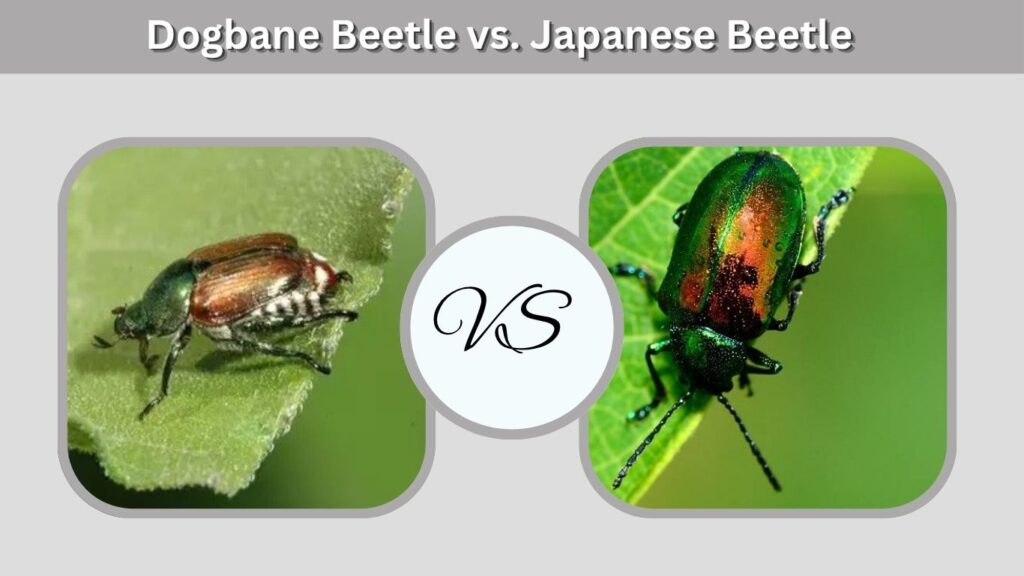
Both species have metallic green coloring, but they differ greatly in appearance, host range and pest status.
| Feature | Dogbane beetle | Japanese beetle |
| Scientific name | Chrysochus auratus | Popillia japonica |
| Shape | Elongated and oval | Broad and rounded |
| Color | Iridescent blue-green, gold or copper | Green head with copper-brown wing covers |
| White hair patches | Absent | Present along the abdomen |
| Main foods | Dogbane leaves and roots | More than 300 plant species |
| Pest status | Usually harmless specialist | Major invasive garden pest |
| Larvae | Feed on dogbane roots | Feed mainly on grass roots |
Japanese beetles have distinctive white hair patches along the sides and tip of the abdomen. They can damage flowers, fruit, foliage and lawns, whereas dogbane beetles primarily remain on dogbane and are not known to damage economically important crops.
Are Dogbane Leaf Beetles Good or Bad?
Dogbane beetles are generally neutral or beneficial members of native ecosystems. Their feeding can reduce dogbane foliage, but it rarely eliminates healthy plant colonies. They do not normally harm vegetable gardens, homes, turfgrass or ornamental plants.
In dense populations, adults may consume a noticeable portion of dogbane leaves. One study cited by the University of Kentucky found that high densities could remove up to 40% of spreading dogbane foliage, suggesting possible value in natural weed suppression. However, the beetle is not currently used as a formal biological-control agent.
How to Get Rid of Dogbane Beetles
Control is rarely necessary because these beetles concentrate on dogbane and do not threaten most garden plants. Leaving them alone is usually the best option.
When protecting a valued dogbane patch, gardeners can handpick adults into a container of soapy water or gently remove them from individual plants. Avoid treating an entire garden with broad-spectrum insecticides, which may kill pollinators and other harmless insects.
An insecticide should be considered only when feeding is severe and the product label permits use on the affected plant and site. Always follow the label instructions exactly.
FAQs
How big is a dogbane beetle?
Adult dogbane beetles measure approximately 8–11 mm, or 0.31–0.43 inches. Their oval, convex bodies may look slightly larger because of their rounded shape and intense metallic reflection.
Why are dogbane beetles so colorful?
Their structural surface reflects light at different angles, creating shifting green, blue, gold and copper colors. The conspicuous appearance may also warn predators about the defensive chemicals obtained from dogbane plants.
Do dogbane beetles kill dogbane plants?
Adults chew leaves and larvae feed on roots, but they usually do not kill established dogbane colonies. Heavy populations may remove substantial foliage, although serious plant decline is uncommon.
Are dogbane beetles harmful to milkweed?
Dogbane is their principal host. Some records associate them with milkweed-family plants, but significant milkweed damage is not commonly reported. A blue beetle feeding heavily on western milkweed may instead be the related cobalt milkweed beetle.
Can you keep a dogbane beetle as a pet?
It is possible to observe one temporarily, but keeping it successfully requires fresh, pesticide-free dogbane and suitable seasonal conditions. Because adults have specialized food requirements and a naturally brief lifespan, they are better observed on their host plants outdoors.