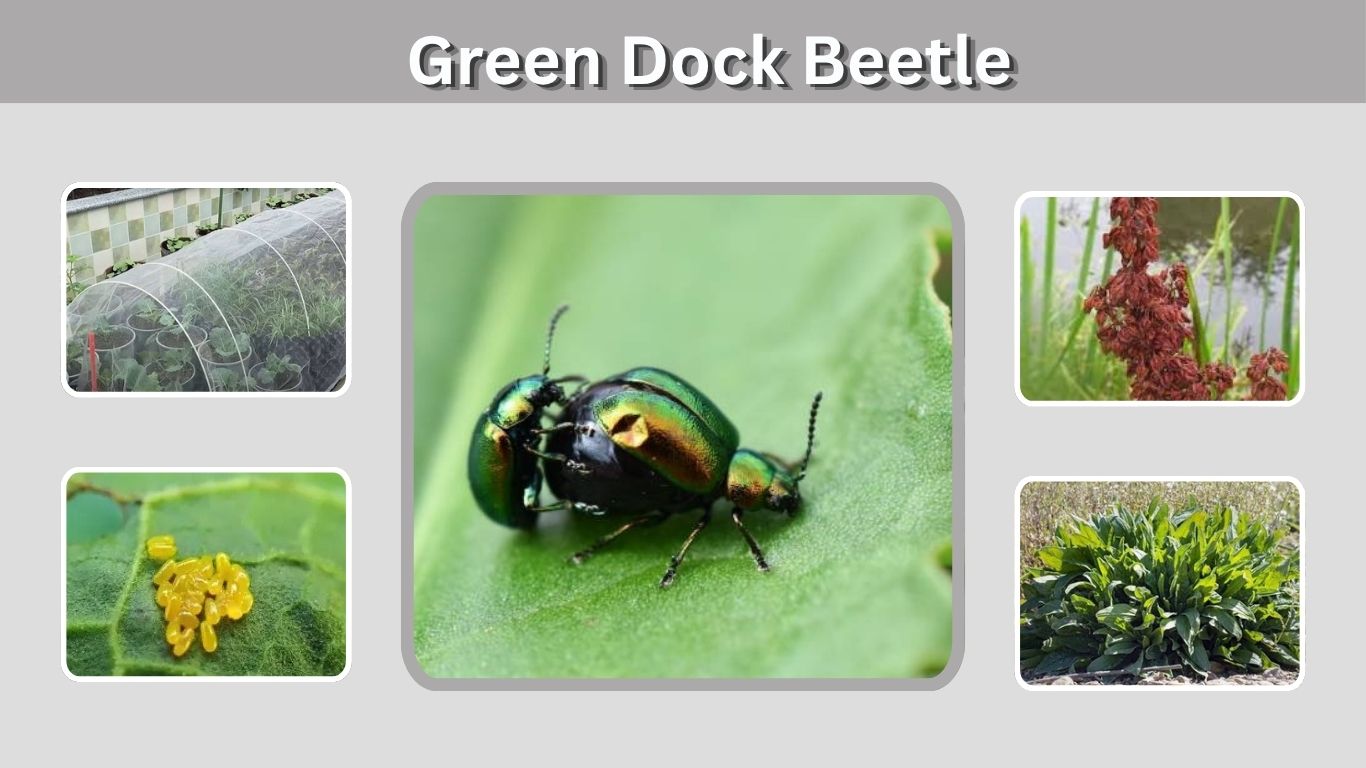
The green dock beetle is a small leaf beetle recognized by its brilliant metallic-green body. Commonly found on dock and sorrel plants, it spends much of its life feeding, mating, and laying eggs on leaves. Although large groups can create noticeable plant damage, these beetles are harmless to people and may even help suppress unwanted dock weeds. Understanding their appearance, diet, larvae, life cycle, and behavior makes it easier to decide whether control is necessary.
What Is a Green Dock Beetle?
The green dock beetle, also called the green dock leaf beetle or green sorrel beetle, is a plant-feeding species with the scientific name Gastrophysa viridula. It belongs to Chrysomelidae, the leaf beetle family.
The species is native to Europe and is particularly common and widespread in Britain. It is normally found wherever its preferred dock plants grow, including field edges, gardens, damp meadows, roadsides, wasteland, and areas near water.
Green Dock Beetle Identification
Adult beetles can be recognized by the following features:
- Approximately 4–6 mm long
- Oval and strongly rounded body
- Shiny metallic-green wing covers
- Green, blue, bronze, or purple reflections
- Small head with threadlike antennae
- Dark legs and underside
- Enlarged abdomen in egg-carrying females
The beetle may appear emerald green in sunlight but almost black in poor lighting. Its metallic color can also change depending on the viewing angle.
Pregnant females are especially distinctive. Their abdomen becomes so enlarged that the green wing covers are pushed apart, exposing the swollen dark abdomen underneath.
Green Dock Beetle vs. Other Shiny Green Beetles
Green dock beetles may be confused with mint beetles, flea beetles, jewel beetles, and other metallic leaf beetles. The host plant provides one of the strongest identification clues.
A small, rounded green beetle accompanied by yellow eggs or dark larvae on a dock leaf is likely a green dock beetle. However, beetles found in Canada, Australia, or other places outside its well-established European range should be identified carefully because several unrelated species have a similar metallic-green appearance. This is an inference based on the species’ documented native range and global occurrence data.
What Do Green Dock Beetles Eat?
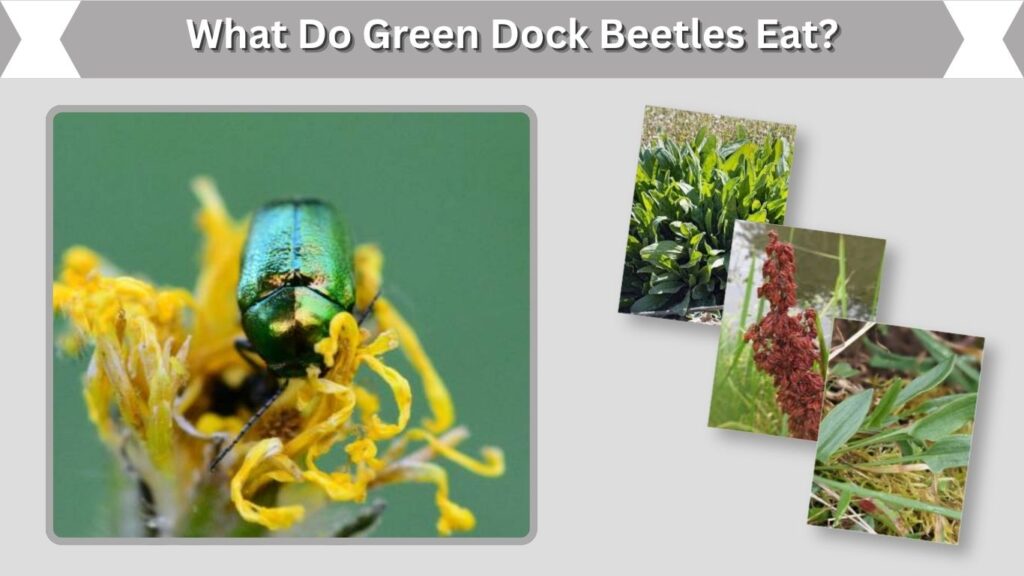
Green dock beetles are herbivores that feed mainly on plants in the genus Rumex. Both adults and larvae consume leaf tissue.
Their common food plants include:
- Broad-leaved dock
- Curled dock
- Common sorrel
- Sheep’s sorrel
- Water dock
- Garden sorrel
- Rhubarb
Broad-leaved dock is one of their most important host plants. Because dock can become an invasive agricultural weed, the feeding activity of these beetles may sometimes provide useful natural control.
Do Green Dock Beetles Eat Rhubarb?
Green dock beetles occasionally move from wild dock plants onto rhubarb, which belongs to the same plant family. Adults create rounded or irregular holes, while numerous larvae may remove larger sections of tissue.
Minor damage usually does not threaten a mature rhubarb plant. Young, weak, or heavily infested plants may need protection, especially when many larvae are feeding together.
The species has also occasionally been recorded feeding on ornamental plants such as begonia, although these are not its typical hosts.
Green Dock Beetle Eggs and Larvae
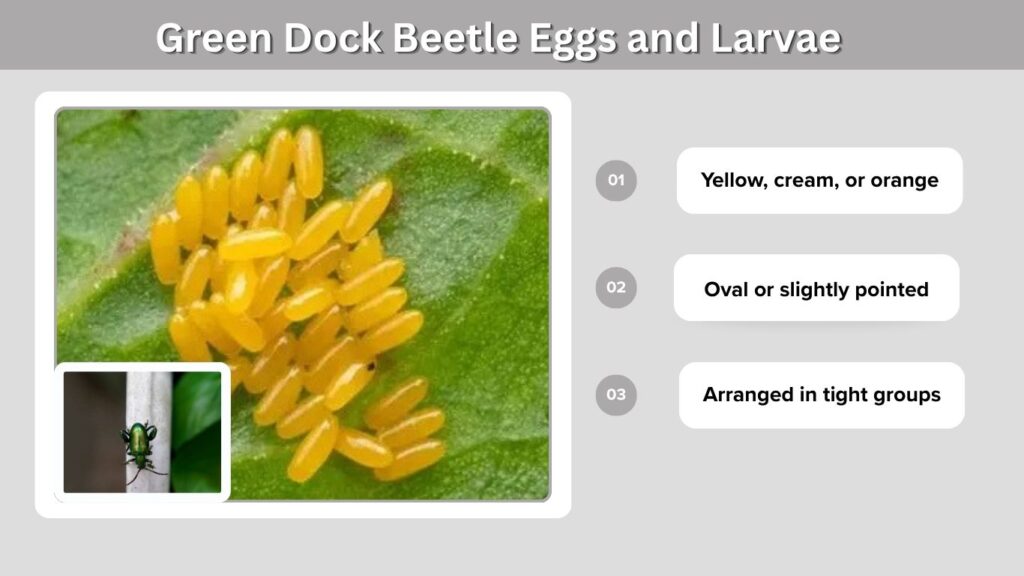
Eggs and larvae are generally found on the same dock plants as the adults. Checking the undersides of damaged leaves is the easiest way to locate them.
What Do the Eggs Look Like?
Female green dock beetles lay clusters of small, elongated eggs on the undersides of leaves. The eggs are usually:
- Yellow, cream, or orange
- Oval or slightly pointed
- Arranged in tight groups
- Attached upright or at a slight angle
- Deposited in clusters containing several dozen eggs
A female can lay multiple batches during the breeding season. The eggs may become darker or more orange shortly before they hatch.
What Do the Larvae Look Like?
Newly hatched larvae are small and dark. As they grow, they develop segmented, somewhat flattened bodies that may appear black, brown, or dark purple.
Mature larvae can reach approximately 8 mm long. They often gather in groups and feed from the underside of a leaf, creating thin, transparent patches before larger holes appear.
Green dock beetle larvae have special attachment structures that help them grip smooth or sloping leaves. They use their six legs and an additional contact structure at the rear of the abdomen, known as a pygopod.
Green Dock Leaf Beetle Life Cycle
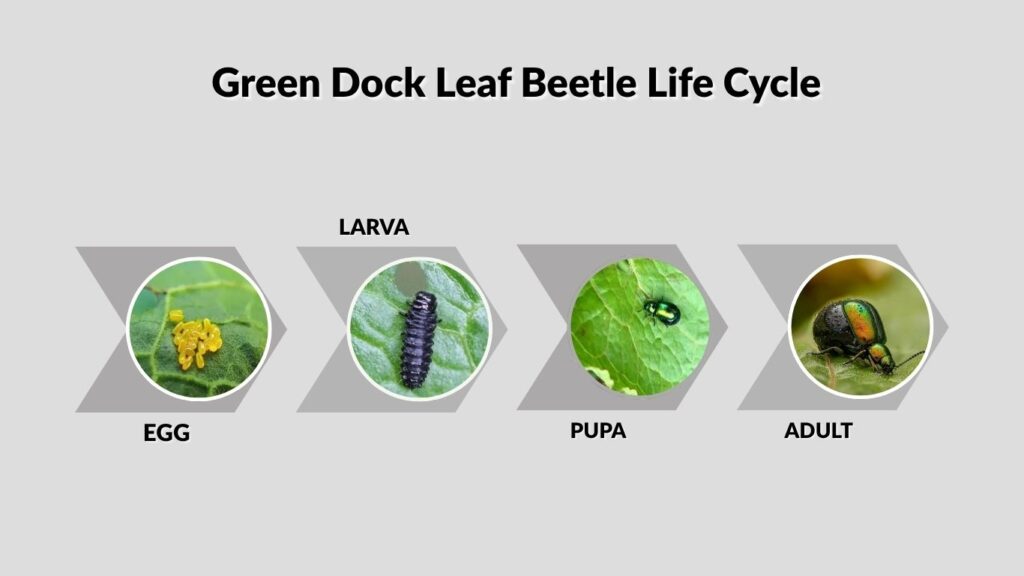
The green dock beetle undergoes complete metamorphosis, passing through egg, larval, pupal, and adult stages.
| Life stage | Appearance and activity |
| Egg | Yellow-orange clusters beneath leaves |
| Larva | Dark, segmented leaf-feeding grub |
| Pupa | Yellow-orange form hidden underground |
| Adult | Small, oval, metallic-green beetle |
From Egg to Larva
The eggs hatch into small larvae that immediately begin consuming the host leaf. Larvae pass through three growth stages, known as instars, becoming larger after each molt.
Young larvae may drop from a leaf when disturbed. Older larvae tend to remain attached while feeding and can quickly produce noticeable damage when present in large groups.
Pupation and Adult Emergence
After completing the third instar, the larva drops to the ground and digs a shallow chamber. Pupation usually occurs approximately 2 cm beneath the soil surface.
Under suitable conditions, the adult may emerge about six to nine days later. Newly emerged adults are soft and lighter in color. Their wing covers gradually expand, harden, and develop the familiar metallic-green appearance.
The species may produce more than one generation during a warm season. Adults can overwinter in sheltered places and become active again when temperatures rise.
Are Green Dock Beetles Harmful?
Green dock beetles are not harmful to people or pets. They are not poisonous, venomous, or known to transmit human diseases.
Their main impact is feeding damage to plants. However, whether they should be considered pests depends on what they are eating.
When feeding on unwanted dock weeds, they can be beneficial because they weaken the plants and may reduce flowering. When they move onto rhubarb or cultivated sorrel, the same feeding behavior can become undesirable.
Do Green Dock Beetles Bite?
Green dock beetles do not normally bite people. Their mouthparts are designed to chew plant tissue rather than pierce skin.
A beetle may move its jaws defensively when handled, but it is too small to cause a medically important injury. Washing the skin is sufficient in the unlikely event that handling causes minor irritation.
Signs of a Green Dock Beetle Infestation
Common signs include:
- Numerous shiny green beetles on dock or rhubarb
- Yellow egg clusters beneath leaves
- Groups of dark larvae
- Small rounded holes in leaves
- Skeletonized or transparent leaf sections
- Ragged leaf margins
- Dark droppings around feeding areas
The larvae usually cause the most concentrated damage because many may hatch and feed together.
How to Get Rid of Green Dock Beetles
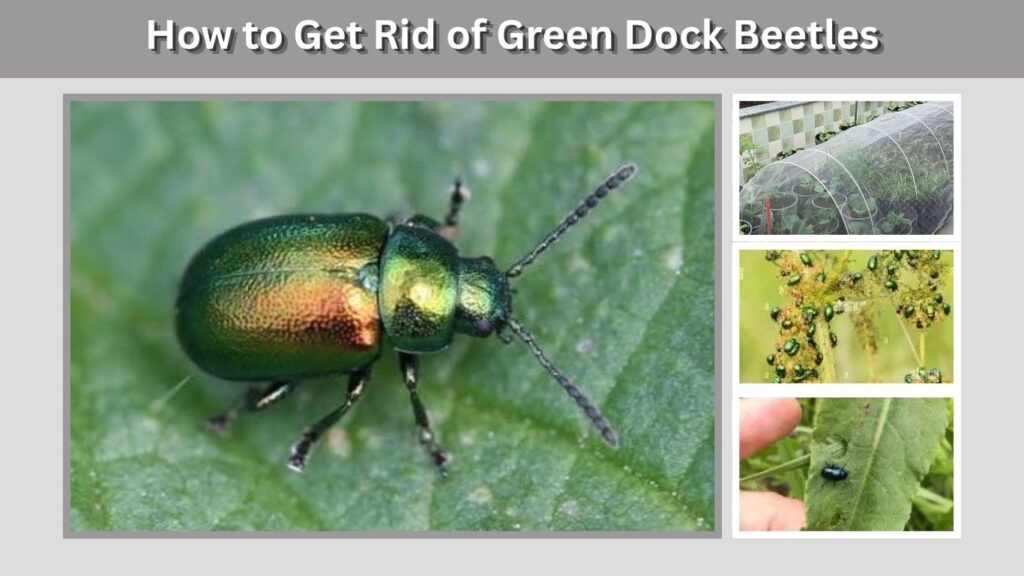
Control is rarely needed when the insects are feeding only on wild dock. In gardens, treatment should focus on protecting cultivated plants rather than eliminating every beetle.
Remove Beetles by Hand
Inspect the tops and undersides of leaves. Pick off adults and larvae and remove egg clusters by rubbing or clipping the affected leaf section.
Place the insects in a container of soapy water rather than moving them to another cultivated host.
Manage Nearby Dock Plants
Dock growing beside rhubarb can support large beetle populations. Removing some nearby dock may reduce movement onto crops.
However, abruptly cutting all heavily infested dock plants may force surviving beetles to search for another food source. Inspect nearby rhubarb and sorrel after dock is removed.
Green Dock Beetle frin
Fine insect mesh can prevent adult beetles from reaching vulnerable plants. Ensure the covering is secured around the edges and that no beetles or eggs are already underneath it.
Mature plants can usually tolerate limited feeding, so removing only the worst-damaged leaves may be enough.
Use Insecticides Only When Necessary
Broad-spectrum insecticides can kill pollinators and natural predators along with the beetles. They are generally unnecessary for minor cosmetic damage.
When severe feeding threatens an edible crop, use only a product legally approved for that plant and pest in your location. Follow its directions, harvest interval, and safety instructions exactly.
FAQs
Are green dock beetles dangerous?
Green dock beetles are not dangerous to humans, pets, or livestock. They contain no medically significant venom and do not spread disease. Their only notable effect is chewing damage to dock, sorrel, rhubarb, and a limited number of other plants.
Are green dock beetles beneficial?
They can be beneficial when feeding on broad-leaved dock and other unwanted weeds. Heavy feeding damages dock leaves and may weaken the plant before it produces seeds. However, gardeners may view the beetles as pests when they attack rhubarb or cultivated sorrel.
Why is the female green dock beetle so swollen?
Before laying eggs, the female’s abdomen expands dramatically to accommodate developing eggs. It can become so large that her green wing covers separate and expose the dark abdomen. This unusual appearance is normal and does not indicate disease or injury.
Can green dock beetles fly?
Yes. Adult green dock beetles have functional wings and can fly, although they are often seen crawling on their host plants. Flying allows them to locate new patches of dock, escape disturbed vegetation, and move onto related plants such as rhubarb.
Should green dock beetles be removed from gardens?
Removal is unnecessary when they are restricted to unwanted dock plants. When adults or larvae begin damaging rhubarb, sorrel, or ornamentals, hand-picking and removing egg-covered leaves usually provide adequate control without harming pollinators or other beneficial insects.