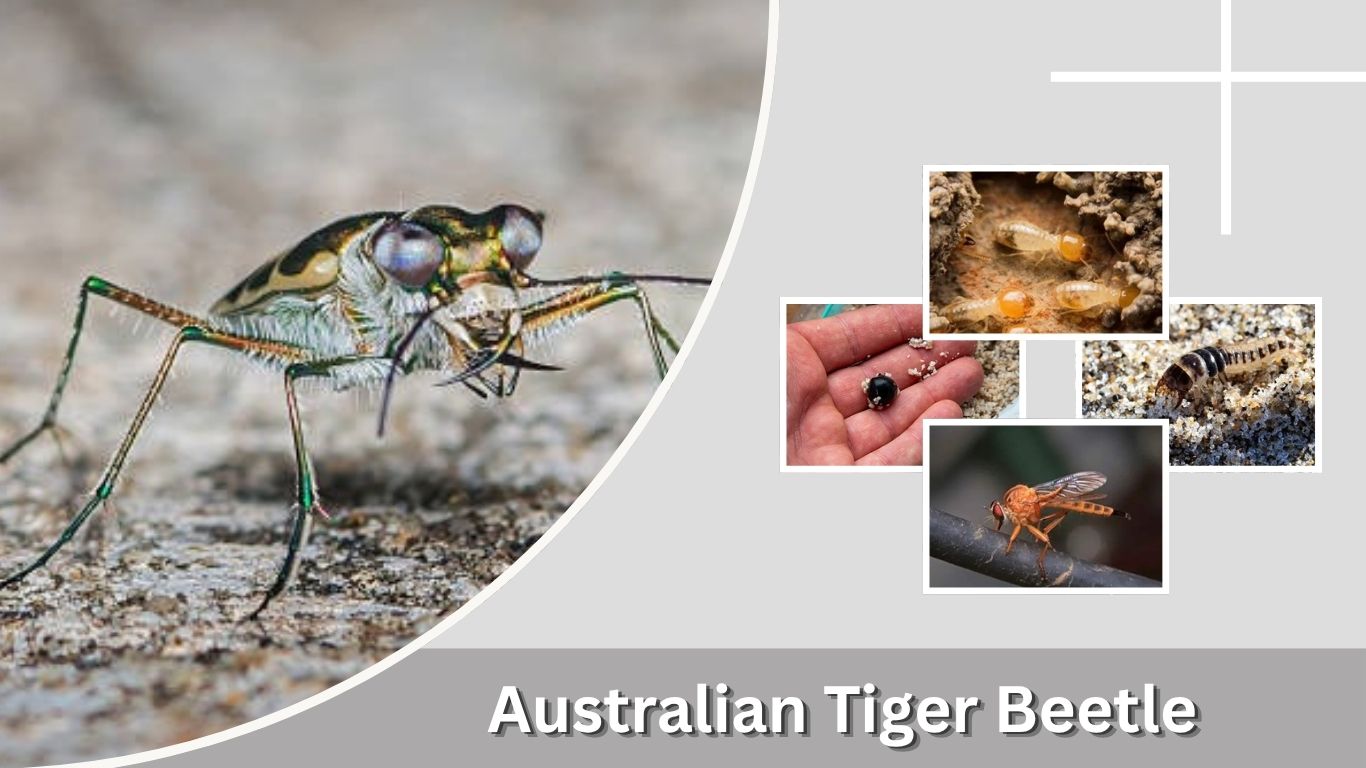
The Australian tiger beetle is a fast, predatory insect known for its powerful jaws, long legs, and remarkable running ability. Australia supports numerous tiger beetle species, but Rivacindela hudsoni receives the most attention because it holds the widely reported record for the fastest-running insect. This flightless beetle races across hot, open ground while hunting ants and other small creatures. Its specialized body, saline habitat, and stop-and-start hunting style make it one of Australia’s most fascinating beetles.
What Is an Australian Tiger Beetle?
“Australian tiger beetle” can refer broadly to the many tiger beetle species found across Australia. However, the name is frequently used for Rivacindela hudsoni, a large and exceptionally fast species from the country’s dry interior.
Tiger beetles are active predators rather than plant-eating garden pests. Adults use their speed and strong mandibles to pursue small animals across the ground. Their name reflects their aggressive hunting behavior rather than any relationship to tigers.
Scientific Classification
The accepted scientific name of the record-holding Australian species is Rivacindela hudsoni. It is also listed in some classifications as Cicindela (Rivacindela) hudsoni.
Its basic classification is:
- Order: Coleoptera
- Group: Tiger beetles
- Genus: Rivacindela
- Species: Rivacindela hudsoni
- Scientific authority: Sumlin, 1997
The Atlas of Living Australia recognizes Cicindela (Rivacindela) hudsoni as an accepted Australian species. Taxonomists differ over whether Rivacindela should be treated as a full genus or as a subgenus within Cicindela.
What Does the Australian Tiger Beetle Look Like?
Australian tiger beetles generally have streamlined bodies, prominent eyes, long legs, and curved jaws. Their appearance varies considerably among species, ranging from dark brown or black to metallic green, blue, bronze, or copper.
Rivacindela hudsoni is comparatively dark and less brightly colored than many familiar green tiger beetles.
Identification Features
- Body approximately 20–21 millimetres long
- Dark brown or black wing covers
- Pale cream or yellow margins along the wing covers
- Iridescent green or bronze head and thorax
- Large, bulging compound eyes
- Long, slender running legs
- Threadlike antennae
- Strong, sickle-shaped mandibles
Its large eyes help it locate moving prey in open habitats. The long legs hold its body above the hot surface and allow rapid acceleration across firm, level ground.
How Fast Is the Australian Tiger Beetle?
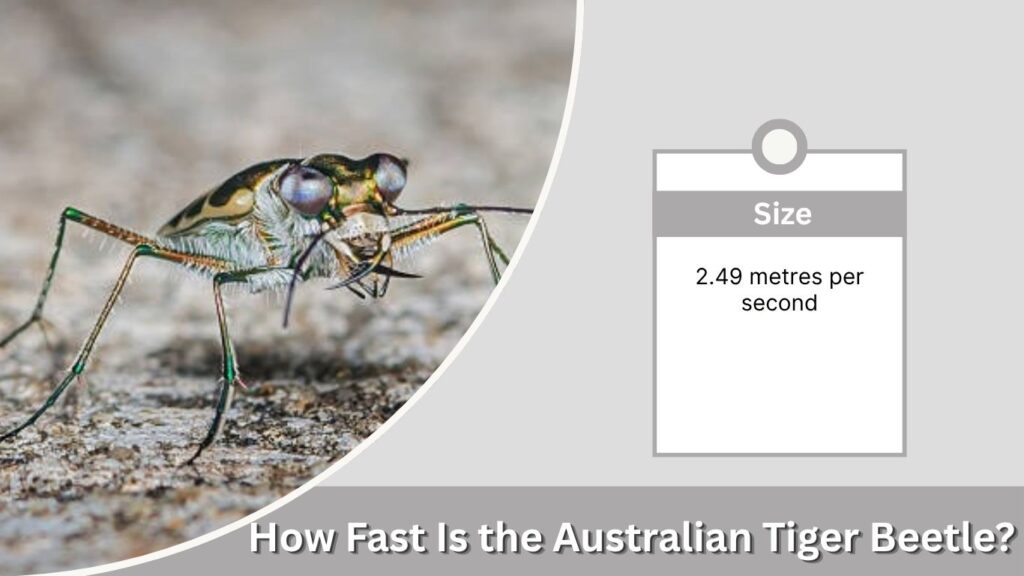
Rivacindela hudsoni has been measured at approximately 2.49 metres per second, equivalent to nearly 9 kilometres per hour or 5.6 miles per hour. That may not sound extremely fast compared with a car or large animal, but it is extraordinary for an insect only about two centimetres long.
The beetle can cover roughly 120–125 body lengths in one second. Research into flightless Australian Rivacindela found that their running speeds were the fastest recorded for insects.
| Speed measurement | Approximate result |
| Metres per second | 2.49–2.5 m/s |
| Kilometres per hour | 9 km/h |
| Miles per hour | 5.6 mph |
| Body lengths per second | 120–125 |
Why Can It Run So Fast?
Several physical and behavioral adaptations contribute to its speed:
- Long legs provide an extended stride.
- A lightweight, narrow body reduces resistance.
- Strong leg muscles produce rapid acceleration.
- Open, level habitat permits unobstructed running.
- Flightlessness allows greater dependence on terrestrial movement.
- Warm ground temperatures can improve muscle performance.
The speed record applies specifically to running insects. Other insects can travel faster while flying.
Does It Become Blind While Running?
Tiger beetles do not permanently lose their sight, but rapid movement makes it difficult for them to maintain a clear visual image of their prey. Information moves across their visual field faster than their eyes can process it effectively.
To compensate, a hunting beetle runs in a short burst, stops to relocate its target, and then sprints again. This produces the characteristic stop-and-start chase seen in many tiger beetles.
Where Does the Australian Tiger Beetle Live?
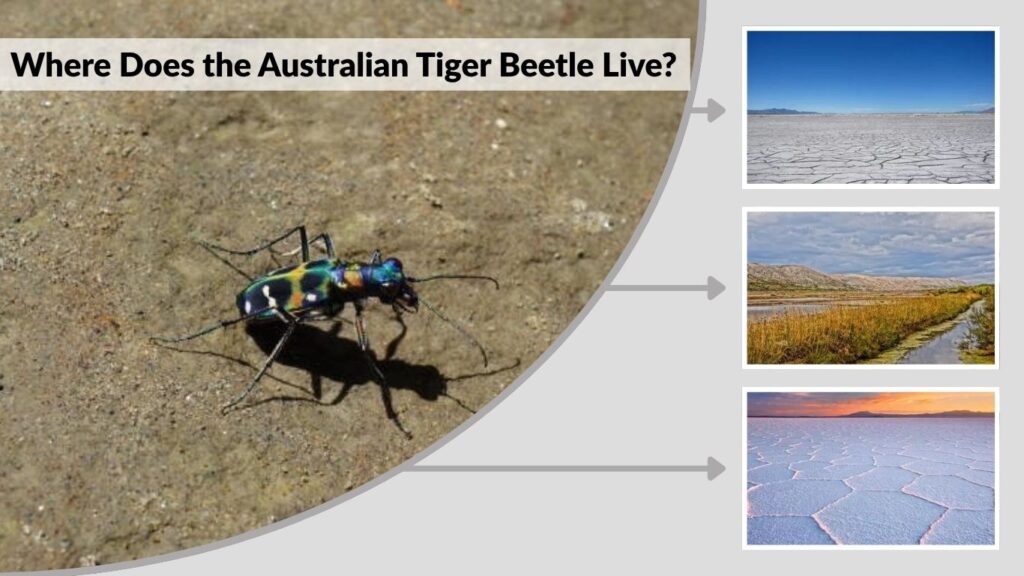
Australian tiger beetles occupy numerous habitats, including beaches, riverbanks, forest clearings, desert margins, salt flats, clay pans, and sandy tracks. Individual species often have highly specific soil, moisture, and temperature requirements.
Rivacindela hudsoni is associated particularly with the arid and saline environments of inland Australia.
Preferred Habitat of Rivacindela hudsoni
This species is most strongly connected to:
- Dry salt lakes
- Saline streams
- Salt-encrusted flats
- Open clay or sandy ground
- Hot, sparsely vegetated landscapes
- Arid areas of South Australia
Flat, open surfaces allow the beetle to see prey and run without colliding with vegetation. The species was originally described from South Australia, and the Rivacindela group is strongly associated with Australia’s inland saline landscapes.
Many other Australian tiger beetles live in different environments, so not every species is restricted to salt lakes.
What Do Australian Tiger Beetles Eat?
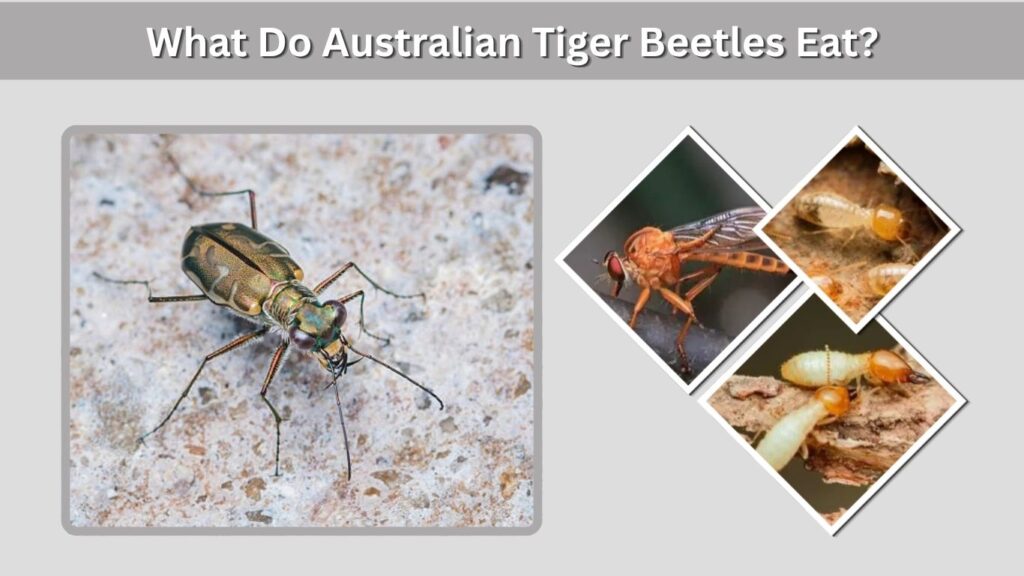
Adult Australian tiger beetles are carnivorous. They chase, capture, and consume small invertebrates living on exposed ground.
Common prey may include:
- Ants
- Small beetles
- Flies
- Termites
- Caterpillars
- Spiders
- Grasshopper nymphs
- Other soft-bodied arthropods
The beetle catches prey with its curved mandibles. It then uses digestive fluids to break down the softer tissues before consuming them. Hard and indigestible body parts may be discarded.
How Do They Hunt?
A tiger beetle first scans the ground with its large eyes. Once it detects movement, it sprints toward the animal and grabs it with its mandibles.
The chase is often divided into several stages:
- The beetle spots potential prey.
- It runs forward in a rapid burst.
- It stops and visually relocates the target.
- Another sprint.
- It seizes the prey at close range.
Its speed is useful not only for hunting but also for escaping birds, lizards, spiders, and other predators.
Can Australian Tiger Beetles Fly?
The answer depends on the species. Many Australian tiger beetles have functional hindwings and can fly, especially when disturbed or moving between feeding locations.
However, Rivacindela hudsoni is considered flightless. Its flying wings are reduced, and the beetle depends primarily on running. Several members of the Australian Rivacindela group have independently developed reduced wings and flightlessness.
Research suggests that rapid running may be especially valuable for flightless species living in open, relatively stable saline habitats.
Australian Tiger Beetle Life Cycle
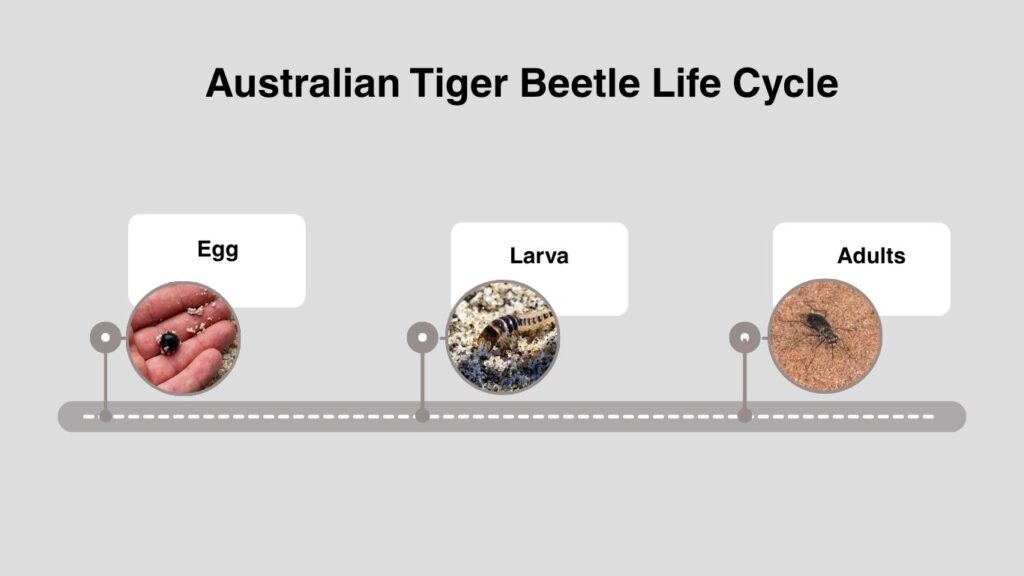
Australian tiger beetles undergo complete metamorphosis through four stages: egg, larva, pupa, and adult.
Eggs and Larvae
Females place eggs in suitable soil. After hatching, the larvae dig vertical burrows and remain inside them for much of their development.
A larva has a large head, powerful jaws, and hooks on its abdomen. It waits near the tunnel entrance and ambushes ants or other small animals passing nearby. When prey approaches, the larva lunges upward, grabs it, and pulls it underground.
Pupae and Adults
After passing through several larval stages, the mature larva seals its tunnel and forms an underground pupal chamber. The adult later emerges and begins hunting on the soil surface.
Development time varies according to the species, temperature, rainfall, prey availability, and habitat conditions.
Are Australian Tiger Beetles Dangerous?
Australian tiger beetles are not dangerous to people. They are not venomous, do not spread disease, and do not attack humans.
A captured beetle may pinch the skin with its mandibles in self-defense. The pinch can be noticeable, but it is not normally medically significant. Handling should still be avoided because the beetle’s legs and body can be damaged easily.
Tiger beetles are beneficial predators that contribute to healthy natural food webs by feeding on other small arthropods.
Australian Tiger Beetle Facts
- Rivacindela hudsoni is widely recognized as the fastest-running insect.
- It can reach about 2.5 metres per second.
- It covers around 120–125 body lengths every second.
- The species is approximately two centimetres long.
- It was formally described in 1997.
- It lives in hot, saline areas of inland Australia.
- Unlike many tiger beetles, it cannot fly.
- It hunts using short, extremely fast running bursts.
- Both adults and larvae are predators.
- Large eyes and curved mandibles are characteristic tiger beetle features.
FAQs
What is the scientific name of the Australian tiger beetle?
The record-holding Australian tiger beetle is scientifically known as Rivacindela hudsoni. Some scientific resources list it as Cicindela (Rivacindela) hudsoni because the classification of Rivacindela as a genus or subgenus varies among taxonomic treatments.
How fast can an Australian tiger beetle run?
Rivacindela hudsoni can run at approximately 2.49 metres per second, or nearly 9 kilometres per hour. This equals around 120–125 times its body length each second, making it the fastest insect measured while running.
How big is the Australian tiger beetle?
Rivacindela hudsoni is approximately 20–21 millimetres long. Other Australian tiger beetle species may be smaller or larger, so there is no single size that applies to every species found throughout the country.
Where are Australian tiger beetles found?
They occur in habitats such as salt flats, sandy beaches, riverbanks, forest openings, clay pans, and inland deserts. Rivacindela hudsoni is especially associated with dry, saline environments in South Australia and other parts of the arid interior.
Can you keep an Australian tiger beetle as a pet?
Tiger beetles are not well suited to ordinary pet enclosures. They require specialized temperature, soil, prey, and space conditions. Collecting may also be restricted in protected areas or for threatened species, so observing them in their natural habitat is preferable.