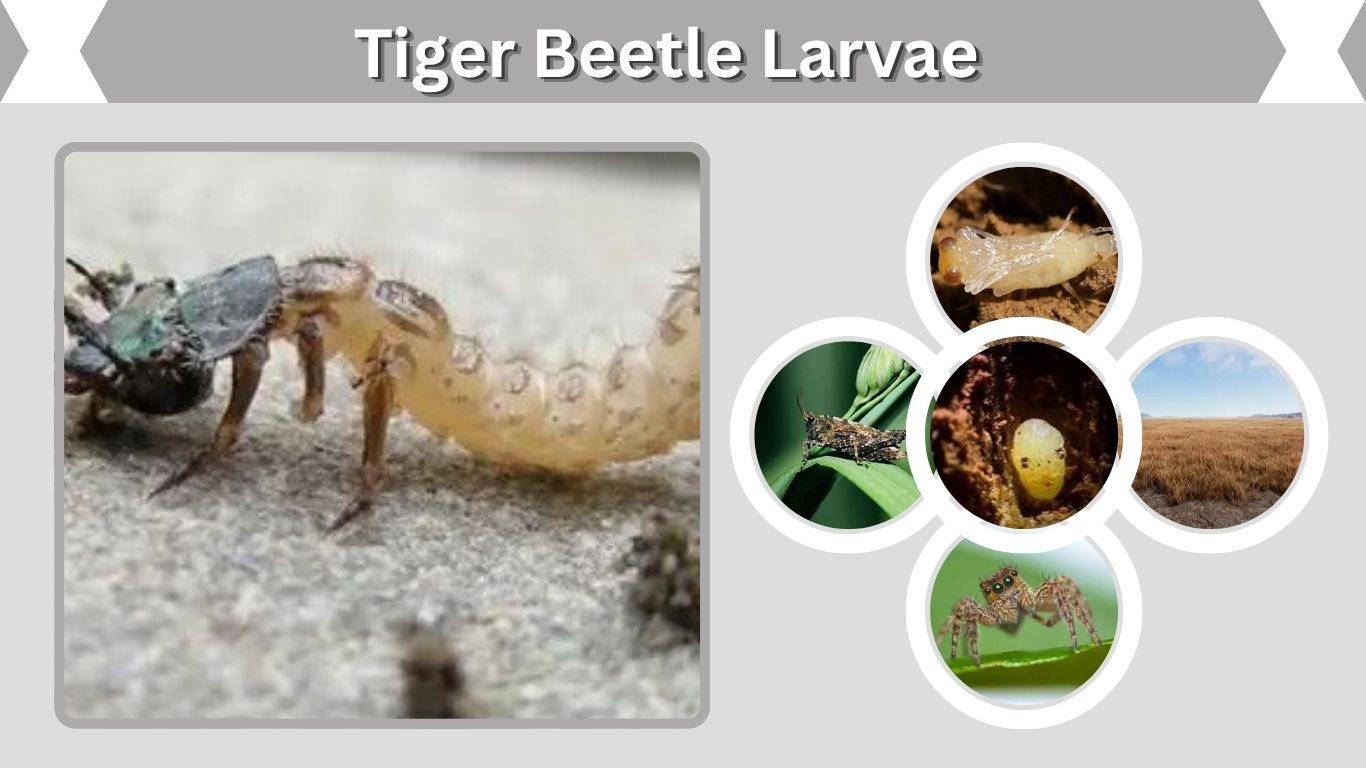
Tiger beetle larvae may look like ordinary pale grubs at first, but they are highly specialized underground predators. Unlike adult tiger beetles, which chase prey across open ground, the larvae remain inside vertical burrows and ambush insects passing near the entrance. Their oversized heads, curved jaws, sharp vision, and hook-bearing abdominal humps make them perfectly adapted for this unusual hunting strategy. This guide explains how to identify tiger beetle larvae, where they live, what they eat, whether they bite, and why some species construct small turrets around their burrows.
What Do Tiger Beetle Larvae Look Like?
Tiger beetle larvae have long, narrow bodies that are usually cream, tan, or pale brown. Their appearance differs greatly from the metallic, long-legged adult beetles they eventually become.
The most distinctive features are their broad, hardened heads and powerful, sickle-shaped mandibles. The head and first body segment are often dark brown or black, while the remaining body is softer and lighter in color.
Identification Features
- Long, pale, grub-like body
- Large, flattened head
- Strong, curved mandibles
- Dark, hardened thoracic shield
- Several small eyes on each side of the head
- A hump with hooks or spines on the abdomen
- Body positioned vertically inside a soil burrow
The flattened head can fit closely against the burrow opening, helping conceal the larva while it waits for prey. The hooks on its abdomen grip the burrow wall, preventing a struggling insect from pulling the larva out.
Where Do Tiger Beetle Larvae Live?
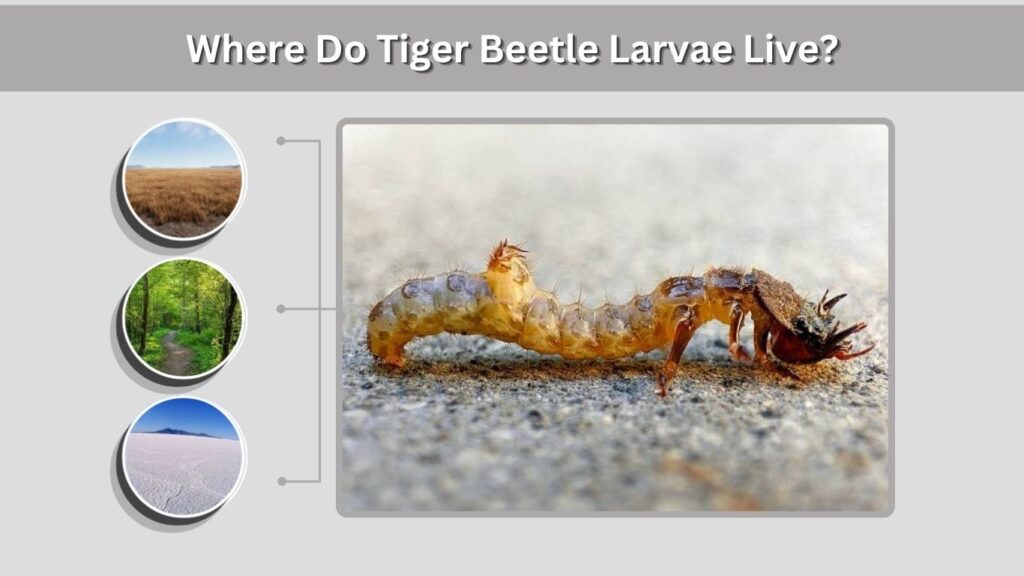
Tiger beetle larvae live in tunnels excavated in soil, sand, clay, or other exposed substrates. Suitable habitat varies among species, but most require relatively open ground with little dense vegetation.
Common larval habitats include:
- Sandy beaches and dunes
- Streambanks and riverbars
- Woodland paths
- Dry grasslands
- Salt flats
- Clay banks
- Desert washes
- Sandy roadsides
- Rocky glades
Green tiger beetle larvae are commonly associated with sunny, exposed soil, while beach tiger beetle larvae occupy sandy shorelines. Other species may specialize in saline soils, moist river edges, or extremely dry habitats.
Bare ground is important because dense vegetation and thick leaf litter can make hunting and burrow construction difficult. Habitat changes that allow vegetation to cover previously open soil may therefore reduce suitable areas for certain tiger beetles.
What Does a Larval Burrow Look Like?
The entrance usually appears as a small, clean, circular hole. It may resemble an ant nest opening, although there is often no pile of loose soil surrounding it.
A larva waits near the top with its head positioned level with the surface. When disturbed by shadows, footsteps, or sudden movement, it rapidly retreats deeper underground.
Burrow depth depends on the species, larval stage, soil moisture, temperature, and substrate. Older larvae generally create wider and deeper burrows than newly hatched larvae.
What Do Tiger Beetle Larvae Eat?
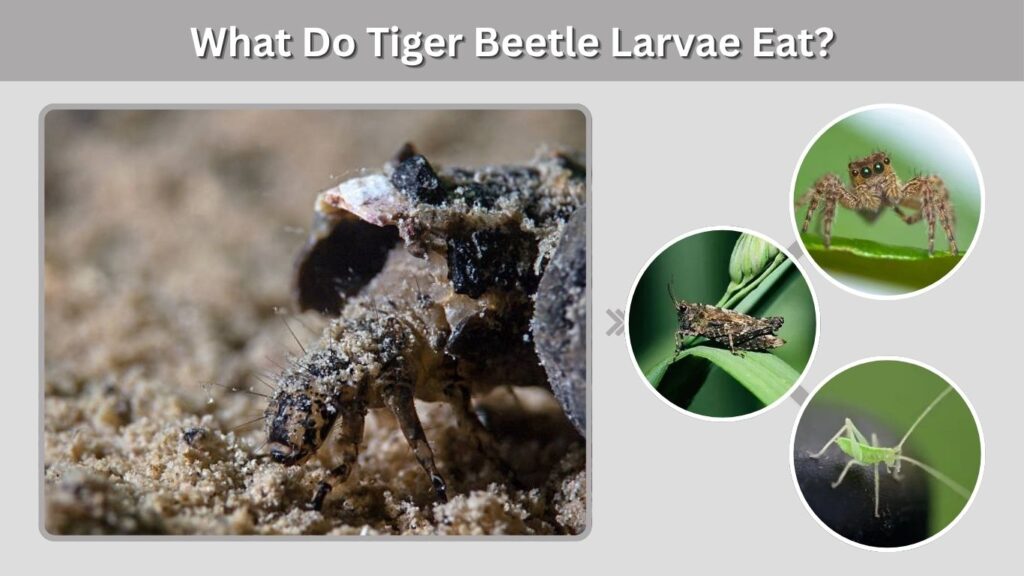
Tiger beetle larvae are carnivorous. They eat small insects and other invertebrates that approach the mouths of their burrows.
Their prey can include:
- Ants
- Small beetles
- Flies
- Caterpillars
- Springtails
- Tiny grasshoppers
- Spiders
- Insect larvae
- Small crickets
- Other ground-dwelling arthropods
The exact diet depends on which prey animals live near the burrow. A beach species may capture organisms moving through sand, while a woodland species may encounter ants, springtails, and small beetles.
Tiger beetle larvae can also release digestive fluids that begin breaking down captured prey before the food is consumed.
How Do Tiger Beetle Larvae Catch Food?
The larva remains almost motionless at the burrow entrance, with its jaws ready. Its developed eyes help it judge the movement and distance of approaching prey.
When an insect moves within range, the larva suddenly throws its head upward or backward and closes its mandibles around the victim. It then pulls the prey into the tunnel.
The hooked hump on the abdomen braces the larva against the burrow wall during the attack. This anchoring system is particularly important when the captured prey is strong or larger than expected.
Why Do Some Tiger Beetle Larvae Build Turrets?
Some tiger beetle larvae construct raised collars or chimney-like turrets around their burrow entrances. These structures may be made from soil particles, clay, sand, or small pieces of vegetation.
Research suggests that turrets can help regulate burrow temperature, allowing larvae to remain near the entrance and hunt for longer periods during hot conditions. Experiments on turret-building larvae found that the structures did not primarily prevent flooding or parasitoid attacks.
Turrets may also provide a slightly elevated hunting position, but their purpose can differ among species and environments.
Why Don’t Most Larvae Build Turrets?
Turret construction is not universal. Many species live successfully in plain, circular burrows without any raised structure.
Possible reasons include differences in:
- Soil texture
- Local temperature
- Moisture levels
- Available building material
- Hunting behavior
- Species-specific instincts
- Risk of burrow collapse
A larva living in loose beach sand may face different environmental pressures than one living in firm clay or cool woodland soil.
Tiger Beetle Larval Life Cycle
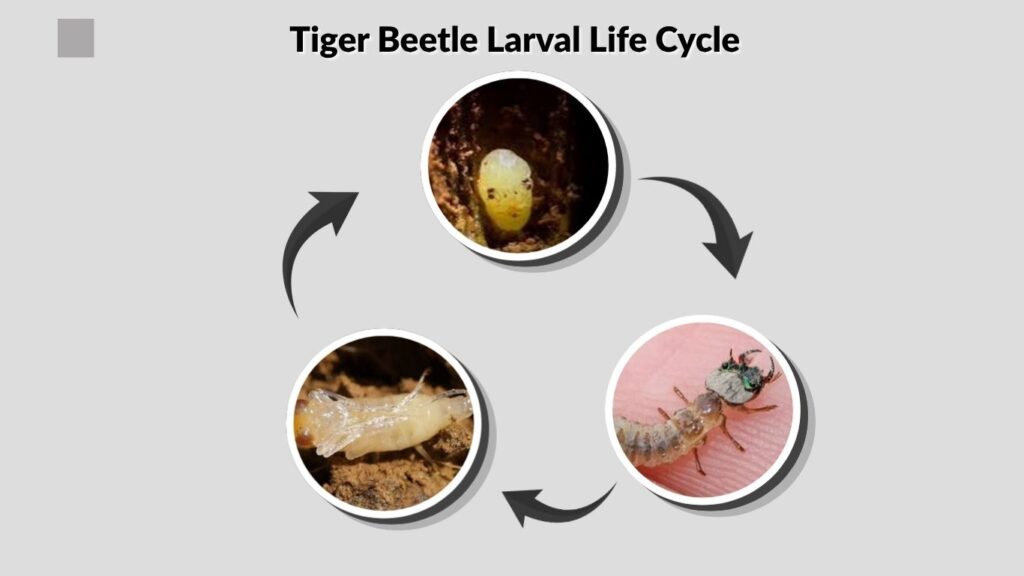
Tiger beetles undergo complete metamorphosis with four stages: egg, larva, pupa, and adult.
Egg Stage
A female places individual eggs in suitable soil. After hatching, each young larva begins excavating its own narrow burrow.
Larval Stages
Tiger beetle larvae normally pass through three developmental stages called instars. After each molt, they become larger and enlarge or rebuild their burrows.
Food availability affects how quickly they develop. Larvae with regular access to prey may progress more quickly than larvae living where food is scarce.
Pupal Stage
When fully developed, the larva closes its tunnel and creates a chamber underground. Inside this protected space, it changes into a pupa.
Adult Stage
The completed adult eventually digs to the surface. Depending on the species and climate, the total larval period may last several months or extend for several years. Some tiger beetles can remain larvae for as long as four years.
Do Tiger Beetle Larvae Bite?
Tiger beetle larvae possess strong mandibles and can potentially pinch when handled. However, they remain inside their burrows and do not seek out people.
A bite would be most likely if someone removed a larva from its tunnel and held it with bare fingers. It would generally be a defensive pinch rather than an aggressive attack.
Tiger beetle larvae are not venomous and are not considered medically dangerous. The best practice is to observe them without digging them out or placing fingers near their jaws.
Are Water Tiger Beetle Larvae the Same Thing?
The term “water tiger” usually refers to the larvae of predaceous diving beetles, not true tiger beetles. Water tiger larvae are aquatic, free-moving predators with elongated bodies and large jaws.
True tiger beetle larvae generally live in soil burrows on land, although some species occupy damp habitats close to streams, rivers, wetlands, or beaches. Despite their similar predatory behavior, the two groups belong to different beetle lineages and have very different lifestyles.
Predators of Tiger Beetle Larvae
Although they are efficient hunters, tiger beetle larvae are also prey for other animals.
Known enemies include ants, birds, predatory beetles, parasitoid wasps, and bee flies. Some parasitoids locate a larval burrow and place an egg on or near the tiger beetle larva. The developing parasitoid then feeds on its host.
Larvae defend themselves by retreating rapidly, plugging their tunnels during unfavorable conditions, and anchoring firmly against the burrow walls.
FAQs
Are six-spotted tiger beetle larvae green?
No. Despite the bright metallic-green appearance of adult six-spotted tiger beetles, their larvae are generally pale or cream-colored with darker heads and thoracic plates. Color alone is rarely enough to identify a tiger beetle larva to species.
How can you find a tiger beetle larval burrow?
Look for small, round openings in bare, compacted, or sandy soil where adult tiger beetles are active. Observe quietly from a distance. A larva may slowly raise its head to the entrance after nearby movement stops.
Can tiger beetle larvae leave their burrows?
They spend most of their larval lives inside burrows. They may relocate under certain conditions, particularly after disturbance, flooding, or unsuitable soil changes, but they are not normally seen roaming across the ground like many other beetle larvae.
Are tiger beetle larvae beneficial?
Yes. They are native predators that help control populations of ants, flies, small beetles, caterpillars, and other invertebrates. They are also part of the food web and can indicate the presence of healthy, specialized open-ground habitats.
Should I catch a tiger beetle larva?
It is better to observe the larva in its natural burrow. Digging can injure its soft body or destroy the tunnel it depends on for feeding and protection. Some tiger beetle species are rare or legally protected, making disturbance especially inappropriate.