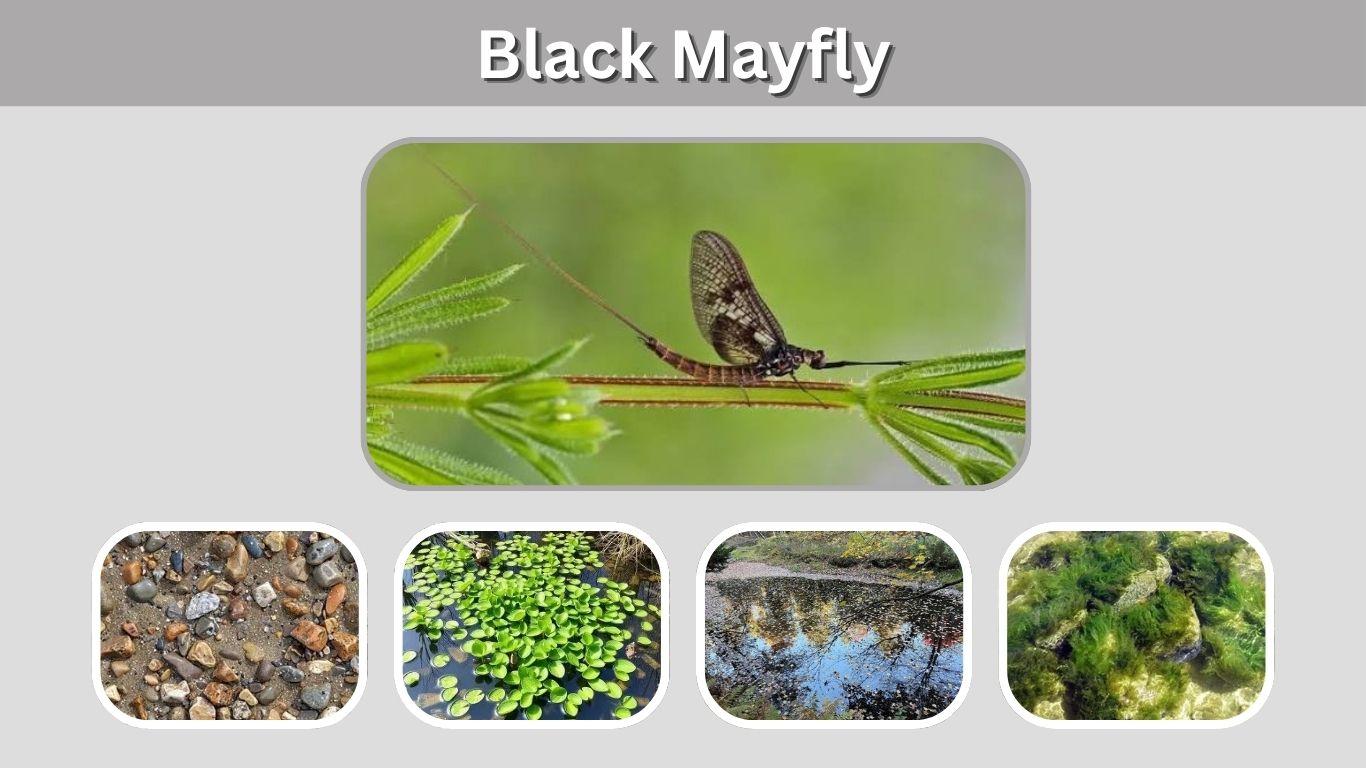
A black mayfly is usually a dark-colored member of the insect order Ephemeroptera rather than one officially recognized species. The term may describe naturally dark adults, Black Quill mayflies, Black Drake mayflies, or artificial flies used by anglers. These delicate insects develop underwater as nymphs before emerging in large seasonal hatches. Black mayflies do not bite, sting, or damage homes, but they may gather around lights near lakes and rivers.
What Is a Black Mayfly?
“Black mayfly” is a general description used for mayflies with black, dark brown, charcoal, or smoky coloration. A mayfly’s appearance can also change between its two winged stages.
The first winged stage is called the subimago or dun. It often has cloudy wings and a dull body. After one final molt, it becomes a mature imago or spinner, which usually has clearer wings and a shinier body. Mayflies are unusual because they molt once after developing functional wings.
| Feature | Black Mayfly |
| Insect order | Ephemeroptera |
| Color | Black, brown, charcoal, or smoky gray |
| Wings | Usually two pairs held upright |
| Tails | Two or three long filaments |
| Young stage | Aquatic nymph |
| Adult diet | Usually does not eat |
| Biting ability | Does not bite or sting |
| Common habitat | Freshwater lakes, rivers, ponds, and streams |
Black Mayfly Identification
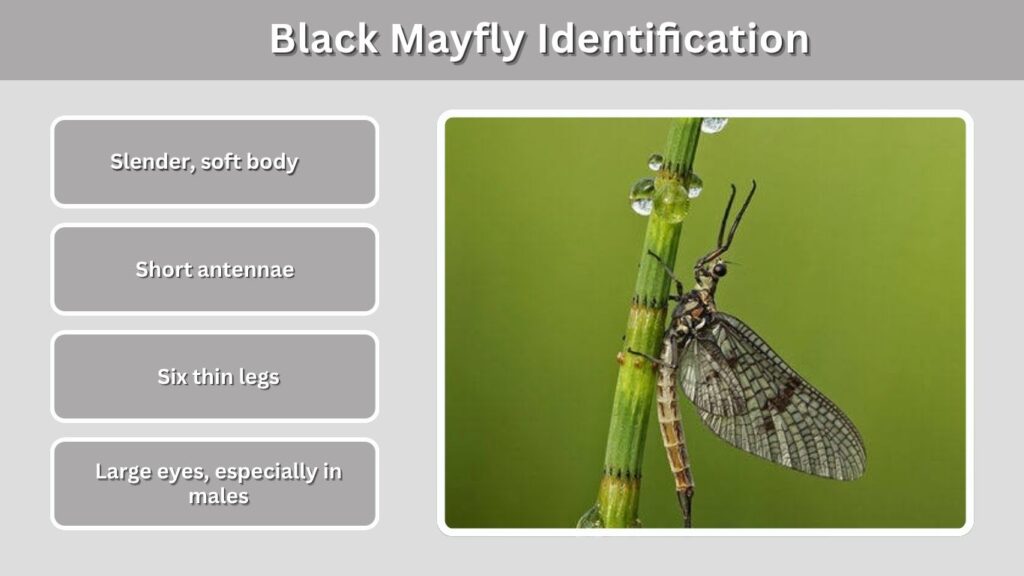
Black mayflies have the same basic body structure as other mayflies. Color alone is not enough to identify the exact species because several unrelated species can appear dark.
Main Identification Features
- Slender, soft body
- Black, dark brown, or charcoal coloration
- Large triangular front wings
- Much smaller hind wings or none in some species
- Wings held vertically when resting
- Two or three long tail filaments
- Short antennae
- Six thin legs
- Large eyes, especially in males
Adult mayflies cannot fold their wings flat across the abdomen like many true flies. Their upright wings and long tails are their most recognizable characteristics.
Is the Black Mayfly a Single Species?
No. Several mayflies may be called black mayflies because of their color or established fly-fishing names.
Black Quill Mayfly
The name Black Quill is commonly associated with Leptophlebia cupida, also known as the early brown spinner. This prong-gilled mayfly is a recognized North American species.
The name “Little Black Quill” is applied to another mayfly, Teloganopsis deficiens. This demonstrates why common names should not be used as proof that two dark mayflies belong to the same species.
Black Drake Mayfly
“Black Drake” is mainly an angling name and can be applied differently by region. Some references use it for dark spinner stages of large drake mayflies, while North American anglers may apply the term to species within Siphlonurus or other groups.
For accurate identification, location, body size, wing pattern, emergence date, and nymph characteristics should be examined instead of relying solely on the name Black Drake.
What Does a Black Mayfly Nymph Look Like?
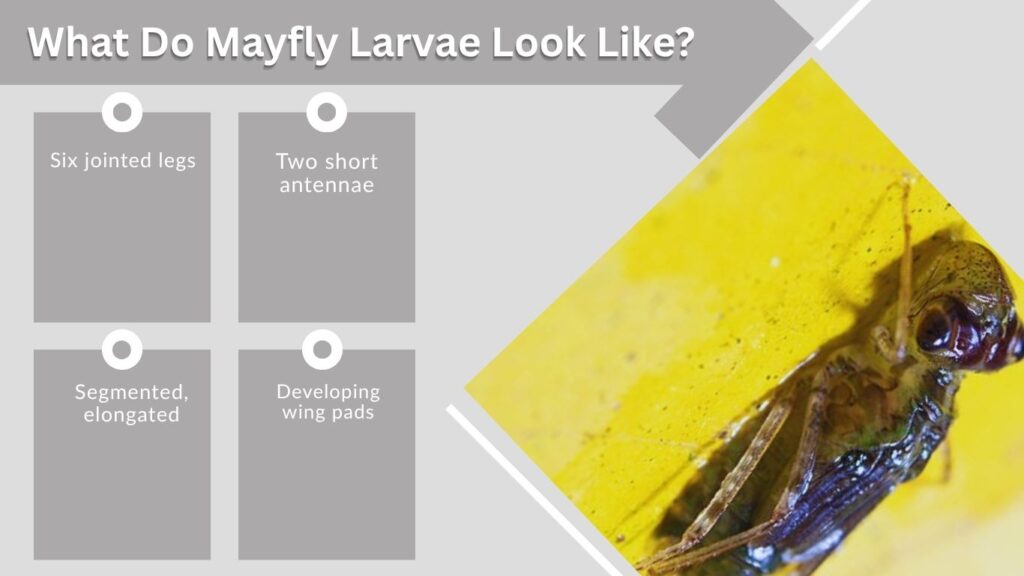
The black mayfly nymph is the immature aquatic stage. Nymphs may appear black, brown, olive, tan, or mottled depending on the species, habitat, and stage of development.
Nymph Identification
- Six jointed legs
- Two short antennae
- Usually three tails, although some have two
- External gills along the abdomen
- Developing wing pads on older nymphs
- Segmented, elongated, or flattened body
- One claw at the end of each foot
- Dark color that blends with rocks and debris
The gills may resemble small leaves, feathers, or plates. Different body shapes allow nymphs to swim, crawl, cling to stones, or burrow into sediment. EPA identification guidance describes mayfly nymphs as having abdominal gills and normally three long rear filaments.
Where Do Black Mayflies Live?
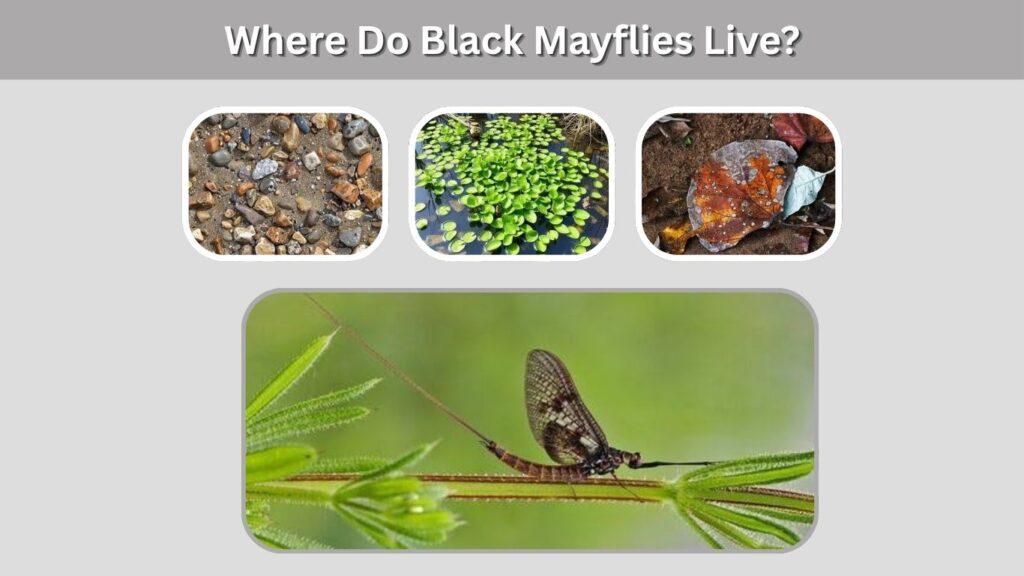
Mayfly nymphs live in freshwater. Depending on the species, they may inhabit fast-flowing rocky streams, slow rivers, ponds, wetlands, or lakes.
They commonly hide among:
- Submerged rocks
- Gravel and sand
- Aquatic vegetation
- Fallen branches
- Leaf litter
- Muddy lake bottoms
- Algae-covered surfaces
Many species favor well-oxygenated water, although environmental tolerances differ. Mayflies are often included in freshwater monitoring because changes in their diversity and abundance can provide information about habitat and water quality. A single mayfly sighting, however, does not prove that water is completely free of pollution.
What Do Black Mayflies Eat?
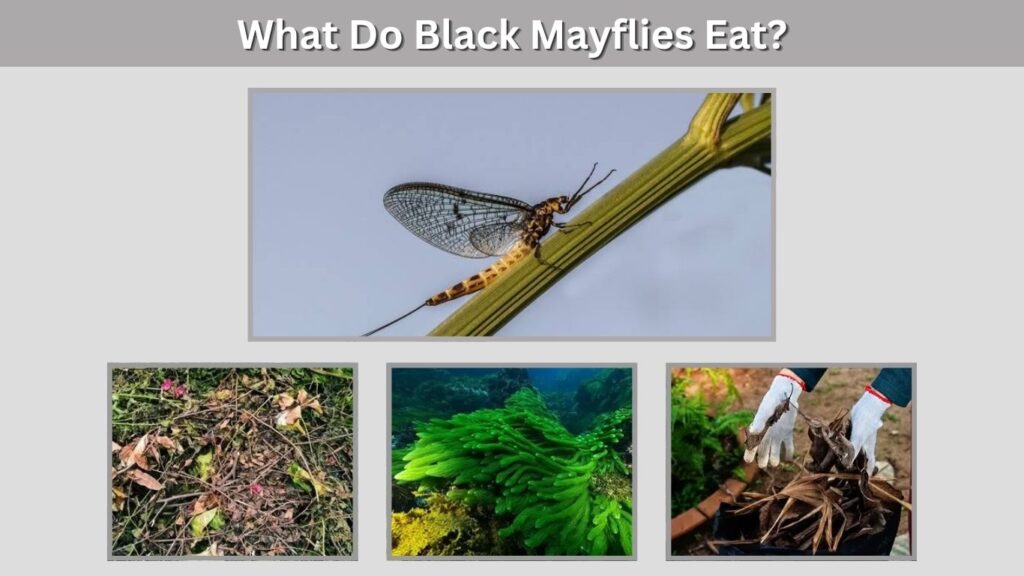
The diet depends mainly on life stage. Black mayfly nymphs commonly consume algae, diatoms, biofilm, decaying leaves, and fine organic particles.
Some scrape food from rocks, while others collect material from the bottom or filter particles from moving water. A small number of mayfly nymphs prey on tiny aquatic animals, but most feed on living or decomposing plant material.
Adult mayflies generally do not eat. Their mouthparts and digestive systems are reduced, and they survive on energy stored during the nymph stage.
Black Mayfly Life Cycle
Black mayflies follow the same life cycle as other members of Ephemeroptera:
Egg → nymph → subimago → adult
Females lay their eggs in or on freshwater. The eggs hatch into aquatic nymphs that feed, grow, and molt repeatedly. Depending on the species and water conditions, the nymph stage may last several months or more than a year.
When development is complete, the nymph rises toward the surface or crawls onto a rock or plant. It sheds its aquatic exoskeleton and becomes a winged subimago. After resting for a short period, it molts into a mature adult.
Adults form mating swarms, reproduce, and die soon afterward. The winged stage may last only several hours or a few days.
Are Black Mayflies Dangerous?
Black mayflies are harmless to people and pets. They do not bite, sting, spread human diseases, eat clothing, or damage buildings.
Large hatches may still create temporary problems. Adults can gather around streetlights, doors, windows, bridges, and waterfront buildings. Dead insects may accumulate on roads or outdoor surfaces and can become slippery when present in enormous numbers.
Turning off unnecessary exterior lights, closing windows, and using intact screens can reduce the number entering a house. Pesticide treatment is rarely necessary because the adults are short-lived and developed in nearby water rather than inside the building.
Black Mayfly vs. Black Fly
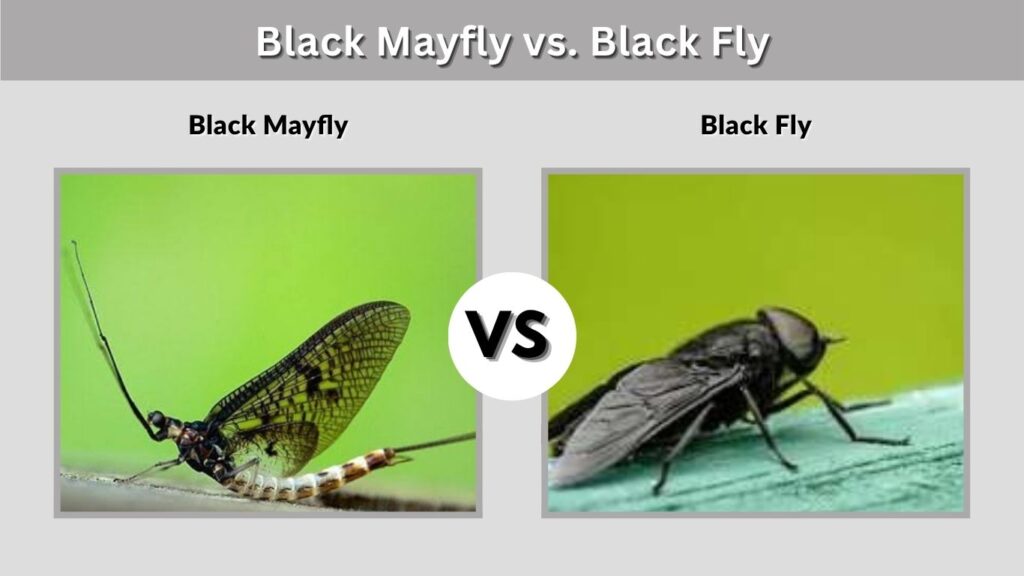
Black flies and black mayflies are completely different insects.
| Feature | Black Mayfly | Black Fly |
| Insect group | Ephemeroptera | Diptera |
| Wings | Usually two pairs | One pair |
| Long tails | Two or three | None |
| Adult feeding | Usually does not eat | Females of some species take blood |
| Biting | No | Some species bite |
| Resting wings | Held upright | Folded over the body |
| Body shape | Slender and delicate | Small, compact, and humpbacked |
A black fly has a short, rounded body and resembles a tiny humpbacked fly. A mayfly has a long abdomen, upright triangular wings, and obvious tail filaments.
Black Mayflies and Fly Fishing
Black mayfly patterns imitate dark nymphs, emerging duns, adults, or spent spinners. Trout may feed heavily during a natural hatch, especially when mayflies rise through the water or sit on the surface.
Common dark imitations include:
- Black Quill patterns
- Black Drake patterns
- Dark Pheasant Tail Nymphs
- Black or charcoal emergers
- Dark spinner patterns
- Small black mayfly nymphs
The best fly is not necessarily the darkest one. Anglers should match the natural insect’s approximate size, body shape, wing position, and life stage. A dark nymph pattern should generally be presented beneath the surface, while a dry fly imitates a winged insect floating on top.
FAQs
Are black mayflies and black flies the same?
No. Mayflies have upright wings and long tails and cannot bite. Black flies are compact true flies with one pair of wings, and females of some species bite people and animals to obtain blood.
Why is a mayfly completely black?
Dark coloration may be natural for the species, sex, or life stage. A recently emerged dun may also look darker because its wings and body have not yet developed the clearer appearance of the mature spinner.
Do black mayflies bite?
Black mayflies do not bite or sting. Adult mayflies have reduced mouthparts and normally do not feed. Their short adult lives are devoted to mating and egg laying.
What does a black mayfly nymph eat?
Most nymphs consume algae, diatoms, biofilm, fungi, bacteria, and decomposing plant particles. A small number of species may also capture tiny aquatic animals.
Why are black mayflies around my house?
The house is probably close to a lake, pond, river, or stream where the nymphs developed. Adults are attracted to artificial lights and may temporarily gather around windows, doors, walls, and outdoor lamps.