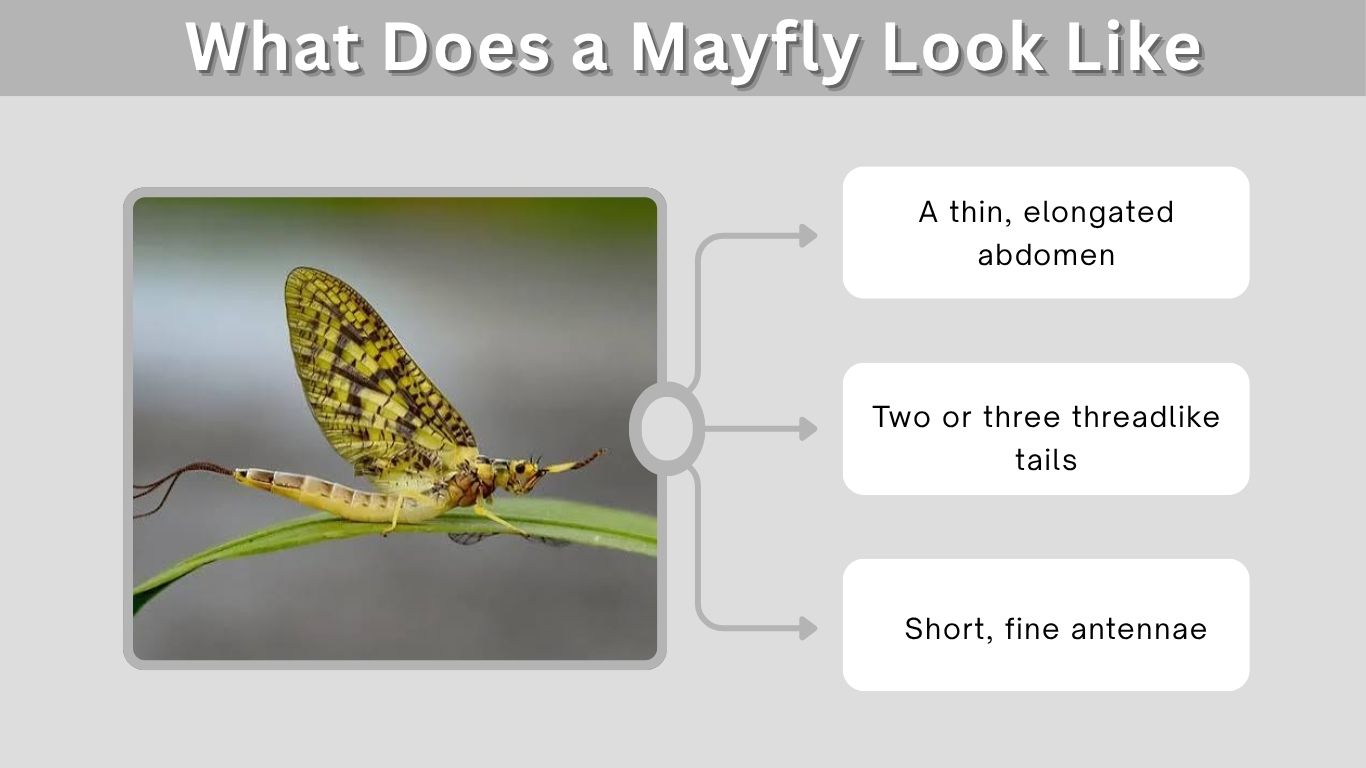
A mayfly is a slender, delicate insect with transparent triangular wings, a narrow body, and two or three long threadlike tails. Adults commonly hold their wings upright over their bodies rather than folding them flat. They are usually seen near lakes, rivers, ponds, and streams, especially during seasonal hatches. Mayflies do not bite or sting. Their aquatic young look different from adults, with visible abdominal gills, six legs, and usually three tails.
What Does an Adult Mayfly Look Like?
Adult mayflies are soft-bodied insects belonging to the order Ephemeroptera. Their size, color, and wing shape vary among species, but most share several recognizable features.
Adults generally measure around ¼ to 1¼ inches long, excluding their tail filaments. Their bodies may be pale yellow, cream, tan, brown, gray, olive, or nearly black. Newly emerged mayflies sometimes appear unusually pale or translucent.
Adult Mayfly Identification
Look for these features:
- A thin, elongated abdomen
- Two or three threadlike tails
- Two large triangular forewings
- Two much smaller hindwings in most species
- Transparent wings with numerous visible veins
- Wings held upright while resting
- Short, fine antennae
- Long, delicate front legs
- Large compound eyes, especially in males
- A soft body that is easily damaged
The two large forewings look like miniature sails when the insect is resting. The hindwings can be difficult to see and are extremely small or absent in some groups. The long tails are often as long as, or longer than, the body.
| Feature | Typical mayfly appearance |
| Body | Slender and soft |
| Size | Approximately ¼–1¼ inches |
| Wings | Clear, triangular, and heavily veined |
| Resting position | Wings held upright |
| Tails | Usually two or three long filaments |
| Color | Cream, yellow, tan, brown, olive, or gray |
| Antennae | Short and fine |
| Usual location | Near freshwater |
What Do Mayflies Look Like When They Hatch?
A mayfly does not emerge from the water as its final mature adult. It first becomes a winged subadult called a subimago, or “dun” among anglers.
The Newly Emerged Dun
A dun often looks dull, pale, smoky, or slightly cloudy. Its wings may appear less transparent than those of the mature adult, and its body can look soft and fragile.
After resting for several hours, the dun sheds its skin once more. Mayflies are unusual because they are the only known insects that molt again after developing functional wings.
The Mature Spinner
The final reproductive adult is often called a spinner by anglers. It usually has clearer, shinier wings and a more defined body color than the dun.
Mature males may have especially large eyes and unusually long front legs, which help them locate and hold females during aerial mating. After mating, many adults fall onto the water with their wings spread outward.
What Does a Mayfly Nymph Look Like?
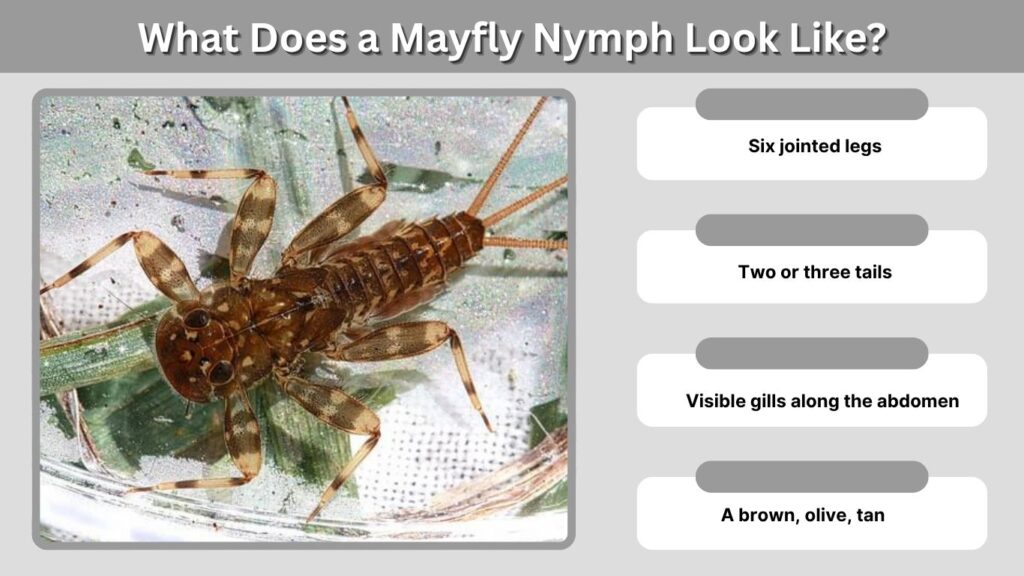
Young mayflies are aquatic nymphs, also called naiads. They live beneath the water on rocks, plants, woody debris, mud, or sand. They do not look exactly like the delicate winged adults but retain the long body and tail filaments.
Mayfly Nymph Identification
A mayfly nymph generally has:
- An elongated or flattened body
- Six jointed legs
- Two or three tails
- One claw at the end of each foot
- Visible gills along the abdomen
- Wing pads on older nymphs
- A brown, olive, tan, or yellowish color
- A body adapted for crawling, swimming, or burrowing
The abdominal gills are particularly useful for identification. Depending on the species, they may resemble small plates, leaves, feathers, or tufts arranged along both sides of the abdomen. Most nymphs have three tails, although some appear to have only two.
Nymph shape depends on habitat. Species living in fast streams may have broad, flattened bodies that help them cling to rocks. Swimming species are more streamlined, while burrowing mayflies often have cylindrical bodies and strong front legs for digging into sediment.
What Do Mayfly Eggs Look Like?
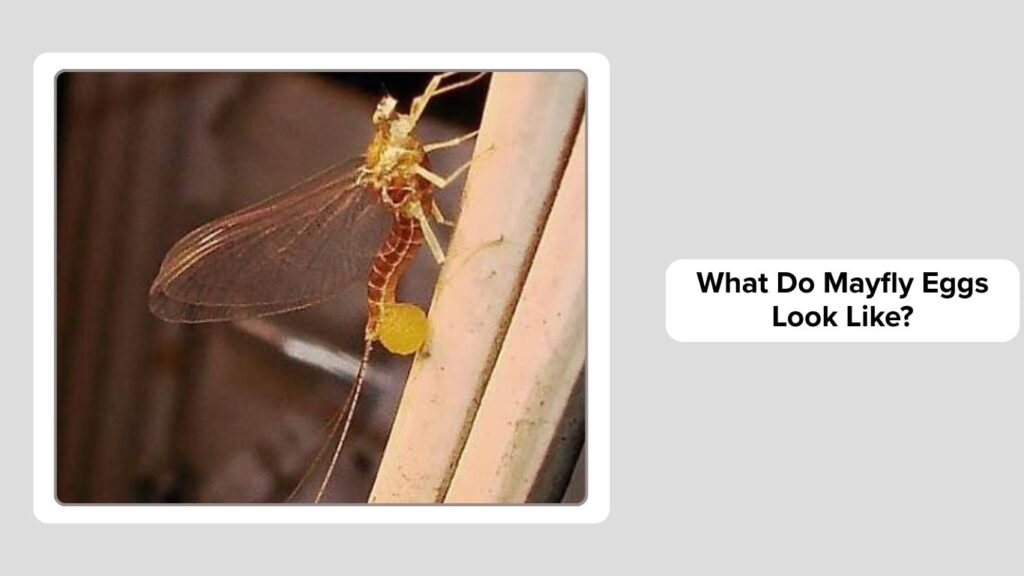
Mayfly eggs are extremely small and are rarely useful for identification without magnification. A female usually lays them directly on the water or releases them while flying just above its surface.
The eggs sink and settle among rocks, plants, sand, or bottom sediment. After development, tiny aquatic nymphs emerge and begin the longest stage of the mayfly life cycle.
A cluster of mayflies around a lake does not mean that visible eggs will be attached to buildings, trees, or furniture. Their eggs are deposited in water rather than in homes.
What Does a Mayfly Hatch Look Like?
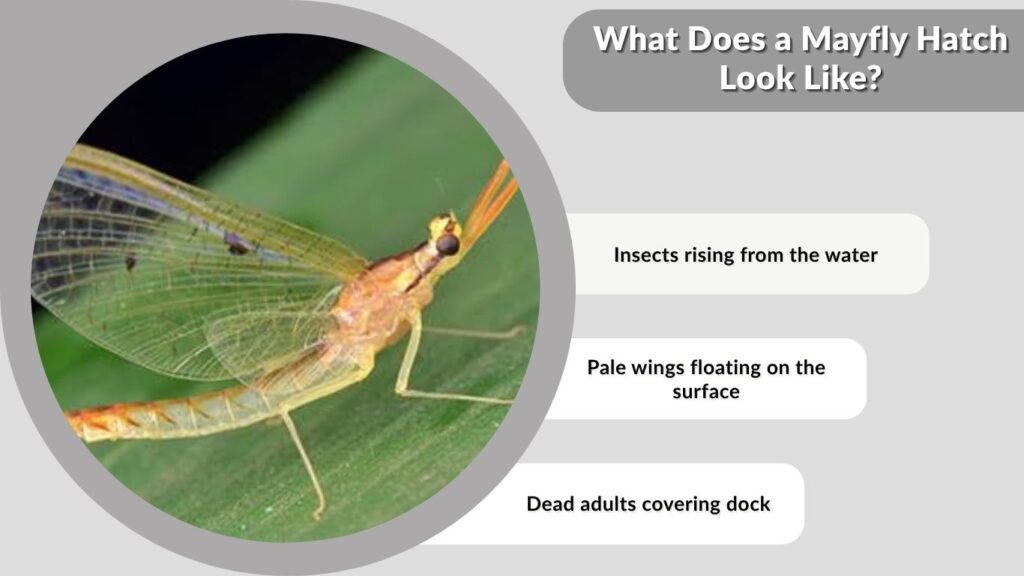
A mayfly hatch occurs when mature nymphs rise toward the surface and emerge as winged insects. Small hatches may involve only scattered individuals, while synchronized hatches can produce enormous clouds.
During a large hatch, you may see:
- Insects rising from the water
- Pale wings floating on the surface
- Mayflies resting on shoreline plants
- Swarms dancing above water
- Thousands gathering around streetlights
- Dead adults covering docks, roads, and vehicles
- Fish feeding actively at the surface
Mayfly swarms sometimes become large enough to appear on weather radar. Despite their numbers, they are temporary nuisance insects and do not damage buildings, clothing, food, or furniture.
Do Mayflies Look Like Mosquitoes?
A small mayfly may be confused with a mosquito from a distance, but several differences become obvious upon closer inspection.
Mosquitoes have one pair of narrow wings, a noticeable forward-projecting proboscis, and no long tail filaments. Mayflies have two pairs of wings, although the second pair may be very small, and usually possess two or three tails. Their large forewings are held vertically when resting.
Mayflies also lack functional adult mouthparts and cannot feed. Mosquitoes possess functional mouthparts; females of most species require blood to produce eggs, while males feed on plant sugars.
Bugs That Look Like Mayflies
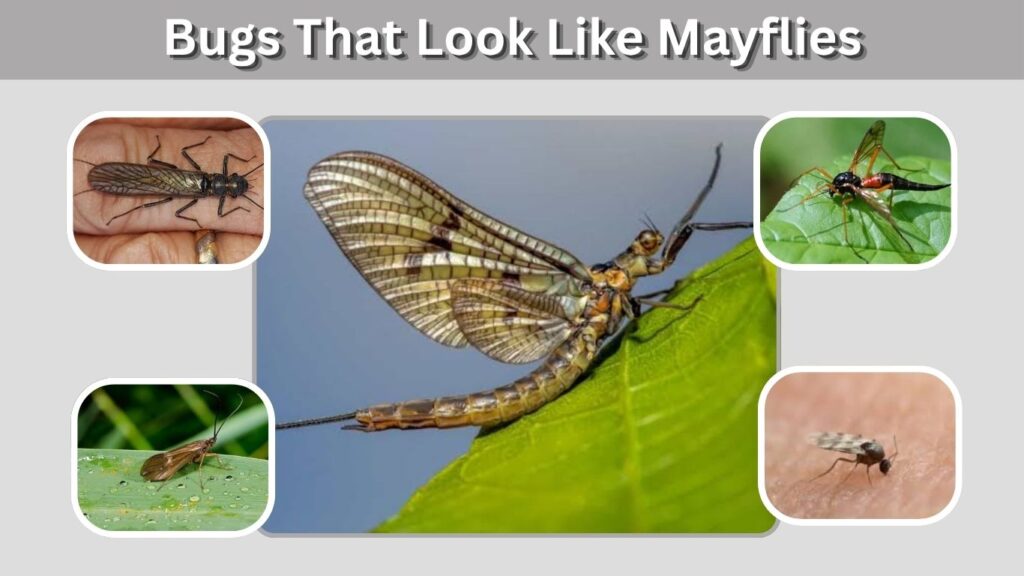
Several insects found around water and outdoor lights can be mistaken for mayflies.
Stoneflies
Stoneflies often have two tails and two pairs of transparent wings. However, their wings rest flat along the back instead of standing upright like sails. Stonefly bodies are also generally sturdier, and their antennae are longer.
Caddisflies
Caddisflies are small, mothlike insects that often appear around water and lights. They hold their usually hairy wings rooflike over the body and lack a mayfly’s long tail filaments.
Midges
Nonbiting midges are small, mosquito-like flies that may form large swarms near water. They have one pair of wings and no long tails. Male midges often have feathery antennae, unlike the short antennae of mayflies.
Crane Flies
Crane flies resemble oversized mosquitoes and have exceptionally long legs. They possess one pair of wings and do not have two or three threadlike tails. Many adults are considerably larger and more awkward-looking than mayflies.
Damselflies
Damselflies have slender bodies and may hold their wings together above the abdomen. However, their wings are long and similarly shaped, their bodies are usually firmer, and they lack a mayfly’s threadlike tails. Adult damselflies are also active predators, while adult mayflies do not eat.
What Does a Mayfly Bite Look Like?
There is no characteristic mayfly-bite appearance because mayflies do not bite people. Adults have only remnant mouthparts and cannot eat or drink. They also have no stinger.
An itchy red bump noticed during a mayfly hatch was probably caused by another insect, such as a mosquito, biting midge, flea, or another biting arthropod. Some aquatic insects attracted to outdoor lights, including backswimmers, can also deliver painful defensive bites if handled.
Avoid diagnosing an unexplained skin reaction based only on nearby insects. Seek medical care for difficulty breathing, facial swelling, widespread hives, rapidly increasing swelling, or signs of infection.
Why Do Mayflies Like Light?
Adult mayflies are strongly attracted to artificial illumination. Porch lights, streetlights, illuminated signs, and bright windows may draw them away from the water and cause dense accumulations around buildings.
This behavior becomes especially noticeable during synchronized hatches because thousands of adults emerge over a short period. Turning off unnecessary exterior lights and closing curtains can reduce the number gathering around a property.
FAQs
How Can You Quickly Identify a Mayfly?
Look for a slender body, clear triangular wings held upright, and two or three long tails. Mayflies are normally found near freshwater and have short antennae rather than the long antennae seen on many similar insects.
Are Mayflies Always White?
No. Their color varies by species and life stage. Mayflies may be cream, yellow, tan, gray, olive, reddish-brown, or dark brown. Newly emerged subadults often look paler and cloudier than mature adults.
Do Baby Mayflies Have Wings?
Aquatic mayfly nymphs do not have functional wings. Older nymphs develop visible wing pads on the thorax. Functional wings appear when the insect leaves the water and molts into a subadult.
What Is the Difference Between a Mayfly Nymph and a Stonefly Nymph?
Mayfly nymphs normally have abdominal gills, three tails, and one claw per foot. Stonefly nymphs usually have two tails and two claws at the end of each foot.
Are Mayflies Harmful?
Mayflies do not bite, sting, infest houses, or damage property. Large swarms can create temporary messes, unpleasant odors, reduced visibility, and slippery surfaces when dead insects accumulate