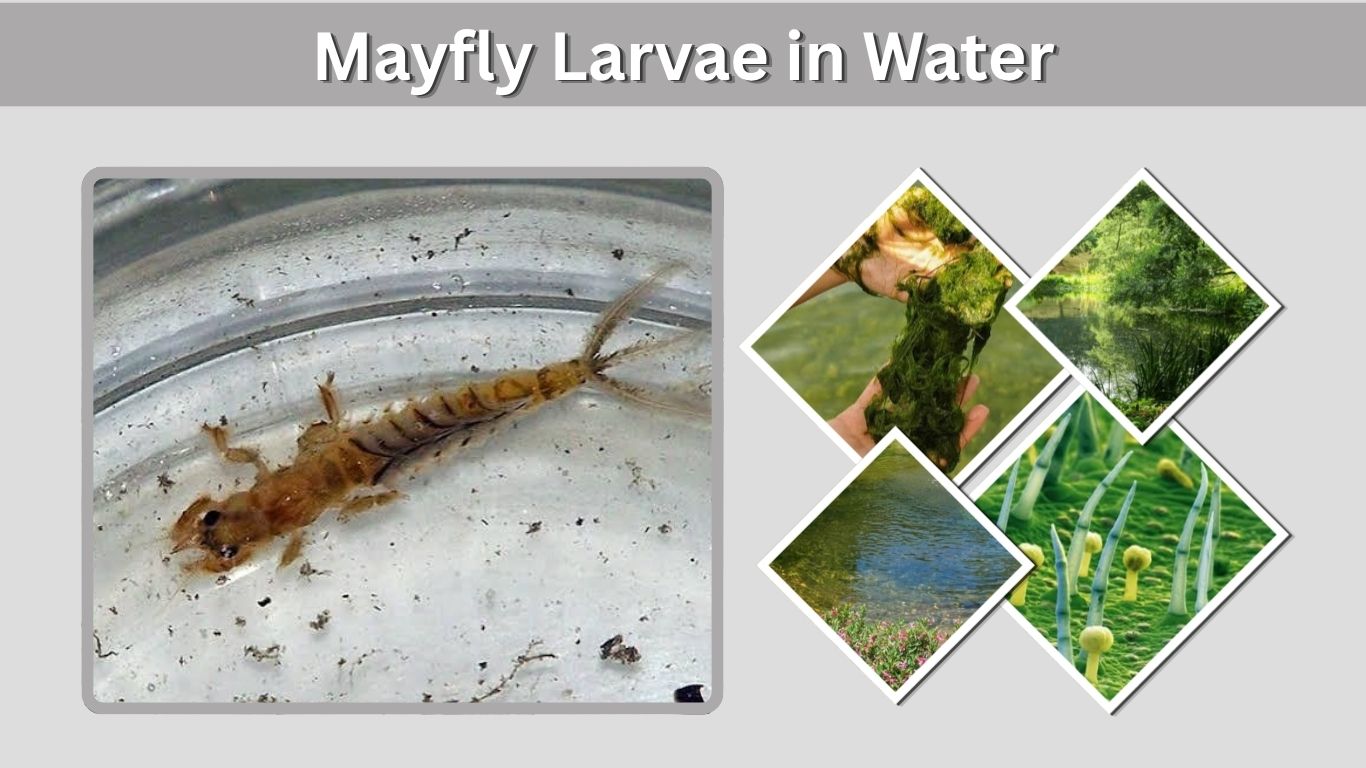
Mayfly larvae live underwater in freshwater lakes, ponds, rivers, and streams. More accurately called nymphs or naiads, they spend most of the mayfly life cycle feeding and growing beneath the surface. They usually have six legs, visible abdominal gills, developing wing pads, and two or three long tails. Depending on the species, mayfly nymphs may cling to rocks, swim through vegetation, crawl across the bottom, or burrow into soft mud. Their presence can also provide useful information about water quality.
What Are Mayfly Larvae?
Mayfly larvae are the immature aquatic stage of insects in the order Ephemeroptera. Although people frequently call them larvae, “nymph” is technically more accurate because mayflies undergo incomplete metamorphosis and do not have a pupal stage.
The nymph develops directly into a winged subadult after completing numerous underwater molts. It later molts once more to become a reproductive adult—a feature that makes mayflies unusual among insects.
| Feature | Mayfly nymph |
| Habitat | Freshwater lakes, ponds, rivers, and streams |
| Body | Slender, flattened, or cylindrical |
| Legs | Six jointed legs |
| Tails | Usually three, sometimes two |
| Breathing organs | External abdominal gills |
| Diet | Mainly algae, plant material, and organic debris |
| Aquatic lifespan | Several months to multiple years |
| Adult transition | Emerges at or near the water surface |
What Do Mayfly Larvae Look Like in Water?
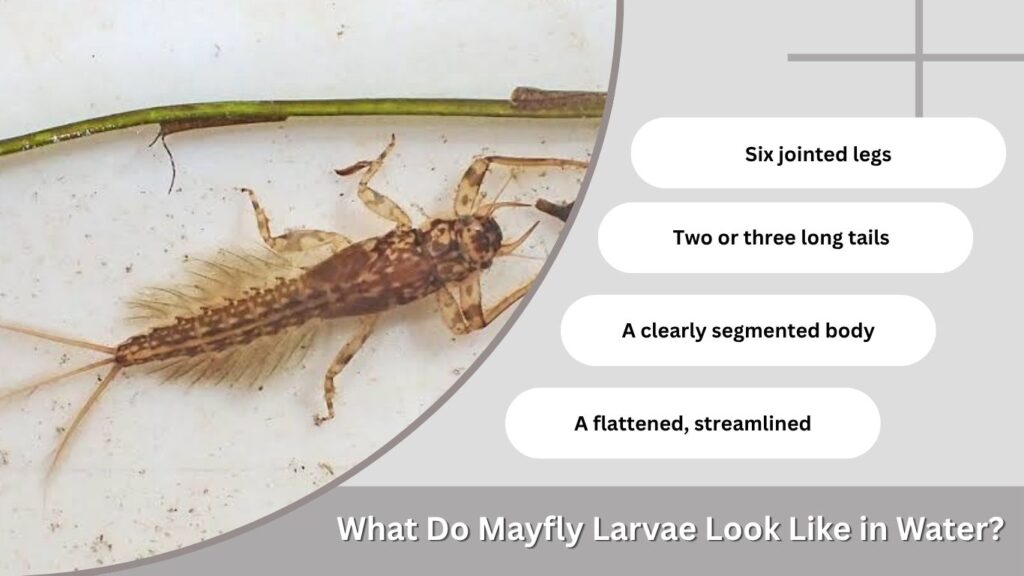
Mayfly nymphs generally have slender, segmented bodies measuring around half an inch to one inch, excluding their tails. However, size varies significantly among species and developmental stages.
Their colors commonly include tan, olive, yellowish, reddish-brown, dark brown, or nearly black. These natural colors help them blend into submerged rocks, sand, mud, leaves, and aquatic vegetation.
Identification Features
Look for the following characteristics:
- Six jointed legs
- Two or three long tails
- Leaflike or feathery gills along the abdomen
- A clearly segmented body
- Short antennae extending from the head
- Small wing pads in older nymphs
- One or no claws at the end of each leg
- A flattened, streamlined, or cylindrical shape
The external gills are among the best identifying features. They occur along the sides or upper rear portion of the abdomen and may resemble small leaves, plates, feathers, or tufts. These structures allow the nymph to obtain oxygen from the surrounding water.
Where Do Mayfly Nymphs Live?
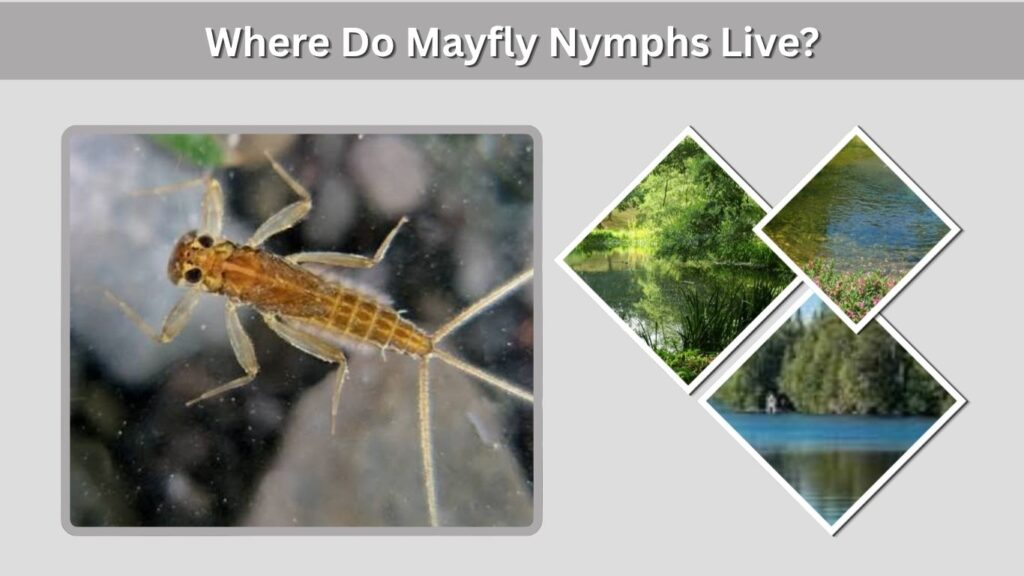
Mayfly nymphs occupy many kinds of freshwater habitat. Different body forms are adapted to different currents, depths, and bottom materials.
Fast-Moving Streams
Many species live beneath rocks in clean, well-oxygenated streams. These nymphs often have broad, flattened heads and bodies that help them remain close to the substrate rather than being carried away by the current.
They may hide in cracks, crawl over stone surfaces, or remain underneath rocks where the current is weaker.
Lakes and Ponds
Other species live in still or slow-moving water. They may crawl across submerged plants, leaves, logs, sand, and other bottom material.
Swimming nymphs tend to have streamlined bodies and tails fringed with fine hairs. They can move through open water in short bursts but usually remain close to vegetation or the bottom.
Muddy Bottoms
Burrowing mayflies, including species in the genus Hexagenia, dig tunnels into soft mud or silt. Their bodies are usually cylindrical, and their front legs are adapted for digging.
These nymphs spend much of their development inside U-shaped burrows. They move water through the burrow to obtain oxygen and collect food from the surrounding sediment. Large populations of Hexagenia occur in suitable lake and river bottoms, including parts of western Lake Erie.
How Long Do Mayflies Live in Water?
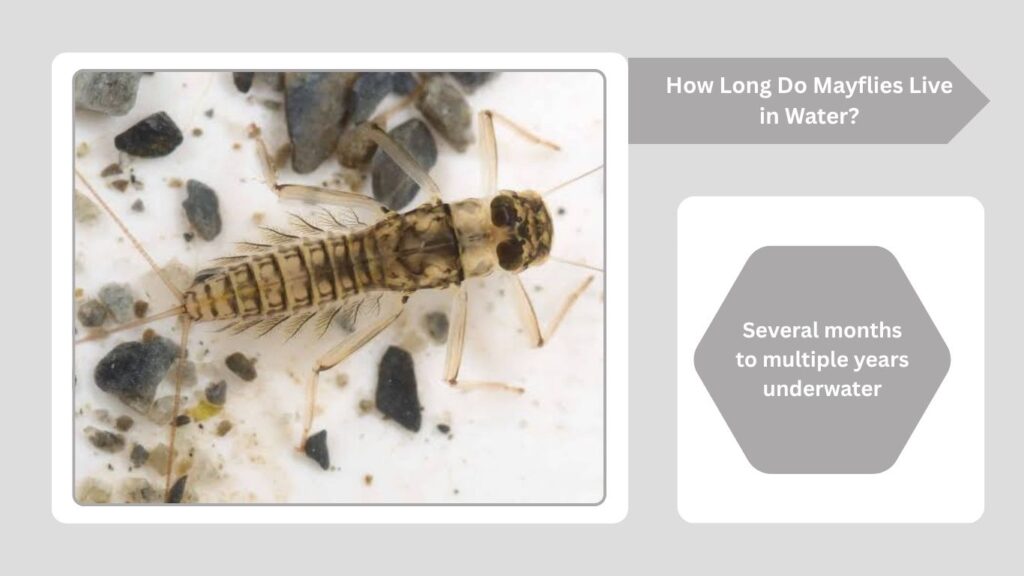
Mayflies spend several months to multiple years underwater, depending on the species, climate, food supply, and water temperature. The aquatic stage is far longer than the winged adult stage, which may last only several hours or a few days.
During this extended period, a nymph repeatedly molts as it grows. Older nymphs develop darker and more noticeable wing pads behind the head.
Some species complete their aquatic development within one season. Others, particularly those living in colder lakes and rivers, may remain underwater for two years or longer. Therefore, there is no single lifespan that applies to every mayfly species.
Do Mayflies Hatch in Water?
Yes. The mayfly life cycle begins when a female deposits her eggs on or directly into the water. The eggs normally sink and settle among rocks, vegetation, sand, or bottom sediment.
The eggs hatch underwater, producing tiny nymphs. These young mayflies remain aquatic while they feed, grow, and molt.
When development is complete, the mature nymph rises toward the surface. It breaks through its nymphal skin and emerges as a winged subadult called a subimago or dun.
The dun may take flight immediately, rest on shoreline vegetation, or remain briefly on the water. It later molts into the final reproductive stage, often called a spinner by anglers.
What Do Mayfly Nymphs Eat?
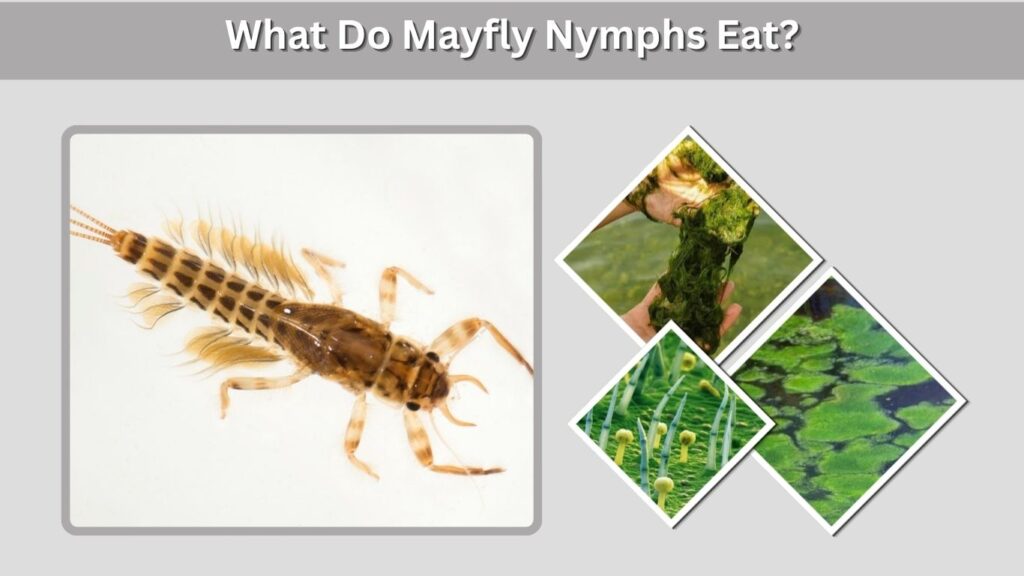
Most mayfly nymphs eat algae, microscopic plants, decaying vegetation, and small pieces of organic matter. They may scrape food from rocks, collect particles from sediment, or gather material carried by the current.
A smaller number of species are predatory and consume tiny aquatic animals. However, plant material and organic debris make up much of the diet for many common mayflies.
Their feeding helps process organic material and transfer energy through freshwater food webs. Mayfly nymphs are then eaten by trout, bass, other fish, aquatic insects, amphibians, and additional underwater predators.
Are Mayfly Larvae a Sign of Clean Water?
Mayfly nymphs are commonly used as biological indicators because many species are sensitive to pollution, low dissolved oxygen, sedimentation, and habitat disturbance.
The EPA generally classifies mayflies as pollution-intolerant macroinvertebrates. A diverse community containing mayflies, stoneflies, caddisflies, and other sensitive organisms can suggest that a waterbody supports relatively healthy aquatic conditions.
However, finding one mayfly does not prove that the water is completely clean or safe to drink. Water-quality assessments consider:
- The number of mayfly species
- Their abundance
- Overall macroinvertebrate diversity
- Dissolved oxygen
- Temperature and streamflow
- Bottom substrate
- Turbidity and sedimentation
- Nutrients, metals, pesticides, and other pollutants
Macroinvertebrates reflect conditions over time because they have limited mobility and cannot easily escape long-term pollution. Even so, chemical and physical water testing is needed for a complete assessment.
Effects of Low Oxygen
Mayfly nymphs obtain oxygen through their abdominal gills, so low dissolved oxygen can reduce their survival. Nutrient enrichment may encourage excessive algae growth; when the algae die and decompose, oxygen levels can fall.
Research on western Lake Erie has found that bottom-water hypoxia, temperature-related stratification, predation, and other environmental conditions can affect Hexagenia nymph populations.
What Water Temperature Do Mayflies Need to Hatch?
There is no universal hatching temperature for all mayflies. Different species develop and emerge under different conditions.
Water temperature can affect:
- Egg-development speed
- Nymph growth
- Molting rate
- Seasonal emergence
- Dissolved oxygen
- Food availability
- The timing of mass hatches
A warming period may help trigger emergence once nymphs are fully developed, but weather, daylight, streamflow, species, and local habitat also influence timing. EPA guidance identifies temperature, oxygen, seasonal life cycles, substrate, and streamflow as important factors shaping aquatic macroinvertebrate communities.
Are Mayflies Bad for Water?
No. Mayflies are natural and beneficial members of freshwater ecosystems. Their nymphs help process algae and organic material, while their eggs, nymphs, emerging subadults, and adults provide food for many animals.
Large numbers of dead adults floating on the surface after a hatch may look alarming, but this is a normal seasonal event. The adults die soon after mating and laying eggs because their winged stage is naturally brief.
Dead mayflies may collect along shorelines and produce an odor as they decompose. This does not mean they poisoned the water. In most cases, their emergence demonstrates that the water supported a substantial aquatic population before the adults appeared.
Mayfly Nymph vs Similar Aquatic Insects
Mayfly nymphs may be confused with stonefly, damselfly, or caddisfly young.
| Aquatic insect | Main identification clue |
| Mayfly nymph | Two or three tails and abdominal gills |
| Stonefly nymph | Two tails and usually no obvious side abdominal gills |
| Damselfly nymph | Three broad, leaflike tail gills |
| Dragonfly nymph | Robust body with no external tails |
| Caddisfly larva | Soft caterpillar-like body, often inside a case |
The mayfly’s combination of six legs, abdominal gills, and two or three thin tails is usually enough for a general identification.
FAQs
Can mayfly larvae live in pond water?
Yes. Some mayfly species live in ponds and lakes, while others require moving streams or rivers. Suitable oxygen, food, temperature, vegetation, and bottom material determine which species can survive in a particular pond.
How deep do mayfly nymphs live?
Depth varies by species and habitat. Some occupy shallow stream edges and rocks, while burrowing species live in deeper lake or river sediments. There is no single depth range that applies to all mayflies.
Do mayfly larvae bite people?
Mayfly nymphs do not normally bite people. They lack stingers and are not considered dangerous. Most scrape algae or gather organic particles, although a few species prey on very small aquatic animals.
Why are mayflies floating on top of the water?
A mature nymph may be emerging into its first winged stage, or an adult may have returned to lay eggs. Dead adults also fall onto the surface after mating, creating an important food source for fish.
Do mayflies live only in freshwater?
Mayflies are overwhelmingly associated with freshwater habitats such as streams, rivers, ponds, and lakes. Their aquatic nymphs are not typical marine insects, although tolerance for salinity and water conditions varies among species.