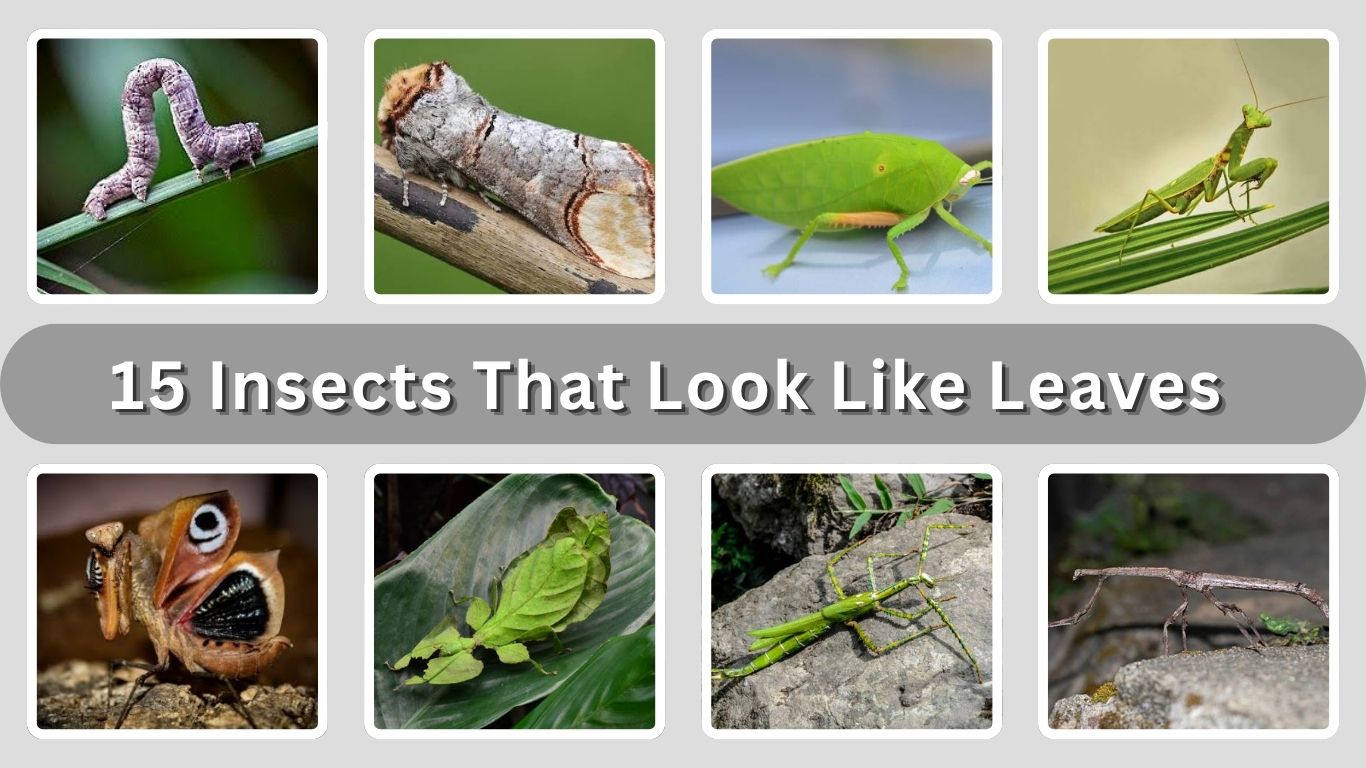
Some insects have evolved extraordinary camouflage that makes them nearly indistinguishable from leaves, sticks, twigs, and broken branches. Walking stick insects use long, narrow bodies to disappear among stems, while leaf insects have flattened bodies complete with vein-like markings. Other masters of disguise include dead leaf mantises, leaf katydids, inchworm caterpillars, and moths that look like sticks. This guide explores 15 remarkable insects that resemble plants, including their identification features, habitat, diet, behavior, and defensive adaptations.
1. Walking Stick Insect
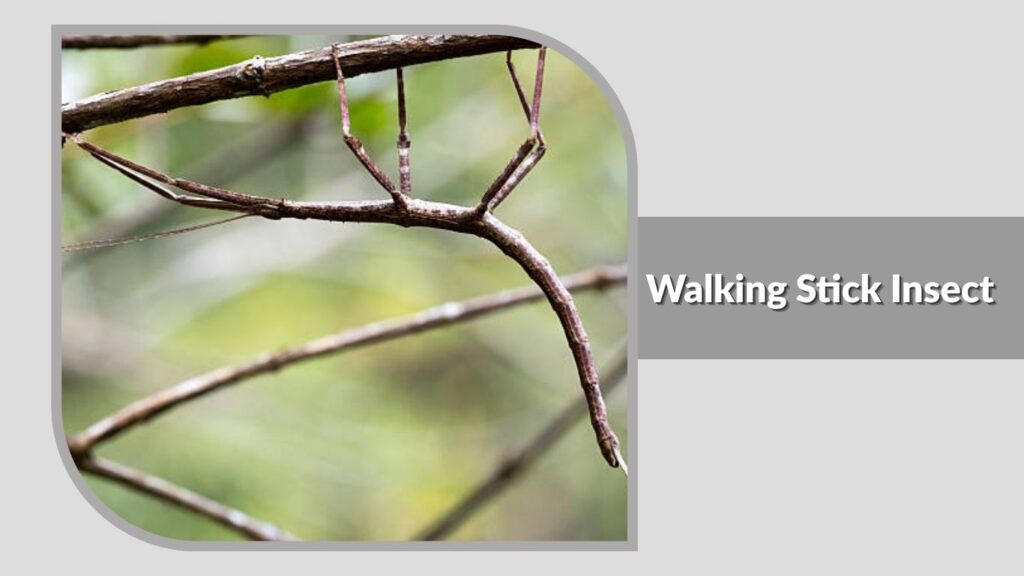
The walking stick insect is the best-known bug that looks like a stick or slender tree branch. Also called a stick bug, stick-like insect, or phasmid, it belongs to the order Phasmatodea. Its narrow body, long legs, muted color, and slow movements provide excellent camouflage against twigs and vegetation.
Identification
- Long, narrow body resembling a twig
- Six thin, jointed legs
- Long antennae extending from the head
- Usually brown, tan, gray, or green
- Small head with chewing mouthparts
- Wingless or winged, depending on the species
- Slow, swaying movement that resembles a branch in wind
- Adults ranging from a few inches to more than seven inches in some North American species
A walking stick may remain completely motionless when approached, making it difficult to distinguish from the branch supporting it.
Habitat and Behavior
Walking stick insects mainly inhabit forests, woodlands, grasslands, gardens, and areas containing dense shrubs. Most species are concentrated in tropical and subtropical regions, although walkingsticks also occur in temperate areas.
These insects are commonly active at night. During the day, they rest among leaves and branches, relying on camouflage to avoid birds, reptiles, and other predators. Some sway gently while walking, strengthening the illusion of a twig moving in the breeze.
Diet and Feeding
Walking sticks are herbivores that consume leaves from trees, shrubs, and other plants. Their preferred food varies by species and may include oak, eucalyptus, acacia, elm, blackberry, rose, or privet.
They use their chewing mouthparts to cut pieces from leaf edges. Although individual insects usually cause limited damage, unusually large populations may remove considerable foliage from trees or garden plants.
Are Walking Stick Insects Dangerous?
Most walking stick insects do not bite, sting, or attack humans. When threatened, they usually freeze, drop to the ground, display their wings, or escape.
Certain species can pinch with spiny legs or release defensive chemicals. The two-striped walkingstick is especially notable because its spray can severely irritate the eyes. For this reason, unknown stick insects should be observed without placing them close to the face.
2. Giant Walking Stick
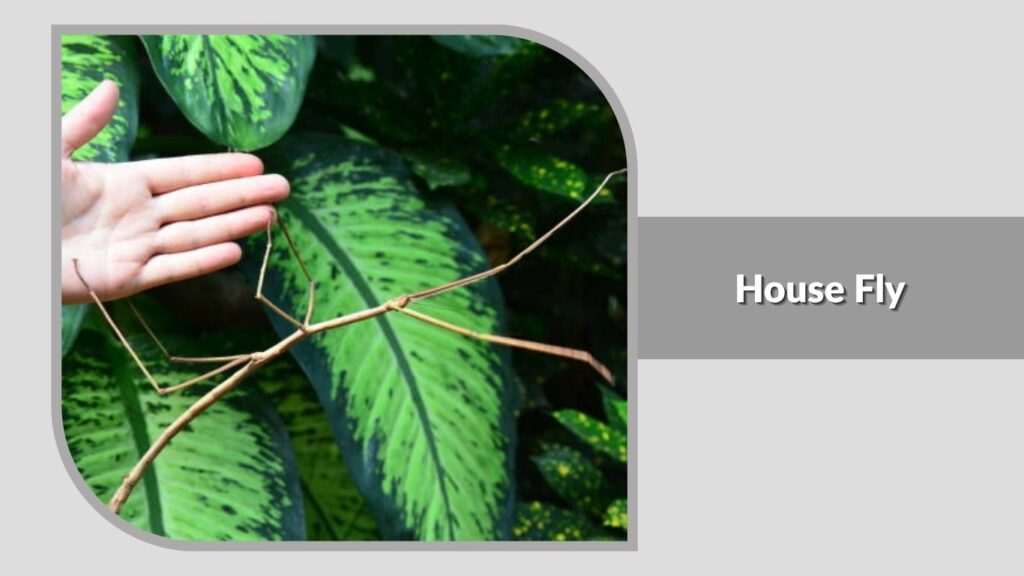
The giant walking stick, Megaphasma denticrus, is an exceptionally long insect that looks like a stick or narrow tree branch. It is considered North America’s longest insect when measured by body length. Females may reach about seven inches, making this species much larger than the common walking stick.
Identification
- Extremely long, narrow body
- Adult females reaching up to seven inches
- Green, tan, brown, or rusty-brown coloration
- Six long legs and slender antennae
- Noticeable spines on the middle and hind legs
- One large spine on each hind leg of adult males
- Wingless body resembling a large twig
- Females generally larger and heavier than males
The size and spiny legs help distinguish this species from smaller stick-like insects.
Habitat and Behavior
Giant walking sticks live among trees, shrubs, woodland edges, and other areas containing abundant vegetation. Their colors allow them to blend into living stems, dried branches, and leaf stalks.
During the day, they may remain nearly motionless. When moving, they sometimes sway from side to side, imitating a twig moving in the wind. This combination of physical and behavioral camouflage helps them avoid birds and other predators.
Diet and Feeding
Like other walking sticks, the giant walking stick is herbivorous and feeds on foliage. It uses chewing mouthparts to remove pieces from leaves while remaining hidden among branches.
A single insect normally causes little noticeable damage. However, walking sticks may remove more foliage when unusually large numbers gather in the same area. Healthy trees can generally tolerate occasional feeding.
Safety and Defense
Giant walking sticks do not normally bite or sting people. Their leg spines may produce a scratch or pinch if the insect is grabbed tightly, but they are not aggressive.
Because their legs are long and fragile, they should not be pulled from a plant. A container or branch can be placed in front of the insect so it can climb onto the surface by itself.
3. Northern Walkingstick
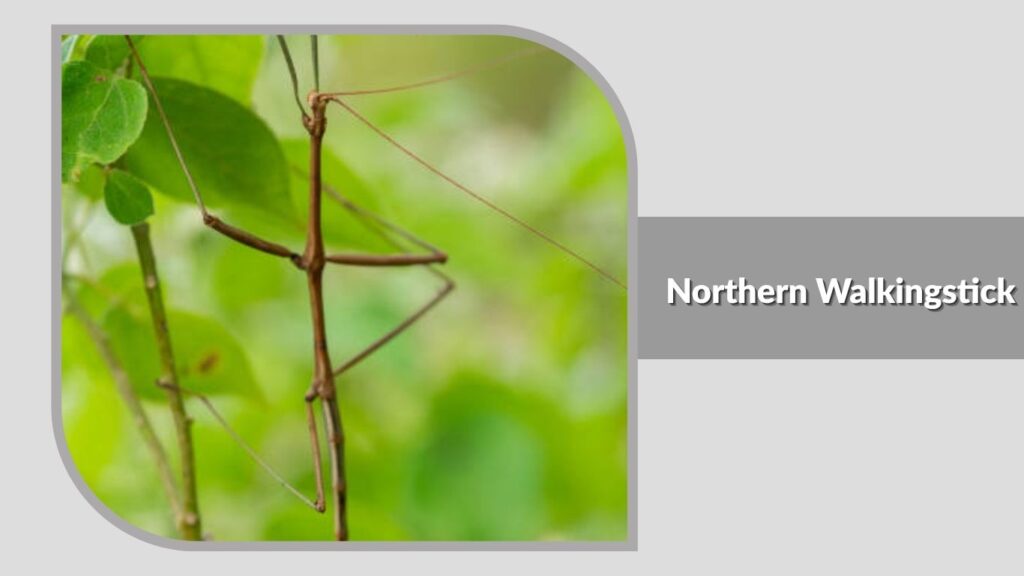
The northern walkingstick, Diapheromera femorata, is a slender bug that looks like a twig. It is also called the common walkingstick and occurs across much of eastern North America. Its narrow body, exceptionally long antennae, and brown or green coloring make it difficult to notice among deciduous trees.
Identification
- Slender, twig-shaped body
- Adult males measuring around three inches
- Adult females reaching approximately 3¾ inches
- Antennae measuring about two-thirds of the body length
- Brown adult males
- Larger, greenish-brown adult females
- Green immature insects
- Small, pincer-like structures at the abdomen’s tip
- Wingless appearance
Its thin body separates it from the broader and more strongly striped two-striped walkingstick.
Habitat and Behavior
Northern walkingsticks are commonly found in deciduous forests, wooded parks, gardens, and tree-filled residential areas. They spend much of their lives among leaves and branches, where their twig-like shape provides protection.
They are often overlooked unless they walk onto a wall, road, window, or other surface where their camouflage becomes less effective. When threatened, an individual may freeze, sway gently, or drop from its perch.
Diet and Feeding
This species feeds primarily on the foliage of deciduous trees and shrubs. Oak and hazelnut are especially important food plants, although northern walkingsticks may also use walnut, cherry, locust, and related trees.
Population increases can occasionally result in noticeable defoliation. Unless repeated over multiple seasons, healthy trees generally recover from this temporary leaf loss.
Safety and Defense
Northern walkingsticks are harmless plant eaters. They do not possess a stinger and are not known for a dangerous bite or irritating spray.
Their main defense is camouflage rather than aggression. Handling should still be limited because their legs can break when squeezed or pulled. Allow the insect to walk freely onto another surface when relocation is necessary.
4. Southern Two-Striped Walkingstick
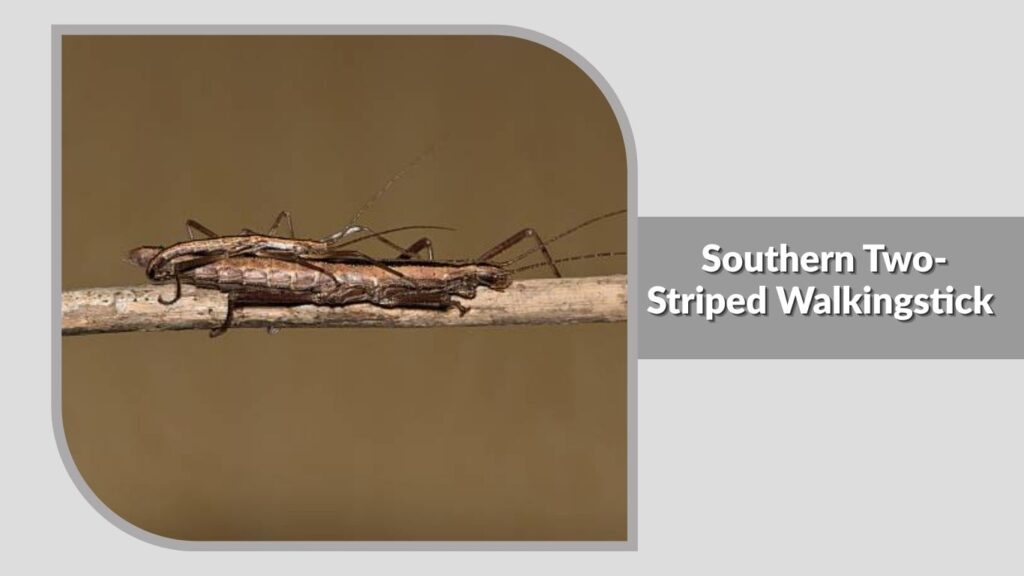
The southern two-striped walkingstick, Anisomorpha buprestoides, is a stout stick-like bug found in the southeastern United States. It differs from most walking sticks because it has highly visible lengthwise stripes and can release an irritating defensive spray. It is particularly common in Florida.
Identification
- Thick, sturdy body compared with other walking sticks
- Brown body with prominent dark longitudinal stripes
- Some populations displaying black-and-white coloration
- Wingless adults
- Long antennae in both sexes
- Female length averaging about 2⅔ inches
- Male length averaging about 1⅔ inches
- Small male frequently seen riding on a larger female
- Three conspicuous dark lines may be visible across the body
Living insects often appear more brightly marked than preserved specimens.
Habitat and Behavior
Southern two-striped walkingsticks inhabit scrublands, forests, gardens, and areas containing trees and shrubs. They may hide beneath loose bark or gather in protected spaces during daylight.
The insects appear to be mainly active at night. Adults are particularly noticeable during fall, when mating pairs and egg-laying females are commonly observed in Florida.
Diet and Feeding
This walkingstick eats the leaves of woody plants. Recorded foods include oak, crepe myrtle, rose, rosemary, lyonia, and privet.
Although groups may occasionally contain many individuals, the species is not generally associated with the serious defoliation caused by certain other walking sticks. Its feeding usually produces limited local damage.
Defensive Spray and Safety
The southern two-striped walkingstick can accurately spray a defensive secretion from glands located just behind its head. The liquid may travel approximately 12–16 inches and can cause severe burning, redness, light sensitivity, and temporarily impaired vision when it reaches the eyes.
Do not handle this species or place your face near it. After eye exposure, immediately rinse with plenty of clean water without rubbing. Persistent pain, light sensitivity, or vision changes require medical attention.
5. Indian Stick Insect
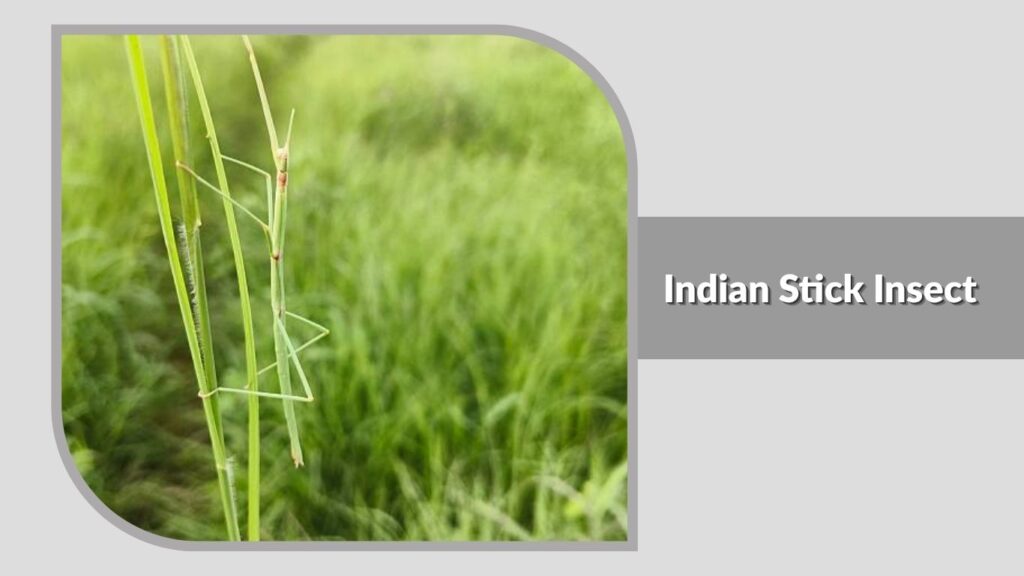
The Indian stick insect, Carausius morosus, is also called the Indian walking stick, common stick insect, or laboratory stick insect. This slender insect that looks like a branch is native to India but has become widely known through classrooms, laboratories, and the pet trade.
Identification
- Long, thin, twig-like body
- Adult length reaching approximately four inches
- Usually brown, tan, greenish, or gray-brown
- Six slender legs
- Shorter antennae than many other walking sticks
- Small head with chewing mouthparts
- Wingless body
- Females much more commonly encountered than males
- Ability to remain rigid like a dried twig
Color may vary slightly with age, surroundings, and environmental conditions.
Habitat and Behavior
Wild Indian stick insects are associated with vegetated coastal areas in India. They are usually most active after dark and rest motionless among foliage during the day.
Their slow movements and branch-like posture make them difficult for predators to detect. When disturbed, they may freeze, sway, drop from a branch, or continue walking slowly rather than attempting to attack.
Diet and Feeding
Indian stick insects are herbivores that consume leaves. In captivity, they are commonly offered pesticide-free bramble, rose, privet, ivy, oak, and similar foliage.
Leaves should remain fresh, and any water container holding cut stems must be covered so small insects cannot fall into it. They should never receive plants treated with pesticides or collected beside heavily sprayed roads and fields.
Reproduction and Safety
Female Indian stick insects can reproduce without males through parthenogenesis. The resulting offspring are generally female, allowing a small captive group to produce many eggs in a relatively short period.
They do not normally bite or sting, but their delicate bodies require gentle treatment. This species can establish populations outside its original range and is considered a plant-pest concern in some places. Captive insects and eggs must never be released outdoors, and ownership regulations should be checked before keeping them.
6. Vietnamese Walking Stick
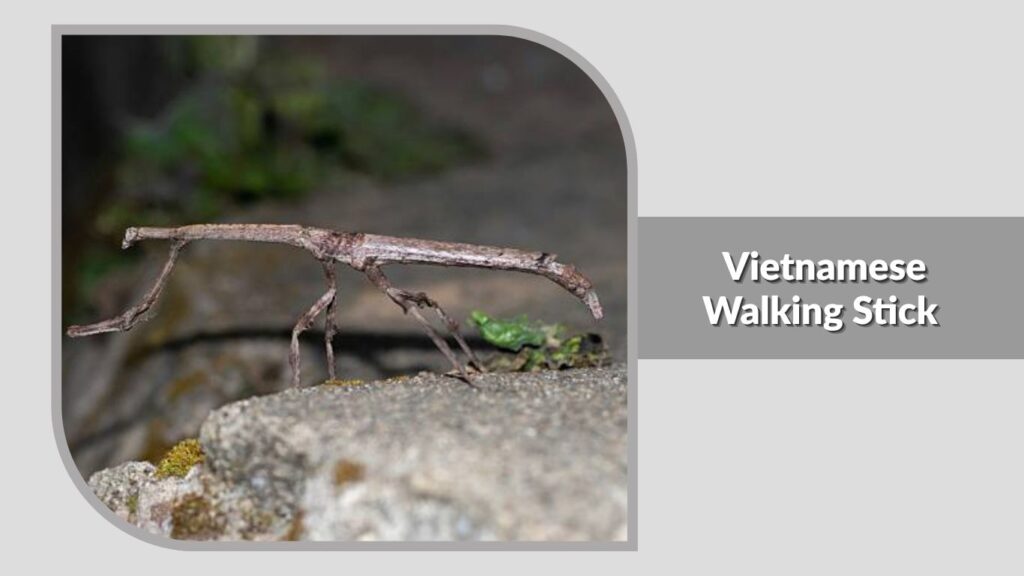
The Vietnamese walking stick, Medauroidea extradentata, is a slender insect that looks like a stick or narrow branch. Also called the Annam walking stick, it comes from Vietnam’s tropical forests and is commonly kept in classrooms and insect collections because of its calm behavior and convincing camouflage.
Identification
- Long, narrow, twig-shaped body
- Usually brown, gray-brown, or green
- Adult length of approximately 4–5 inches
- Six extremely thin legs
- Small pointed bumps along the thorax
- Short, threadlike antennae
- Wingless in both sexes
- Front legs frequently extended beside the head
- Females much more common than males
Its narrow shape makes it difficult to notice when resting along stems or dried branches.
Habitat and Behavior
Vietnamese walking sticks live among the trees and shrubs of tropical forests. They remain almost motionless during daylight, then become more active after dark.
When threatened, the insect may extend its front legs, hold its body rigid, and resemble a broken twig. Young insects can sometimes regenerate a damaged leg during later molts, but adults generally cannot replace lost limbs.
Diet and Feeding
This species is entirely herbivorous. It consumes leaves using chewing mouthparts and obtains moisture from its food and water droplets.
Captive individuals commonly accept bramble, raspberry, rose, hawthorn, oak, and similar pesticide-free foliage. Fresh leaves should be available continuously because dried or chemically treated plants may be harmful.
Reproduction and Safety
Females can reproduce through parthenogenesis without mating, which explains why males are rarely encountered. A female drops many small eggs onto the ground, where they may take two to six months to hatch.
Vietnamese walking sticks do not normally bite or sting. Their delicate legs can break during rough handling, so they should be allowed to walk onto a branch rather than being grabbed.
7. Giant Prickly Stick Insect
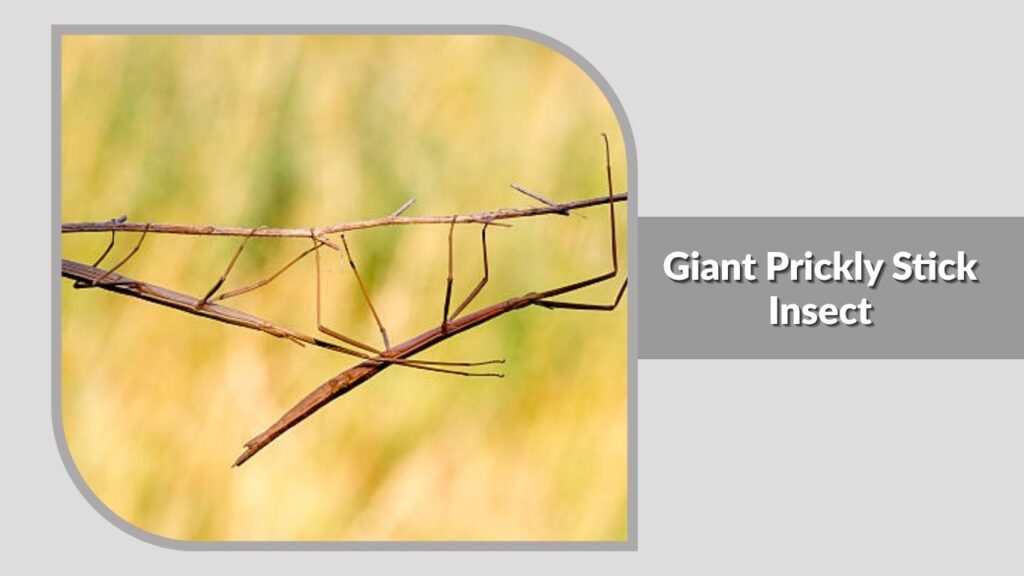
The giant prickly stick insect, Extatosoma tiaratum, is an Australian phasmid that resembles a twisted branch covered with thorns and dead leaves. It is also called Macleay’s spectre, giant spiny stick insect, or spiny leaf insect. Adult females can reach approximately 20 centimeters and are much heavier than males.
Identification
- Thick, curved body covered with small spines
- Brown, tan, green, or lichen-like coloration
- Broad, leaf-shaped expansions on the legs
- Adult females reaching approximately 20 centimeters
- Smaller males measuring around 11 centimeters
- Small wings in females
- Larger functional wings in adult males
- Curled abdomen resembling a scorpion’s tail
- Strong difference between male and female appearance
Females are bulky and heavily armored, while males are slimmer, flatter, and capable of flight.
Habitat and Behavior
This species is native to Australia, where it lives among eucalyptus trees and forest vegetation. Its irregular body outline helps it disappear among curled leaves, bark, and small branches.
When disturbed, it may rock from side to side like foliage moving in the wind. A frightened female may curl her abdomen upward and raise her front legs, producing a scorpion-like threat display despite having no stinger.
Diet and Feeding
Giant prickly stick insects feed mainly on eucalyptus leaves. Captive insects outside Australia may also accept rose, raspberry, bramble, and other suitable foliage.
They eat mostly after dark and remain hidden during the day. Their food must be free from pesticides, roadside contamination, and household chemicals.
Reproduction and Defense
Females can produce offspring with or without males. Unfertilized eggs generally produce female young and may take nine to twelve months to hatch. Fertilized eggs can hatch sooner and may produce both sexes.
The insect does not sting, but its spines and defensive posture discourage handling. It should be moved using a branch rather than being pulled from vegetation.
8. Spiny Leaf Insect
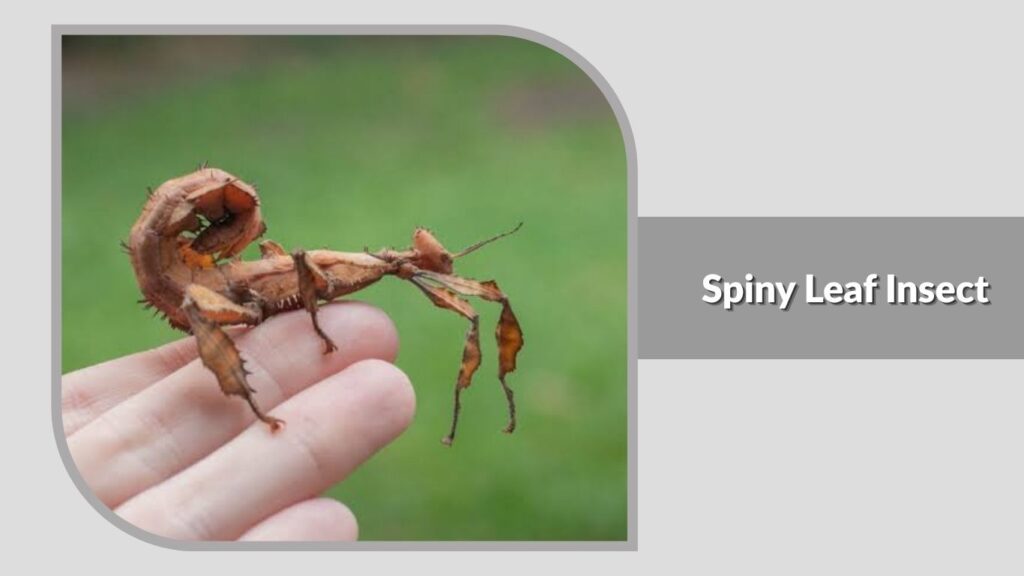
The spiny leaf insect is another widely used name for Extatosoma tiaratum, the same Australian species often called the giant prickly stick insect. It earns the “leaf insect” name from its flattened legs, irregular body edges, and dried-leaf appearance rather than from the broad green body seen in true leaf insects of the family Phylliidae.
Identification
- Broad, irregular body with many small spines
- Leaf-shaped lobes on the legs
- Curled abdomen in adult females
- Females thick-bodied and wingless in flight
- Males narrow-bodied with functional wings
- Green, brown, tan, or mottled coloration
- Small head with chewing mouthparts
- Nymphs resembling dark ants
- Body swaying that imitates moving leaves
Its rough outline resembles damaged or dried vegetation rather than a smooth living leaf.
Camouflage and Defense
Spiny leaf insects rely primarily on disguise. They remain still for long periods and move with a rocking motion that resembles a leaf blowing in the wind.
Young nymphs look and behave like red-headed black ants. This resemblance may provide protection during the vulnerable period immediately after hatching. Adult females use a curled-abdomen display to appear more threatening.
Diet and Daily Activity
The species is nocturnal and feeds mainly on eucalyptus foliage. During daylight, it often hangs beneath branches or remains motionless among leaves.
Captive individuals may accept raspberry, rose, or bramble where eucalyptus is unavailable. A tall enclosure is essential because the insect must hang vertically while shedding its old exoskeleton.
Eggs and Ant Relationship
Female spiny leaf insects drop eggs onto the ground. Each egg has a small edible knob called a capitulum that attracts ants.
Ants may carry the egg into their underground nest, eat the capitulum, and leave the remaining egg protected inside. The nymph later emerges from the ant nest and climbs into vegetation.
9. Giant Leaf Insect
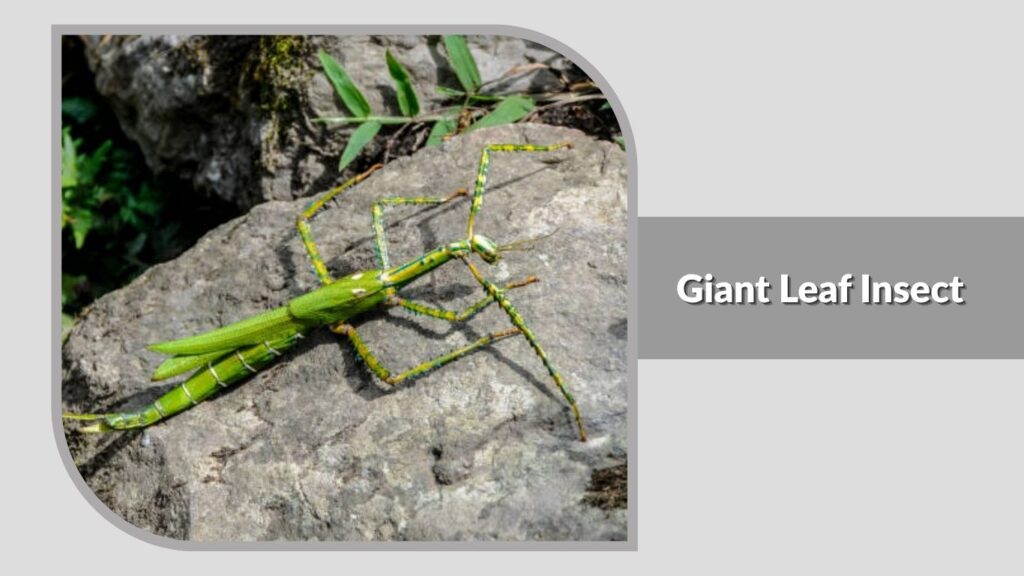
The giant leaf insect, Pulchriphyllium giganteum, is one of the most convincing examples of an insect that looks like a leaf. Formerly known as Phyllium giganteum, it inhabits Southeast Asian tropical forests and can reach approximately four inches in body length.
Identification
- Broad, flattened, leaf-shaped body
- Bright green or yellow-green coloration
- Leaf-like veins across the body and wings
- Brown patches resembling damaged foliage
- Irregular edges that imitate bite marks
- Adult female length of around 4–4.3 inches
- Flattened, leaf-shaped legs
- Small head partly hidden by the body
- Slow, rocking movement
- Females encountered more often than males
Even the insect’s abdomen resembles a large central leaf blade.
Habitat and Camouflage
Giant leaf insects live in Southeast Asian rainforests, where they rest among broad leaves. Their coloration, venation, and body shape make them extremely difficult for birds, reptiles, and other predators to detect.
They strengthen the illusion by swaying when they walk. Brown markings may look like dry patches or areas that have been eaten by another insect.
Diet and Feeding
These insects are herbivores that consume forest vegetation. Captive individuals may feed on oak, eucalyptus, bramble, raspberry, rose, and salmonberry leaves.
Their camouflage can be so convincing that individuals may occasionally mistake another leaf insect for part of the food plant and nibble it.
Reproduction and Life Cycle
Female giant leaf insects can reproduce without mating. Their unfertilized eggs usually produce female offspring, which is one reason adult males are rarely observed.
The eggs may take around six months to hatch. Young insects then molt repeatedly and may require approximately nine additional months to reach adulthood.
10. Malaysian Leaf Insect
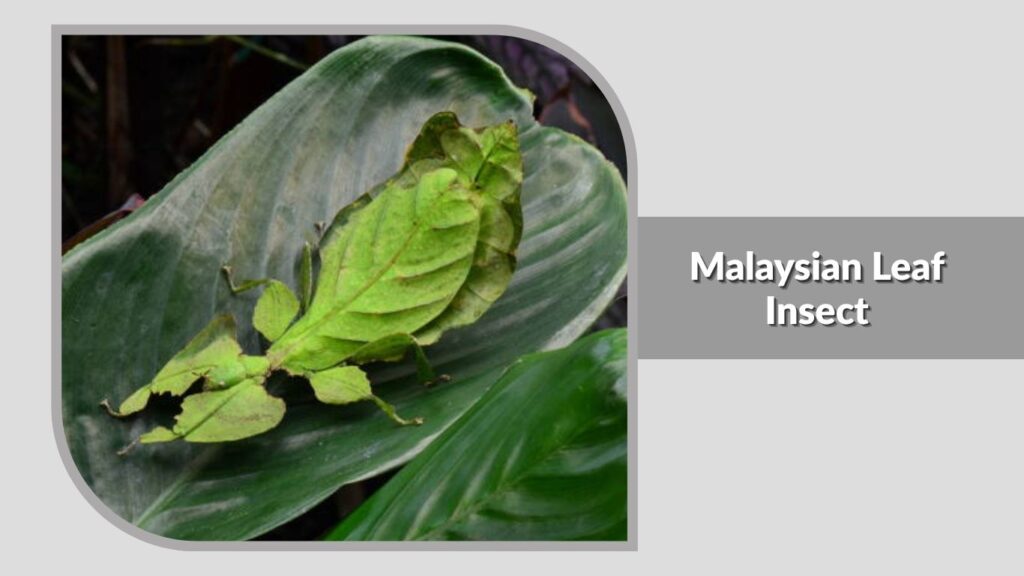
“Malaysian leaf insect” is a broad common name used for several leaf insects from Malaysia. One species frequently associated with the name is Pulchriphyllium bioculatum, formerly classified as Phyllium bioculatum. It belongs to the true leaf-insect family Phylliidae and uses its flattened body to resemble living foliage.
Identification
- Flattened green body shaped like a leaf
- Broad abdomen with visible leaf-like veins
- Enlarged, flattened sections on the legs
- Irregular brown or yellow markings
- Females broader and heavier than males
- Males usually slimmer with longer wings
- Small head and chewing mouthparts
- Slow swaying movement
- Excellent camouflage among living leaves
Species-level identification may require examining the antennae, wing veins, abdomen shape, and leg lobes.
Habitat and Behavior
Malaysian leaf insects inhabit warm, humid forests containing dense vegetation. They spend most of their time resting or feeding among leaves rather than walking across open ground.
During daylight, they remain almost completely still. At night, they become more active and move through the vegetation to find fresh foliage.
Diet and Feeding
These insects eat leaves and do not prey on other animals. Food choices vary between species, but captive leaf insects are often maintained on pesticide-free bramble, rose, oak, guava, or related broadleaf plants.
They obtain much of their moisture from fresh foliage and droplets on the leaves. Poor ventilation or constantly wet conditions may encourage mold, while excessively dry conditions can interfere with molting.
Safety and Camouflage
Malaysian leaf insects do not normally bite or sting humans. Their primary defense is remaining invisible among vegetation.
When disturbed, they may sway, freeze, or drop from the plant. Their legs and bodies are delicate, so direct handling should be limited and captive insects should never be released outside their native range.
11. Dead Leaf Mantis
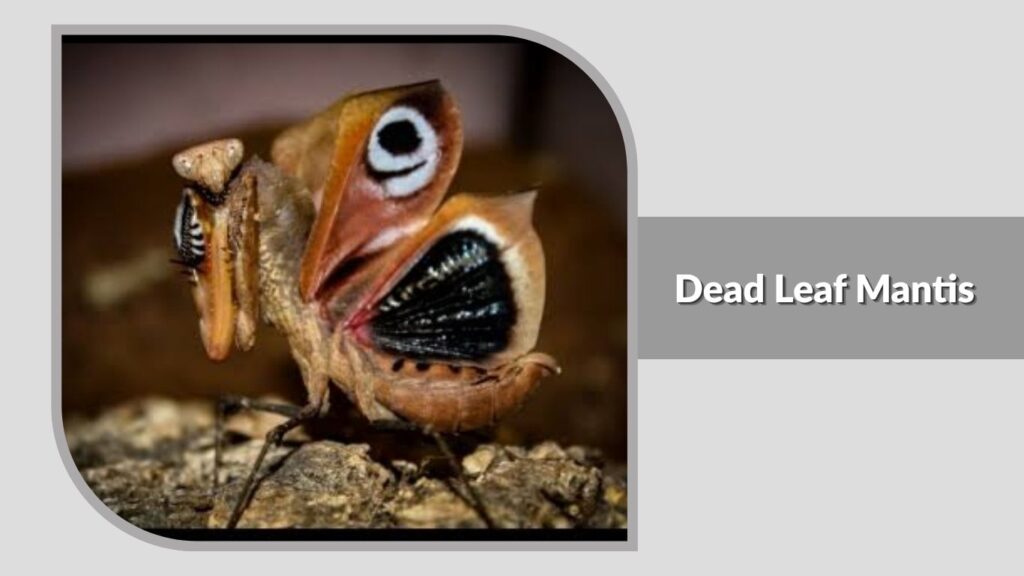
The dead leaf mantis, especially Deroplatys desiccata, is a remarkable insect that looks like a leaf. Its flattened body, irregular edges, brown coloring, and vein-like markings create the appearance of dry foliage. Unlike plant-eating leaf insects, this mantis is a predator that uses its camouflage to approach or ambush other insects.
Identification
- Broad, flattened body resembling a dead leaf
- Brown, tan, reddish-brown, or dark-gray coloring
- Irregular body edges that imitate damaged foliage
- Wide, leaf-shaped shield behind the head
- Triangular head with large compound eyes
- Spiny, folded forelegs used for capturing prey
- Long folded wings with leaf-like veins
- Females generally broader and heavier than males
Habitat and Camouflage
Dead leaf mantises are associated with warm forests in Southeast Asia. They rest among dried leaves, tree bark, and low vegetation, where their body shape becomes extremely difficult to detect.
The insect may remain motionless or sway gently, imitating a leaf moved by wind. This disguise protects it from predators and helps conceal it from potential prey.
Diet and Hunting
The dead leaf mantis is carnivorous. It waits with its spiny front legs folded before rapidly grabbing flies, moths, crickets, and other appropriately sized insects.
Mantises are sit-and-wait predators rather than active plant feeders. Their raptorial forelegs contain spines that hold struggling prey while it is eaten.
Defense and Safety
A frightened dead leaf mantis may freeze, drop, sway, or display its wings to appear larger. It has no stinger and does not inject venom.
Although it is not considered dangerous to people, handling may stress the insect. Its delicate legs and wings can also be damaged easily, so observation is preferable to direct contact.
12. Stick Mantis
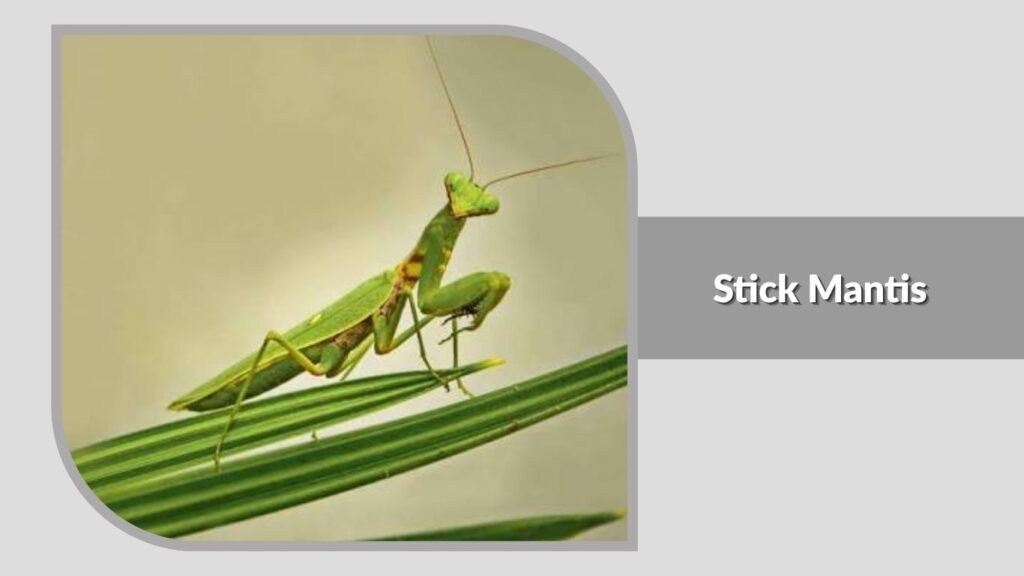
The stick mantis is a slender predatory insect that can be mistaken for a walking stick or blade of grass. One well-documented North American example is the grass-like mantid, Thesprotia graminis. Its elongated body provides camouflage, while its folded, spiny forelegs reveal that it is a mantis rather than a plant-eating stick insect.
Identification
- Extremely slender, elongated body
- Light-brown, tan, or green coloration
- Adult length commonly around 47–56 millimeters
- Triangular head with upward-pointing projections
- Long section behind the head and forelegs
- Spiny raptorial front legs
- Adult males with functional wings
- Adult females without functional wings
- Abdomen sometimes held in a slightly curved position
Habitat and Range
The grass-like stick mantis occurs in the southeastern United States, with records from Florida, Georgia, and Mississippi. It inhabits pine stands, grassy vegetation, thickets, and Spanish moss growing on trees.
Its narrow shape allows it to blend with pine needles and thin stems. It may remain still for long periods while waiting for prey to move within reach.
Diet and Hunting Behavior
Stick mantises are predators, not herbivores. They use a sit-and-wait hunting technique, holding their forelegs in the familiar praying position until another insect approaches.
Recorded prey includes flies, moths, small grasshoppers, crickets, beetles, true bugs, spiders, and sometimes other mantises. The grass-like mantis is especially suited to capturing flies and small or medium-sized moths.
Stick Mantis vs Walking Stick
A walking stick has ordinary front legs and chewing mouthparts designed for foliage. A stick mantis has enlarged, spiny forelegs that fold against its body and snap forward to capture prey.
Walking sticks belong to Phasmatodea, while mantises belong to Mantodea. Despite their similar camouflage, their diets and behavior are completely different.
13. Giant Leaf Katydid
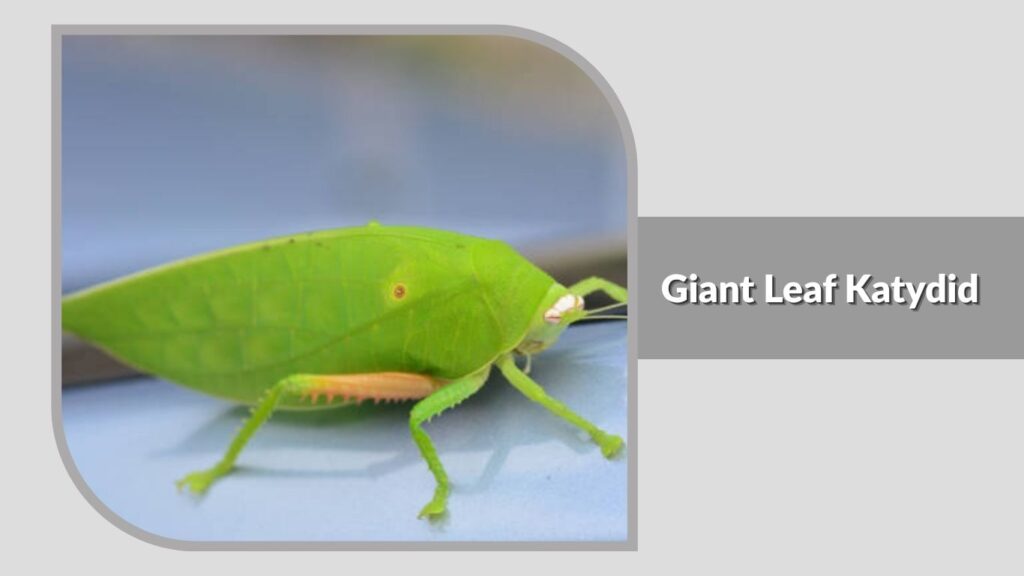
The giant leaf katydid, commonly represented by Stilpnochlora couloniana, is a large green bug that looks like a leaf. Its broad wings imitate the shape, color, and veins of living foliage. It is considered the largest katydid in the United States, with adults exceeding 65 millimeters in length.
Identification
- Large, bright-green body
- Broad forewings resembling leaves
- Visible vein-like patterns across the wings
- Extremely long, threadlike antennae
- Strong hind legs used for jumping
- Narrower body beneath the broad wings
- Adult length exceeding 2.5 inches
- Young nymphs with unusually long hind legs
- Some nymphs showing a dark hourglass marking
Habitat and Distribution
This giant katydid occurs in Florida and southern Georgia, as well as Cuba, the Bahamas, and other Caribbean areas. It generally lives high in the crowns of deciduous trees.
The insect may be difficult to find during daylight because its wings blend into foliage. Adults sometimes fly toward outdoor lights at night, making them more noticeable around buildings.
Diet and Activity
Giant katydids are primarily plant eaters. They chew foliage and have been maintained on oak and bramble leaves in captivity.
They are mainly active after dark, when they move through tree canopies to feed and reproduce. Their green coloring and leaf-shaped wings provide protection while they rest during daylight.
Is a Giant Leaf Katydid Dangerous?
Giant leaf katydids do not have stingers and are not venomous. Their large size, powerful hind legs, and chewing mouthparts may appear intimidating, but they do not normally attack people.
An insect that enters a building can be guided into a container and released onto outdoor vegetation. Pulling its legs or wings may cause serious injury to the katydid.
14. Inchworm Caterpillar
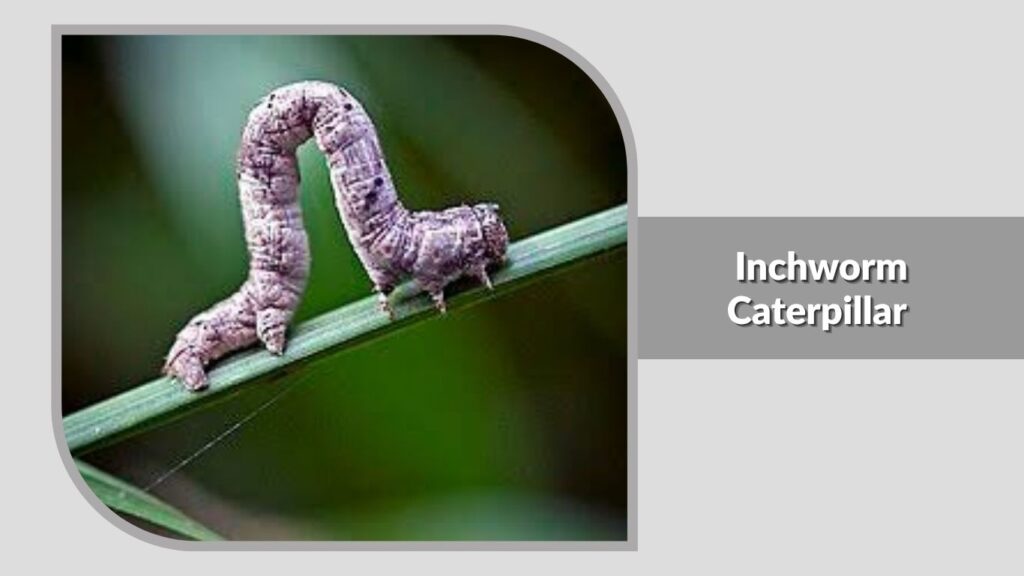
An inchworm is the larva of a geometer moth in the family Geometridae. Many are caterpillars that look like sticks, thin stems, or leaf stalks. Their name comes from their looping movement, which appears to measure the surface one “inch” at a time.
Identification
- Long, slender caterpillar body
- Usually green, brown, gray, or mottled
- Two or three pairs of rear prolegs
- Three pairs of small true legs near the head
- Distinctive looping or arching movement
- Ability to hold the body straight like a twig
- Small head with chewing mouthparts
- Smooth or slightly textured skin
- Size and markings varying widely among species
Why Do Inchworms Move in Loops?
Most caterpillars have several pairs of prolegs along the abdomen. Inchworms have only a few pairs positioned near the rear.
They grip the surface with their front legs, draw the rear of the body forward to form an arch, and then extend the front half again. This creates their recognizable looping movement.
Habitat and Food
Geometer moths occur worldwide except Antarctica. Their larvae live in forests, scrublands, gardens, farms, and cities.
Many inchworms feed on the leaves of trees and shrubs. The exact food plant depends on the species, so the plant on which an inchworm is discovered can provide an important identification clue.
Life Cycle and Safety
After feeding and growing through several molts, the inchworm forms a pupa and later emerges as an adult geometer moth. Adults often have slender bodies and broad wings marked with wavy lines.
Most inchworms do not pose a serious threat to humans. However, unfamiliar caterpillars should be observed rather than handled because some caterpillar species have irritating hairs or defensive secretions.
15. Buff-Tip Moth
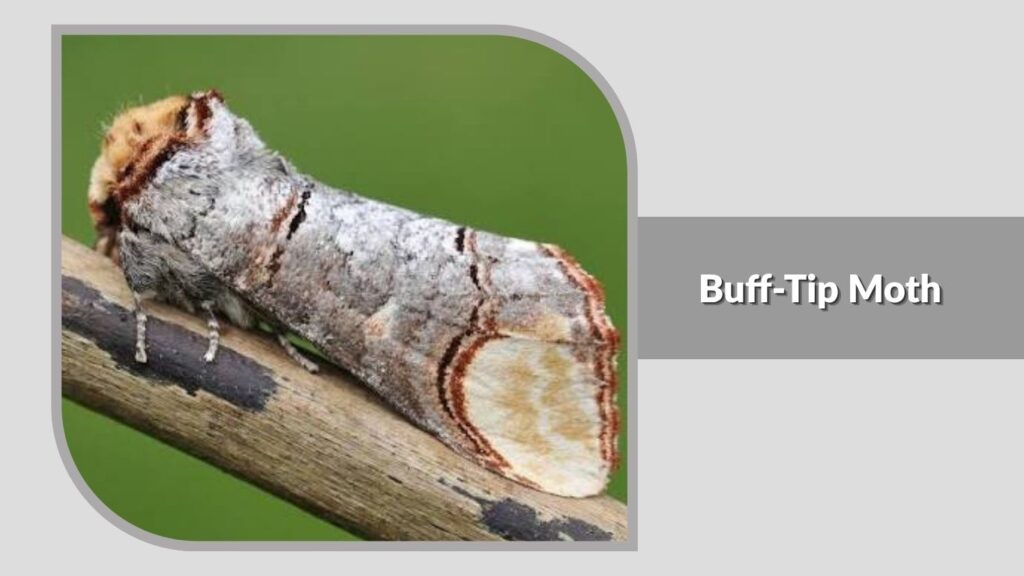
The buff-tip moth, Phalera bucephala, is a nighttime moth famous for resembling a broken birch twig. When resting with its wings wrapped closely around its body, its cylindrical shape, gray markings, and pale wing tips create exceptionally convincing camouflage.
Identification
- Thick, cylindrical resting shape
- Mottled gray wings resembling tree bark
- Large buff-colored patches at the wing tips
- Matching buff-colored area on the thorax
- Wings held almost vertically against the body
- Adult wingspan of approximately 44–68 millimeters
- Yellow-and-black caterpillars
- Rounded head and thick, furry-looking body
- Appearance similar to a freshly broken birch twig
Habitat and Distribution
Buff-tip moths inhabit open woodland, scrub, hedgerows, parks, and gardens. They are widespread through England, Wales, Ireland, the Isle of Man, and the Channel Islands, but are more localized in mainland Scotland.
Adults may occasionally be discovered resting on branches or on the ground during daylight. Their camouflage often makes them nearly invisible unless they move.
Diet and Life Cycle
The caterpillars feed on deciduous trees, particularly willow, birch, oak, and hazel. They may also use alder, elm, lime, beech, rowan, hornbeam, and sycamore.
Yellow-and-black caterpillars are generally seen from July through early October. They later enter the soil, form pupae, and remain underground through winter before adults emerge.
Behavior and Safety
Adult buff-tip moths fly at night and are attracted to artificial light, often appearing later in the evening. During the day, they rely on camouflage instead of actively escaping.
They do not bite, sting, or damage household materials. Caterpillars may remove leaves from individual branches, but their presence is normally part of the local woodland and garden ecosystem.
FAQs
What insect looks most like a leaf?
True leaf insects are the most convincing examples. Species such as the giant leaf insect and Malaysian leaf insect have flattened green bodies, leaf-like veins, irregular edges, and broad legs that closely resemble living foliage.
What bug looks like a stick or twig?
Walking stick insects are the most common bugs that look like sticks. Their long, narrow bodies, thin legs, brown or green coloring, and slow swaying movements help them blend into branches, stems, and twigs.
Are insects that look like leaves dangerous?
Most leaf-like insects, including leaf insects and katydids, are harmless plant eaters. Dead leaf mantises are predators, but they are not dangerous to people. Avoid rough handling because some species may pinch, scratch, or defend themselves when threatened.
What caterpillar looks like a small stick?
Inchworms are caterpillars that often resemble thin sticks, stems, or leaf stalks. They belong to the geometer moth family and are recognized by their looping movement, which results from having fewer abdominal prolegs than most caterpillars.
How can you tell a stick mantis from a walking stick?
A stick mantis has a triangular head and enlarged, spiny front legs that fold together for catching prey. A walking stick has ordinary front legs, a smaller head, and chewing mouthparts adapted for eating leaves rather than hunting insects.