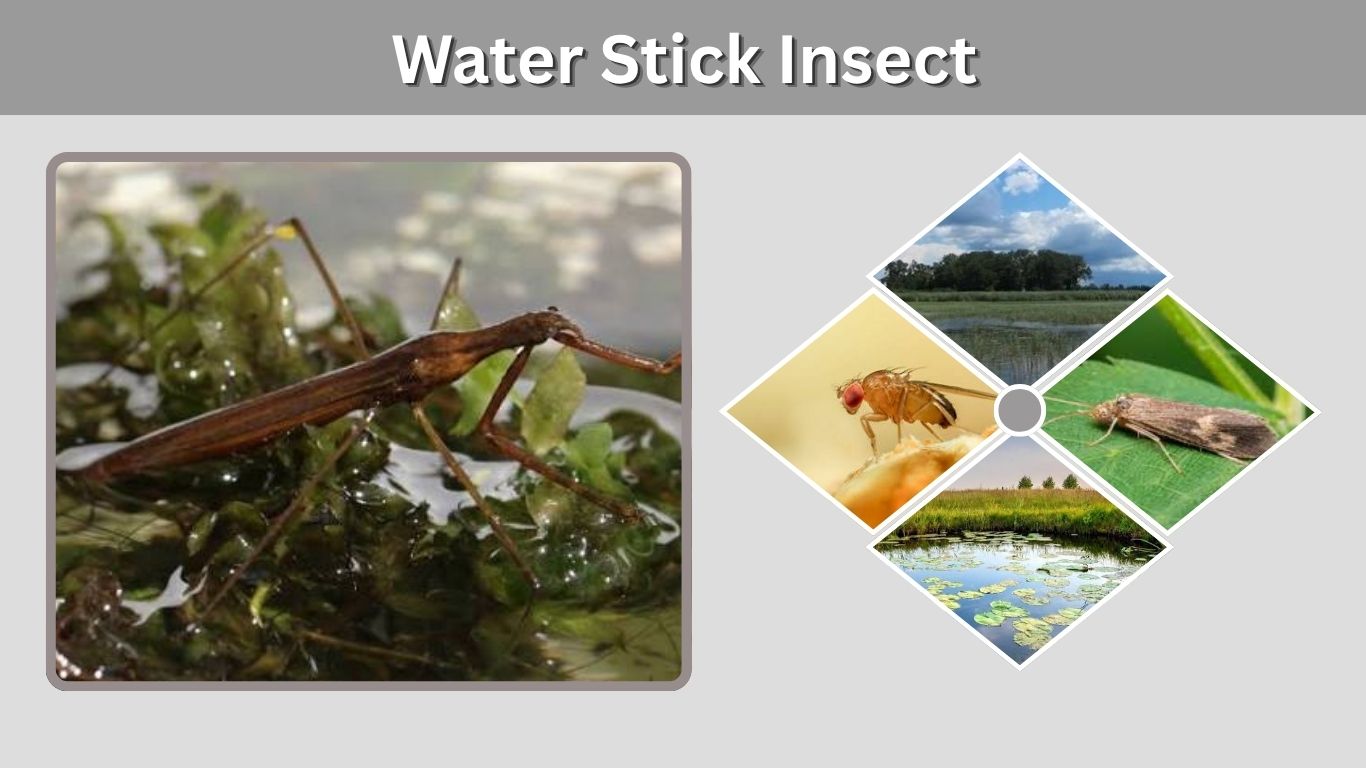
The water stick insect is a long, slender aquatic predator that looks surprisingly similar to a twig floating among pond plants. Most insects given this common name belong to the genus Ranatra, part of the water scorpion family Nepidae. Unlike true walking stick insects, water stick insects are predators that capture other aquatic animals with powerful front legs. They also possess a long breathing tube at the end of the abdomen that functions much like a snorkel, allowing them to remain submerged while taking in atmospheric oxygen.
What Is a Water Stick Insect?
A water stick insect is an aquatic true bug belonging to the genus Ranatra. These insects are close relatives of water scorpions and are sometimes themselves called slender water scorpions.
Despite their appearance, they are not true stick insects.
| Feature | Water Stick Insect |
| Genus | Ranatra |
| Family | Nepidae |
| Order | Hemiptera |
| Number of legs | 6 |
| Diet | Carnivorous |
| Habitat | Freshwater |
| Breathing | Abdominal breathing tube |
| Metamorphosis | Incomplete |
Species of Ranatra occur in different regions around the world, including North America, Europe, Asia, Africa, and Australia.
What Does a Water Stick Insect Look Like?
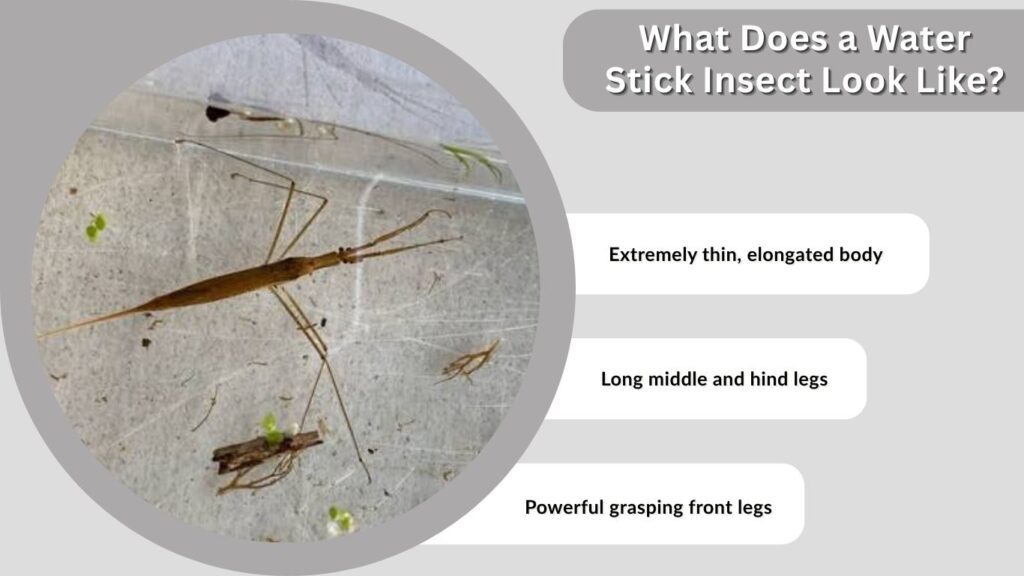
Water stick insects have one of the most distinctive body shapes among aquatic insects.
Their elongated brown or grayish bodies resemble narrow sticks, reeds, or dead pieces of vegetation.
Identification
Typical features include:
- Extremely thin, elongated body
- Six legs
- Long middle and hind legs
- Powerful grasping front legs
- Brown or gray coloration
- Piercing-sucking mouthpart
- Large eyes
- Two-part breathing tube at the rear
- Fully developed wings in adults
The front legs are bent and adapted for grabbing prey, giving them a somewhat mantis-like appearance.
This body shape provides excellent camouflage when the insect remains motionless among submerged plants.
Water Stick Insect Size
Size varies considerably among Ranatra species.
For example, the European water stick insect Ranatra linearis has a body approximately 3–5 cm (1.2–2 inches) long, with a breathing tube that can add a similar amount to its apparent total length.
North American species may be around an inch or more in body length depending on species. A photographed Ranatra from New Hampshire, for example, measured roughly 1.25 inches.
Where Do Water Stick Insects Live?
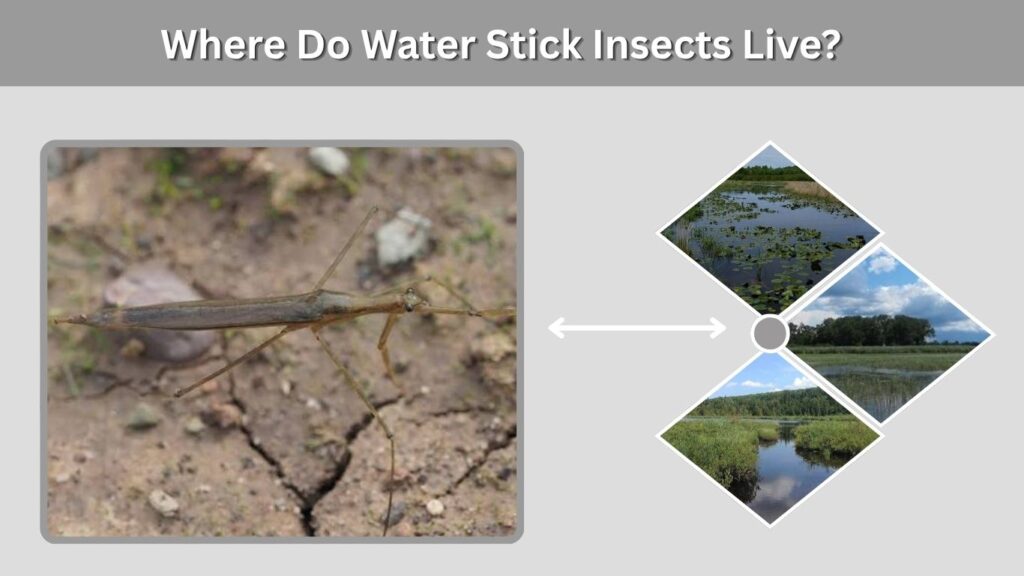
Water stick insects primarily inhabit slow-moving or still freshwater.
Suitable habitats include:
- Ponds
- Marshes
- Lakes
- Wetlands
- Slow streams
- Ditches
- Temporary pools
- Vegetated edges of larger bodies of water
They particularly favor places containing abundant submerged plants.
Vegetation provides both camouflage and convenient places from which the insect can ambush prey.
Some Ranatra are also capable of leaving the water and flying to another pond when conditions change.
How Do Water Stick Insects Breathe?
One of their most interesting adaptations is the long structure projecting from the end of the abdomen.
Water Stick Insect Breathing Tube
The tube is made from two closely fitting structures and functions similarly to a snorkel.
A water stick insect can remain almost completely submerged while positioning the tip of its breathing tube at the water surface.
Atmospheric oxygen then enters the insect’s respiratory system.
This adaptation allows it to remain hidden underwater while waiting for prey instead of repeatedly exposing its entire body.
The breathing tube is not a stinger, despite its sharp appearance.
What Do Water Stick Insects Eat?
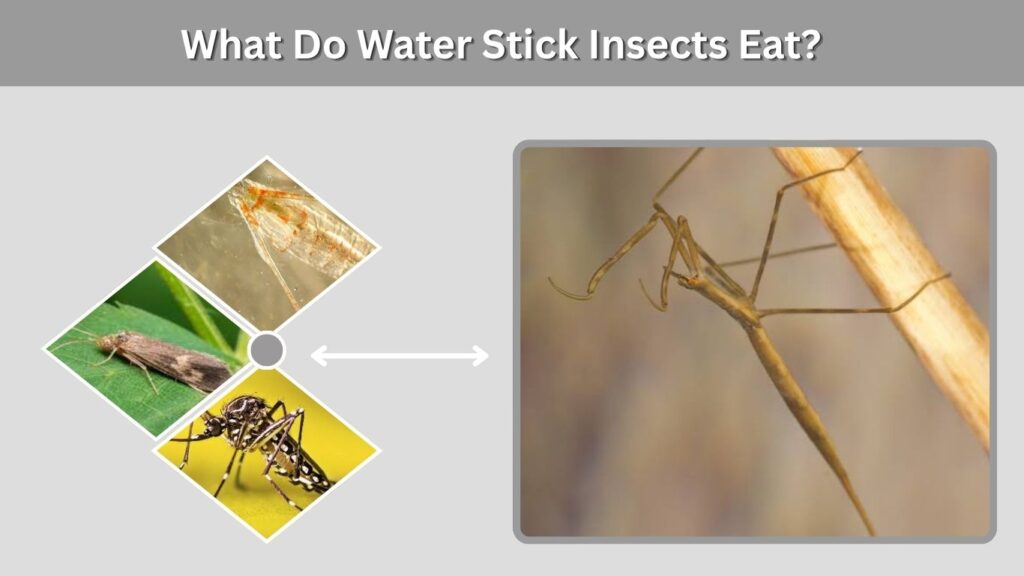
Water stick insects are carnivorous ambush predators.
Depending on their size, they may capture:
- Mosquito larvae
- Aquatic insect larvae
- Small crustaceans
- Aquatic worms
- Other water bugs
- Tadpoles
- Very small fish
Ranatra linearis, for example, is known to prey on aquatic invertebrates as well as tadpoles and small fish.
How Do They Catch Food?
A water stick insect usually waits motionless among plants.
When prey moves within reach, it rapidly closes its raptorial front legs around the victim.
It then inserts its piercing-sucking mouthpart into the prey and feeds on its body fluids.
This hunting strategy resembles that of a praying mantis, although the two insects are not closely related.
Do Water Stick Insects Bite?
Yes, a water stick insect is physically capable of biting humans, although people are not its normal prey.
The insect has a strong piercing beak used for feeding.
A defensive bite may occur if the insect is:
- Picked up
- Squeezed
- Trapped against skin
- Handled carelessly
The bite can be painful, but water stick insects do not normally pursue or attack people.
It is best to observe them without handling them.
Are Water Stick Insects Poisonous?
They are not considered poisonous in the usual sense and do not have a scorpion-like venomous stinger.
Their long rear breathing tube may resemble a stinger, but it is used for obtaining air.
The mouthparts at the front of the body are what can cause a defensive bite.
Water Stick Insect Life Cycle
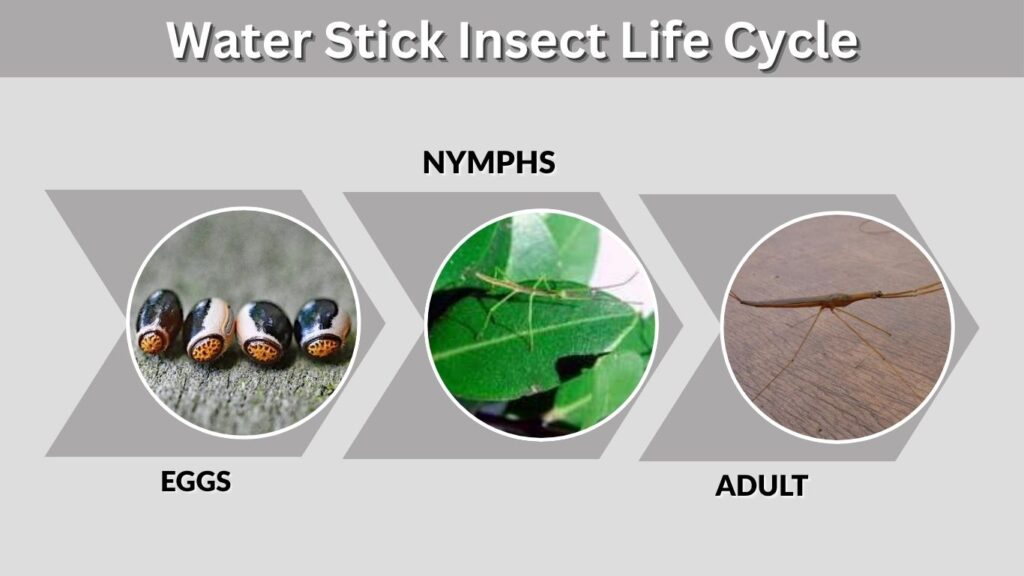
Water stick insects undergo incomplete metamorphosis:
Egg → Nymph → Adult
They do not have caterpillar or pupal stages.
Eggs
Females generally deposit eggs in or around aquatic vegetation.
The precise laying behavior varies among species.
Nymphs
Young water stick insects resemble smaller versions of adults.
They already possess six legs and a predatory lifestyle but do not initially have fully developed wings.
Nymphs grow by repeatedly shedding their exoskeleton.
Adults
After the final molt, the insect becomes a winged reproductive adult.
Adult wings are normally hidden against the long body and may not be obvious until the insect flies.
Water Stick Insect Adaptations
Living as an underwater predator requires several specialized adaptations.
Twig-Like Camouflage
The narrow brown body makes the insect resemble submerged stems or dead vegetation.
Camouflage helps it both avoid predators and remain hidden from prey.
Raptorial Front Legs
The front pair of legs functions like gripping arms.
These legs can close quickly around insects or other small aquatic animals.
Breathing Tube
Its abdominal respiratory tube lets the insect breathe while remaining almost entirely submerged.
Piercing Mouthparts
Like other true bugs, Ranatra possesses a piercing-sucking beak rather than chewing jaws.
Wings
Although these insects spend much of their time underwater, adults can fly.
Flight allows them to move between freshwater habitats when a pond dries up or becomes unsuitable.
Water Stick Insect vs. Water Scorpion
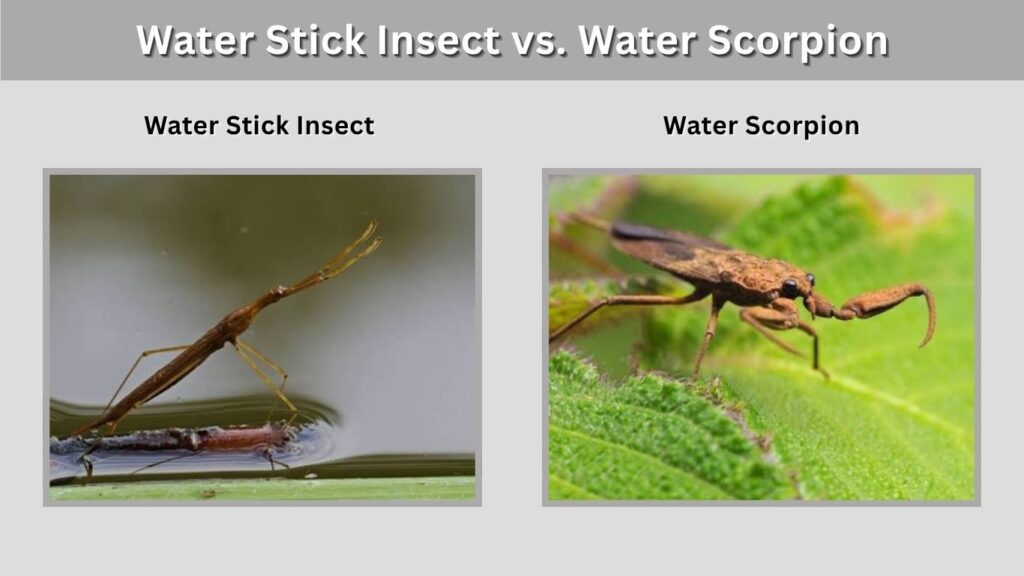
Water stick insects are actually members of the same family as water scorpions.
However, the names are often used to distinguish two different body forms.
| Feature | Water Stick Insect (Ranatra) | Typical Water Scorpion (Nepa) |
| Body | Very long and narrow | Broad and flattened |
| Appearance | Resembles a twig | Resembles a leaf |
| Front legs | Raptorial | Raptorial |
| Breathing tube | Long | Long |
| Diet | Predatory | Predatory |
| Family | Nepidae | Nepidae |
So a water stick insect is essentially a slender type of water scorpion, not an aquatic version of a walking stick.
Water Stick Insect vs. Walking Stick
Their similar appearances result mainly from camouflage.
True walking sticks are terrestrial members of the order Phasmatodea and primarily eat plants.
Water stick insects belong to Hemiptera and hunt other animals.
Another major difference is the mouth.
Walking sticks possess chewing mouthparts for eating leaves, while Ranatra has a piercing beak for consuming animal prey.
Water Stick Insects in the UK
The best-known UK species is Ranatra linearis.
It occurs particularly in central and southern Britain and can be found in vegetated freshwater habitats such as ponds, lakes, and marshes. The species is also widely distributed across Europe and extends into North Africa.
Its long body and respiratory tube make it one of Britain’s most distinctive aquatic true bugs.
Water Stick Insects in Florida
Florida also supports Ranatra species. BugGuide, for example, documents Ranatra australis from Marion County, Florida.
They may occur around ponds, wetlands, spring runs, and other vegetated freshwater environments.
Because the insects remain motionless among vegetation, they can be present without being easily noticed.
Do Stick Insects Need Water?
This question often comes from confusion between water stick insects and ordinary walking sticks.
Water stick insects (Ranatra) live primarily in freshwater.
True terrestrial stick insects do not live underwater. They obtain water from fresh leaves and environmental moisture, although captive-care requirements vary by species.
The two groups only look superficially similar.
Interesting Water Stick Insect Facts
- Water stick insects belong to the genus Ranatra.
- They are true bugs, not genuine walking sticks.
- They have six legs.
- Their front legs are modified for catching prey.
- They hunt other aquatic animals.
- Their long rear tube functions like a snorkel.
- They can remain underwater while breathing atmospheric air.
- Adults have wings and can fly.
- Their twig-like body provides excellent camouflage.
- Some species can catch tadpoles and tiny fish.
- They are close relatives of water scorpions.
- Their breathing tube is not a stinger.
FAQs
1. What is a water stick insect?
A water stick insect is a slender aquatic true bug, usually belonging to the genus Ranatra. It resembles a twig but is actually a predatory relative of water scorpions. It lives primarily in vegetated freshwater and captures small aquatic animals.
2. Can water stick insects bite humans?
Yes, they can potentially deliver a painful defensive bite with their piercing mouthparts if handled or squeezed. However, humans are not their prey, and these insects normally remain hidden or attempt to escape rather than attack people.
3. How does a water stick insect breathe underwater?
It has a long breathing tube extending from the rear of its abdomen. The insect places the end of this tube at the water surface, allowing atmospheric air to enter while most of its body remains submerged.
4. What do water stick insects eat?
Water stick insects eat small aquatic animals such as mosquito larvae, other insect larvae, aquatic invertebrates, and sometimes tadpoles or very small fish. They catch prey using specialized grasping front legs.
5. Is a water stick insect the same as a water scorpion?
Water stick insects are members of the water scorpion family Nepidae. The name usually refers to slender Ranatra species, while “water scorpion” often describes broader-bodied relatives such as Nepa. Both are predatory aquatic true bugs.