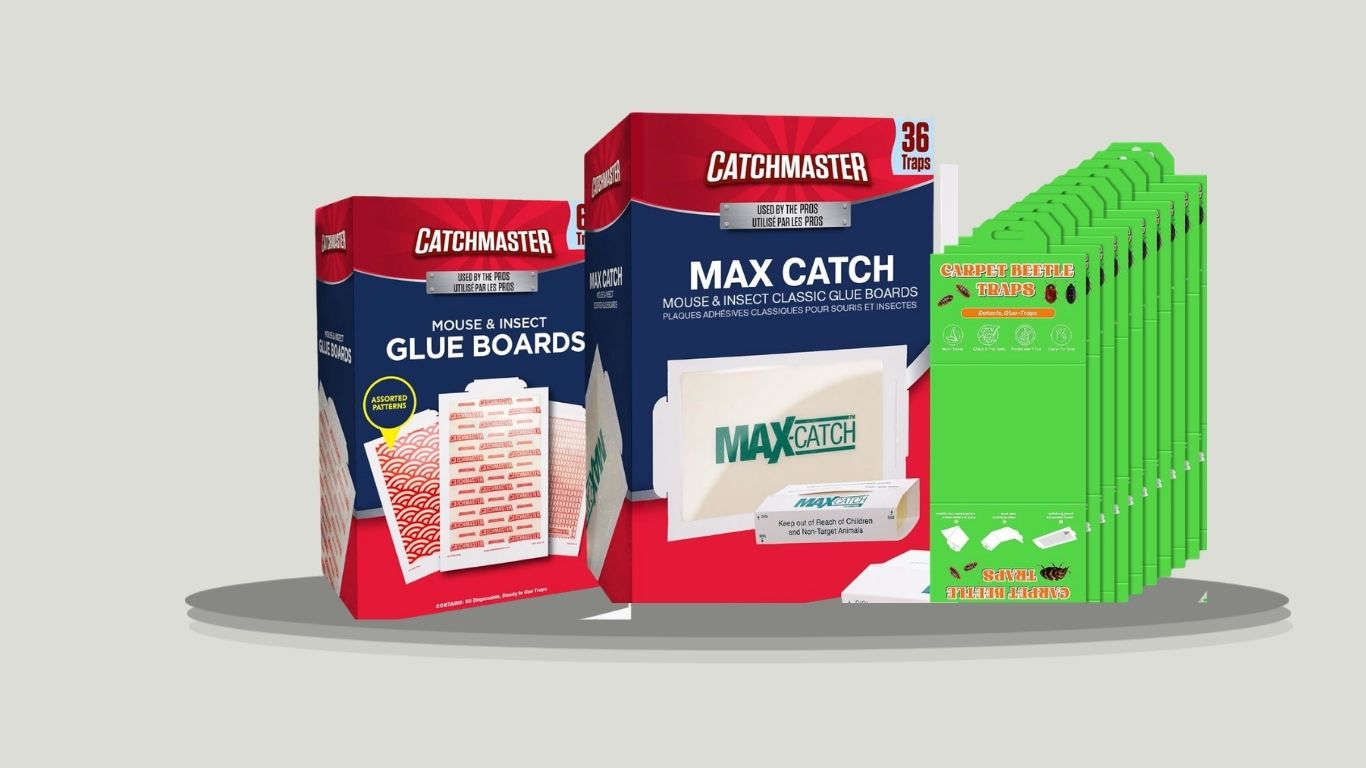
Carpet beetles can quietly damage carpets, clothing, upholstery, and other natural-fiber materials before you even notice them. Sticky traps offer a simple way to monitor activity and capture adult beetles or other crawling pests without relying heavily on sprays. The best carpet beetle sticky traps use strong adhesive, practical placement designs, and in some cases pheromone attractants to improve detection. In this guide, we review eight reliable options for bedrooms, closets, storage areas, basements, and other indoor spaces where carpet beetles may be active.
1. Catchmaster Crawling Pest & Insect Sticky Traps
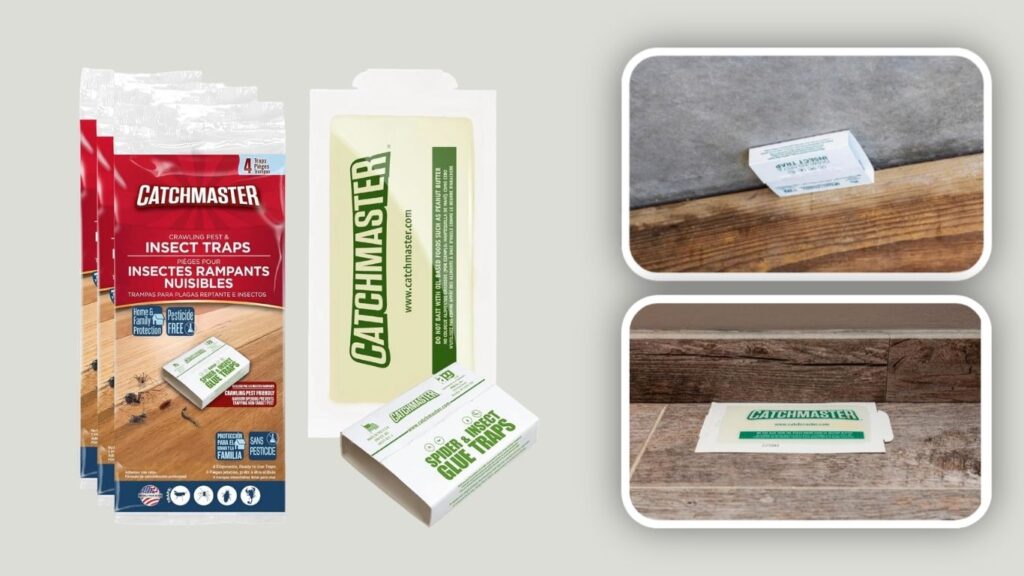
Catchmaster Crawling Pest & Insect Sticky Traps are a practical choice for homeowners who want to monitor carpet beetles and other crawling pests without relying on sprays. Their simple glue-board design works particularly well along baseboards, closet edges, underneath furniture, and other locations where insects travel. Catchmaster states that its crawling-insect traps use professional-strength adhesive and require no bait.
Key Features
- Professional-strength adhesive surface
- Pesticide-free trapping method
- Ready to use without additional bait
- Suitable for carpet beetles and various crawling insects
- Easy placement beside walls and pest pathways
- Useful for ongoing indoor pest monitoring
Why It’s Best for General Indoor Monitoring
The biggest advantage of these traps is versatility. Carpet beetles often hide in locations that are difficult to inspect, including closets, beneath furniture, and around room edges. Placing several sticky boards in suspected areas can provide a clearer picture of where pest activity is concentrated.
They are especially useful when you are unsure exactly where beetles are coming from. Instead of repeatedly spraying an entire room, strategically positioned traps can help identify active zones.
Adhesive Performance and Placement
The flat profile makes these traps convenient for baseboards, storage spaces, utility rooms, bedrooms, and other low-traffic locations. Manufacturer information indicates that Catchmaster crawling-insect traps can remain effective for extended periods under normal indoor conditions.
For carpet beetles, positioning matters almost as much as adhesive strength. Consider placing traps close to natural-fiber rugs, closets, upholstered furniture, and windows where adult beetles may appear.
Overall Verdict
For homeowners wanting a straightforward multi-pest sticky trap, this Catchmaster option offers an appealing balance of simplicity and coverage. It does not depend on complicated setup or chemical treatments, making it particularly useful for monitoring.
Remember that sticky traps work best as part of a broader carpet beetle management strategy. Finding and cleaning the infestation source remains essential because carpet beetle larvae are responsible for most fabric damage.
2. Carpet Beetle Traps for Crawling Insects – Non-Toxic
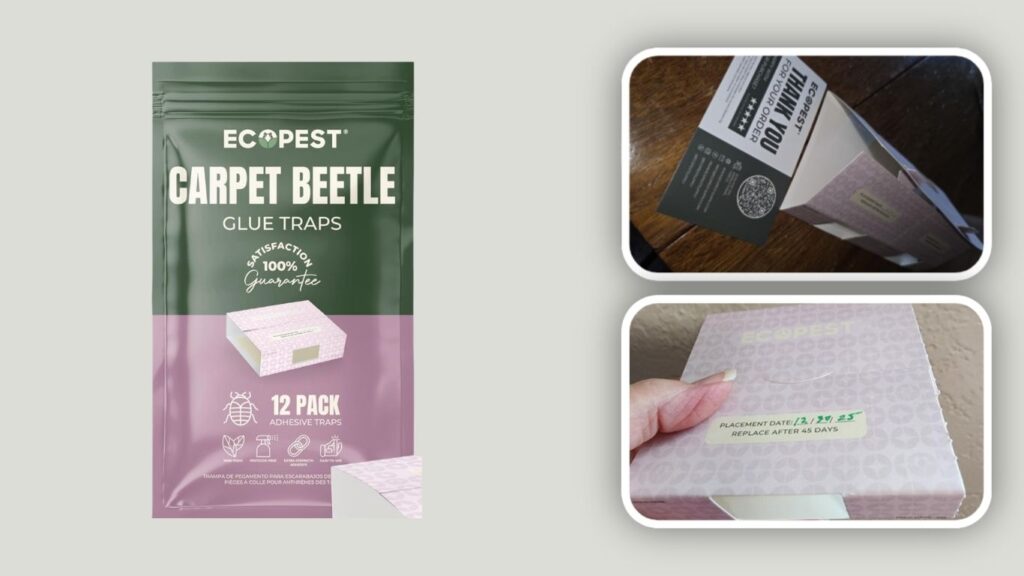
These carpet beetle sticky traps are designed specifically around indoor crawling-pest monitoring. Their non-toxic approach makes them suitable for locations where homeowners would rather avoid routine insecticide spraying. They can be positioned around carpet edges, closets, furniture, storage spaces, or other suspected beetle pathways.
Key Features
- Designed for carpet beetles and crawling insects
- Non-toxic trapping approach
- Adhesive capture surface
- Suitable for discreet indoor placement
- No complicated installation
- Helpful for detecting hidden pest activity
Why It’s Best for Carpet Beetle-Focused Monitoring
Unlike a general mouse or large insect glue board, this option is marketed specifically toward carpet beetles and similar crawling pests. That makes it particularly appealing when carpet beetles—not rodents or larger insects—are the main concern.
The trap can also act as an early-warning system. Carpet beetle infestations can remain unnoticed because larvae frequently develop in dark, undisturbed spaces. University of Kentucky Extension notes that glue traps can help detect fabric-pest infestations early and can be positioned in closets, on shelves, and around susceptible materials.
Practical Performance Around the Home
The best strategy is to distribute several traps rather than relying on a single location. Place them near suspected activity and compare catches over time. Areas producing more beetles may indicate that the infestation source is nearby.
This monitoring approach is especially useful around wool carpeting, stored clothing, furniture edges, pet-hair accumulation areas, and storage rooms.
Overall Verdict
This is a sensible choice for anyone who wants a trap aimed more directly at carpet beetle monitoring. Its simple sticky design provides a low-maintenance way to watch problem areas and determine whether activity is increasing or declining.
For better results, combine trapping with thorough vacuuming and inspection. Traps reveal activity, while cleaning and removing infested materials address the conditions that allow carpet beetles to persist.
3. Carpet Beetle & Crawling Insect Monitoring Sticky Traps
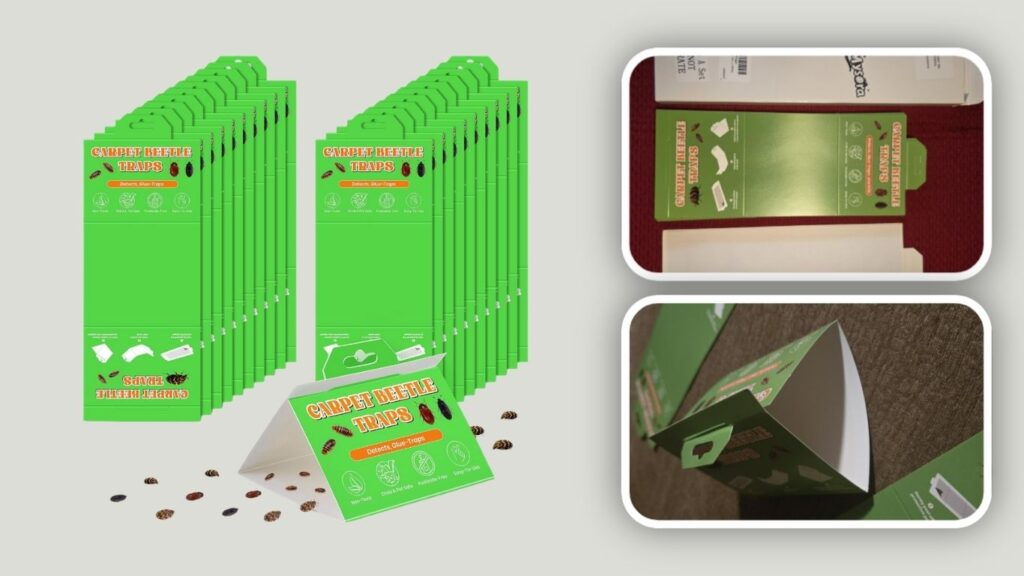
These monitoring sticky traps are designed for homeowners who want an uncomplicated way to track carpet beetles and other crawling insects. Rather than treating an entire room blindly, strategically placed adhesive traps can help determine where beetles are most active and whether your cleaning or control efforts are working.
Key Features
- Sticky monitoring surface
- Intended for carpet beetles and crawling pests
- Non-toxic mechanical capture
- Works in multiple indoor locations
- Useful for infestation detection
- Simple disposable design
Why It’s Best for Locating Pest Activity
The strongest reason to consider this type of trap is monitoring. Carpet beetles can originate from unexpected locations, including stored fabrics, lint accumulation, animal hair, dead insects, old nests, and natural-fiber materials.
When several traps are distributed around a room, differences in catch numbers can provide useful clues. University of Kentucky Extension notes that areas producing higher trap catches are often closer to infested materials.
That makes monitoring traps particularly valuable before deciding where more intensive cleaning is necessary.
Performance in Closets and Storage Areas
Closets, storage rooms, furniture edges, and carpet perimeters are excellent locations because these spaces can remain undisturbed for long periods. Place traps where they will remain flat and free from excessive dust.
Regular inspection is important. UC Integrated Pest Management recommends checking carpet beetle sticky traps once or twice each week when they are being used to monitor an infestation.
Overall Verdict
This product makes the most sense for homeowners who view trapping as a monitoring tool rather than a complete treatment. It helps turn an otherwise difficult-to-see pest problem into something measurable.
If you are trying to determine which closet, room, or storage area deserves attention first, several strategically positioned traps can provide valuable information without introducing additional pesticides into the space.
4. INSECTRA Carpet Beetle Pheromone Traps
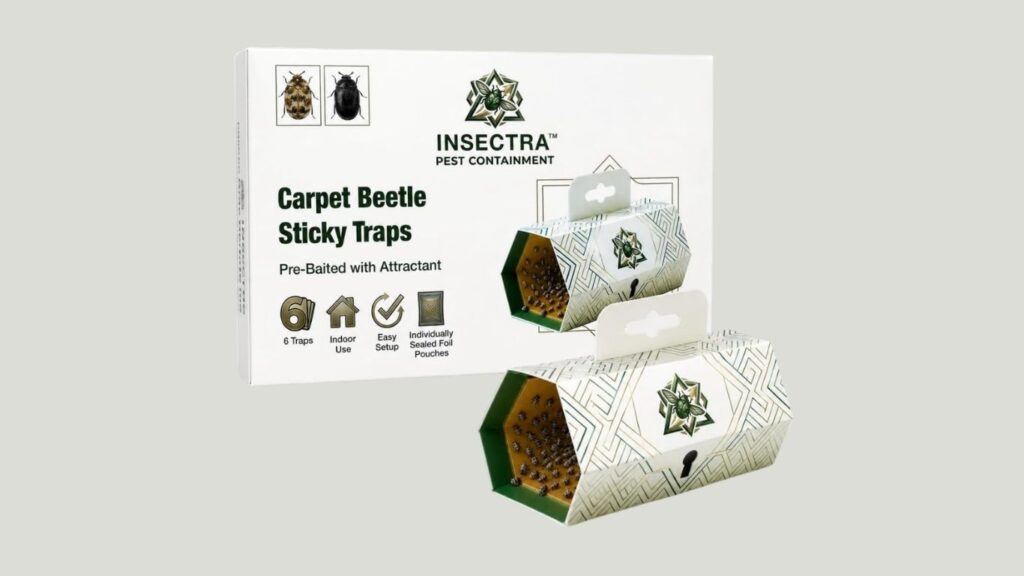
INSECTRA Carpet Beetle Pheromone Traps take a more targeted approach by combining an adhesive trap with an attractant-style system. Pheromone traps can be especially useful when the objective is detecting adult carpet beetles and monitoring whether beetle activity continues after cleaning or other control measures.
Key Features
- Pheromone-based attraction system
- Sticky capture surface
- Designed for carpet beetle monitoring
- Suitable for closets and storage areas
- Helps detect adult beetle activity
- Convenient passive monitoring method
Why It’s Best for Targeted Monitoring
A pheromone trap has an important advantage over an ordinary glue board: instead of depending entirely on an insect accidentally walking across the adhesive, the attractant is intended to draw targeted beetles toward the trap.
UC Integrated Pest Management recommends appropriately baited pheromone sticky traps for carpet beetle monitoring and notes that they can supplement other management methods.
This makes the INSECTRA option particularly interesting when you already know carpet beetles are present and want more focused monitoring.
Pheromone Performance and Proper Placement
Correct identification matters with pheromone trapping. Carpet beetle pheromones can be species-specific, meaning a trap designed for one species may not be equally attractive to another. UC IPM specifically recommends matching the pheromone trap to the carpet beetle species causing the problem.
Use the trap around closets, stored fabrics, collection areas, or locations where adult beetles have previously appeared.
Overall Verdict
INSECTRA is one of the more specialized options in this roundup because it is built around carpet beetle pheromone monitoring rather than general crawling-pest capture.
It is particularly suitable for people who want to monitor adult beetle activity after identifying an infestation. For the strongest results, pair pheromone monitoring with vacuuming, fabric inspection, laundering, and removal of the larval food source.
5. Catchmaster Max-Catch Sticky Glue Traps – 72 Pack
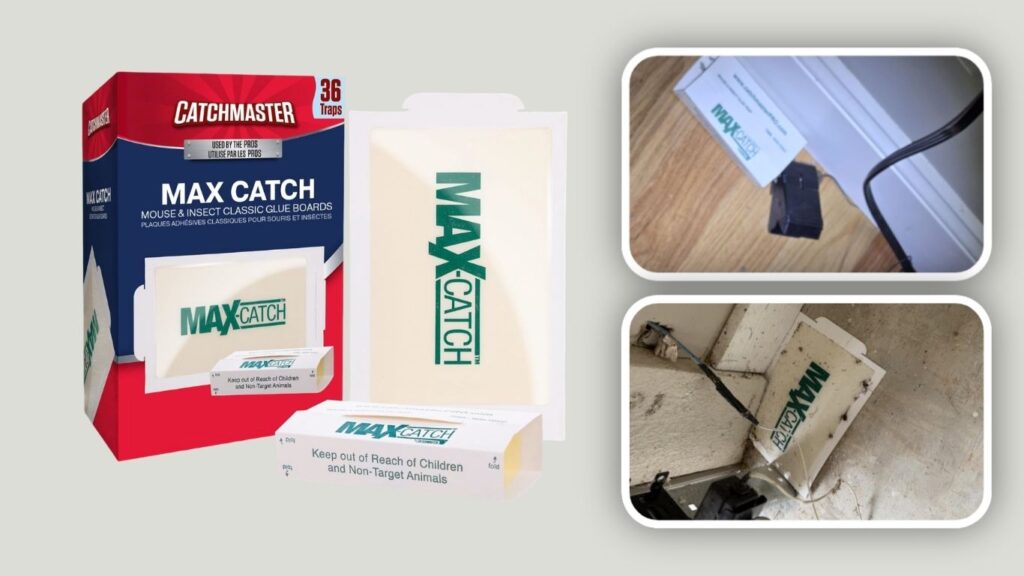
The Catchmaster Max-Catch bulk glue boards are a strong option when extensive coverage matters. A large supply allows traps to be placed in multiple rooms, closets, storage areas, basements, and along baseboards instead of concentrating all monitoring in one location. Catchmaster describes its Max-Catch boards as pesticide-free, ready to use, and suitable for numerous crawling pests.
Key Features
- Large 72-trap pack
- Heavy-duty adhesive
- Pesticide-free design
- No bait required
- Can be used flat or folded
- Suitable for broad indoor monitoring
Why It’s Best for Whole-Home Coverage
A carpet beetle infestation is not always confined to one closet. Beetles and larvae can occur in several rooms, making a larger supply especially useful.
With 72 boards available, you can create a more systematic monitoring layout. Traps can be positioned near baseboards, underneath furniture, beside storage containers, in closets, and close to suspected fabric-pest activity.
This makes the bulk pack particularly attractive for larger homes or recurring pest problems.
Adhesive Strength and Long-Term Use
Catchmaster states that Max-Catch boards use professional-strength adhesive and can remain effective for up to one year under normal indoor conditions. They may also be folded into a tunnel configuration, which helps protect the sticky surface in dusty environments.
For carpet beetles, smaller strategic zones are often more useful than placing boards randomly throughout the room.
Overall Verdict
The Max-Catch 72-pack stands out primarily for value and coverage. It is less specialized than a carpet-beetle pheromone trap, but the quantity makes it practical for extensive monitoring.
For homeowners dealing with pest activity across several areas—or anyone who wants enough traps to replace dirty or filled boards without immediately running out—this bulk format provides considerable flexibility.
6. Catchmaster Spider, Roach & Crawling Insect Glue Traps
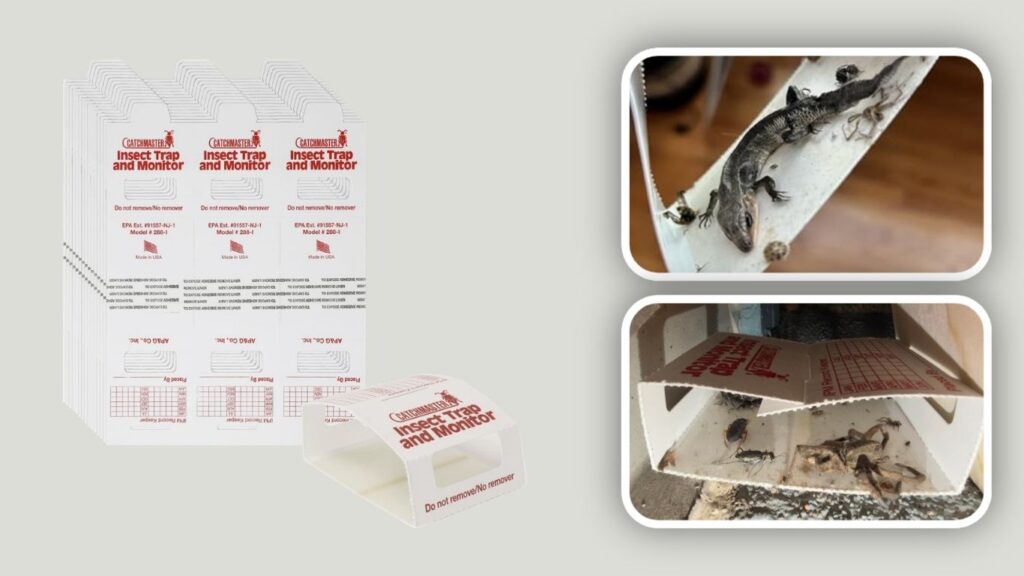
These Catchmaster traps are marketed primarily for spiders, roaches, crickets, and crawling insects, but the adhesive-board format can also be useful for monitoring crawling carpet beetles in suitable locations. The listing associated with this product identifies it as a 45-piece Catchmaster trap package, giving users enough boards for multiple pest pathways.
Key Features
- 45-count package
- Strong adhesive surface
- Designed for crawling pests
- Low-profile indoor placement
- Useful in closets and room edges
- Multi-pest monitoring capability
Why It’s Best for Multi-Pest Homes
Not every home has just one pest problem. Basements, garages, older houses, and storage rooms can contain spiders, crickets, beetles, and other crawling insects simultaneously.
A general crawling-insect glue board therefore provides more flexibility than a narrowly targeted trap. If something is moving along the same pathway, the adhesive surface can potentially capture it.
For households dealing with several crawling pests at once, this flexibility can make the traps more useful throughout the year.
Placement and Everyday Performance
Position these traps against walls, underneath furniture, behind storage boxes, inside closets, and near other sheltered pathways. Carpet beetles frequently appear along baseboards and near windows, so those locations deserve attention as well.
Rutgers recommends sticky traps near windows for adult varied carpet beetles and notes that traps around floor perimeters and corners can help monitor larval activity.
Overall Verdict
This Catchmaster option is a good match for people who want broad crawling-pest monitoring rather than a carpet-beetle-only solution.
The generous trap count also makes strategic placement easier. While it lacks the targeted attraction of a pheromone trap, its straightforward adhesive design can reveal active pathways and support an ongoing integrated pest-management routine.
7. Mysora Carpet Beetle Pheromone Traps
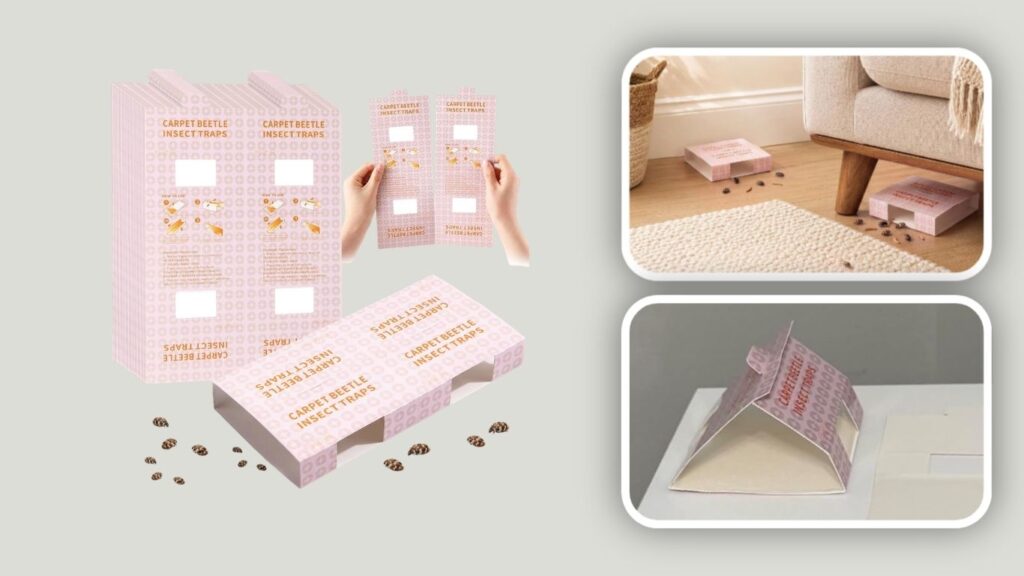
Mysora Carpet Beetle Pheromone Traps are another targeted option for homeowners who prefer attractant-based monitoring. Their primary advantage is the combination of a sticky capture surface and pheromone lure, which is designed to increase the likelihood of detecting the appropriate adult carpet beetles instead of waiting for insects to randomly cross a plain glue board.
Key Features
- Pheromone-attractant design
- Sticky capture surface
- Intended specifically for carpet beetles
- Passive, continuous monitoring
- Convenient for closets and storage areas
- Useful for confirming ongoing adult activity
Why It’s Best for Hard-to-Detect Infestations
Carpet beetles often become noticeable only after damaged fabrics, shed larval skins, or adult beetles begin appearing. A targeted monitoring trap can provide additional evidence of activity before the infestation becomes obvious.
Pheromone traps are especially valuable when placed near areas containing susceptible materials. UC IPM recommends appropriately baited sticky traps as part of a monitoring program and explains that they can help reveal where beetles originate.
Targeted Attraction and Placement
Use pheromone traps strategically rather than filling every room with them. Closets containing wool, storage rooms, textile collections, and areas with previous adult beetle sightings are logical starting points.
Because pheromone attractants can be species-specific, identifying the carpet beetle involved will improve the usefulness of this type of trap.
Overall Verdict
The Mysora pheromone trap is one of the more purpose-driven products on this list. It is particularly appealing when you already suspect carpet beetles and want targeted evidence of continuing adult activity.
It should not be viewed as the only step in control, however. Its strongest role is detection and monitoring while cleaning and source removal address the larvae responsible for damage.
8. Catchmaster Mouse & Insect Glue Boards
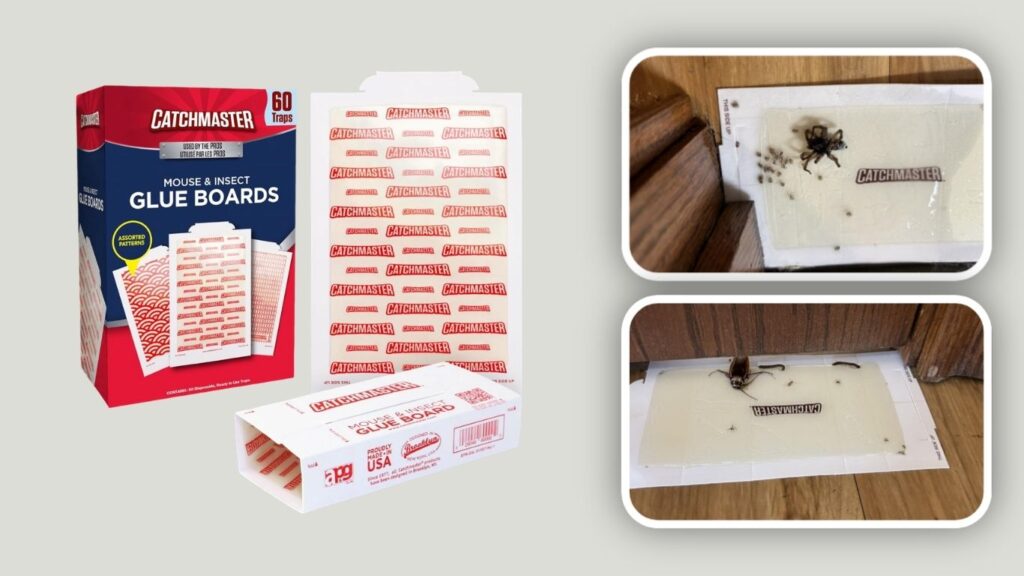
Catchmaster Mouse & Insect Glue Boards are larger general-purpose adhesive traps that can handle multiple crawling pests while providing plenty of sticky surface area. The product associated with the supplied listing is sold as a 60-pack and uses heavy-duty adhesive boards that can be positioned against baseboards or folded into a tunnel shape.
Key Features
- Bulk 60-board package
- Heavy-duty adhesive
- Pesticide-free trapping method
- Can lie flat or fold into a tunnel
- Suitable for multiple crawling pests
- Useful for large monitoring areas
Why It’s Best for Large Monitoring Zones
The generous adhesive area makes this Catchmaster option useful in basements, storage rooms, attics, utility spaces, and other locations where you want broad coverage.
The 60-board quantity also allows traps to be replaced frequently or distributed across multiple suspected areas. This is useful for carpet beetle monitoring because infestations can have more than one source.
Instead of relying on a single trap, homeowners can create a simple monitoring network throughout the property.
Durability and Flexible Placement
The boards can be positioned directly beside baseboards or folded into covered shapes for tighter or dustier areas. Catchmaster documentation for similar Max-Catch boards emphasizes long-lasting adhesive and flexible flat-or-tunnel placement.
For carpet beetles, place boards near windows, closets, carpet edges, upholstered furniture, and suspected larval feeding sites rather than in open floor areas.
Overall Verdict
Catchmaster Mouse & Insect Glue Boards are best suited to homeowners who value quantity, adhesive area, and versatility over species-specific attraction.
They may be excessive for someone who only wants one or two discreet monitoring traps, but their bulk format becomes valuable when several rooms need coverage. For a broader pest-monitoring program that includes carpet beetles alongside spiders, crickets, and other crawling insects, they offer plenty of practical flexibility.
FAQs
1. Do sticky traps actually work for carpet beetles?
Yes, sticky traps can be useful for detecting and monitoring carpet beetles. They are particularly valuable for determining where beetles are active and whether control efforts are reducing their numbers. University extension guidance recommends both baited and unbaited sticky traps for carpet beetle monitoring.
However, traps alone may not eliminate an established infestation.
2. Where should I put carpet beetle sticky traps?
Good locations include closets, carpet edges, baseboards, underneath furniture, shelves, storage areas, and around windows. Adult varied carpet beetles are commonly attracted toward windows, while traps placed around floor edges can help monitor crawling activity.
Placing several traps in different locations can also help pinpoint the infestation source.
3. Are pheromone traps better than regular sticky traps?
Pheromone traps can provide more targeted monitoring because the attractant draws appropriate adult beetles toward the sticky surface. However, pheromones may be species-specific, so the trap needs to match the carpet beetle species present.
Plain sticky traps remain useful when you want broader monitoring of crawling insects.
4. How often should carpet beetle traps be checked?
Check the traps approximately once or twice per week while actively monitoring an infestation. Compare catches between locations and over time. A trap that consistently catches more beetles may indicate that the infestation source is nearby.
Replace traps when they become dusty, filled with insects, or lose their adhesive effectiveness.
5. Can sticky traps completely eliminate carpet beetles?
Usually not. Sticky traps are primarily useful for monitoring and capturing some adults or crawling individuals. The damaging stage is the larva, which can feed in hidden areas on wool, fur, feathers, hair, and other animal-based materials.
Successful control generally requires finding the source, vacuuming thoroughly, cleaning or treating infested fabrics, removing lint and animal hair, and properly storing susceptible materials. Sanitation and exclusion are key components of carpet beetle management.