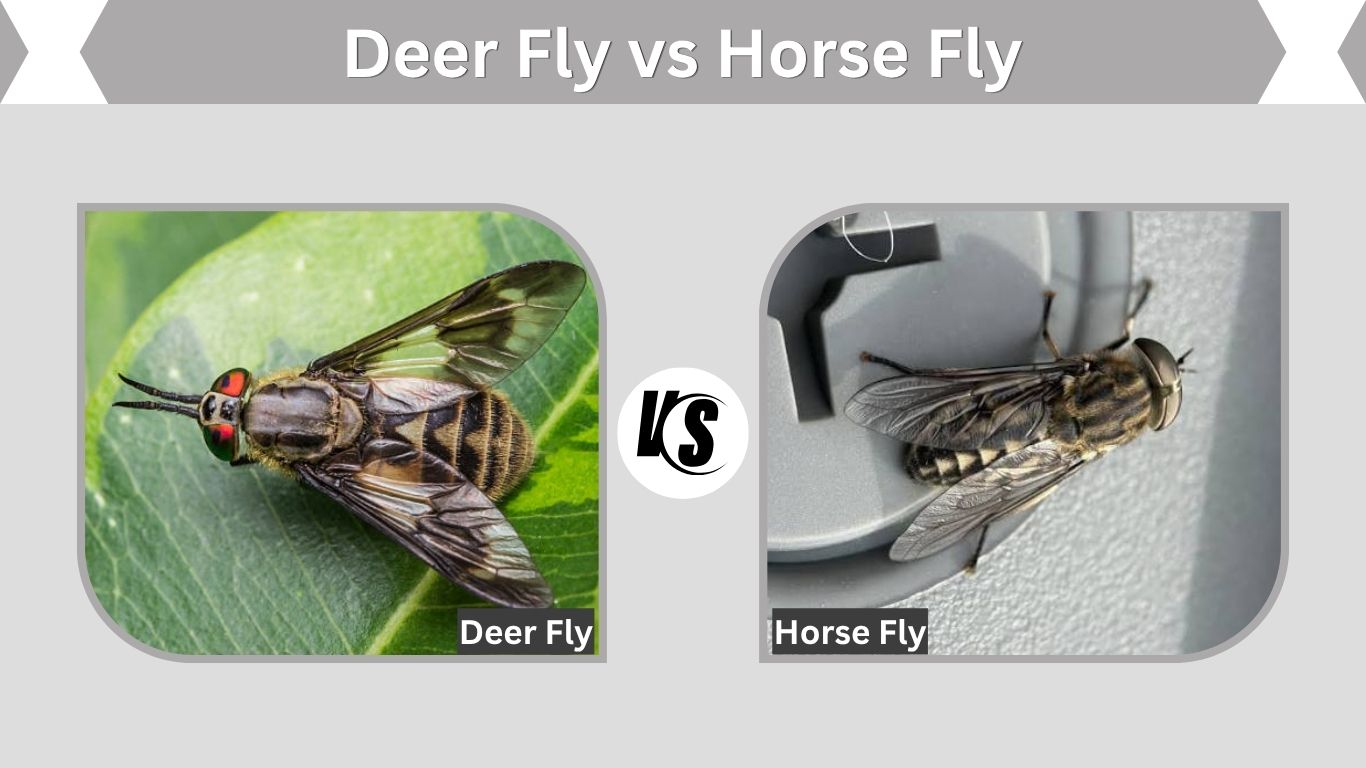
Deer flies and horse flies are closely related biting flies that can make outdoor activities uncomfortable during warm weather. Both belong to the Tabanidae family, and females of both groups feed on blood. However, they differ in size, wing patterns, appearance, preferred hosts, and some aspects of their behavior. Horse flies are generally larger and heavier-bodied, while deer flies tend to be smaller and often have noticeably patterned wings. This deer fly vs horse fly comparison explains their key differences, bites, habitats, and identification features so you can tell them apart more easily.
Deer Fly vs Horse Fly: Quick Comparison
| Feature | Deer Fly | Horse Fly |
| Size | Usually smaller | Usually larger |
| Body | Compact, often yellowish or dark | Large, stout, heavy-bodied |
| Wings | Frequently patterned or banded | Usually clearer or less patterned |
| Eyes | Large, often brightly colored | Large and sometimes iridescent |
| Bite | Painful | Often very painful |
| Activity | Mainly daytime | Mainly daytime |
| Family | Tabanidae | Tabanidae |
| Blood Feeding | Females | Females |
Horse flies can approach about an inch in length, whereas deer flies are generally smaller, often around 1/4 to 1/2 inch. Deer flies also frequently show characteristic light-and-dark wing patterns.
What Is a Deer Fly?
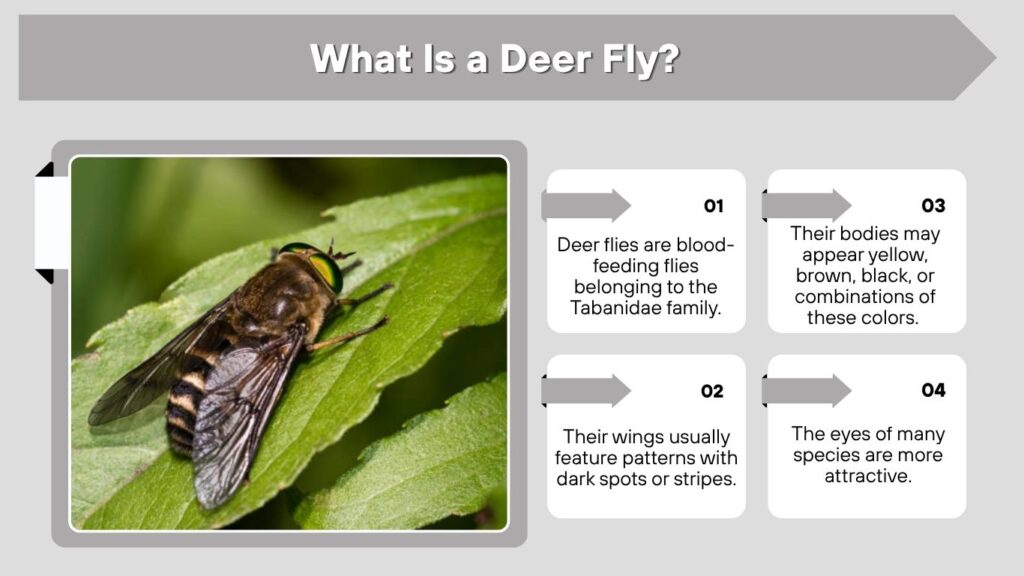
Deer flies are blood-feeding flies belonging to the Tabanidae family. They are generally smaller than horse flies and commonly have patterned wings with dark markings or bands.
Their bodies may appear yellow, brown, black, or combinations of these colors. Many species also have striking eyes that can appear green, gold, or brightly patterned.
Female deer flies feed on blood because they need additional nutrients for egg production. Males primarily feed on nectar and other plant sugars.
Deer flies are usually encountered during daylight hours around wetlands, wooded areas, trails, lakes, marshes, and places where large mammals are present.
What Is a Horse Fly?
Horse flies are larger members of the same Tabanidae family. Their thick bodies and powerful flight often make them easier to notice than deer flies.
Many horse flies are dark brown, gray, or black, although appearance varies considerably among species. Their most distinctive characteristic is often their size.
Horse flies may reach about one inch long, making some species considerably larger than common house flies or deer flies.
Like deer flies, only females normally take blood meals. They commonly attack horses, cattle, deer, people, and other warm-blooded animals.
Deer Fly vs Horse Fly Size
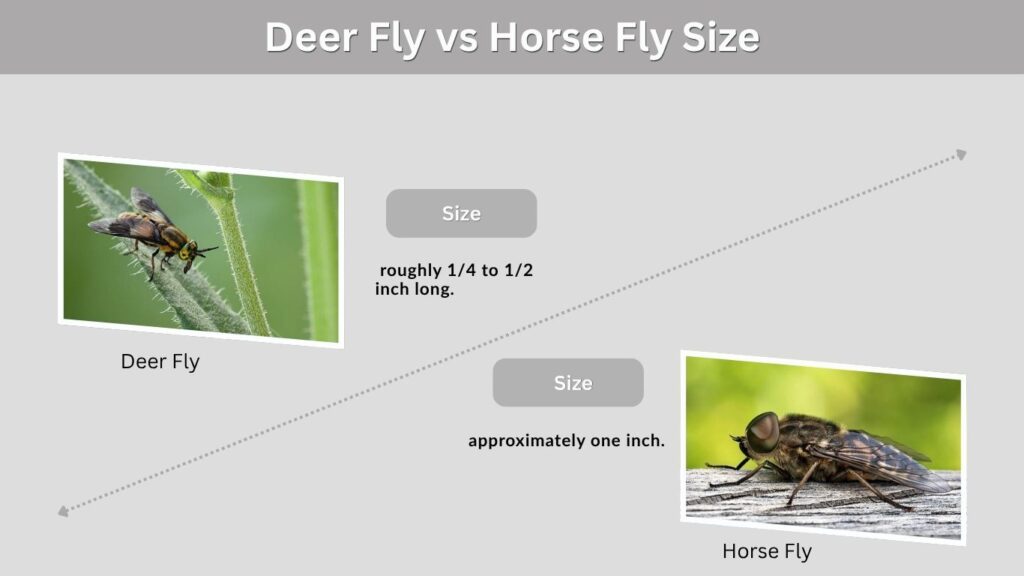
Size is usually one of the easiest ways to distinguish these flies.
Deer flies are typically smaller and more compact. Many measure roughly 1/4 to 1/2 inch long.
Horse flies have a broader size range and may reach approximately one inch. Their bodies also tend to look thicker and more robust.
However, size alone is not perfect because there are many species within both groups. A large deer fly may overlap in size with a smaller horse fly.
Looking at the wings, body shape, and overall appearance provides a more reliable identification.
Deer Fly vs Horse Fly Pictures: What Should You Look For?
When comparing deer fly vs horse fly pictures, start with the wings.
Deer flies commonly have obvious dark patches, stripes, or other patterns across their wings. These markings are one of their most useful identifying features.
Horse fly wings tend to look clearer or less dramatically patterned, although this varies by species.
Next, compare body size. Horse flies generally appear larger and thicker, whereas deer flies have a smaller, more compact appearance.
Both groups have extremely large compound eyes that occupy much of the head. The eyes can appear colorful or iridescent depending on species and lighting.
Deer Fly Bite vs Horse Fly Bite
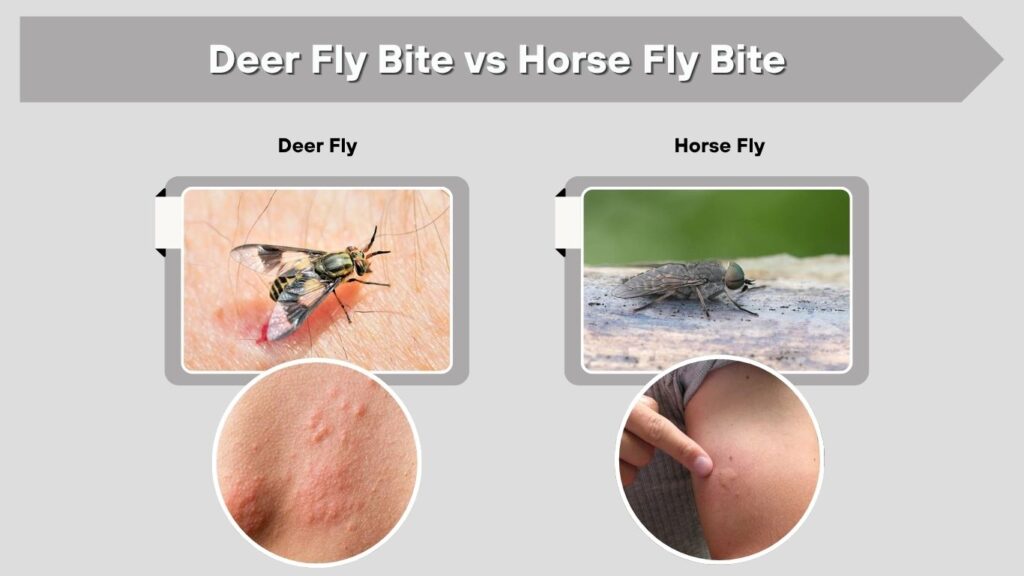
Both deer fly and horse fly bites can be painful because these insects do not feed in exactly the same way as mosquitoes.
Instead of inserting a fine needle-like feeding tube, female tabanid flies use cutting mouthparts to damage the skin and then consume blood from the wound.
This feeding method explains why the bite may be immediately noticeable.
What Does a Deer Fly Bite Feel Like?
A deer fly bite can produce a sharp, sudden pain. The affected area may later become red or discolored, swollen, tender, or itchy.
A small wound or spot of blood may sometimes be noticeable shortly after the bite.
What Does a Horse Fly Bite Feel Like?
Horse fly bites are also painful and can feel sharp or burning. Because some horse flies are considerably larger, their bites can leave noticeable swelling and soreness.
Both groups are recognized as painful biting flies.
The severity of an individual bite depends on the species, location of the bite, and the person’s immune response, so bite appearance alone usually cannot reliably determine which fly caused it.
Which Bite Is Worse: Deer Fly or Horse Fly?
Both can deliver painful bites, and there is no universal rule that one always hurts more.
A large horse fly may create a particularly noticeable wound because of its size, but deer fly bites can also be intensely painful.
The body’s reaction matters just as much as the insect’s size. One person may develop only a small bump, while another may experience significant swelling, itching, or soreness.
For uncomplicated bites, cleaning the area, using a cold compress, and avoiding scratching can help while the skin heals.
Seek medical attention for difficulty breathing, severe swelling, rapidly worsening symptoms, or signs of infection.
Where Do Deer Flies and Horse Flies Live?
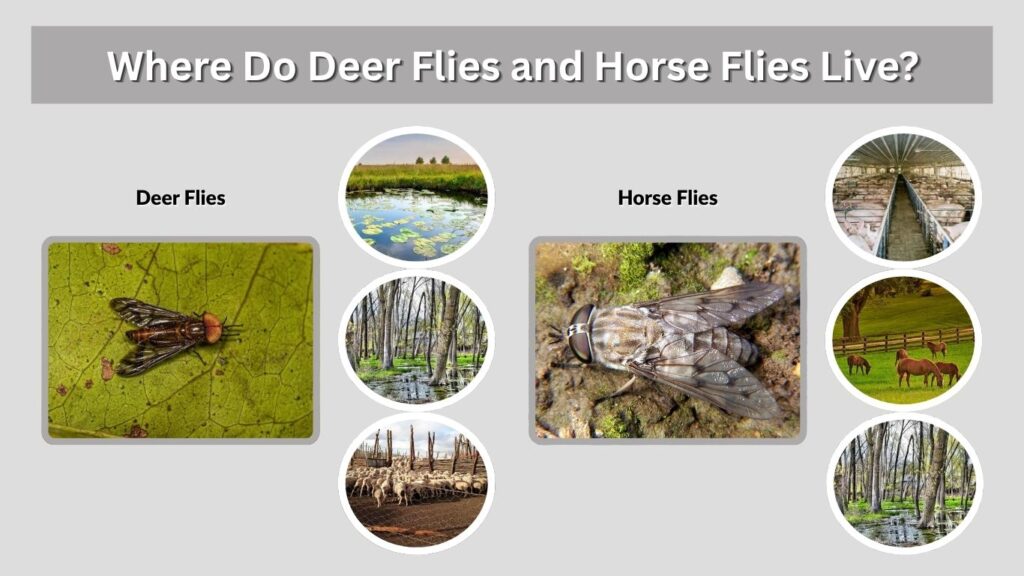
Both groups are often associated with moist environments.
Their immature stages commonly develop around wetlands, marshes, swamps, and other aquatic or semi-aquatic habitats. Adults may travel away from these breeding areas in search of hosts.
University of Minnesota Extension notes that horse and deer flies are daytime-active biting flies commonly associated with swampy environments.
You may encounter them around:
- Lakes and ponds
- Wetlands and marshes
- Wooded trails
- Farms
- Pastures
- Livestock areas
- Campsites near water
They are usually most noticeable during warm weather when adults are actively searching for hosts.
Deer Fly vs Horse Fly vs Black Fly
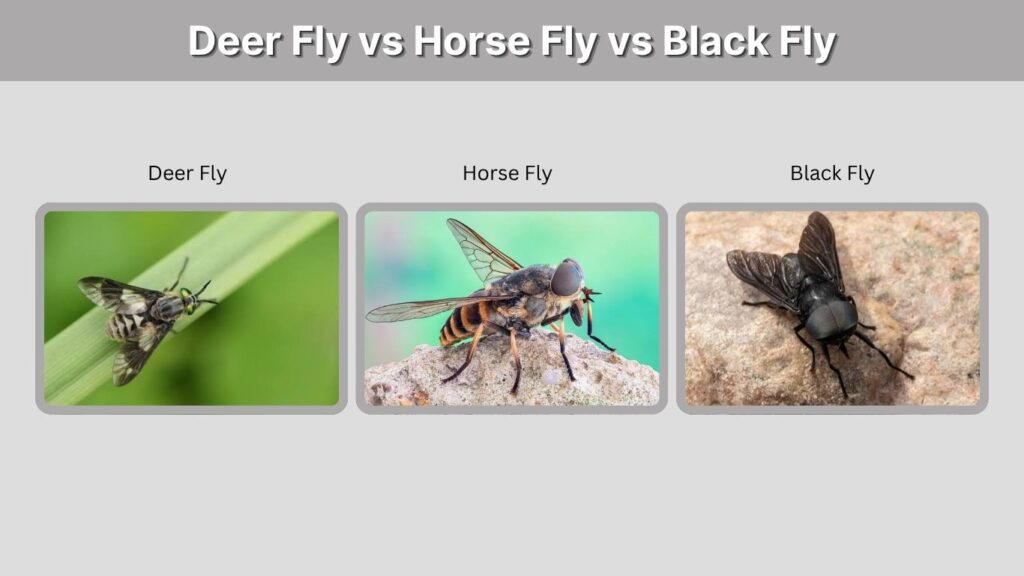
Black flies are much smaller than either deer flies or horse flies.
They are tiny, gnat-like insects, whereas deer and horse flies are substantially larger and more robust. Black flies commonly develop in flowing streams and rivers, while horse and deer fly larvae are strongly associated with wet or swampy environments.
Black flies may attack in groups, producing numerous small bites. Horse flies and deer flies are larger insects and often produce more immediately noticeable individual bites.
University of Minnesota Extension describes black flies as roughly 1/16 inch long, compared with approximately 1/3 to 1 inch for horse and deer flies as a broad group.
How to Avoid Deer Fly and Horse Fly Bites
Because both flies are active during daylight, avoiding heavily infested areas at peak activity can reduce exposure.
Wear long sleeves, long pants, and a hat when hiking or working around wetlands, farms, or wooded environments. Physical barriers can be especially useful because these flies actively search for hosts.
Deep shade or screened shelter may also provide relief in areas with substantial horse and deer fly activity.
Because these flies can be persistent, combining protective clothing with other appropriate control measures is generally more practical than depending on one strategy alone.
FAQs
Are deer flies and horse flies the same?
No. They are different groups of flies, although both belong to the Tabanidae family and share similar blood-feeding behavior.
Which is bigger, a deer fly or horse fly?
Horse flies are generally larger. Deer flies are commonly around 1/4 to 1/2 inch long, while some horse flies can approach one inch.
Do deer flies and horse flies both bite humans?
Yes. Females of both groups can bite humans and other mammals because they use blood meals to support egg production.
How can you tell a deer fly from a horse fly?
Look primarily at size and wings. Deer flies are usually smaller and frequently have patterned wings, while horse flies tend to be larger and heavier-bodied.
Are horse fly bites worse than deer fly bites?
Not necessarily. Both can be painful. Large horse flies may produce particularly noticeable bites, but reaction severity varies according to the insect species and the individual who is bitten.