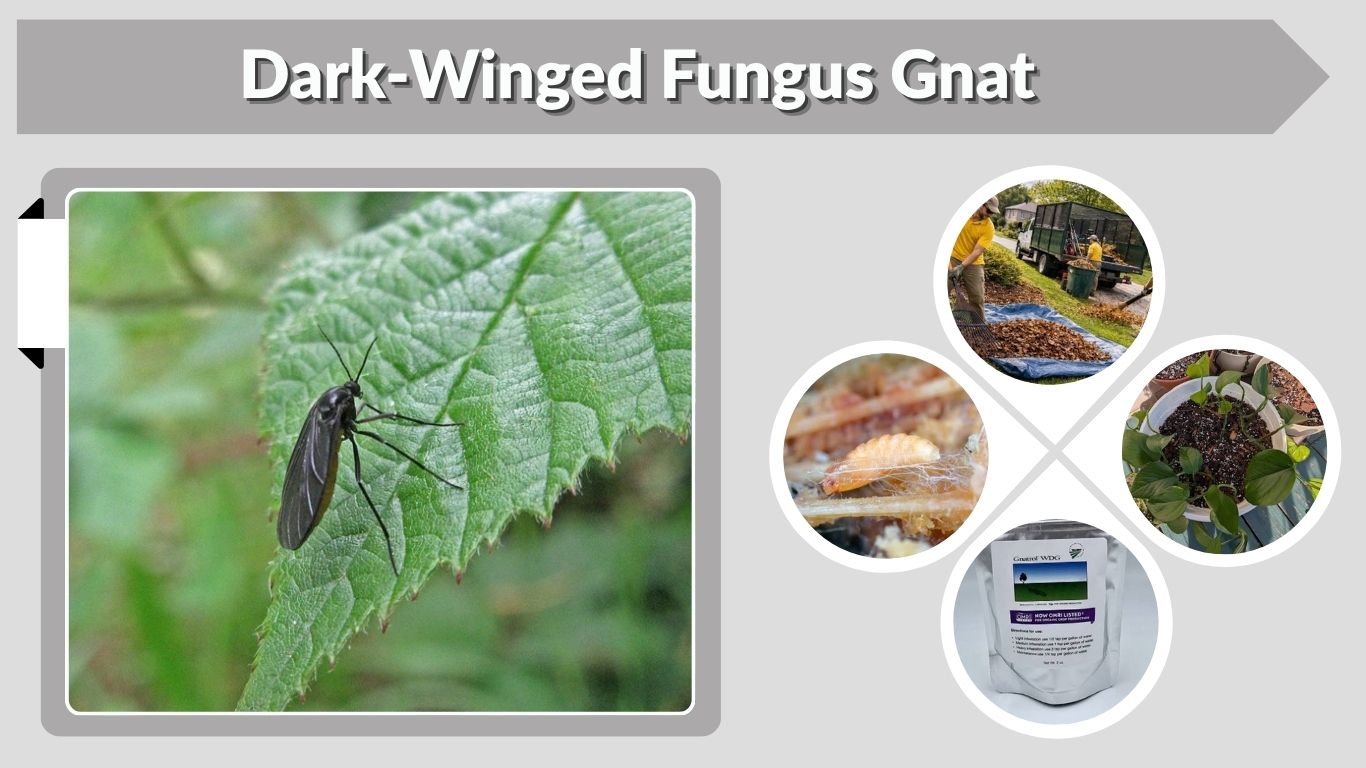
The dark-winged fungus gnat is a tiny, mosquito-like fly commonly associated with damp soil, decaying organic matter, and indoor houseplants. These insects belong to the family Sciaridae and are often noticed crawling across potting soil or flying near windows. Although adult fungus gnats are mainly a nuisance, their larvae can feed on fungi, decaying material, and delicate plant roots. Understanding their appearance, larvae, life cycle, habitat, and control methods makes an infestation much easier to identify and manage.
What Is a Dark-Winged Fungus Gnat?
Dark-winged fungus gnats are small flies in the family Sciaridae. Several species, particularly those in the genus Bradysia, commonly occur around greenhouses and houseplants. Their preference for moist environments explains why they frequently appear around overwatered pots. Adults are weak fliers and generally remain close to the soil where their larvae develop.
Dark-Winged Fungus Gnat Identification
Look for these common characteristics:
- Adult length of roughly 1/16 to 1/8 inch
- Dark brown or nearly black body
- Long, thin legs
- Thread-like antennae
- Clear to smoky-colored wings
- Mosquito-like overall appearance
- A characteristic forked or Y-shaped vein on the wings
- Short, somewhat erratic flights around soil and plants
Their slender appearance helps distinguish them from the more robust-looking shore flies sometimes found in similar damp environments.
Dark-Winged Fungus Gnat Size
Adult dark-winged fungus gnats are extremely small. Many reach only about 3 mm long, although exact size varies among species. Because of their tiny bodies, they can easily be mistaken for miniature mosquitoes or other household gnats.
Adults often spend more time running across soil surfaces than making long flights. When they do fly, their movement tends to be short and irregular.
Dark-Winged Fungus Gnat Larvae
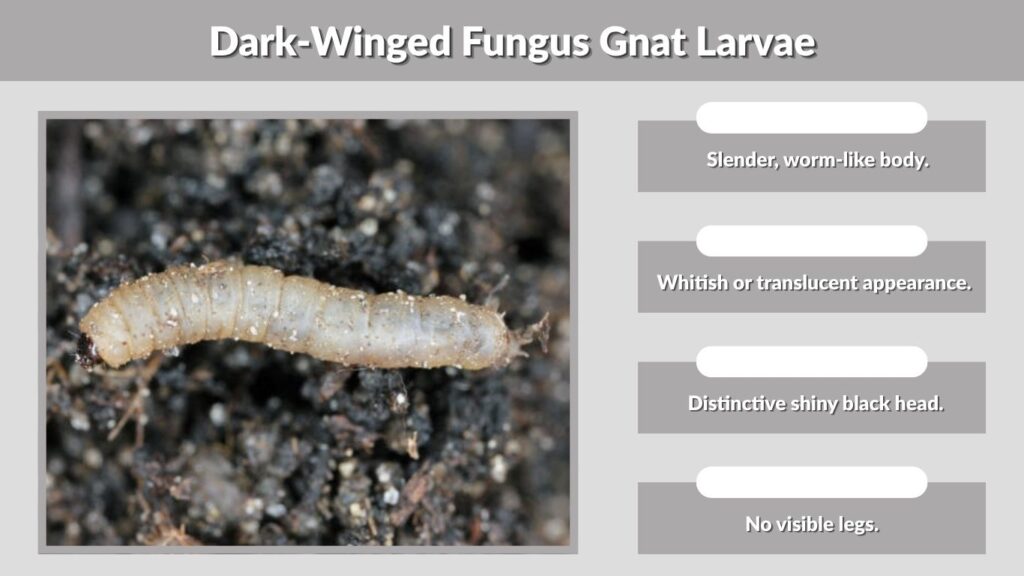
The larvae are responsible for most of the feeding associated with fungus gnats. They develop primarily in moist soil containing fungi and decomposing organic material. Houseplant potting mixes can provide ideal conditions, particularly when they remain continuously wet. Mature larvae may reach around 6 mm long before pupating and eventually emerging as adult gnats.
What Do Fungus Gnat Larvae Look Like?
Dark-winged fungus gnat larvae can usually be recognized by several features:
- Slender, worm-like body
- Whitish or translucent appearance
- Distinctive shiny black head
- No visible legs
- Digestive contents sometimes visible through the body
- Mature length of approximately 6 mm
They are sometimes described as tiny maggots, but the noticeable black head capsule is an important identification feature.
What Do the Larvae Eat?
Larvae primarily consume fungi, algae, decaying plant material, and organic matter. They can also feed on fine roots and root hairs.
Healthy established houseplants usually tolerate small populations. Seedlings, cuttings, young plants, and plants already under stress can be more vulnerable when large larval populations occur.
Dark-Winged Fungus Gnat Life Cycle
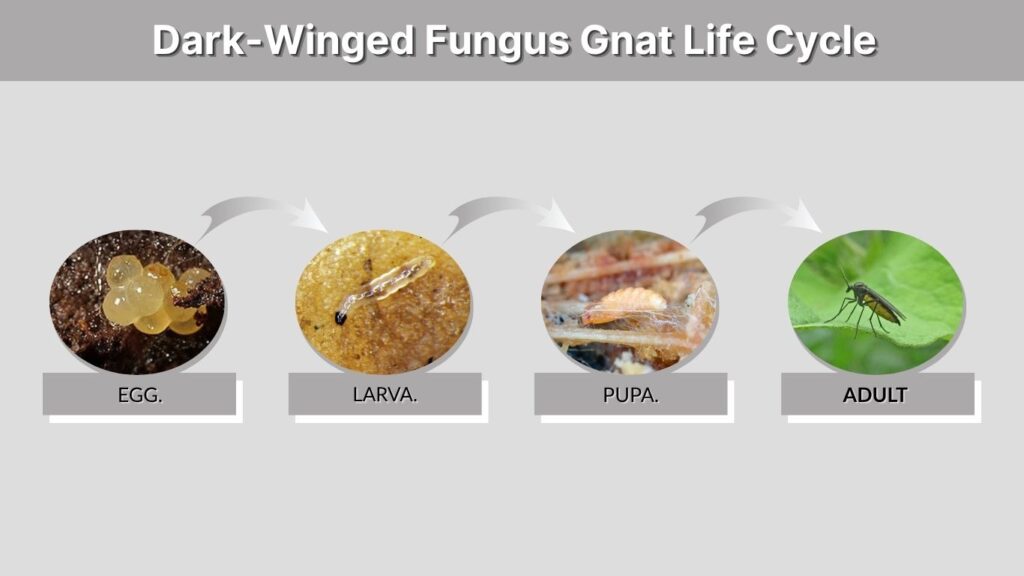
Warm indoor environments allow fungus gnats to reproduce continuously when sufficient moisture is available. Eggs are deposited in damp growing media, where larvae hatch and begin feeding. Larvae pass through their developmental stages before forming pupae in the soil. New adults then emerge and begin another generation, allowing populations to increase quickly around persistently wet houseplants.
Four Main Life Cycle Stages
The fungus gnat life cycle consists of:
- Egg: Females deposit tiny eggs in moist soil or organic growing media.
- Larva: Larvae feed on fungi, algae, decaying material, and sometimes roots.
- Pupa: Mature larvae pupate within or near the soil.
- Adult: Small dark flies emerge and begin reproducing.
Under favorable indoor conditions, a generation can be completed in roughly three to four weeks. Adults themselves are comparatively short-lived.
Do Dark-Winged Fungus Gnat Larvae Migrate?
Most houseplant fungus gnat larvae remain within their growing medium. However, mass migration has been documented in some Sciaridae species, particularly certain Sciara gnats.
Hundreds or thousands of larvae can occasionally move together in a narrow, snake-like procession sometimes called a “snakeworm.” This unusual behavior is not typical of ordinary indoor houseplant infestations, and scientists still do not fully understand why some species form these migrations.
Dark-Winged Fungus Gnats in the House
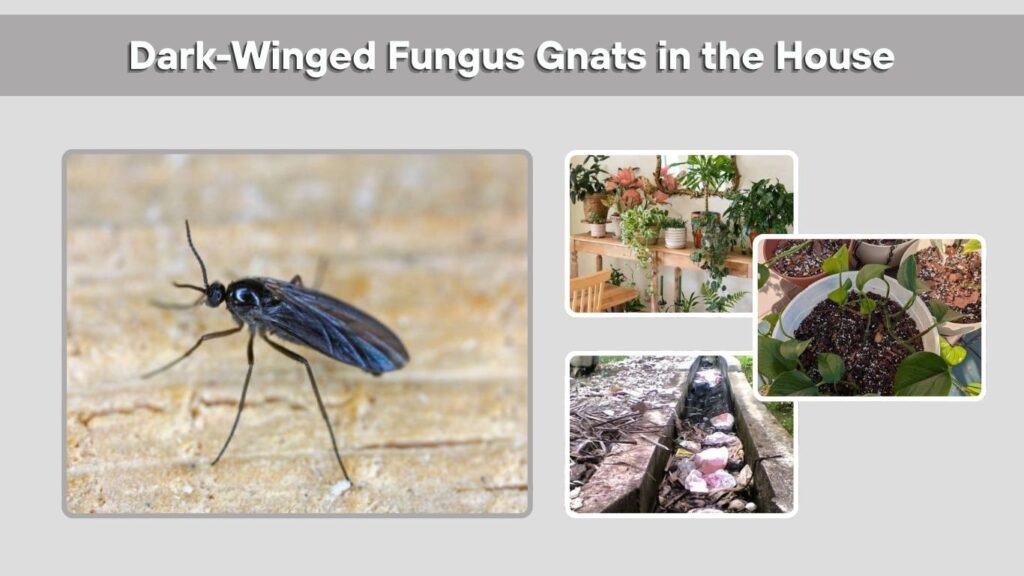
Finding dark-winged fungus gnats indoors usually indicates a moist breeding source nearby. Houseplants are among the most common sources because wet potting mix supports fungal growth and larval development. Adults may remain around the plants or disperse toward windows, walls, lamps, and other bright areas of the room.
Why Fungus Gnats Appear Indoors
Conditions that encourage infestations include:
- Frequent houseplant watering
- Constantly damp potting mix
- Poor container drainage
- Decaying leaves inside pots
- Organic-rich growing media
- Algae or fungal growth
- Standing water near plants
A sudden increase in adults should therefore trigger an inspection of plant pots rather than focusing only on the flying insects.
Are Dark-Winged Fungus Gnats Attracted to Light?
Adult fungus gnats may gather around windows and other bright areas after emerging from plant containers. However, their breeding site remains the more important factor.
If gnats continually appear around windows, inspect nearby houseplants and damp organic material. Eliminating the larval habitat generally provides much better long-term control than repeatedly killing individual adults.
Do Dark-Winged Fungus Gnats Bite?
Dark-winged fungus gnats associated with houseplants do not bite people. Adult Bradysia fungus gnats are harmless to humans and are primarily considered nuisance insects. Their mosquito-like shape sometimes causes concern, but they do not behave like blood-feeding mosquitoes.
Can They Damage Plants?
Large larval populations may affect plants by:
- Feeding on fine roots
- Damaging root hairs
- Feeding on young plant tissue
- Increasing stress on seedlings or cuttings
- Contributing to problems in persistently wet growing media
Established indoor plants often experience little serious damage, so controlling soil moisture remains one of the most important management measures.
How to Get Rid of Dark-Winged Fungus Gnats
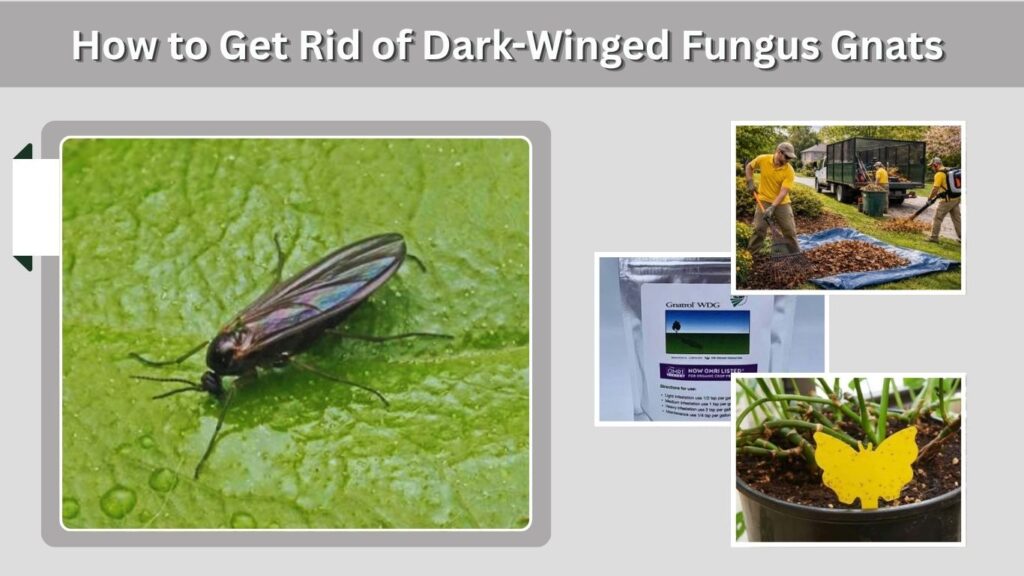
Effective control should target both adults and the larvae living in potting soil. Simply killing flying adults usually provides temporary relief because additional gnats can continue emerging from the growing medium. Correcting excessive moisture, monitoring adults, and treating larvae when necessary provides a more complete approach.
Dark-Winged Fungus Gnat Control Steps
- Reduce watering: Allow the upper portion of potting soil to dry between waterings when appropriate for the plant.
- Improve drainage: Make sure containers have functional drainage holes.
- Remove debris: Discard fallen leaves and decomposing plant matter.
- Use yellow sticky traps: Place traps near pots to monitor and capture adults.
- Check for larvae: A slice of raw potato placed on the soil can help detect larvae.
- Consider Bti: Products containing Bacillus thuringiensis subsp. israelensis can target fungus gnat larvae when used according to their labels.
- Report when necessary: Severe persistent infestations may justify replacing contaminated growing media.
Moisture management is particularly important because continuously damp soil creates favorable conditions for repeated generations.
Preventing Another Infestation
Avoid keeping potting soil constantly saturated unless the plant specifically requires very wet conditions. Remove dead vegetation, maintain drainage, and inspect new plants before placing them alongside established houseplants.
Sticky cards can also serve as an early-warning system. Catching a few adults early may help reveal a developing infestation before their numbers become noticeably annoying.
FAQs
Dark-winged fungus gnats generate plenty of confusion because they resemble mosquitoes and other tiny household flies. Their larvae are even less familiar because they remain hidden within soil. These quick answers address several common questions concerning identification, household infestations, larvae, plant damage, and control.
1. What is the scientific name of a dark-winged fungus gnat?
Dark-winged fungus gnats belong to the family Sciaridae. Bradysia is an important genus containing species commonly associated with houseplants and greenhouse growing media.
2. Are dark-winged fungus gnats harmful to humans?
No. Common houseplant fungus gnats do not bite people. Their main indoor significance is as nuisance flies rather than human pests.
3. Where do dark-winged fungus gnat larvae live?
Larvae usually develop in damp soil, potting mix, decaying organic material, and other moist environments where fungi and organic matter are available.
4. Why are dark-winged fungus gnats suddenly everywhere?
A population can increase when potting soil remains consistently moist. Because their life cycle can be completed within several weeks under favorable indoor conditions, multiple generations may develop around the same plants.
5. What is the best way to control fungus gnats?
Start by reducing excessive soil moisture and improving drainage. Use sticky traps for adults and, when needed, an appropriately labeled Bti treatment for larvae. Controlling the breeding environment is generally more effective than targeting flying adults alone.