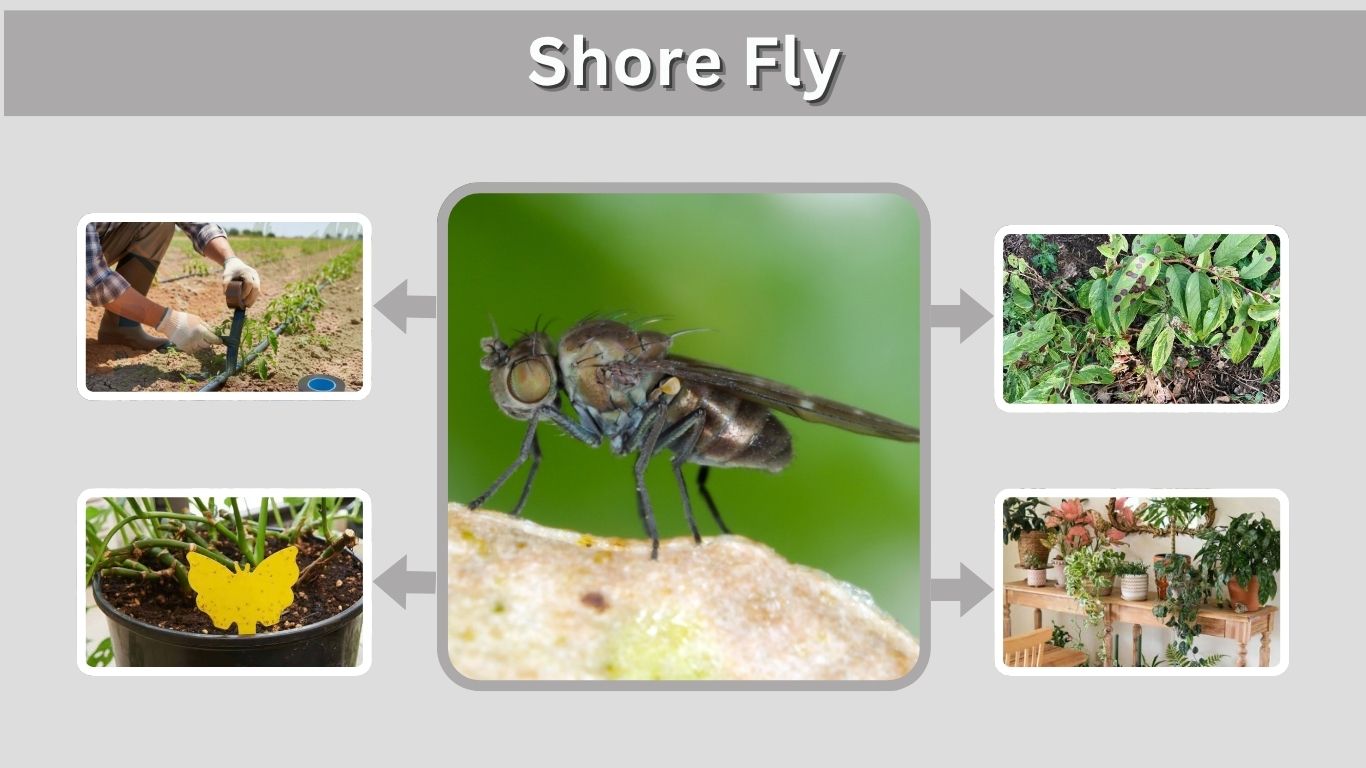
A shore fly is a small, dark fly commonly found around algae, standing water, damp potting media, greenhouses, and other persistently wet environments. The species Scatella stagnalis is especially common in greenhouse production. Shore flies are often confused with fungus gnats or fruit flies, but their stockier bodies, short antennae, and spotted wings help distinguish them. Although they do not bite people or directly feed on healthy plants, large populations can become annoying and may reduce the appearance and cleanliness of indoor plants and greenhouse crops.
What Is a Shore Fly?
Shore flies belong to the fly family Ephydridae, a large group whose members are strongly associated with moist habitats. In greenhouses, Scatella stagnalis is one of the species most frequently encountered. These flies thrive where algae develops because both adults and larvae use algae-rich environments for food and reproduction. Excess watering therefore commonly accompanies serious infestations.
Shore Fly Identification
An adult shore fly can usually be identified by the following features:
- About 2 mm (1/12 inch) long
- Dark gray to brown, stout body
- Relatively short legs
- Short, bristle-like antennae
- Large dark eyes
- Transparent to smoky-gray wings
- Several pale spots visible on each wing
- More robust appearance than a fungus gnat
When resting, the wings overlap along the body. The pale spots can create a blotchy appearance that is especially useful for separating shore flies from other tiny household flies.
Where Do Shore Flies Live?
Shore flies naturally prefer wet locations containing algae and microorganisms. In managed environments, they are common around greenhouse floors, irrigation areas, growing media, puddles, benches, drainage systems, and containers where algae is allowed to develop.
Their presence is often an environmental warning. A large population usually means some part of the growing area is remaining wetter than necessary.
Shore Fly Larvae and Eggs
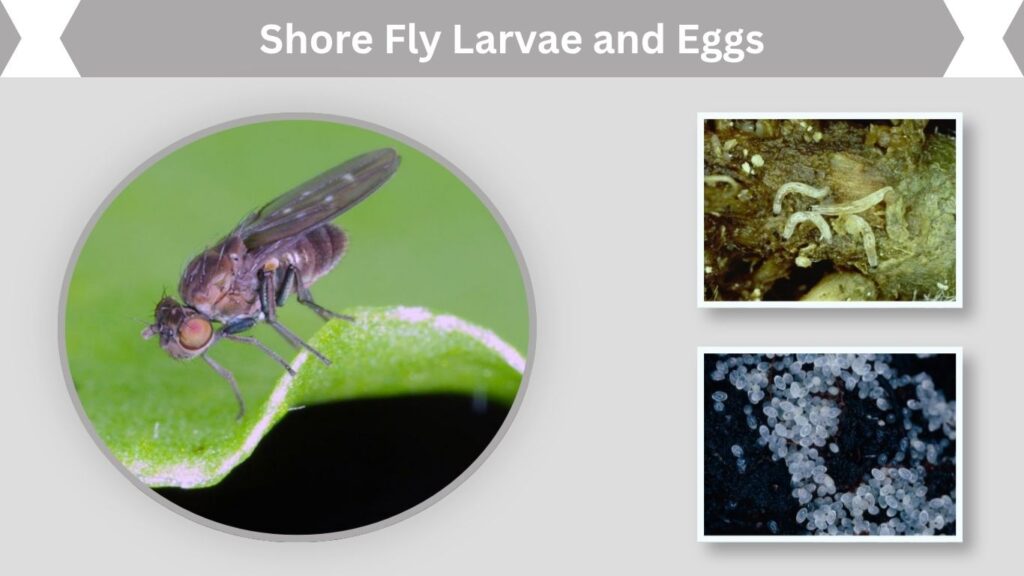
Shore fly larvae look very different from adults and remain close to their moist food source. Females typically place their small eggs in or near algal growth. After hatching, the larvae spend their development feeding primarily on algae and microorganisms rather than roots. This is an important difference between shore flies and some other soil-associated pests.
What Do Shore Fly Larvae Look Like?
Common larval characteristics include:
- Maggot-like body
- Yellowish, tan, or whitish coloration
- No clearly defined dark head capsule
- Legless appearance
- Length reaching roughly 1/4 inch
- Forked breathing structure near the rear of the body
The rear breathing tube can remain near the surface of wet material while much of the larva stays within algae or growing media. This feature can help confirm identification.
What Do Shore Fly Larvae Eat?
Shore fly larvae primarily eat algae and microorganisms growing in consistently moist places. Unlike fungus gnat larvae, they are not normally considered root-feeding pests.
This means killing larvae without correcting the wet, algae-covered environment often provides only temporary results. As long as abundant algae and water remain available, the habitat continues to support another generation.
Shore Fly Life Cycle
Shore flies undergo complete metamorphosis, passing from egg to larva, pupa, and finally adult. Warm, moist greenhouse conditions allow populations to develop quickly because water and algae remain continuously available. Understanding where each stage occurs makes control easier because most immature stages remain closely associated with the damp breeding environment.
Main Stages of the Shore Fly Life Cycle
The development process includes:
- Egg: Females deposit tiny eggs in areas containing algae.
- Larva: Eggs can hatch within about two days under suitable conditions.
- Larval development: Larvae feed on algae for approximately 7–10 days.
- Pupa: Pupation occurs in or close to the growing medium.
- Adult: Adults may emerge roughly 4–5 days later.
Purdue Extension reports that adults can live approximately three to four weeks and that a female may produce hundreds of eggs under favorable greenhouse conditions.
Where Do Shore Flies Pupate?
Pupae occur around the same moist environments occupied by the larvae. They are elongated and initially light colored before becoming darker as development progresses.
Because eggs, larvae, and pupae can all be concentrated around algae, removing the breeding material can interrupt several stages of the life cycle simultaneously.
Shore Fly in the House
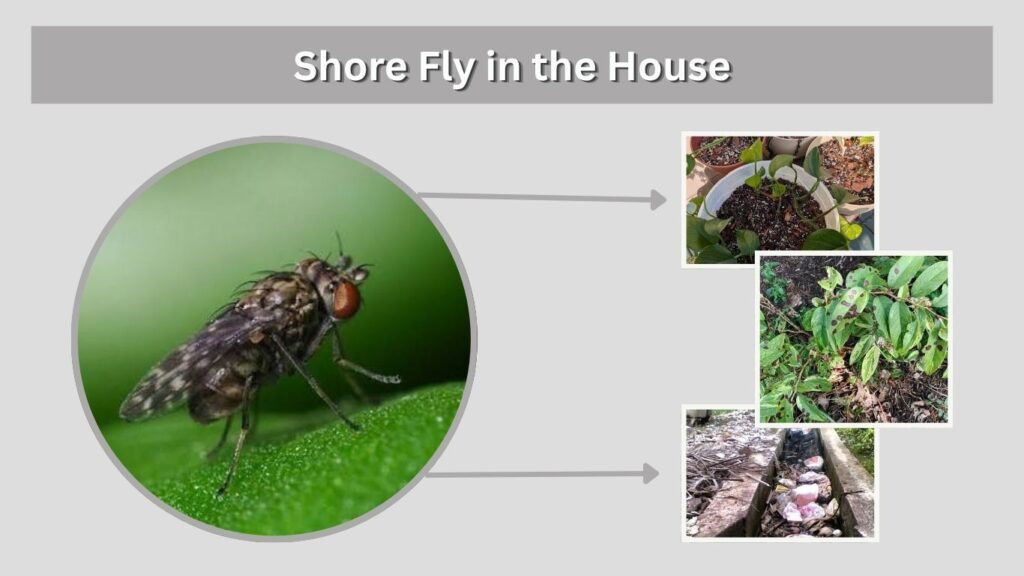
A shore fly inside a house is usually associated with a damp breeding source rather than food left on a counter. Indoor plants, overly wet growing media, algae, standing water, or consistently damp areas can provide suitable conditions. A few adults may disperse away from the source, making the actual breeding location less obvious.
Signs of a Shore Fly Infestation
Look for these clues:
- Small dark flies around houseplants
- Adults resting on leaves
- Flies near wet containers or trays
- Visible algae on potting media
- Constantly saturated soil
- Dark fly specks on leaves
- Repeated appearance despite killing adults
If shore flies appear in a kitchen, inspect nearby plants and persistently wet areas. Ordinary food-associated fruit flies or drain-associated flies may be more likely when no algae-rich breeding site is present.
Why Shore Flies Keep Returning
Repeated infestations usually occur because the underlying environment remains favorable. Capturing adults reduces visible numbers but does little to eliminate eggs and larvae developing in wet algae.
Managing moisture therefore becomes much more important than simply killing every adult seen flying around the room.
Do Shore Flies Bite or Damage Plants?
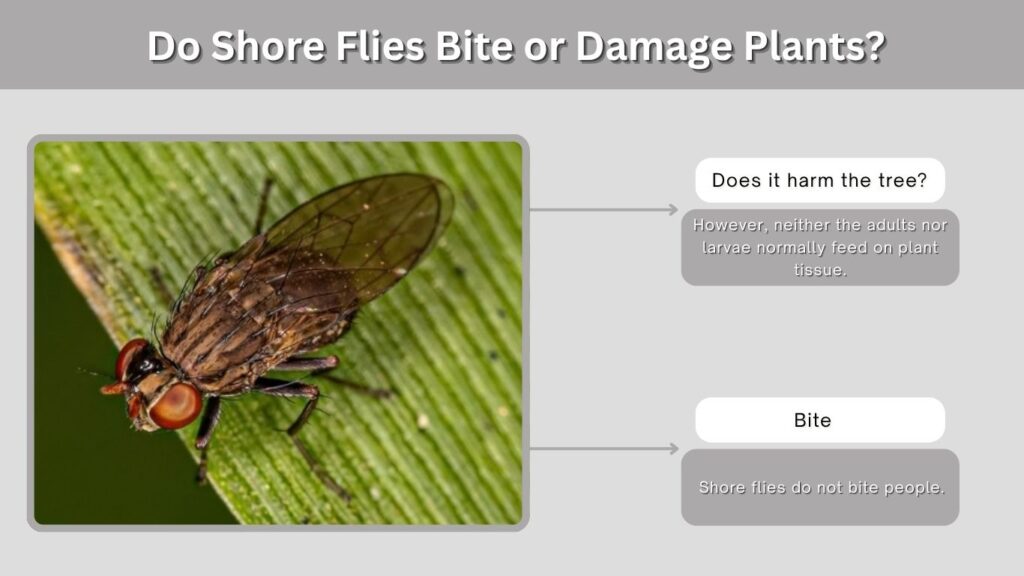
Shore flies can look irritating because they repeatedly land on plants and nearby surfaces. However, neither the adults nor larvae normally feed on plant tissue. Their principal importance is as nuisance insects in greenhouses and other plant-growing environments.
Do Shore Flies Bite People?
Shore flies do not bite people. They are not blood-feeding insects and are not comparable to mosquitoes, biting midges, or black flies.
Their small size and persistent activity can make them annoying, but a mysterious bite occurring around houseplants should not automatically be blamed on shore flies.
What Damage Can Shore Flies Cause?
Direct feeding damage is generally not the concern. Large adult populations can leave dark fecal spots on foliage, reducing the aesthetic quality of ornamental plants.
Adults may also pick up spores of plant-pathogenic fungi and potentially move them within growing areas. For commercial growers, high numbers can therefore affect plant appearance and marketability even without direct feeding injury.
Shore Fly vs Fungus Gnat
Shore flies and fungus gnats often occur together because both benefit from excessively moist growing conditions. Nevertheless, they are different insects and their larvae behave differently. Correct identification matters because finding the underlying breeding habitat is an important part of successful management.
How to Tell Them Apart
A fungus gnat is usually slender and mosquito-like, with long legs, long segmented antennae, and clear wings. Common Bradysia fungus gnats also have a characteristic Y-shaped wing vein.
A shore fly is stockier, has noticeably shorter antennae and legs, and often shows pale spots on its wings. Fungus gnat larvae have a visible shiny black head, whereas shore fly larvae lack this distinctive dark head capsule.
How to Get Rid of Shore Flies
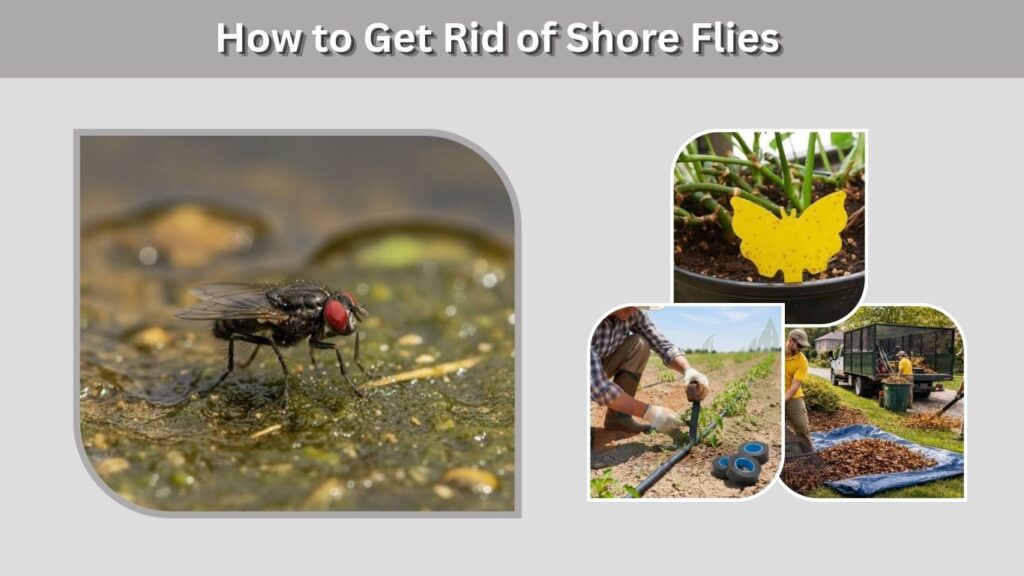
Successful shore fly control begins with removing the wet, algae-rich conditions that allow the insects to reproduce. Insecticides alone are unlikely to permanently solve an infestation when the breeding habitat remains intact. Greenhouses, plant rooms, and homes should therefore focus first on sanitation, drainage, watering practices, and monitoring.
Shore Fly Control Steps
- Remove visible algae from pots, benches, trays, and wet surfaces.
- Allow suitable growing media to dry more between watering.
- Repair dripping irrigation lines and leaking equipment.
- Eliminate standing water and persistent puddles.
- Improve drainage around plant containers.
- Remove old growing media and plant debris.
- Keep growing areas as clean and weed-free as possible.
- Use yellow sticky cards to monitor adult populations.
Sticky cards are useful for determining whether adult numbers are declining, but they should complement habitat management rather than replace it.
Biological Control
Commercial greenhouse programs sometimes use soil-dwelling predators as part of integrated pest management. Purdue Extension discusses predatory mites such as Stratiolaelaps scimitus and the rove beetle Dalotia coriaria among biological-control organisms used against soil-associated greenhouse pests.
Biological control is most successful when excessive standing water and algae are also corrected.
FAQs
Shore flies are easily confused with fungus gnats, fruit flies, and other tiny household insects. Knowing their appearance and breeding requirements can prevent unnecessary treatments and make locating the true source of an infestation considerably easier.
1. What is the scientific name of a shore fly?
Many species are called shore flies, but Scatella stagnalis is one of the most common species associated with greenhouses and nurseries. It belongs to the family Ephydridae.
2. Are shore flies harmful to humans?
No. Shore flies do not bite or feed on people. They are primarily nuisance insects when they occur in large numbers.
3. Why do I have shore flies in my house?
An indoor infestation usually indicates a moist breeding location containing algae or organic material, such as persistently wet plant-growing areas.
4. What is the difference between a shore fly and a fruit fly?
Shore flies are strongly associated with algae and very wet environments. Many commonly encountered fruit flies are instead attracted to fermenting fruits, vegetables, beverages, and other fermenting organic material.
5. What is the best way to control shore flies?
The most effective approach is to reduce excessive moisture, eliminate algae, improve drainage, remove standing water, and clean breeding areas. Sticky traps can then help monitor remaining adults.