
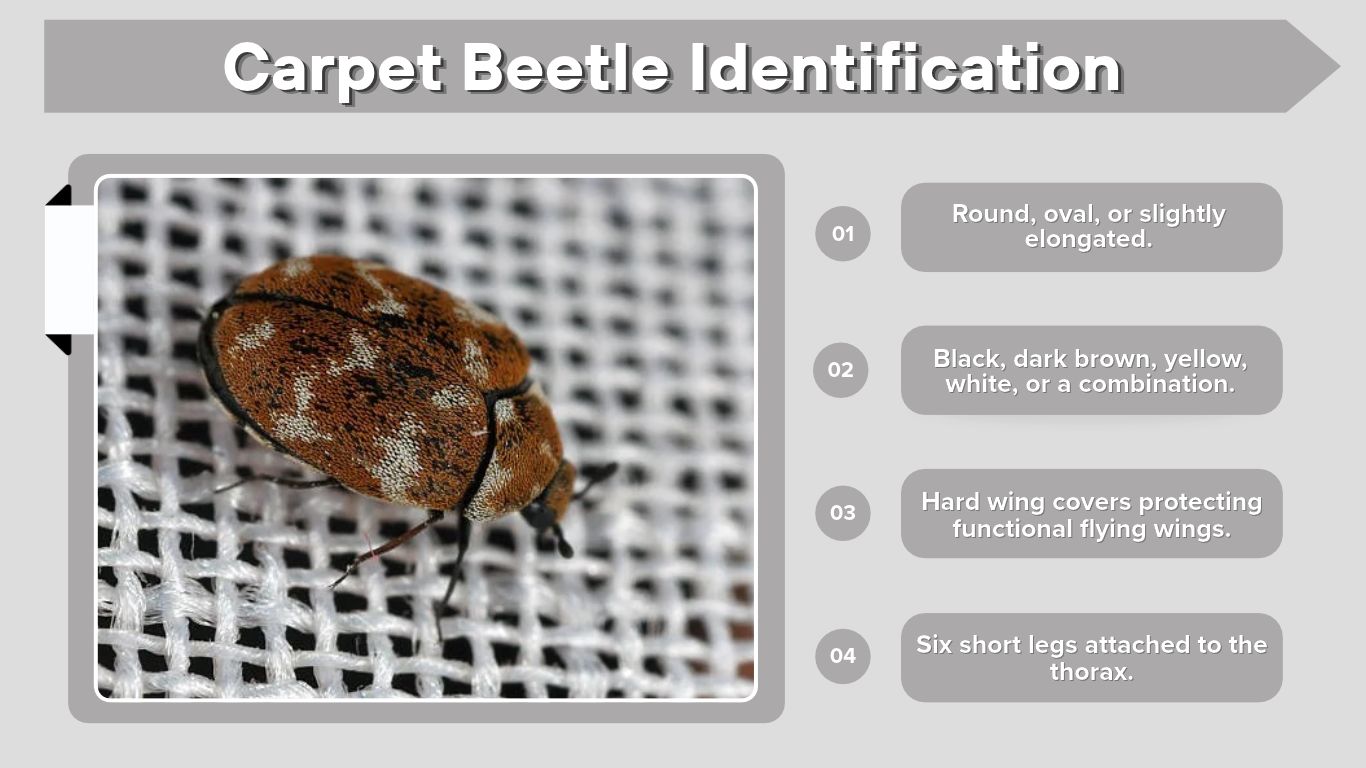
Carpet beetle identification is important for protecting carpets, clothing, furniture, and other household materials from damage. These tiny insects are often mistaken for bed bugs, ticks, fleas, or other small beetles because of their similar size and appearance. However, carpet beetles have distinctive characteristics that make them easier to recognize. Adult carpet beetles are usually small, oval-shaped, and dark or patterned, while their larvae are hairy and segmented. This guide explains how to identify carpet beetles at different life stages, recognize common species, and distinguish them from similar household pests.
What Do Carpet Beetles Look Like?
Carpet beetles are small insects belonging to the family Dermestidae. Their appearance varies depending on the species and stage of development. Adult carpet beetles usually have rounded or elongated oval bodies with hard wing covers. Their larvae look completely different, resembling small, hairy caterpillars. Understanding these differences makes identifying carpet beetles much easier.
Adult Carpet Beetle Identification
Adult carpet beetles generally measure approximately 2–5 mm long, although sizes vary by species.
Common identification characteristics include:
- Body shape: Round, oval, or slightly elongated.
- Color: Black, dark brown, yellow, white, or a combination.
- Wings: Hard wing covers protecting functional flying wings.
- Legs: Six short legs attached to the thorax.
- Antennae: Short, usually club-shaped antennae.
- Surface: Smooth, shiny, or covered with colored scales.
Adult carpet beetles are frequently found near windows, doors, and indoor lighting because many species move toward light.
Carpet Beetle Larva Identification
Carpet beetle larvae are usually more noticeable because of their fuzzy appearance.
Most larvae have brown or dark-colored segmented bodies covered with bristles. Depending on the species, they may appear striped, carrot-shaped, or elongated.
Unlike adults, larvae feed on animal-based materials, including wool, silk, fur, and feathers. Their presence inside closets, carpets, or upholstered furniture may indicate an active infestation.
Common Types of Carpet Beetles and Their Identification
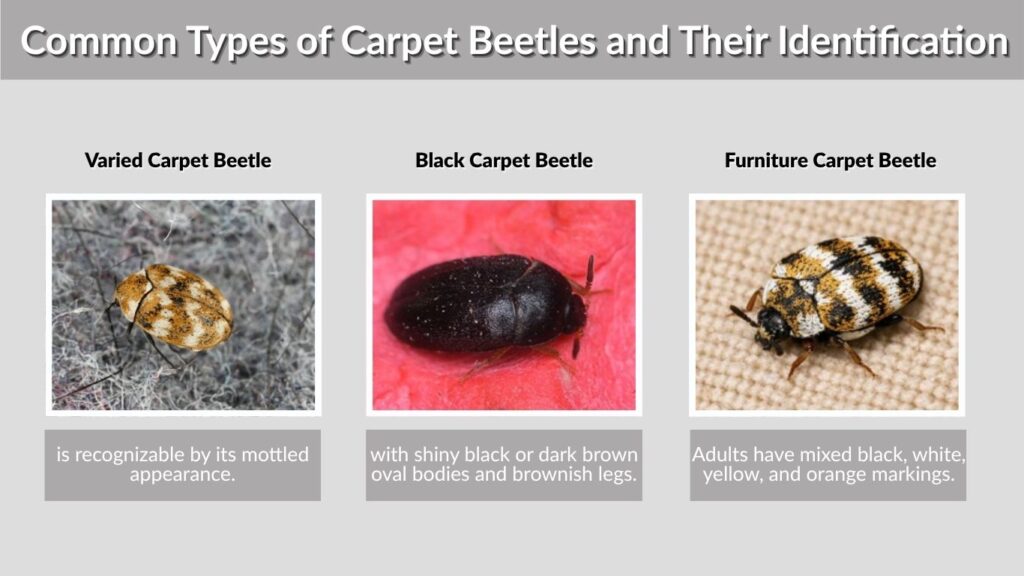
Several carpet beetle species commonly occur inside homes. Although they share similar feeding habits, their body colors, shapes, and larval characteristics can help distinguish them.
1. Varied Carpet Beetle Identification
The varied carpet beetle (Anthrenus verbasci) is recognizable by its mottled appearance.
Adults generally measure 1.5–3.5 mm and have white, yellowish, brown, and black scales.
Their larvae are brown, hairy, and broader toward the rear, with distinctive tufts of bristles. They commonly occur in carpets, wool clothing, and areas containing accumulated organic debris.
2. Black Carpet Beetle Identification
The black carpet beetle (Attagenus unicolor) has a more uniform appearance.
Adults are approximately 3–5 mm long, with shiny black or dark brown oval bodies and brownish legs.
Black carpet beetle larvae are longer and narrower than many other carpet beetle larvae. Their bodies taper toward the rear and end in a noticeable tuft of hairs.
3. Furniture Carpet Beetle Identification
The furniture carpet beetle (Anthrenus flavipes) resembles the varied carpet beetle but is generally rounder.
Adults have mixed black, white, yellow, and orange markings. Their larvae are brown and hairy, becoming narrower toward the rear.
They commonly infest upholstered furniture, wool carpets, and materials containing animal fibers.
Carpet Beetle Life Cycle Identification
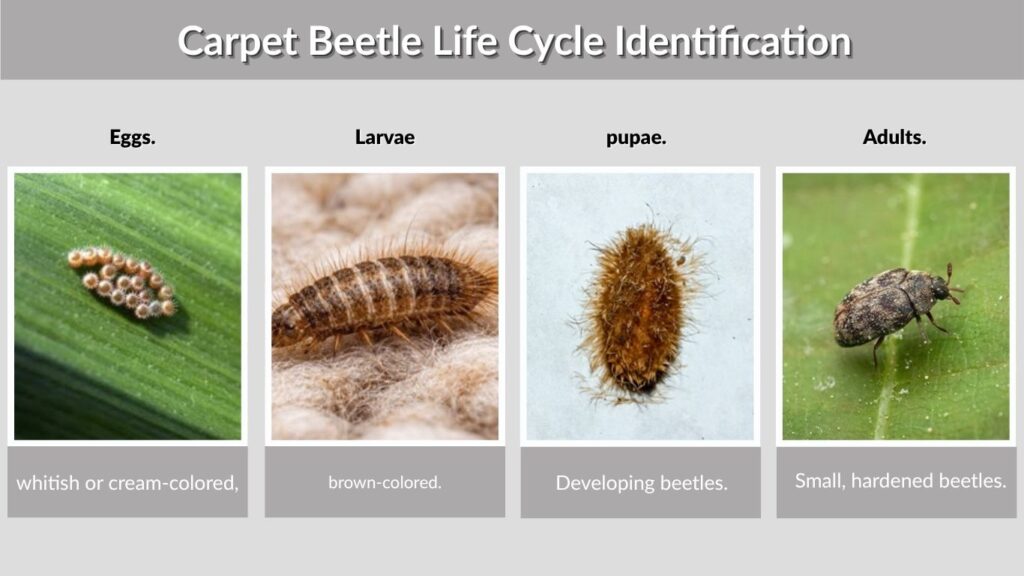
Carpet beetles undergo complete metamorphosis, developing through four life stages. Each stage looks different, and recognizing them helps determine whether the insects are reproducing inside a home.
- Eggs: Tiny, whitish or cream-colored, and usually deposited near suitable larval food sources.
- Larvae: Brown, segmented, and covered with hairs or bristles. This is the destructive feeding stage.
- Pupae: Developing beetles often concealed within their final larval skins, typically in protected locations.
- Adults: Small, hardened beetles that may fly toward windows or feed on flowers outdoors.
The larval stage can last several months or longer, depending on the species and environmental conditions.
Carpet Beetle vs Bed Bug, Tick, and Flea Identification
Carpet beetles are frequently confused with other small household pests. Although their sizes sometimes overlap, their body structures and behavior provide important identification clues.
Understanding these distinctions can prevent unnecessary pest treatments and help homeowners identify the actual problem.
Carpet Beetle vs Bed Bug Identification
Bed bugs have flattened, reddish-brown bodies without hard beetle wing covers. Carpet beetles generally have more rounded, domed bodies.
Carpet beetle larvae are also covered with noticeable bristles, whereas bed bug nymphs are flatter and lack the distinctive fuzzy appearance.
Bed bugs feed on blood, while carpet beetles do not.
Carpet Beetle vs Tick Identification
Ticks have eight legs in their nymph and adult stages, while carpet beetles have six.
Ticks also lack antennae and beetle-like wing covers. Their bodies can become swollen after feeding on blood.
However, tick larvae have six legs, so leg counting alone does not always provide a reliable identification.
Carpet Beetle vs Flea Identification
Fleas have narrow, laterally compressed bodies with powerful hind legs adapted for jumping.
Carpet beetles do not jump like fleas. Adults may fly, while larvae crawl slowly.
Fleas feed on blood, whereas carpet beetles feed on pollen as adults or organic materials as larvae.
Identification Comparison Table
| Pest | Appearance | Distinguishing feature |
| Carpet beetle adult | Small, oval, hard-bodied | Wing covers; may be mottled |
| Carpet beetle larva | Brown, segmented, hairy | Dense bristles |
| Bed bug | Flat, reddish-brown | Wingless; blood-feeding |
| Tick | Rounded, sometimes swollen | Eight legs in adults |
| Flea | Narrow, dark brown | Strong jumping ability |
| Cockroach nymph | Flattened, oval | Long antennae and fast movement |
How to Identify Carpet Beetles by Color and Location
Color and location provide additional clues when identifying small beetles inside a house. However, color alone is insufficient because carpet beetle patterns may fade as their surface scales wear away.
Look for these common characteristics:
- Black with white spots: Often a varied carpet beetle or a related Anthrenus species.
- Solid black oval beetle: Possibly a black carpet beetle.
- Small brown beetle on carpet: Could be an adult carpet beetle or another household beetle.
- Fuzzy brown larva: Often associated with carpet beetles.
- Striped hairy larva: May indicate a varied carpet beetle.
- Beetles near windows: Frequently adult carpet beetles attracted to light.
For reliable identification, examine the body shape, antennae, hairs, and size together rather than relying on color alone.
Signs of Carpet Beetle Infestation and Damage
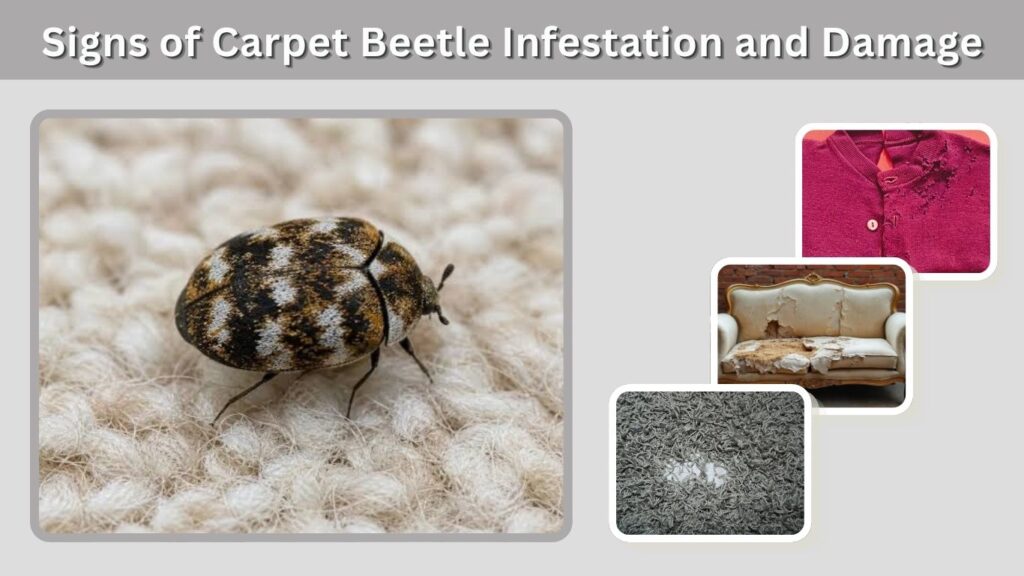
Finding a single adult carpet beetle does not necessarily mean there is an established infestation. However, multiple larvae, shed skins, and damaged natural-fiber materials suggest carpet beetles may be developing indoors.
The most useful evidence comes from identifying where larvae are feeding and examining the damage they leave behind.
Carpet Beetle Damage Identification
Common signs of damage include:
- Irregular holes in wool clothing.
- Thinning or bare patches in natural-fiber carpets.
- Damaged upholstered furniture.
- Brown, bristly shed larval skins.
- Larvae hiding in fabric folds or under furniture.
- Damage around stored animal-based materials.
Unlike clothes moth larvae, carpet beetle larvae generally do not produce silk webbing around damaged fabrics.
Where to Find Carpet Beetles in Your House
Carpet beetle larvae prefer dark, relatively undisturbed areas.
Common hiding places include closets, under beds, along carpet edges, behind baseboards, inside upholstered furniture, and storage boxes.
They may also occur around accumulated pet hair, dead insects, or abandoned animal nests.
Adult beetles are more likely to appear on windowsills and walls.
How to Identify and Control Carpet Beetles
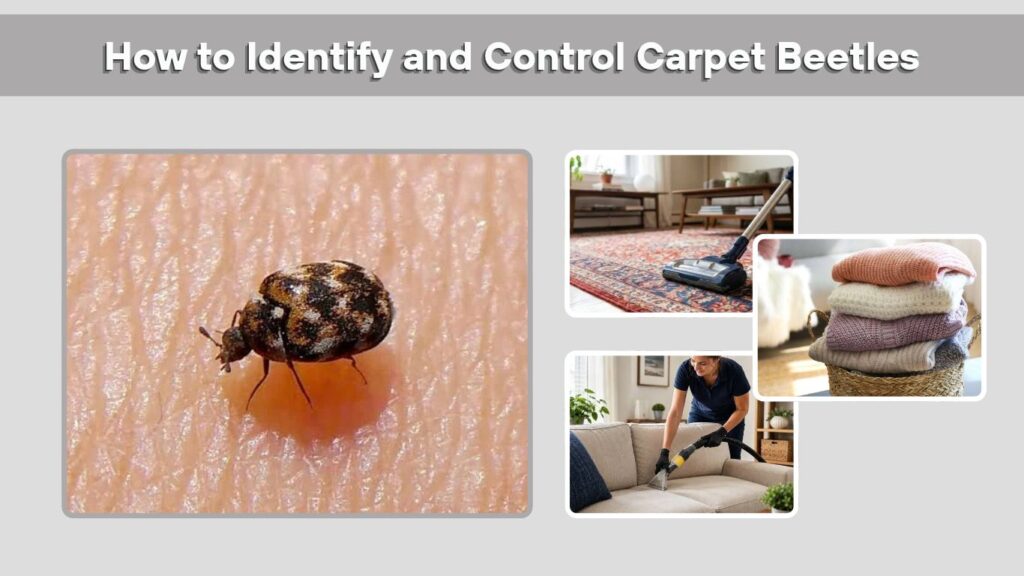
Correct identification is the first step toward effective carpet beetle control. Removing the insects without addressing their food sources may allow the infestation to continue.
Steps to Confirm Carpet Beetle Identification
- Examine the insect using a magnifying glass or a clear close-up photograph.
- Check whether it has a hardened beetle body or hairy larval appearance.
- Inspect nearby carpets, clothing, and furniture for shed skins.
- Compare its features with known carpet beetle species.
- Seek professional identification if the specimen remains uncertain.
Carpet Beetle Prevention and Control Tips
- Vacuum carpets, furniture edges, and hidden corners regularly.
- Clean wool clothing before storing it.
- Keep vulnerable fabrics inside sealed containers.
- Remove lint, pet hair, and dead insects.
- Inspect secondhand furniture and textiles.
- Check windows and screens for entry points.
- Locate and remove infested materials where practical.
Thorough cleaning and eliminating larval food sources are generally the most important control measures.
FAQs
1. How Can I Tell If a Bug Is a Carpet Beetle?
Check its size, shape, body covering, and antennae. Adult carpet beetles are usually small and oval with hard wing covers. Larvae are brown, segmented, and hairy. Finding shed skins near damaged wool or similar materials provides additional evidence.
2. What Does a Black Carpet Beetle Look Like?
An adult black carpet beetle has a shiny, dark brown or black oval body, usually measuring approximately 3–5 mm. Its larvae are elongated, brown to nearly black, with short body hairs and a distinctive tuft of longer hairs at the rear.
3. How Do You Identify Carpet Beetle Larvae?
Carpet beetle larvae usually have small, elongated, segmented bodies covered with hairs or bristles. Their colors range from golden brown to nearly black. Some have distinct bands or stripes, while others have prominent tail tufts that assist with identification.
4. Can Carpet Beetles Be Mistaken for Bed Bugs?
Yes. Small adult carpet beetles and their larvae can be confused with bed bugs. However, bed bugs have flattened bodies and feed on blood, while adult carpet beetles have hard wing covers. Carpet beetle larvae also have noticeably hairy bodies.
5. Are Carpet Beetles Harmful to Humans?
Carpet beetles do not bite humans or feed on blood. However, contact with larval hairs can cause skin irritation or allergic reactions in some people. Their primary household impact is damage to natural-fiber clothing, carpets, upholstery, and other susceptible materials.
