
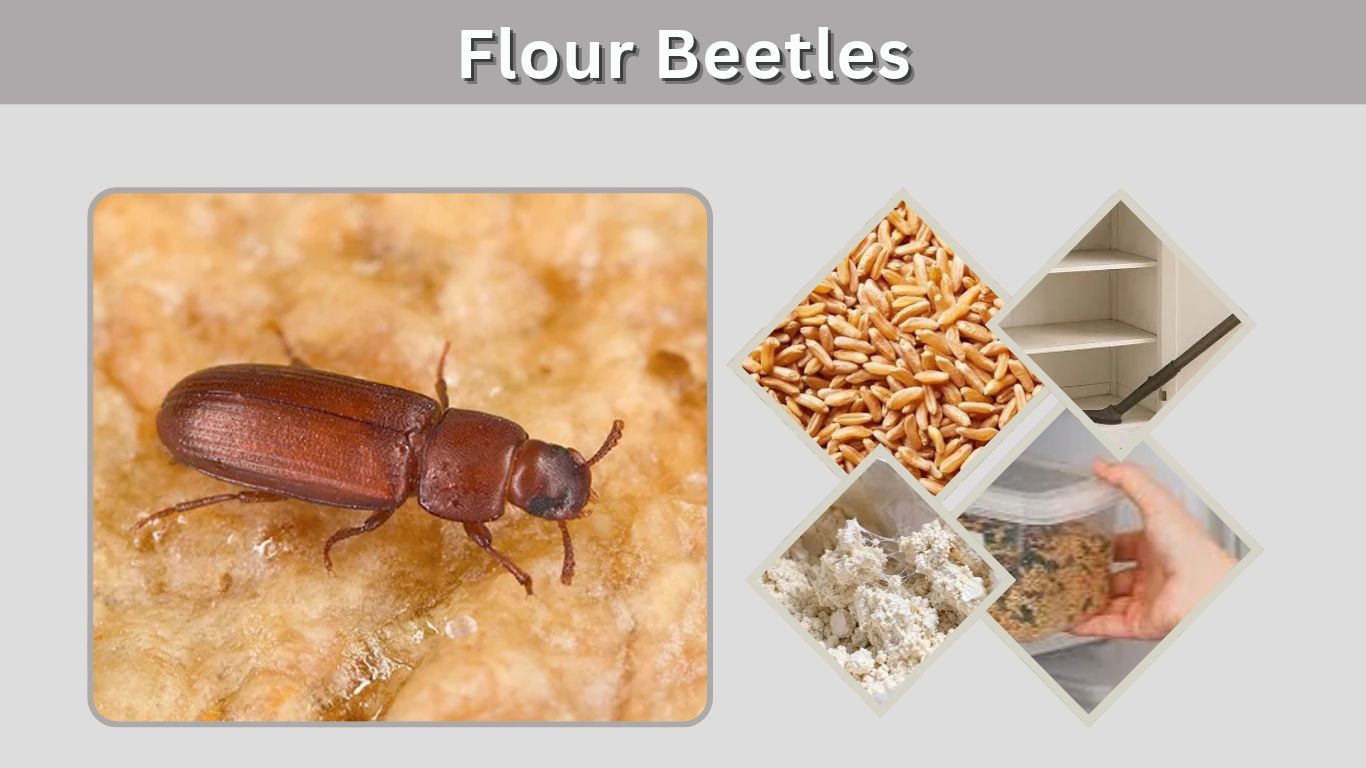
Flour beetles are common pantry pests that infest flour, cereals, grains, spices, and other stored food products. These small reddish-brown insects can multiply quickly when they find suitable food and favorable conditions inside kitchen cabinets or storage areas. The red flour beetle (Tribolium castaneum) and confused flour beetle (Tribolium confusum) are two of the most common species found in homes. Although they do not bite people, their presence can contaminate food and create persistent household infestations. Learning how to identify, prevent, and control flour beetles helps protect stored products.
What Are Flour Beetles?
Flour beetles are small stored-product insects belonging to the family Tenebrionidae. They commonly infest processed grain products, including flour, cereal, cornmeal, pasta, and other dry foods. Both adults and larvae feed on stored materials, allowing populations to develop inside food packages and pantry containers. Two particularly common species are the red flour beetle and the confused flour beetle.
Common Types of Flour Beetles
- Red flour beetle (Tribolium castaneum): A reddish-brown species that commonly infests flour, cereals, spices, and other stored foods.
- Confused flour beetle (Tribolium confusum): A closely related species that looks similar to the red flour beetle and frequently occurs in flour mills and household pantries.
- Black flour beetle: A darker stored-product beetle associated with grain-based materials and animal feed.
- Broad-horned flour beetle (Gnatocerus cornutus): A distinctive species whose males have prominent horn-like projections on their heads.
The red and confused flour beetles are particularly important household pantry pests.
What Do Flour Beetles Look Like?
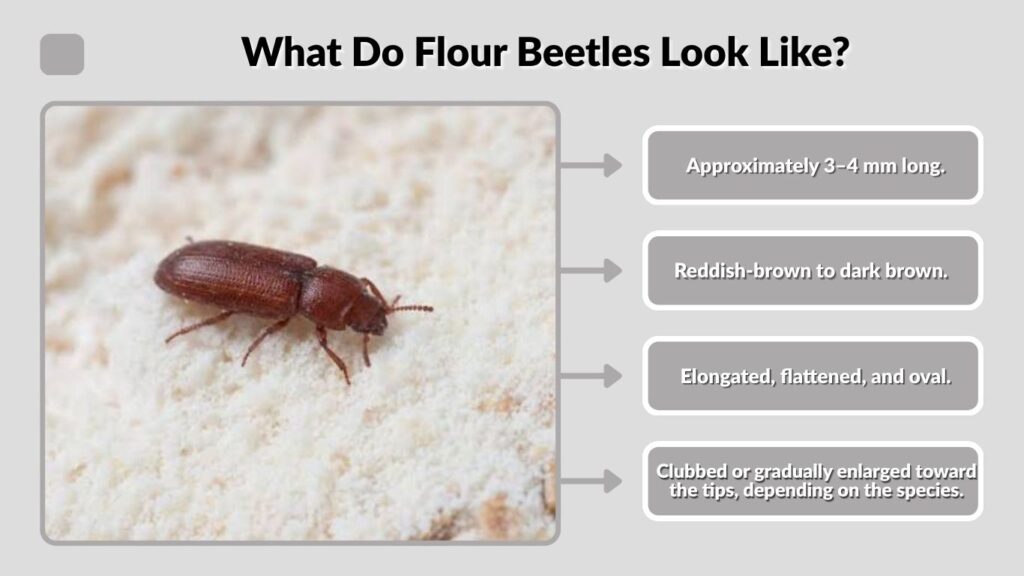
Flour beetles are small, elongated insects with flattened, oval bodies and reddish-brown coloration. Their compact size makes them difficult to notice when they first enter stored food. Adults move quickly across pantry shelves, food containers, and kitchen surfaces. Although the red and confused flour beetles look almost identical, their antennae provide useful identification clues.
Flour Beetle Size and Appearance
- Adult size: Approximately 3–4 mm long.
- Body color: Reddish-brown to dark brown.
- Body shape: Elongated, flattened, and oval.
- Antennae: Clubbed or gradually enlarged toward the tips, depending on the species.
- Larvae: Slender, creamy-white to light brown grubs.
- Eggs: Tiny, white, and often covered with flour particles.
Red Flour Beetle vs. Confused Flour Beetle
The easiest way to distinguish these two species is by examining their antennae.
The red flour beetle has three noticeably enlarged segments at the end of its antennae, forming a distinct club. The confused flour beetle has antennae that gradually increase in size toward the tip.
Another difference is their ability to fly. Red flour beetles can fly, while confused flour beetles are generally flightless.
What Do Flour Beetles Eat?
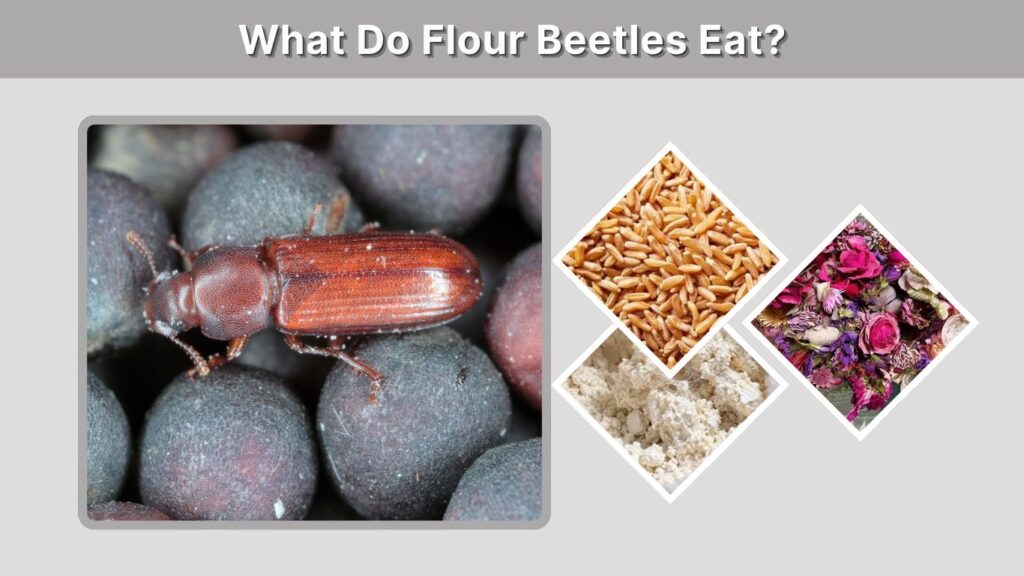
Flour beetles primarily feed on stored grain products and other dried materials. They are particularly attracted to processed grains, broken kernels, and food particles that accumulate inside packaging and storage containers. Both adults and larvae consume infested products, allowing populations to increase when food remains undisturbed for extended periods.
Common Foods That Attract Flour Beetles
- Flour: Wheat flour, cornmeal, and other milled grain products.
- Cereals: Breakfast cereals, oatmeal, and grain-based snacks.
- Rice and pasta: Stored rice, macaroni, and other processed grains.
- Spices: Dried seasonings, herbs, and powdered ingredients.
- Nuts and seeds: Peanuts, sunflower seeds, and other dried seeds.
- Pet food: Dry dog food, cat food, and birdseed.
- Other products: Chocolate, dried fruits, crackers, and cake mixes.
These beetles often infest damaged grains and processed foods rather than healthy, intact kernels.
Flour Beetle Life Cycle
Flour beetles undergo complete metamorphosis through four stages: egg, larva, pupa, and adult. Their development usually takes place inside stored food products, where larvae have continuous access to suitable food. Under favorable temperatures and humidity conditions, a new generation can develop within approximately six to twelve weeks, although development time varies between species and environmental conditions.
Egg and Larval Stages
Female flour beetles lay tiny white eggs loosely among flour, grain dust, and other food materials. The eggs may become coated with food particles, making them difficult to notice.
After hatching, the larvae feed on stored products and grow through several developmental stages. They have slender, creamy-colored bodies with small dark projections near the rear.
Pupal and Adult Stages
When fully developed, the larvae transform into pupae within the infested food material. The pupae are pale and relatively inactive.
Adult beetles emerge after completing metamorphosis. They begin feeding, mating, and reproducing, allowing the infestation to continue if contaminated food remains available. Several life stages may be present in the same package simultaneously.
Are Flour Beetles Harmful?
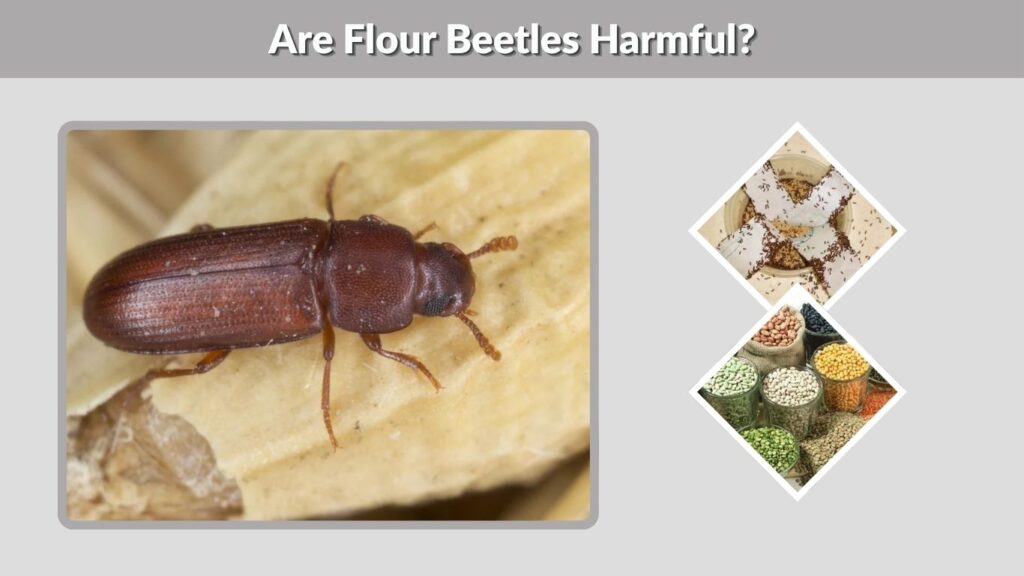
Flour beetles are primarily a food contamination problem rather than a direct threat to people or household structures. They do not bite or sting humans and pets, and they are not known to spread human diseases. However, infested food may contain beetles, larvae, eggs, shed skins, and waste, making it unsuitable for consumption.
Do Flour Beetles Bite Humans?
No. Flour beetles have chewing mouthparts designed for feeding on stored food products, not biting people. They do not feed on human blood or attack pets.
Finding small beetles crawling around a bedroom or kitchen does not necessarily indicate a biting insect problem.
Can Flour Beetles Damage Your Home?
Flour beetles do not normally damage furniture, walls, wooden structures, or clothing. Their primary food sources are dried grain products and other stored materials.
However, adult beetles may wander away from infested packages and appear in unexpected rooms, creating the impression that they are spreading throughout the house.
How to Get Rid of Flour Beetles
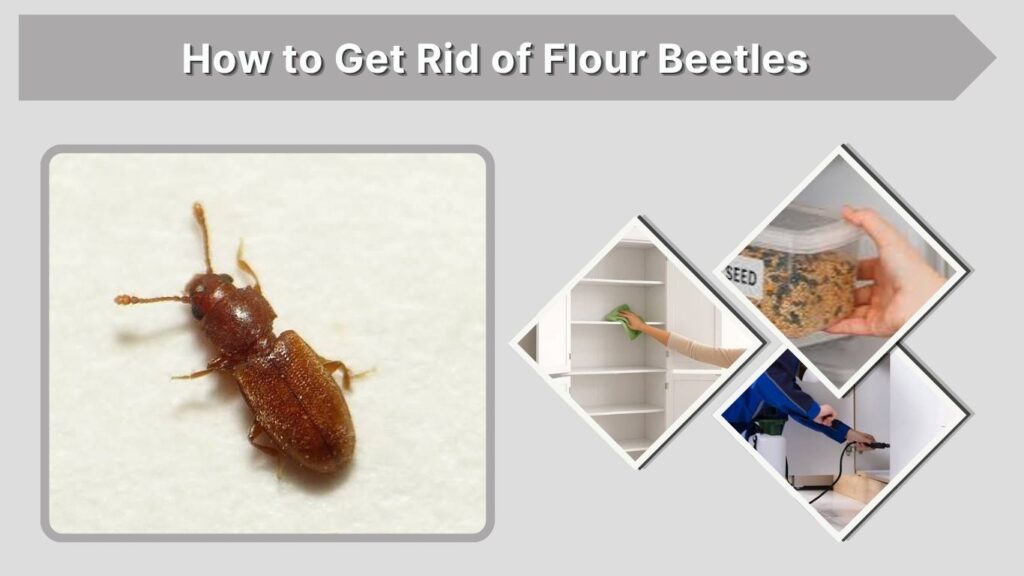
Eliminating flour beetles requires finding and removing the infested food source. Simply killing visible adults will not solve the problem because eggs, larvae, and pupae may remain hidden inside food packages. Thorough cleaning, proper food disposal, and airtight storage are the most effective household control methods.
Effective Flour Beetle Control Methods
- Inspect stored foods: Check flour, cereals, spices, rice, pasta, and pet food for beetles and larvae.
- Discard infested products: Place heavily contaminated food in a sealed bag and remove it from the house.
- Vacuum storage areas: Clean cabinet corners, cracks, shelf joints, and other hiding places.
- Wash pantry shelves: Use soap and water to remove food particles and insect remains.
- Freeze suitable foods: Freeze salvageable dry products at 0°F (-18°C) for approximately one week.
- Use airtight containers: Transfer uninfested products into tightly sealed glass, metal, or heavy-duty plastic containers.
- Monitor beetle activity: Use appropriate pantry pest traps to detect remaining adults.
Avoid spraying insecticides directly inside food cabinets or onto food products. Removing the infestation source is much more important than killing individual beetles.
Why Are Flour Beetles in My Bedroom?
Flour beetles sometimes appear in bedrooms because adult insects can wander away from their original food source. They may crawl across floors, walls, furniture, and windowsills while searching for suitable food or shelter. Their presence does not mean they are breeding in your mattress or feeding on your body.
Check nearby kitchens, cupboards, pet food containers, and stored dry products for the original infestation. Vacuum areas where beetles appear and inspect any dried plants or food materials kept in the bedroom.
FAQs
1. Can Flour Beetles Fly?
Some flour beetles can fly, particularly the red flour beetle (Tribolium castaneum). The confused flour beetle (Tribolium confusum) is generally unable to fly. Both species can crawl quickly and spread between nearby food storage areas.
2. How Big Are Flour Beetles?
Adult flour beetles generally measure approximately 3–4 mm long. They have narrow, flattened bodies and reddish-brown coloration. Their small size makes them difficult to notice inside flour, cereals, and other stored food products.
3. Where Do Flour Beetles Come From?
Flour beetles commonly enter homes through infested flour, cereals, grains, spices, and dry pet food. They may already be present in purchased packages before the products reach your kitchen. Adults can also spread into other storage areas after emerging from infested materials.
4. Can Flour Beetles Live in Your Bed?
Flour beetles do not normally live or reproduce in beds because mattresses and bedding are not their preferred food sources. Beetles found in bedrooms usually originate from infested stored food or other dried materials elsewhere in the home.
5. What Is the Difference Between Flour Beetles and Weevils?
Flour beetles have elongated, flattened bodies without a prominent snout. Weevils generally have a distinctive elongated snout with chewing mouthparts at its tip. Both can infest stored grain products, but they belong to different beetle families and have different identification characteristics.
