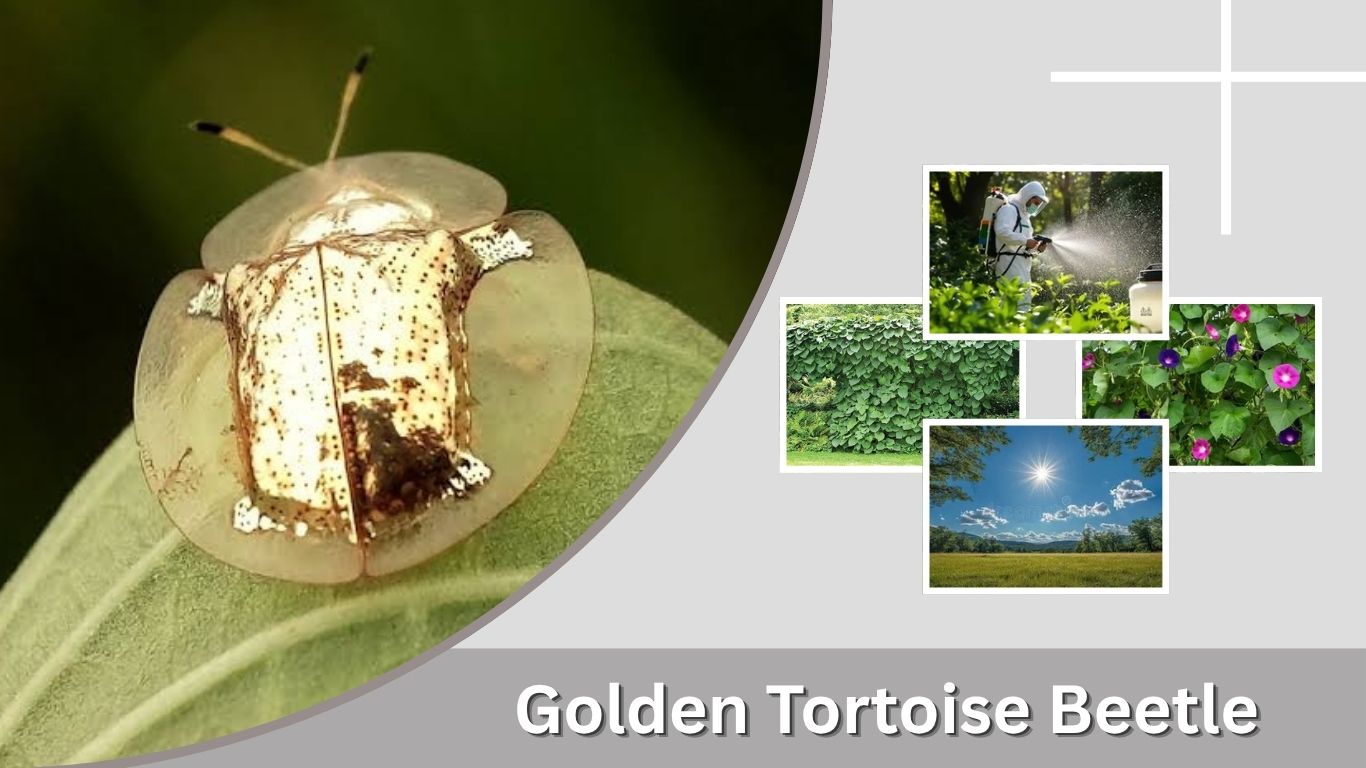
The golden tortoise beetle is a tiny leaf beetle famous for its polished, metallic-gold appearance. Its rounded body and transparent outer edges make it look like a miniature golden turtle resting on a leaf. Despite its striking appearance, this beetle is generally harmless to people and causes only minor plant damage in most gardens. It is commonly found on morning glory, bindweed and sweet potato plants, where both adults and larvae feed on leaves.
What Is a Golden Tortoise Beetle?
The name golden tortoise beetle commonly refers to Charidotella sexpunctata, a member of the leaf beetle family Chrysomelidae. Older references may identify it as Metriona bicolor or Charidotella bicolor. Its accepted scientific name is currently Charidotella sexpunctata.
| Feature | Description |
| Scientific name | Charidotella sexpunctata |
| Family | Chrysomelidae |
| Adult size | Approximately 5–7 mm |
| Main color | Metallic gold, orange or reddish |
| Main foods | Morning glory, bindweed and sweet potato leaves |
| Plant family | Convolvulaceae |
| Risk to people | Very low |
| Typical damage | Small or medium irregular holes in leaves |
These beetles are sometimes called goldbugs or sweet potato leaf beetles. Their expanded wing covers and shield-like shape distinguish them from similarly sized ladybugs.
Golden Tortoise Beetle Identification
Adult golden tortoise beetles are small, oval and strongly domed. Their broad wing covers extend around the body, hiding much of the head and legs when viewed from above.
Adult Appearance
Important identification features include:
- A body measuring about 5–7 mm long
- Metallic gold, golden-yellow or orange coloration
- Transparent or glass-like outer margins
- A rounded, turtle-shell-shaped body
- Small dark spots that may become more visible
- Highly reflective wing covers in living adults
The beetle’s gold is not real metal. Its brilliant appearance results from the way microscopic structures in its outer covering reflect light.
Why Does the Beetle Change Color?
A golden tortoise beetle may lose its bright shine and appear orange, reddish or brown when disturbed. Dark markings can also become more noticeable. The color often returns after the beetle settles.
Research on the related Panamanian golden tortoise beetle, Charidotella egregia, found that microscopic layers and fluid-filled channels in the shell control its reflective appearance. When fluid leaves those channels, the metallic reflection fades and reddish pigment underneath becomes visible. This closely related species provides the best-studied explanation for the group’s dramatic color changes.
Color changes may occur when the insect is handled, stressed, mating or preparing to die. Therefore, a red or orange beetle may still be a golden tortoise beetle.
Eggs, Larvae and Pupae
The eggs are white, oval and flattened. Females place them on leaf undersides or stems, commonly in groups containing roughly 20 eggs. They usually hatch within 5–10 days.
Larvae look very different from adults. They are flattened, yellowish to reddish-brown and covered with branched spines. At the rear of the body is a movable structure called an anal fork. The larva uses it to hold old skin and waste over its back, creating a defensive shield that may discourage predators.
Mature larvae attach themselves to leaves and become brownish, spiny pupae. Some of the larval debris may remain attached during this stage.
Where Do Golden Tortoise Beetles Live?
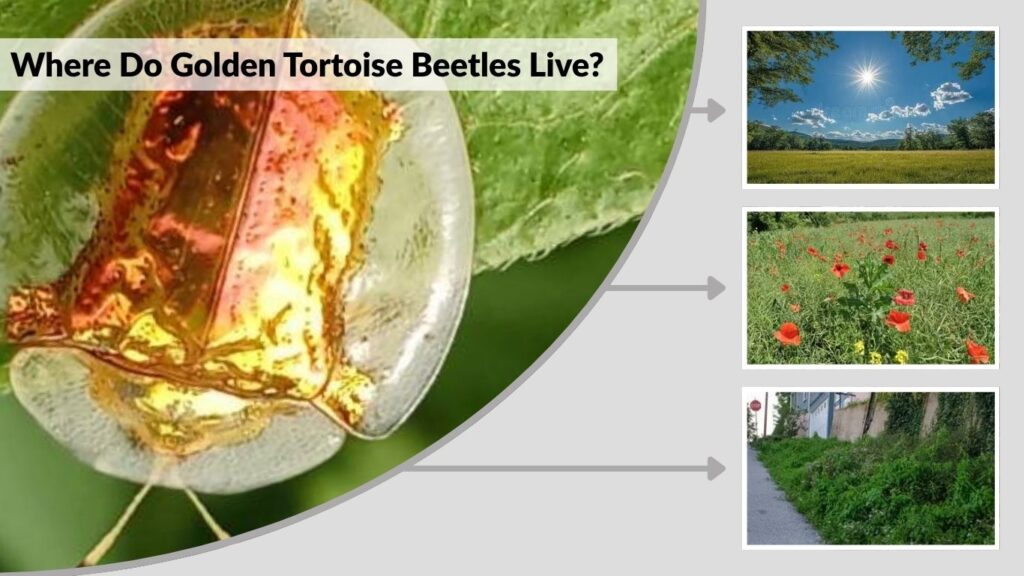
Golden tortoise beetles are native to the Americas. They are especially widespread in eastern North America, extending westward into areas such as Iowa and Texas. Records also occur along parts of western North America and south through Mexico, Central America and South America.
Rather than living in a special nest, these beetles remain around their host plants. Common locations include:
- Gardens containing morning glory vines
- Sweet potato fields
- Roadsides with bindweed
- Weedy field edges
- Meadows and sunny disturbed areas
- The undersides of leaves
They are capable of flying and can move between suitable host plants. However, their small size and habit of remaining beneath foliage make them easy to overlook.
What Do Golden Tortoise Beetles Eat?
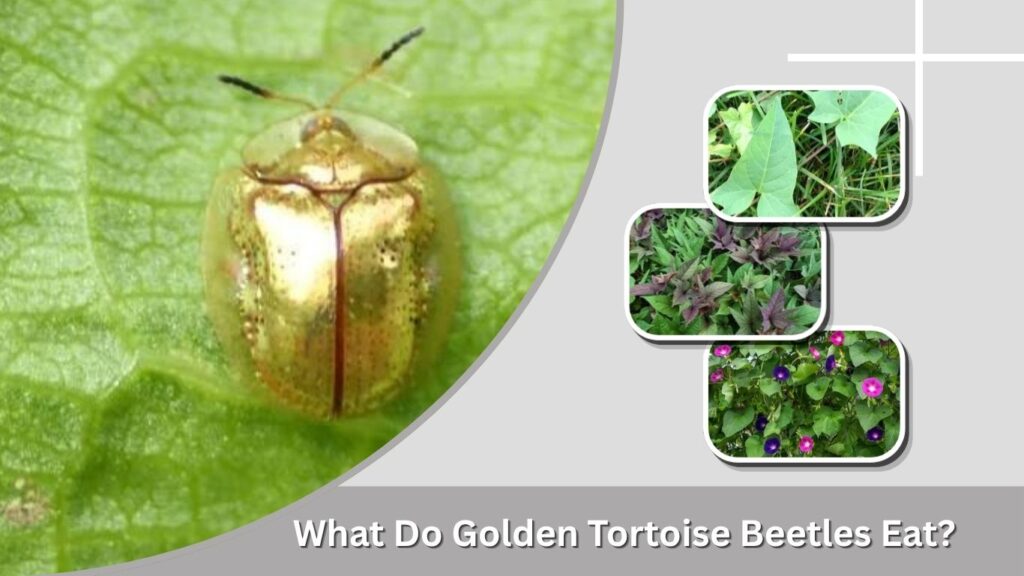
Golden tortoise beetles are plant feeders. Both adults and larvae mainly consume plants in the morning glory family, Convolvulaceae.
Their principal foods include:
- Morning glory leaves
- Sweet potato leaves
- Bindweed leaves
- Wild Ipomoea species
- Related ornamental and weedy vines
They do not normally eat wood, clothing, stored food or household materials. Their presence indoors is usually accidental.
What Does Their Damage Look Like?
Adults and larvae chew small to medium irregular holes through leaves. Feeding often begins on the underside, although the insects may eventually eat completely through the tissue.
A few damaged leaves rarely threaten an established plant. University extension sources note that tortoise beetles are seldom numerous enough to cause serious garden damage, and their feeding is usually cosmetic. Heavy populations can occasionally produce noticeable defoliation, particularly on young sweet potato plants.
Golden Tortoise Beetle Life Cycle
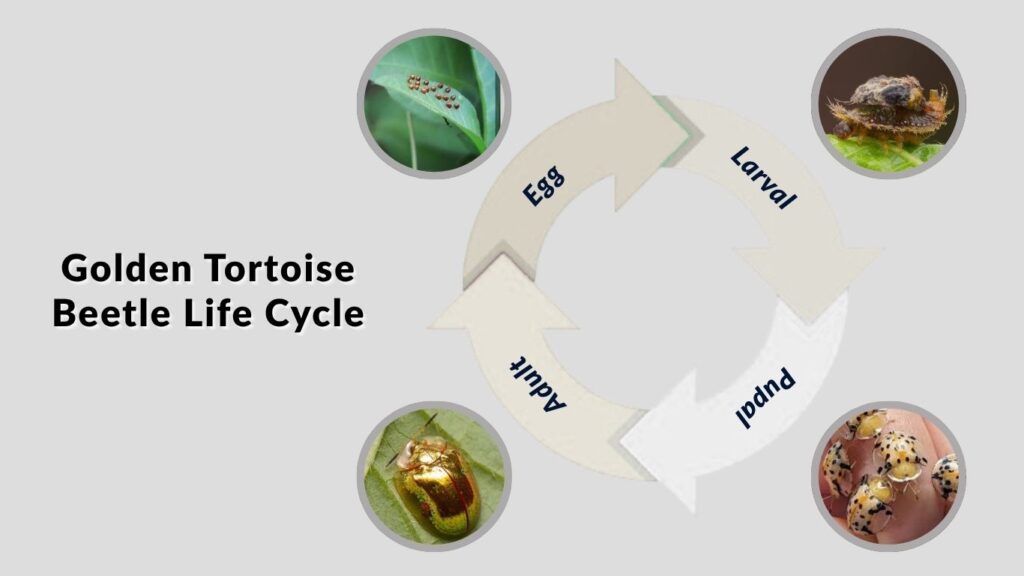
The golden tortoise beetle experiences complete metamorphosis through four stages: egg, larva, pupa and adult.
1. Egg Stage
Eggs are deposited shortly after adults begin feeding in spring or early summer. Hatching generally occurs within 5–10 days.
2. Larval Stage
The larvae pass through three growth stages. They feed on leaves while carrying their unusual waste-and-skin shields. Larval development normally lasts 14–21 days.
3. Pupal Stage
Mature larvae attach themselves to foliage and pupate. The pupal stage lasts approximately 7–14 days.
4. Adult Stage
Development from egg to adult takes about 40 days. In northern regions, there is usually one generation each year. Newly emerged adults feed briefly before entering a dormant state and surviving until the following spring. The exact number of annual generations in warmer climates is not well documented.
Are Golden Tortoise Beetles Harmful?
Golden tortoise beetles are not considered medically important insects. They do not sting, chase people or feed on blood. Their chewing mouthparts are used for eating plant leaves rather than attacking humans or pets.
Do Golden Tortoise Beetles Bite?
They are not known as human-biting pests. A beetle may struggle or hold tightly when handled, but biting incidents are not recognized as a normal concern. It is still better to observe the insect without squeezing or repeatedly touching it.
Are They Poisonous?
Golden tortoise beetles are not known to inject venom or pose a poisoning risk through ordinary contact. Their changing red or orange color does not mean they have become dangerous.
Children and pets should nevertheless be discouraged from eating any unidentified insect. Seek professional medical or veterinary advice if an insect is swallowed and concerning symptoms appear.
Are Golden Tortoise Beetles Rare?
Their jewel-like appearance may seem exotic, but the species has a broad geographic range. They can appear uncommon because they are tiny, seasonal and closely associated with particular vines. Finding one usually reflects the presence of a suitable host plant rather than an exceptionally rare event.
How to Control Golden Tortoise Beetles
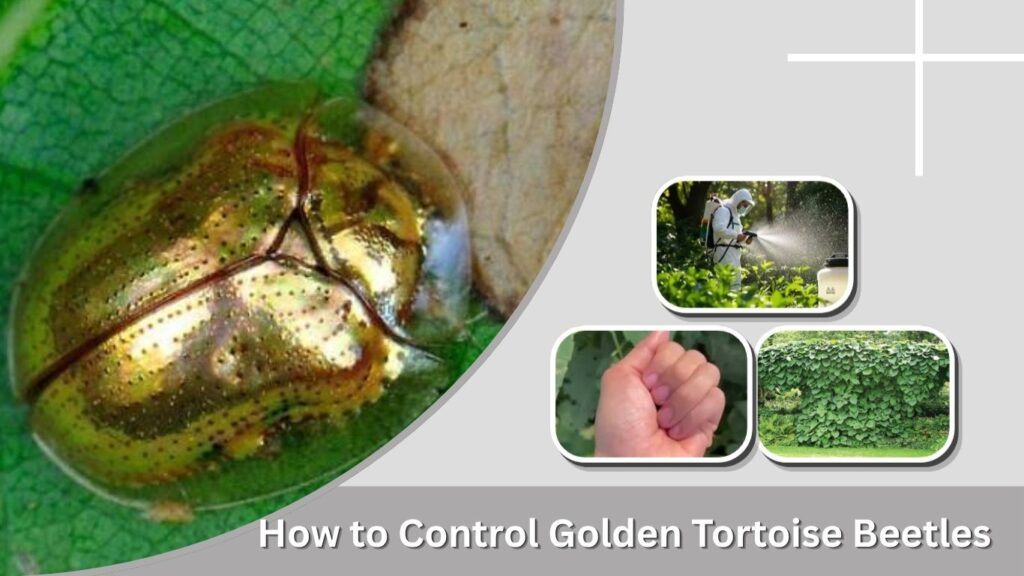
Control is rarely necessary because most infestations cause limited damage. Before treating plants, check whether the beetles are actually reducing plant growth or merely creating a few harmless holes.
Physical Removal
Inspect the undersides of leaves for adults, larvae, eggs and pupae. Handpick them or gently shake them into a container of soapy water. Physical removal is generally the only control needed in a home garden.
Manage Host Plants
Remove unwanted bindweed and volunteer morning glory vines near valuable sweet potato plants. However, avoid removing ornamental host plants unless damage is substantial.
Protect Natural Predators
Lady beetles, damsel bugs, shield bugs, assassin bugs, parasitoid wasps and parasitoid flies can attack golden tortoise beetles or their larvae. Avoid unnecessary broad-spectrum insecticides that could kill these natural enemies.
Use Insecticides Only for Severe Damage
Although foliar insecticides can kill the adults and larvae, treatment is rarely justified. When serious defoliation occurs, use only a product labeled for the affected plant and target pest, and follow all label directions carefully.
FAQs
Can golden tortoise beetles fly?
Yes. Adult golden tortoise beetles have functional wings beneath their hardened wing covers. They can fly between morning glory, bindweed, sweet potato and other suitable host plants, although they often remain still on leaves when feeding.
Can you keep a golden tortoise beetle as a pet?
It is possible to observe one temporarily in a ventilated enclosure with fresh host leaves, but it is not an ideal long-term pet. Its food requirements and seasonal life cycle can be difficult to maintain, and wild beetles are better left in their natural habitat.
Is a ruby-gold tortoise beetle a different species?
The term may describe a golden tortoise beetle displaying reddish or ruby coloration. However, several related tortoise beetle species can look similar, so color alone is not enough for an exact identification.
Are golden tortoise beetles good or bad for gardens?
They are mostly neutral. They may create holes in morning glory or sweet potato leaves, but populations are usually too small to seriously harm healthy plants. They also become food for predators and parasitoids within the garden ecosystem.
Do golden tortoise beetles bring good luck?
Some people associate their gold color with luck, wealth or transformation. These are cultural or personal interpretations rather than scientifically established meanings. Biologically, their coloration is an optical feature that may also help with concealment or defense.