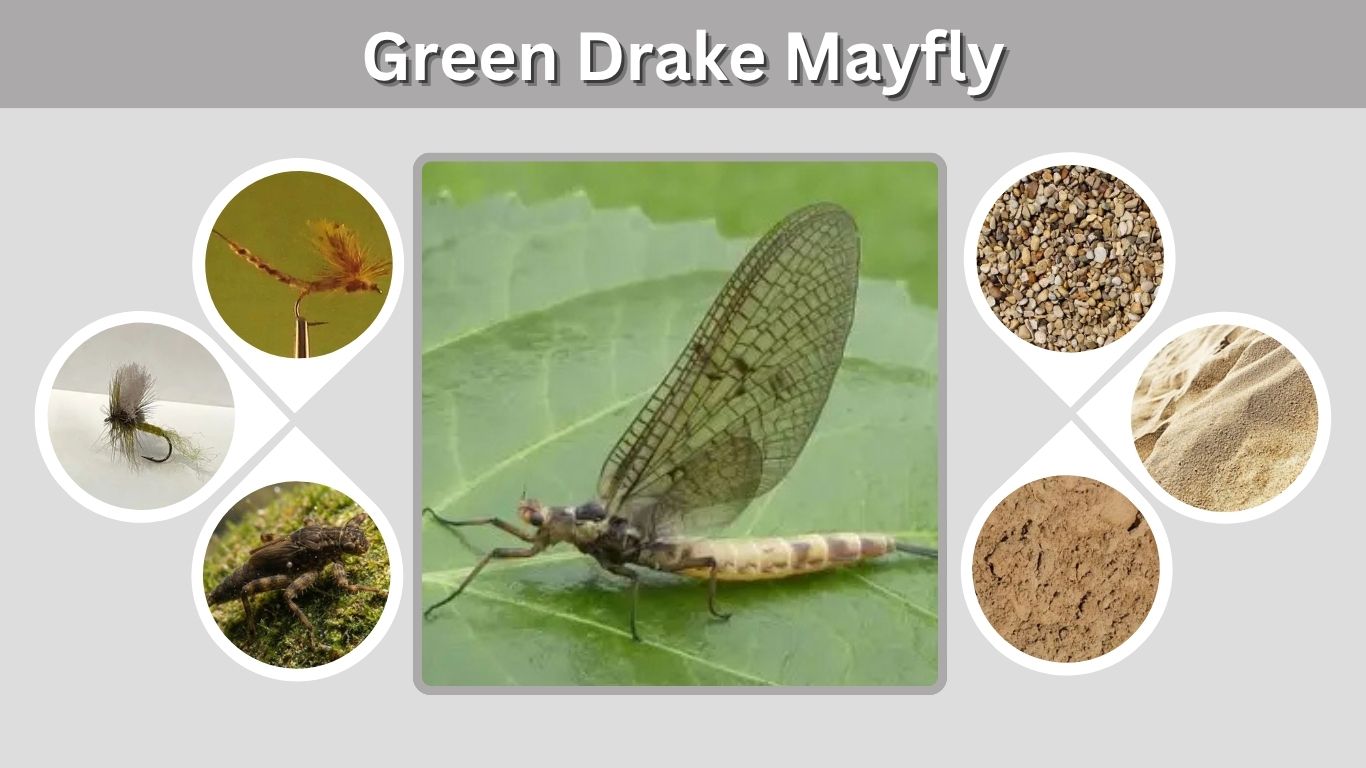
The green drake mayfly is among the largest and most important mayflies for trout anglers in North America. However, “green drake” does not describe one universal species. The Eastern Green Drake usually refers to Ephemera guttulata, while western anglers commonly use the name for several Drunella species. These mayflies differ in appearance, habitat, nymph behavior, and hatch timing. Their dramatic emergence can produce outstanding dry-fly fishing, but the hatch is often brief, localized, and challenging to predict.
Green Drake Mayfly Quick Facts
Green drakes spend most of their lives underwater as nymphs. The winged adults survive only long enough to reproduce and deposit the next generation of eggs.
Basic information
| Feature | Eastern Green Drake | Western Green Drake |
| Main species | Ephemera guttulata | Primarily Drunella grandis |
| Nymph type | Burrower | Crawler or clinger |
| Nymph habitat | Silt, sand, and fine gravel | Rocky streams with gravel and cobble |
| Adult color | Cream, yellow-olive, and brown markings | Olive, greenish-brown, or dark brown |
| Typical fly size | Approximately hook sizes 8–10 | Approximately hook sizes 10–14 |
| Main hatch period | Usually late spring to early summer | Usually summer, depending on elevation |
| Spinner name | Often called a Coffin Fly | Green Drake spinner |
Eastern vs Western Green Drake Mayflies
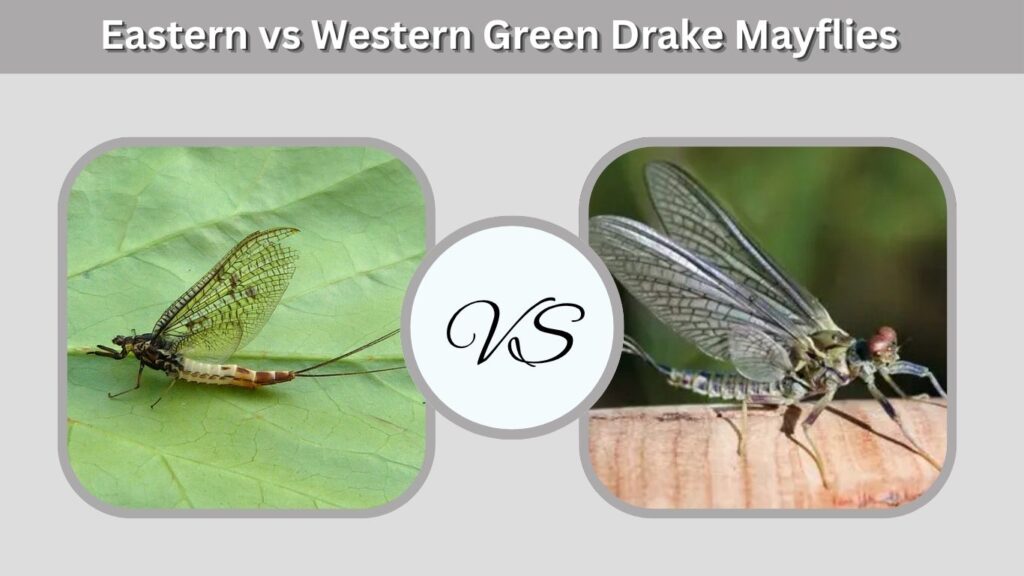
The term “green drake” can cause confusion because eastern and western mayflies are not simply regional forms of the same species.
Eastern Green Drake
The Eastern Green Drake, Ephemera guttulata, occurs in suitable streams and rivers across eastern North America. It is sometimes called the shad fly during emergence and the Coffin Fly during its spinner stage.
Adults are large, with pale cream or yellowish bodies marked by darker brown patterns. Their translucent wings may appear slightly yellow, grey, or olive. Three long tails extend from the abdomen.
Eastern Green Drake nymphs live primarily in soft-bottomed water. They construct burrows in silt, sand, detritus, and fine gravel, making them unavailable to trout during much of the year.
Western Green Drake
Western Green Drake usually refers to Drunella grandis, although related species such as Drunella doddsi may be included under the same fishing name.
These mayflies inhabit cool, flowing rivers in western North America. Their mature nymphs have broad heads, sturdy bodies, strong legs, three tails, and small projections or spines that help them move around rocks.
Western nymphs are crawlers or clingers rather than true burrowers. They live among gravel, cobble, and rocky structures in moderate or fast currents.
What is a giant green drake mayfly?
“Giant Green Drake” is an informal name rather than a consistently defined scientific species. It is sometimes applied to especially large Eastern Green Drakes or other large drake mayflies.
Identification should be based on location, wing pattern, body structure, and nymph characteristics rather than the word “giant” alone.
Green Drake Mayfly Identification
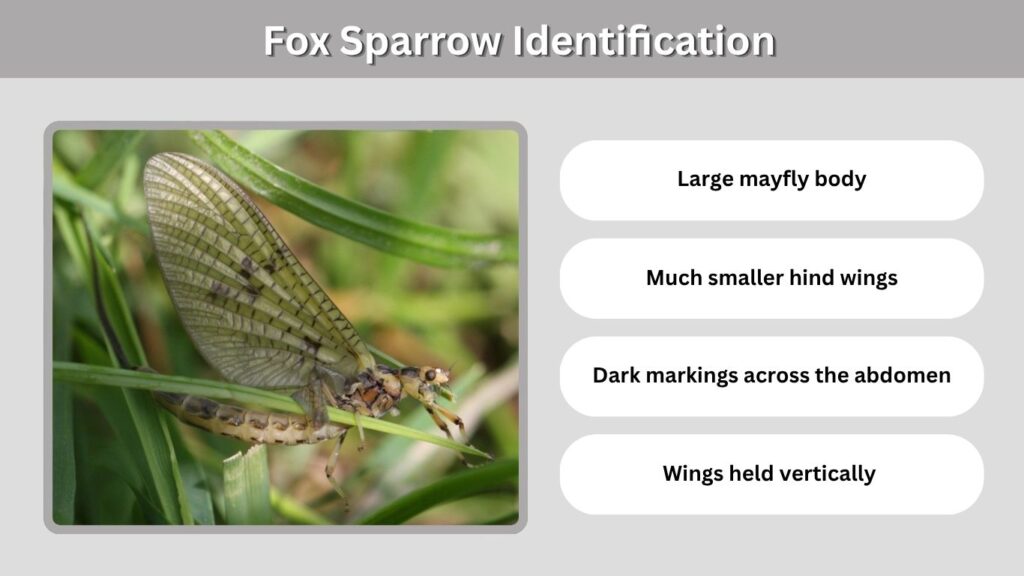
Adults can appear more yellow, tan, or brown than their common name suggests. “Green” usually refers to the olive tint seen in parts of the body or wings.
Adult identification
- Large mayfly body
- Two upright, triangular forewings
- Much smaller hind wings
- Two or three long tails, usually three in green drakes
- Pale olive, yellow, cream, or brown body
- Dark markings across the abdomen
- Wings held vertically while resting
- Short antennae and large compound eyes
Mayflies cannot fold their wings flat across their backs. When resting, they normally hold them together vertically, resembling the sail of a small boat.
Green Drake nymph identification
Green Drake nymphs generally have:
- Three distinct tails
- Visible abdominal gills
- A comparatively large body
- Six jointed legs
- Darkening wing pads before emergence
- Brown, tan, olive, or yellowish coloration
Eastern nymphs have enlarged front legs adapted for digging and feathery gills that help move oxygenated water through their burrows. Western nymphs have stronger crawling legs, broad thoraxes, and body projections suited to rocky currents.
Green Drake Mayfly Habitat and Distribution
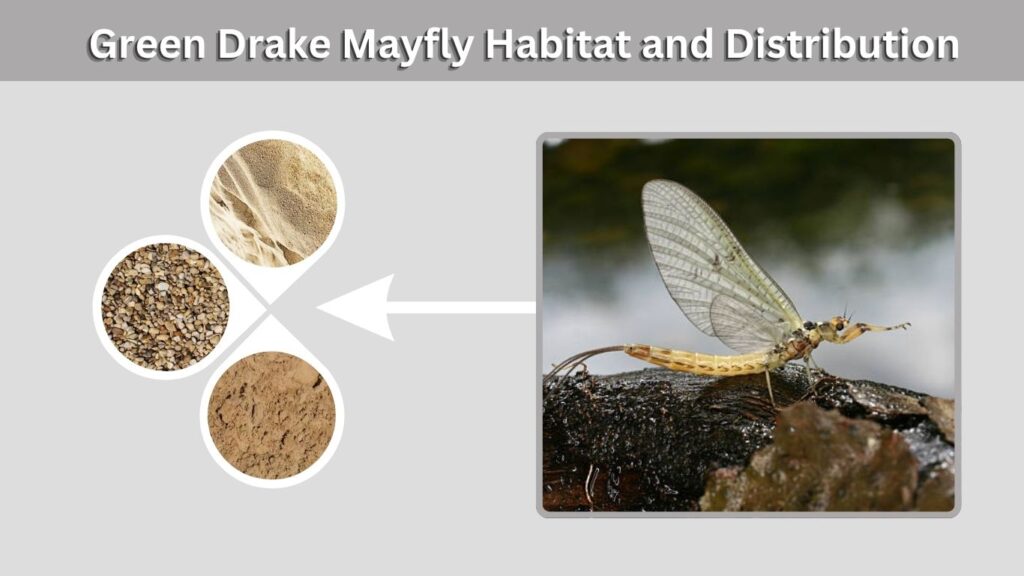
Green drakes require freshwater habitats that provide the correct substrate, temperature, oxygen level, and water quality for their aquatic nymphs.
Eastern Green Drake habitat
Eastern Green Drake nymphs occupy rivers and streams with deposits of:
- Soft silt
- Sand
- Fine gravel
- Organic detritus
- Muddy material in slower sections
The nymph creates a burrow and uses movements of its abdominal gills to circulate water through it. These burrows provide protection while delivering oxygen and suspended food particles.
Western Green Drake habitat
Western Green Drakes favor cool rivers and streams with gravel, cobble, and moderate to fast currents. They may be found beneath and between rocks where the current delivers oxygen and organic food.
Green drakes generally respond poorly to excessive warming, pollution, sediment changes, and low dissolved oxygen. Mayflies are widely used as indicators of stream health because many species are sensitive to deteriorating water conditions.
Green Drake Mayfly Life Cycle
Like other mayflies, green drakes pass through egg, aquatic nymph, subimago, and adult stages. Mayflies are unusual because they molt once more after developing functional wings.
Egg and nymph stages
Females deposit eggs on or in the water after mating. The eggs sink and develop near the stream bottom. Newly hatched nymphs feed, grow, and molt repeatedly.
Depending on the species and environmental conditions, the aquatic stage may continue for one or more years. Nymphs feed primarily on algae, decomposing vegetation, microorganisms, and fine organic particles.
Dun or subimago stage
A mature nymph leaves the bottom and rises toward the surface. Its outer skin splits, allowing a winged subadult called a dun or subimago to emerge.
The dun has duller, less transparent wings and a less glossy body than the mature adult. It rests on the surface while its wings expand, making this stage particularly vulnerable to feeding trout.
Spinner or adult stage
After leaving the water, the dun molts again into a sexually mature adult called a spinner or imago. Its wings become clearer and its body often appears more slender and glossy.
Adults form mating swarms, and females return to the water to deposit their eggs. Spent adults fall with their wings spread flat across the surface. Eastern Green Drake spinners are commonly called Coffin Flies.
Green Drake Mayfly Hatch
A green drake hatch occurs when numerous mature nymphs emerge within a relatively short period. Large insects and concentrated activity can encourage bigger trout to feed near the surface.
When do Green Drakes hatch?
| Region | General hatch period | Common timing |
| Eastern North America | Late May through June | Afternoon, evening, or cloudy periods |
| Lower western rivers | Late spring through early summer | Late morning through evening |
| High-elevation western streams | Mid-to-late summer | Often during warmer daytime periods |
| Spinner fall | After adults mature and mate | Evening or early morning |
These periods are approximate. Water temperature, elevation, latitude, weather, snowmelt, streamflow, and local insect populations can shift the hatch considerably.
Signs that a hatch is beginning
Mature nymphs develop dark wing pads and become more active. Anglers may see empty nymphal skins near the bank, duns drifting on the surface, or trout feeding with deliberate rises.
Before visible duns appear, trout may take ascending nymphs and emergers below the surface. During heavy emergence, fish can switch quickly from nymphs to duns and later to spent spinners.
Green Drake Mayfly Patterns
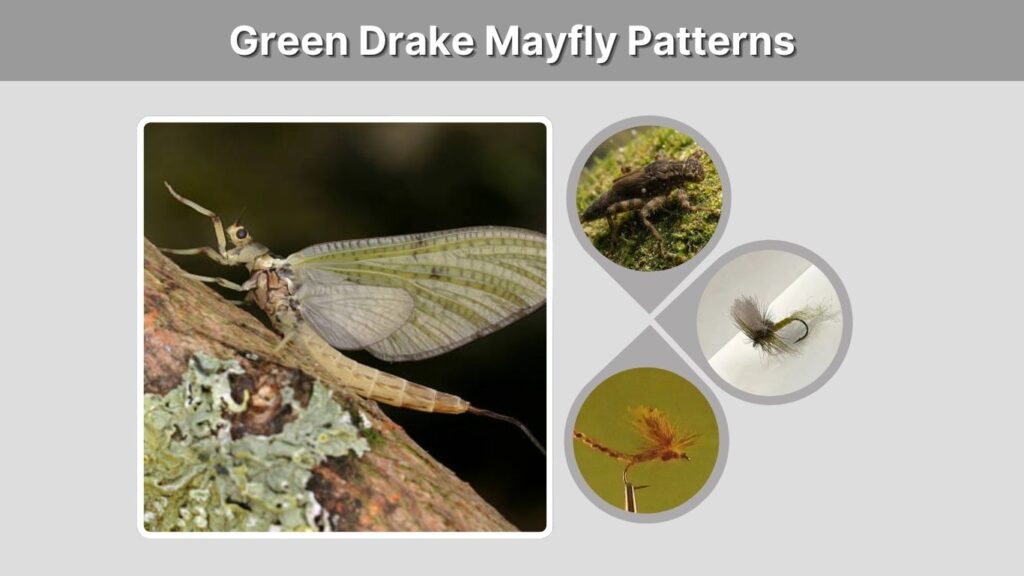
An effective fly should represent the stage trout are currently eating. Carrying only an adult dry fly can be limiting when fish are taking nymphs, emergers, or spinners.
Recommended patterns by stage
| Life stage | Useful fly patterns |
| Nymph | Green Drake Nymph, Hare’s Ear, Poxyback Nymph |
| Emerger | CDC Green Drake Emerger, Soft-Hackle Emerger |
| Dun | Green Drake Comparadun, Parachute Green Drake |
| Adult | Catskill-style Green Drake, Hair-Wing Drake |
| Spinner | Coffin Fly, Spent-Wing Green Drake |
Eastern patterns are commonly tied in cream, yellow-olive, tan, and brown. Western patterns often use darker olive, greenish-brown, or rusty shades. The fly’s silhouette, size, and position in the water are usually more important than matching an exact shade.
Choosing the correct size
Match the local insect rather than relying on a universal hook size. Eastern Green Drakes are commonly represented on hooks around sizes 8–10. Western insects may require sizes 10–14 because species and local populations vary.
Collecting and preserving insects may be prohibited in some locations. A close photograph beside a ruler can provide enough information for later pattern selection.
Why a Green Drake Pattern Will Not Float
Large Green Drake dry flies contain more material than smaller patterns and can become waterlogged quickly.
Common floating problems
A fly may sink because of an overly heavy hook, saturated body materials, inadequate hackle, a twisted leader, or drag from turbulent currents. Applying too much liquid floatant to a soaked fly can also trap water rather than restore buoyancy.
Dry the pattern thoroughly with an absorbent cloth or drying powder before reapplying floatant. Use a lighter hook, buoyant deer hair, foam, CDC, or well-proportioned hackle when tying patterns. A reach cast or upstream mend reduces drag and helps the fly remain naturally upright.
Rearing Green Drake Mayflies
Green drakes are difficult to rear because their aquatic requirements are more complex than simply placing nymphs in an aerated aquarium.
Why laboratory Green Drakes die
Common causes include:
- Water that becomes too warm
- Insufficient dissolved oxygen
- Chlorine, copper, ammonia, or other contaminants
- Sudden changes in pH or water chemistry
- Incorrect current speed
- Missing burrowing or rocky substrate
- Accumulated waste and uneaten food
- Crowding and repeated handling
- Inability to molt or emerge above the water
- An unnatural seasonal temperature or light cycle
Eastern Green Drake nymphs require suitable fine substrate in which to construct and ventilate burrows. Western Green Drakes need flowing, oxygen-rich water and stable rocky surfaces. A bare, still aquarium fails to reproduce either environment.
Rearing troubleshooting
Test temperature, dissolved oxygen, pH, ammonia, nitrite, hardness, and conductivity rather than judging water visually. Use dechlorinated water with gentle continuous renewal, maintain stable seasonal conditions, and avoid abrupt temperature changes.
Provide species-appropriate substrate and modest amounts of natural detritus or biofilm. Emergence structures and a covered aerial chamber are necessary when mature nymphs begin leaving the water. Laboratory culture should follow an established protocol and comply with collection regulations.
FAQs
These answers cover the most common questions about Green Drake identification, hatches, fishing, and adult behavior.
Do Green Drake mayflies bite?
No. Adult Green Drake mayflies do not bite or sting people. Their mouthparts are nonfunctional, and they do not feed during their short winged life. Nymphs are also harmless to humans and spend their time feeding on fine organic material underwater.
How long do Green Drake mayflies live?
The aquatic nymph may live for one or more years, depending on species and environmental conditions. In contrast, the winged dun and adult stages last only a few days. The mature adult’s primary purposes are mating and depositing eggs.
What is the best Green Drake fly pattern?
No single pattern works throughout the hatch. Begin with a weighted nymph before emergence, switch to an emerger when insects ascend, use a Comparadun or parachute pattern for duns, and finish with a Coffin Fly or spent-wing pattern during the spinner fall.
Why are Green Drake hatches difficult to predict?
Emergence depends on water temperature, streamflow, weather, elevation, and local development rates. The main hatch may last only several days on one section of river. Cold fronts, floods, or rapid warming can delay, interrupt, or accelerate activity.
Are Eastern and Western Green Drakes the same insect?
No. The Eastern Green Drake is primarily Ephemera guttulata, a burrowing mayfly. Western Green Drake usually refers to Drunella grandis and related crawling or clinging species. They share a fishing name but differ in taxonomy, nymph structure, habitat, and distribution.