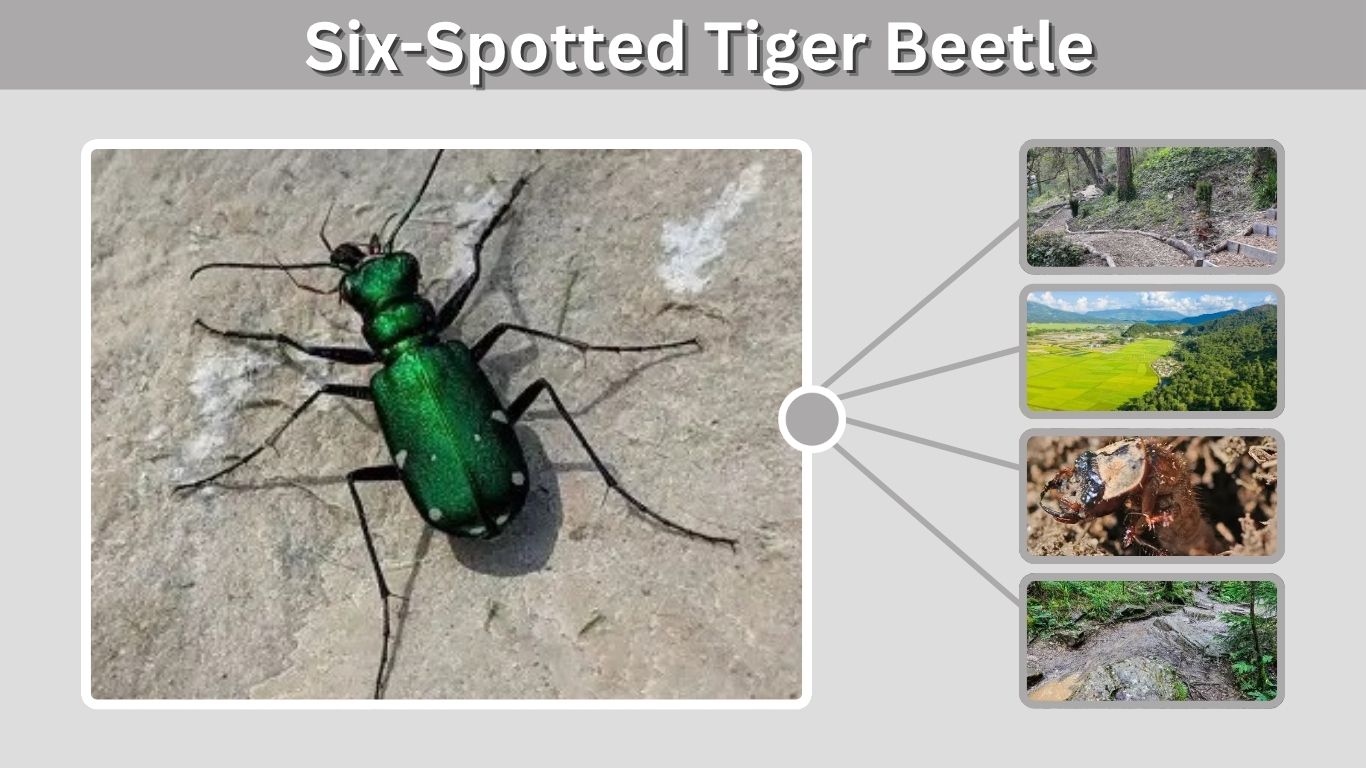
The six-spotted tiger beetle is a fast-moving, metallic-green beetle commonly seen on sunny woodland paths. Although its large jaws and bright coloration can make it look intimidating, this insect is generally harmless to people. It is actually a beneficial predator that hunts ants, caterpillars, spiders, and other small invertebrates.
Despite its name, the beetle does not always have exactly six spots. Some individuals may have fewer spots, additional spots, or no visible spots at all. Color, body shape, behavior, and habitat are therefore more reliable identification features.
What Is a Six-Spotted Tiger Beetle?
The six-spotted tiger beetle is a North American predatory beetle scientifically known as Cicindela sexguttata. It belongs to the tiger beetle group within the ground beetle family, Carabidae.
The name “tiger beetle” reflects its aggressive hunting behavior rather than any danger to humans. Adults actively chase prey across the ground, while the larvae ambush insects from underground burrows.
Six-spotted tiger beetles are especially noticeable because of their shiny green bodies, long legs, large eyes, and pale markings along the edges of their wing covers.
Six-Spotted Tiger Beetle Identification
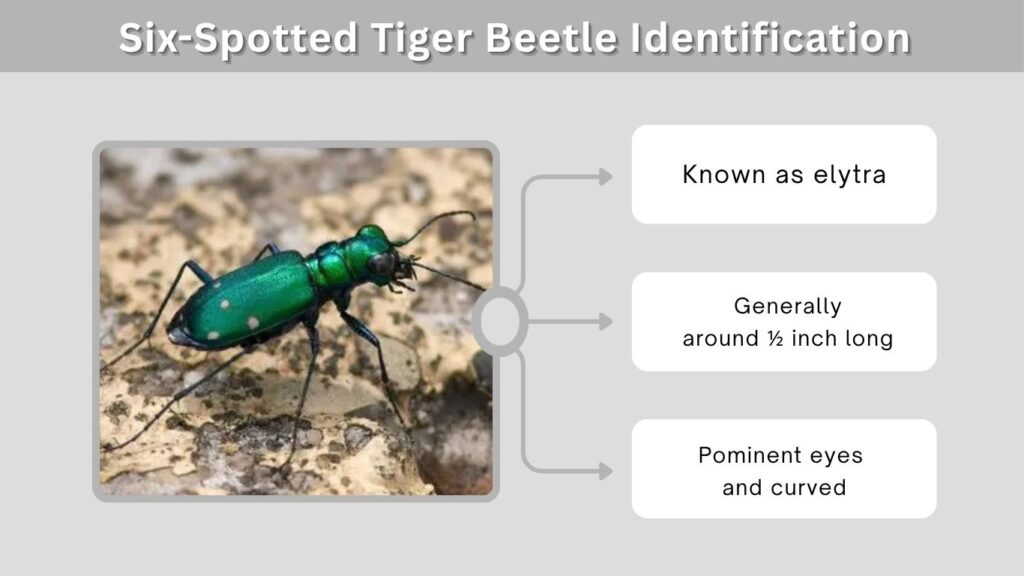
Adult six-spotted tiger beetles have several distinctive physical characteristics.
Color and Appearance
The body is usually bright metallic green or blue-green. Depending on the lighting, some beetles may appear turquoise, emerald, bronze-green, or almost blue.
Their wing covers, known as elytra, commonly have six small cream-colored or white spots near the outer edges. However, individuals may display anywhere from zero to eight spots. The number of markings alone should not be used for identification.
Size
An adult six-spotted tiger beetle is generally around ½ inch long. Its narrow body and long running legs make it appear slightly larger when moving quickly across the ground.
Head and Jaws
The beetle has large, prominent eyes and curved, pale-colored mandibles. These jaws are designed for grabbing, crushing, and cutting small prey.
The combination of large eyes and powerful jaws gives the insect a fierce appearance, even though it presents little risk to people.
Legs and Movement
Six-spotted tiger beetles have long, slender legs that allow them to run rapidly. When disturbed, they often sprint a short distance, fly ahead, land, and begin running again.
This stop-and-start behavior is one of the easiest ways to recognize a tiger beetle on a trail.
Where Do Six-Spotted Tiger Beetles Live?
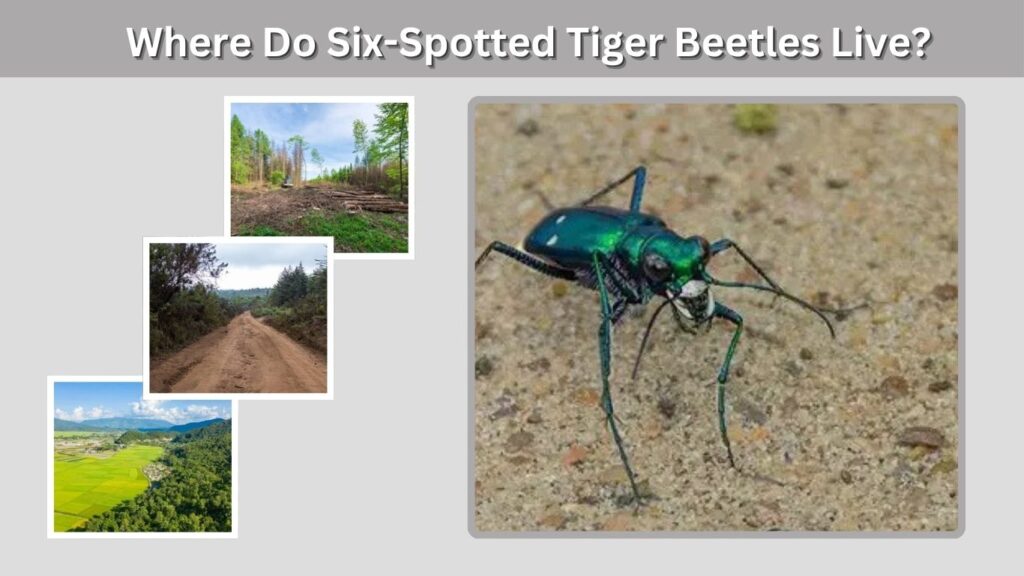
Six-spotted tiger beetles are associated mainly with deciduous forests and woodland edges in eastern North America. Their range extends from parts of southern Canada through much of the eastern United States and south toward Texas.
They are commonly found in:
- Sunny woodland trails
- Dirt roads
- Forest clearings
- Fields beside forests
- Areas around fallen logs
- Dry creek beds
- Forest edges
- Patches of exposed sandy, clay, or loamy soil
Adults often select sunlit areas because warmth helps them remain active. They may repeatedly move between sunny patches and shaded forest areas while hunting.
Six-spotted tiger beetles are most frequently observed from spring into early summer. In many areas, adults are particularly active between April and July.
What Do Six-Spotted Tiger Beetles Eat?
Six-spotted tiger beetles are carnivorous predators. Adults use their speed, eyesight, and strong jaws to pursue small arthropods moving across the ground.
Their diet may include:
- Ants
- Small caterpillars
- Spiders
- Flies
- Beetle larvae
- Small beetles
- Other soft-bodied insects
- Insect eggs and immature arthropods
Rather than waiting passively, adult beetles actively search for prey. Their large eyes detect movement, while their long legs help them close the distance quickly.
Because they consume various insects and other arthropods, six-spotted tiger beetles are considered beneficial predators rather than garden or forest pests.
Six-Spotted Tiger Beetle Larvae
The larval stage looks very different from the metallic-green adult. Tiger beetle larvae are pale or brownish, with a large head, powerful jaws, and hooks on the abdomen.
They spend nearly their entire larval stage inside vertical burrows in the soil, which is why they are rarely noticed.
How the Larvae Hunt
A larva waits near the entrance of its burrow with its head positioned close to the surface. When an ant, spider, or small insect passes nearby, the larva lunges upward, grabs the prey, and pulls it underground.
Hooks on the larva’s abdomen help anchor its body against the burrow wall so that struggling prey cannot pull it out.
Larval burrows may occur in sandy, clay, or loamy soil along trails, dry streambeds, forest edges, and other areas with exposed ground.
Six-Spotted Tiger Beetle Life Cycle
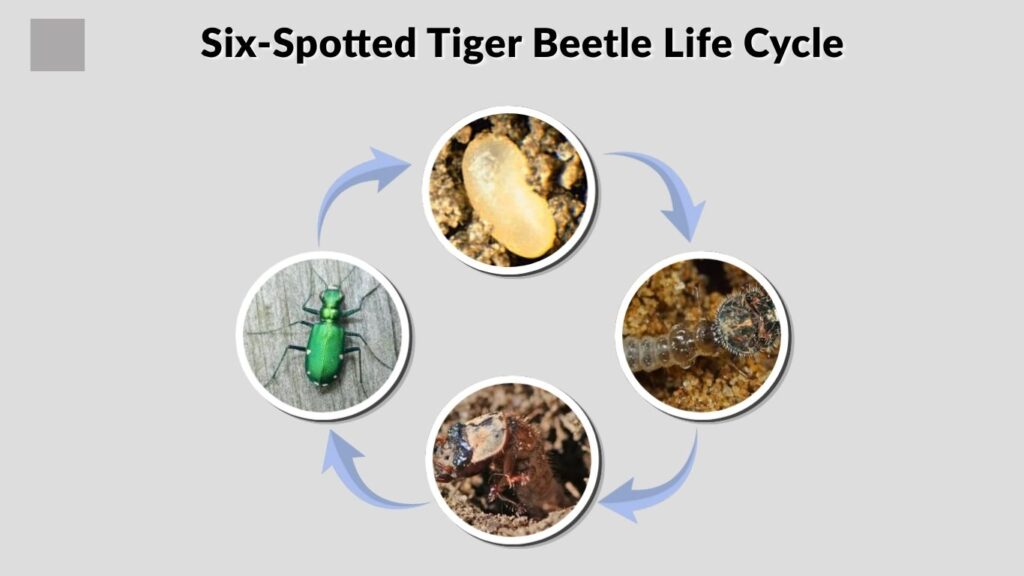
Like other beetles, the six-spotted tiger beetle undergoes complete metamorphosis through four stages:
- Egg
- Larva
- Pupa
- Adult
After mating, the female deposits eggs in small openings in the soil. Once an egg hatches, the larva develops a vertical burrow and begins ambushing passing prey.
The larva grows through several developmental stages while remaining underground. It later seals part of the burrow and changes into a pupa. The adult eventually emerges and becomes an active surface hunter.
The time required to complete the life cycle can vary according to species, climate, food availability, and soil conditions. Adult six-spotted tiger beetles may also overwinter in underground burrows before becoming active again in spring.
Are Six-Spotted Tiger Beetles Poisonous?
Six-spotted tiger beetles are not poisonous and are not known to be venomous. Their metallic coloration is not a warning that they contain dangerous toxins.
They do not sting, transmit venom, or deliberately attack people. Their jaws are hunting tools used to capture much smaller prey.
The safest approach is simply to observe them without handling them.
Do Six-Spotted Tiger Beetles Bite?
A six-spotted tiger beetle may attempt to pinch with its mandibles when trapped, squeezed, or handled roughly. However, it normally escapes by running or flying rather than biting.
Any defensive pinch would usually be minor because the beetle is small. It is not considered medically dangerous.
People can avoid the possibility of a bite by allowing the beetle to move away naturally instead of picking it up.
Six-Spotted Tiger Beetle vs. Emerald Ash Borer
The six-spotted tiger beetle is sometimes mistaken for the emerald ash borer because both insects may have shiny green bodies. However, they differ considerably in shape, behavior, and ecological role.
| Feature | Six-Spotted Tiger Beetle | Emerald Ash Borer |
| Scientific name | Cicindela sexguttata | Agrilus planipennis |
| Body shape | Broad head with narrow waist and long legs | Narrow, elongated, bullet-shaped body |
| Markings | Often has pale spots on wing-cover edges | Usually lacks white edge spots |
| Eyes | Large and prominent | Smaller and less noticeable |
| Behavior | Runs rapidly on trails and open ground | Commonly rests or flies near ash trees |
| Diet | Predatory; eats insects and spiders | Larvae feed beneath ash tree bark |
| Importance | Beneficial predator | Destructive invasive tree pest |
The tiger beetle’s long legs, large jaws, broad head, and rapid ground movement are usually enough to distinguish it from an emerald ash borer.
Golden or Blue Six-Spotted Tiger Beetles
Not every individual appears bright emerald green. Depending on genetics, viewing angle, lighting, and reflection, the body may look blue-green, turquoise, golden-green, bronze, or dark metallic green.
A beetle described as a “golden-spotted tiger beetle” may sometimes be a color variation, a photographed individual reflecting warm light, or a different tiger beetle species. Identification should therefore consider body shape, spot arrangement, location, and habitat rather than color alone.
Can Six-Spotted Tiger Beetles Fly?
Six-spotted tiger beetles can fly well, although they frequently travel by running. When approached, one may fly a few feet ahead, land on the same trail, and continue hunting.
This repeated pattern can make the beetle appear to be leading a person down the path. Flight helps it escape predators, move between hunting areas, and find mates.
Are Six-Spotted Tiger Beetles Beneficial?
Six-spotted tiger beetles are beneficial members of woodland ecosystems. Both adults and larvae prey on small arthropods and help maintain natural predator-prey relationships.
Tiger beetles may also provide information about environmental conditions. Some species are sensitive to habitat changes and are used by researchers as indicators of ecosystem quality.
There is generally no reason to control or remove a six-spotted tiger beetle from a yard, trail, or garden.
How to Find a Six-Spotted Tiger Beetle
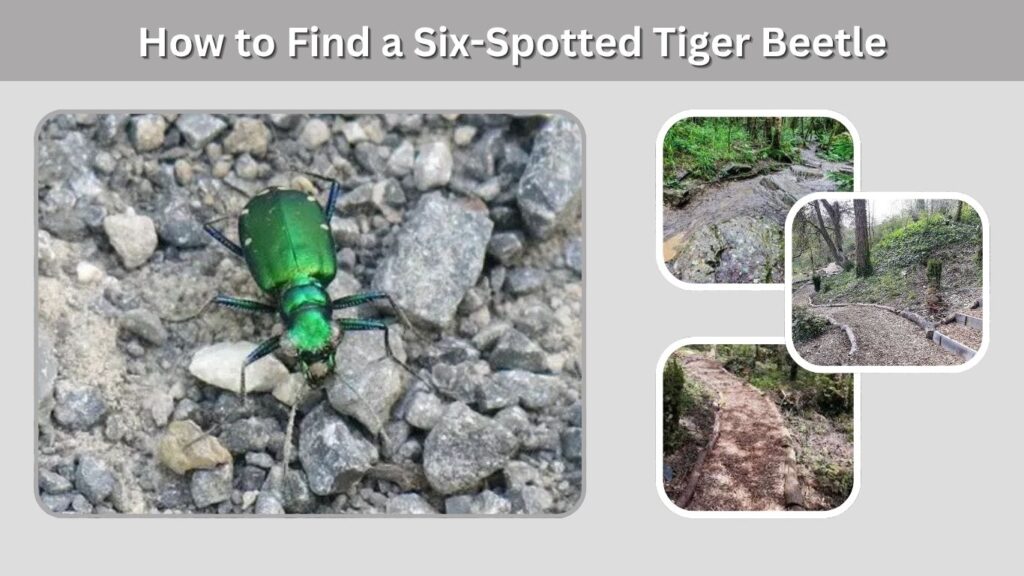
The best time to look for these beetles is on a warm, sunny day in spring or early summer.
Walk slowly along:
- Woodland paths
- Sunny forest openings
- Dirt roads near forests
- Trails with exposed soil
- Forest edges beside fields
Watch several feet ahead for a small, reflective green insect running across the ground. Approach slowly because the beetle may fly away when it senses movement.
Photography is often easier after the beetle lands and pauses in a sunny patch.
Interesting Six-Spotted Tiger Beetle Facts
- Its scientific name is Cicindela sexguttata.
- “Sexguttata” refers to the six-spotted pattern.
- Some individuals have fewer or more than six spots.
- Adults are fast runners and capable flyers.
- Both adults and larvae are predators.
- Larvae hunt from underground burrows.
- Adults are commonly seen on sunny forest trails.
- The beetle is harmless unless handled roughly.
- It is frequently confused with the emerald ash borer.
- Its color may range from green to blue-green or bronze-green.
FAQs
Is a six-spotted tiger beetle rare?
The six-spotted tiger beetle is generally considered a common tiger beetle across suitable parts of eastern North America. However, its abundance varies according to location, season, weather, soil conditions, and the availability of sunny woodland paths.
Why is it called a six-spotted tiger beetle?
The name refers to the six pale spots that commonly appear along the edges of its wing covers. “Tiger” describes its fast, aggressive hunting style. Despite the name, some individuals may have fewer than six spots, more than six, or no obvious spots.
Will six-spotted tiger beetles damage plants?
Six-spotted tiger beetles do not normally feed on healthy plants, flowers, roots, or leaves. They are predators that hunt insects, spiders, and other small arthropods. Therefore, they are not considered damaging garden pests.
Can a six-spotted tiger beetle live indoors?
These beetles are adapted to outdoor woodland habitats and exposed soil. One may accidentally enter a building through an open door or window, but it is unlikely to establish an indoor infestation. It can be gently released outside near a forest edge.
What animals eat six-spotted tiger beetles?
Potential predators include birds, frogs, lizards, spiders, robber flies, and other insect-eating animals. Larvae may also be attacked by ants, predatory beetles, bee flies, or parasitic wasps while living in their soil burrows.