
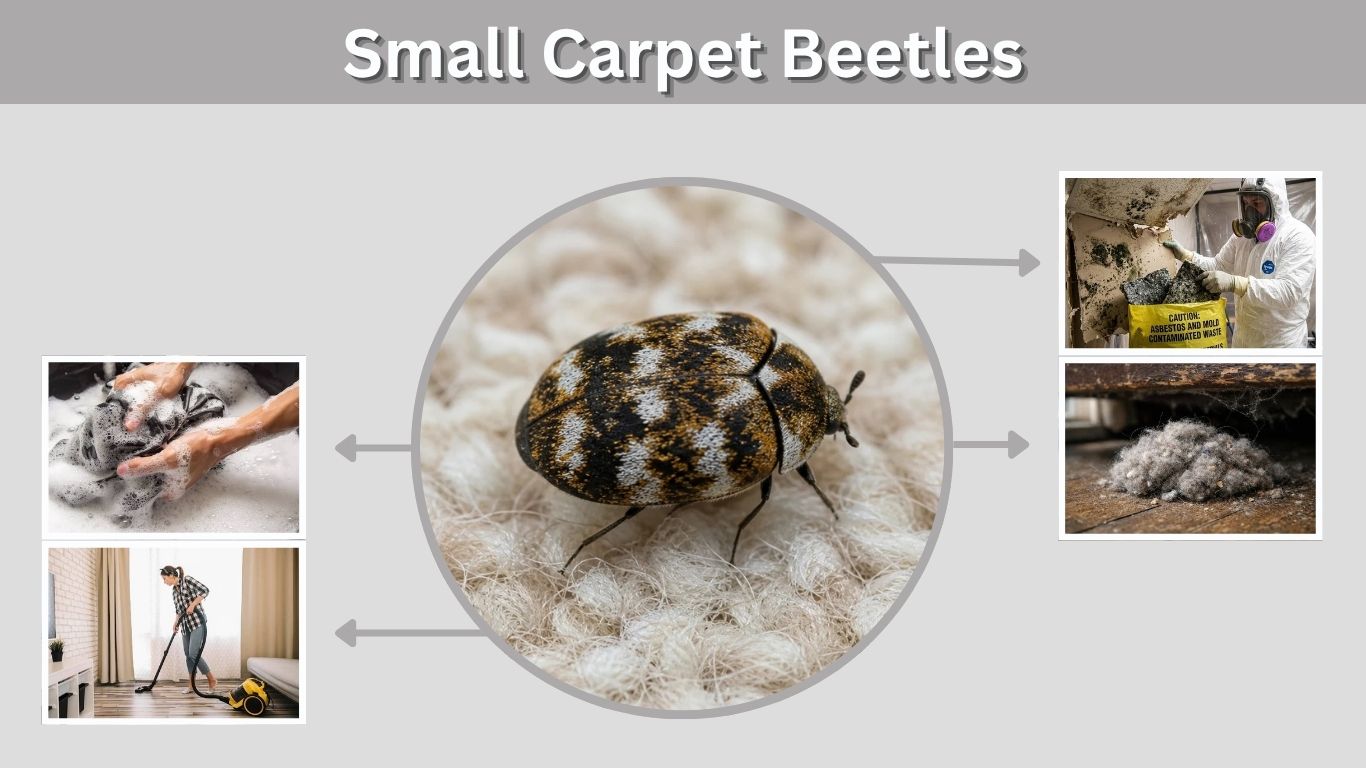
Small carpet beetles are tiny household insects commonly found near carpets, windows, furniture, and stored clothing. Most adults measure just 2 to 5 millimeters long, making them easy to overlook. These beetles may appear black, brown, or patterned with white and yellow markings. Although adult carpet beetles are generally harmless, their larvae can damage wool, silk, fur, and other natural materials. Identifying these insects early helps prevent serious infestations. This guide explains what small carpet beetles look like, where they hide, how to recognize their larvae, and effective ways to remove them.
What Do Small Carpet Beetles Look Like?
Small carpet beetles have compact, oval or rounded bodies covered by hard wing cases. Depending on their species, they may appear solid black, dark brown, or decorated with irregular colored scales.
Their small size makes identification difficult without close examination. Adults have six legs, short antennae, and functional wings.
Small Carpet Beetle Identification
Common identification features include:
- Body Size: Approximately 2–5 mm long
- Body Shape: Rounded, oval, or slightly elongated
- Body Color: Black, brown, yellow, white, or mottled
- Wings: Hardened outer wing covers with flight wings underneath
- Antennae: Short, often with clubbed tips
- Legs: Six relatively short legs
- Movement: Crawling across surfaces and flying as adults
Adult beetles are frequently spotted near windows because many species are attracted to daylight.
How Small Are Carpet Beetles?
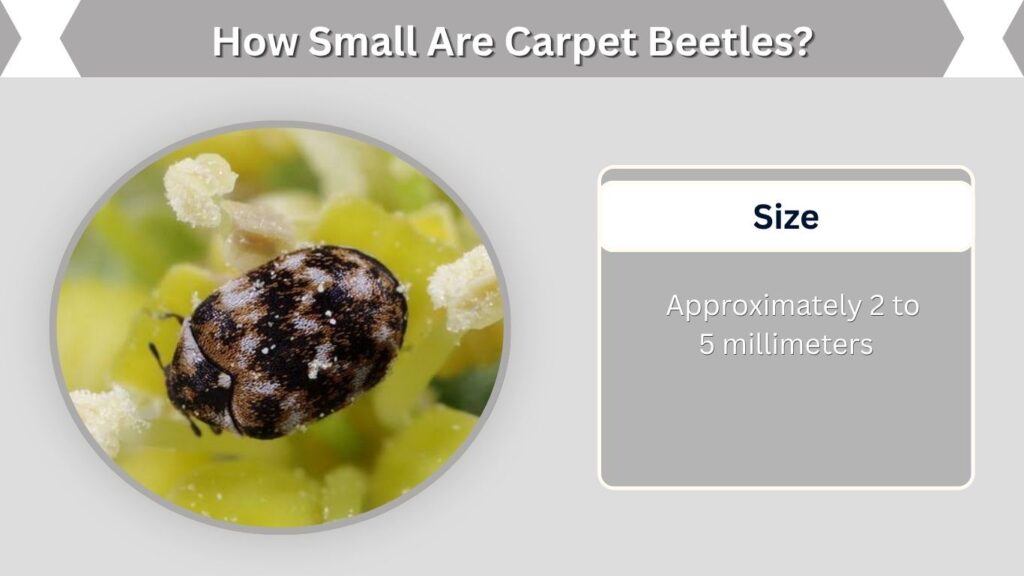
Most adult carpet beetles measure approximately 2 to 5 millimeters, or about 1/12 to 3/16 inch, depending on their species.
Their bodies can resemble tiny dark seeds or moving specks when viewed from a distance.
Carpet Beetle Size Comparison
| Carpet Beetle Type | Adult Size |
| Varied Carpet Beetle | 2–3 mm |
| Black Carpet Beetle | 3–5 mm |
| Furniture Carpet Beetle | 2–3.5 mm |
| Common Carpet Beetle | Approximately 2.5–4 mm |
Young larvae can be smaller than adult beetles, but mature larvae of some species become considerably longer.
Carpet beetles do not remain microscopic throughout their lives. Adults under 1 mm would be unusually small for common household carpet beetle species.
Types of Small Carpet Beetles Found in Homes
Several carpet beetle species frequently occur inside residential buildings. They belong to the family Dermestidae and have similar feeding habits during their immature stages.
Understanding their differences helps identify the particular beetle found in carpets, closets, or furniture.
1. Small Black Carpet Beetles
The black carpet beetle (Attagenus unicolor) is one of the most common carpet beetle species in American homes.
Adults are approximately 3 to 5 mm long, with smooth, elongated oval bodies.
Their coloring ranges from dark brown to nearly black. Unlike varied carpet beetles, they generally lack conspicuous multicolored patterns.
Black carpet beetle larvae are brown, elongated, and often have distinctive tufts of hair near their rear ends.
2. Small Brown Carpet Beetles
Small brown carpet beetles may belong to several species, including black carpet beetles with brown coloration or older varied carpet beetles that have lost their decorative scales.
Their appearance varies from reddish-brown to dark brown.
Because numerous household beetles share similar coloring, body shape, antennae, and larval characteristics should be examined before identification.
3. Varied Carpet Beetles
Varied carpet beetles (Anthrenus verbasci) are tiny, rounded beetles measuring approximately 2 to 3 mm long.
Their bodies have irregular patterns of white, brown, black, and yellowish scales.
Older adults may lose these scales and appear darker or more uniformly brown.
Their larvae are covered with dense hairs and often have alternating light and dark bands.
4. Furniture Carpet Beetles
Furniture carpet beetles (Anthrenus flavipes) are small, rounded insects commonly associated with natural-fiber furnishings.
Adults measure approximately 2 to 3.5 mm and display mottled yellow, white, and dark patterns.
Their larvae may damage wool carpets, upholstered furniture, and other animal-derived materials.
What Do Small Carpet Beetle Larvae Look Like?
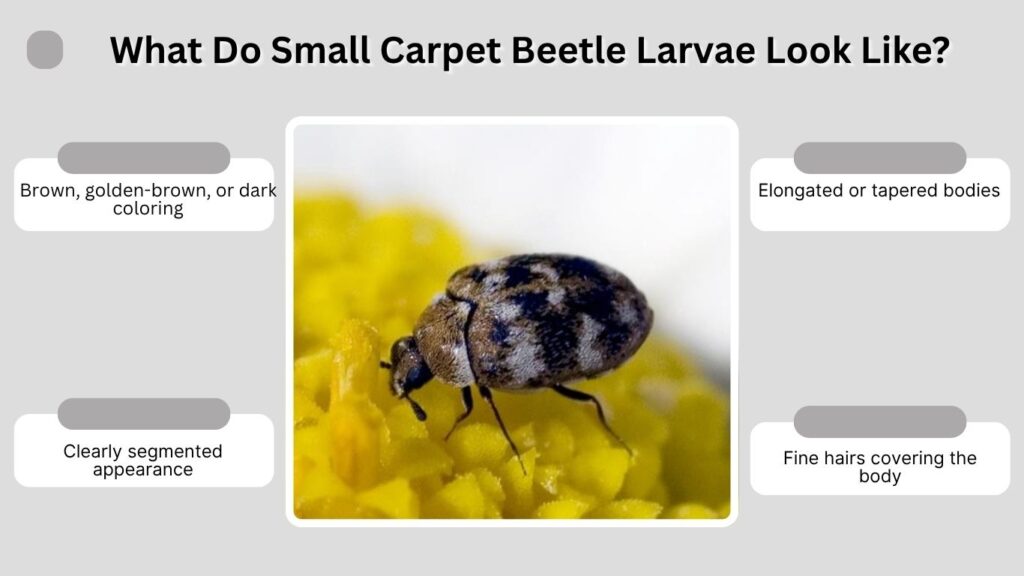
Carpet beetle larvae look noticeably different from adults. Instead of having rounded, hard-shelled bodies, larvae are elongated and covered with short or long bristles.
They may resemble tiny hairy worms or miniature caterpillars.
Small Carpet Beetle Larvae Identification
Important characteristics include:
- Brown, golden-brown, or dark coloring
- Elongated or tapered bodies
- Clearly segmented appearance
- Fine hairs covering the body
- Hair tufts near the rear in some species
- Slow crawling movement
- Preference for dark, undisturbed locations
Mature larvae of certain species can reach approximately 5 to 13 mm.
Unlike adults, larvae feed on materials that contain animal-derived proteins, making them responsible for most household carpet beetle damage.
Why Are Small Carpet Beetles in My House?
Small carpet beetles enter homes primarily because indoor environments provide suitable locations for egg laying and larval development.
Adult beetles naturally live outdoors and often feed on pollen or nectar. They may enter through open windows, doors, and damaged screens.
Common Reasons for Carpet Beetle Activity
Several conditions can attract or support carpet beetles:
- Wool carpets and natural-fiber rugs
- Stored silk or wool clothing
- Pet hair and accumulated lint
- Dead insects around windows
- Upholstered furniture
- Bird nests near buildings
- Undisturbed closets and storage rooms
- Infested secondhand furniture
Adult females lay eggs near materials that developing larvae can consume.
Where Do Small Carpet Beetles Hide?
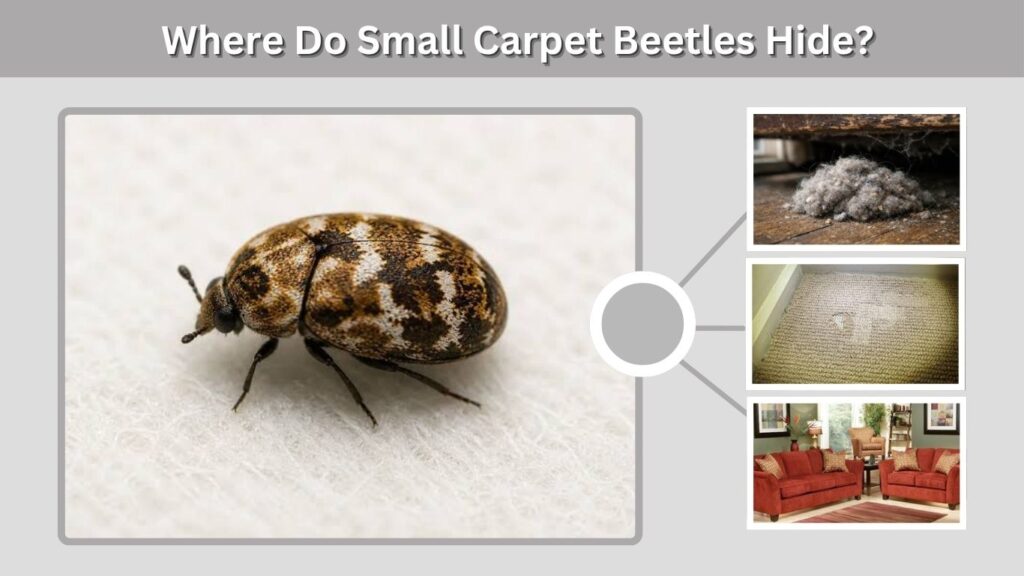
Carpet beetle larvae prefer dark, protected areas where food remains available.
Adults are more noticeable because they often move toward windows and other sources of light.
Common Carpet Beetle Hiding Places
Check the following locations:
- Carpet Edges: Larvae frequently hide along baseboards and beneath rugs.
- Under Furniture: Dust, pet hair, and organic debris accumulate in these locations.
- Inside Closets: Stored wool clothing and other natural fabrics provide food.
- Upholstered Furniture: Larvae may live inside seams and concealed fabric areas.
- Window Frames: Adult beetles commonly gather near natural light.
- Attics: Bird nests and dead insects can support carpet beetle populations.
- Storage Boxes: Undisturbed fabrics may become infested over time.
Finding the larval food source is essential for successful long-term control.
Small Carpet Beetles vs. Other Household Bugs
Many small household insects resemble carpet beetles, especially when viewed without magnification.
Small brown beetles may be confused with pantry beetles, while carpet beetle larvae are sometimes mistaken for other crawling household pests.
Carpet Beetles vs. Bed Bugs
| Feature | Carpet Beetles | Bed Bugs |
| Adult Size | Usually 2–5 mm | Around 4–7 mm |
| Body Shape | Rounded or oval | Flattened and oval |
| Color | Black, brown, or mottled | Reddish-brown |
| Wings | Adults can fly | Cannot fly |
| Food | Larvae feed on organic materials | Feed on blood |
| Skin Effects | Larval hairs can cause irritation | Bites may cause skin reactions |
Carpet beetles do not feed on human blood or bite like bed bugs.
Their larvae can sometimes cause allergic skin reactions through contact with irritating hairs.
How to Get Rid of Small Carpet Beetles
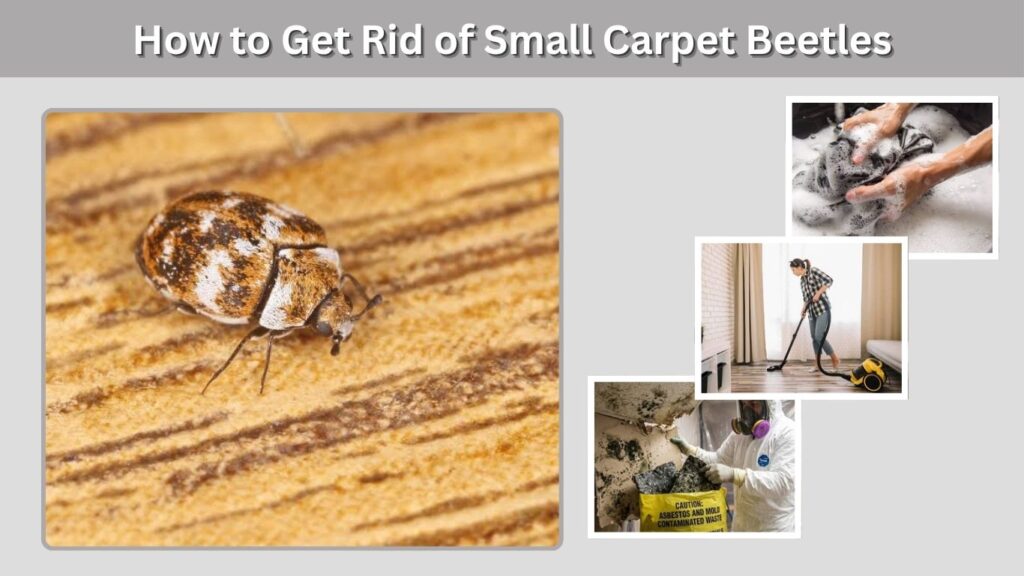
Removing small carpet beetles requires identifying where larvae are feeding and eliminating their food sources.
Vacuuming, laundering vulnerable fabrics, and cleaning hidden spaces are usually the most important steps.
Effective Carpet Beetle Removal Methods
- Vacuum Thoroughly: Clean carpets, furniture, baseboards, closets, and other concealed areas.
- Wash Infested Fabrics: Use appropriate hot-water laundering or professional dry cleaning when suitable.
- Remove Pet Hair: Regularly eliminate accumulated fur, lint, and other organic debris.
- Inspect Stored Clothing: Check wool, silk, and other animal-derived fabrics for larvae or damage.
- Dispose of Heavily Infested Materials: Remove items that cannot be cleaned or restored.
- Clean Window Areas: Vacuum adult beetles near windows and inspect surrounding openings.
- Monitor Activity: Use suitable sticky traps to identify areas with continued beetle activity.
If an infestation continues despite cleaning, professional pest management may be necessary.
How to Prevent Small Carpet Beetles
Preventing carpet beetles is generally easier than eliminating an established infestation.
Because larvae often develop in concealed locations, regular inspection and housekeeping are essential.
Long-Term Prevention Tips
Store clean natural-fiber clothing inside sealed containers. Vacuum beneath furniture and along carpet edges frequently, particularly in homes with pets.
Inspect secondhand rugs and furniture before bringing them indoors.
Repair damaged window screens and seal openings that allow adult beetles to enter.
Finally, check vulnerable fabrics periodically for small holes, shed larval skins, or signs of feeding.
FAQs
1. Are small carpet beetles harmful to humans?
Small carpet beetles are not generally dangerous to humans. They do not feed on blood or sting. However, their larvae have tiny hairs that may cause skin irritation in sensitive individuals. Their main threat is damage to natural fabrics and stored materials.
2. Can small carpet beetles fly?
Yes, adult carpet beetles have functional wings and can fly. They frequently enter homes through open windows and doors. Adults often gather near windows because they are attracted to light. Carpet beetle larvae cannot fly and move only by crawling.
3. Why am I finding tiny black beetles on my carpet?
Tiny black beetles on your carpet may be black carpet beetles, but other household beetles can look similar. Check for hairy larvae, shed skins, or damaged natural fabrics. Finding these signs helps determine whether carpet beetles are actively developing indoors.
4. How small can carpet beetle larvae be?
Newly hatched carpet beetle larvae are extremely small and may be difficult to notice without magnification. As they develop, they grow through several stages. Depending on the species, mature larvae may measure approximately 5 to 13 millimeters long.
5. Does finding one small carpet beetle mean an infestation?
Finding one adult carpet beetle does not necessarily indicate an infestation. Adults commonly fly indoors from outside. However, discovering multiple larvae, shed skins, or damaged wool clothing suggests an established population that should be investigated and addressed promptly.
