
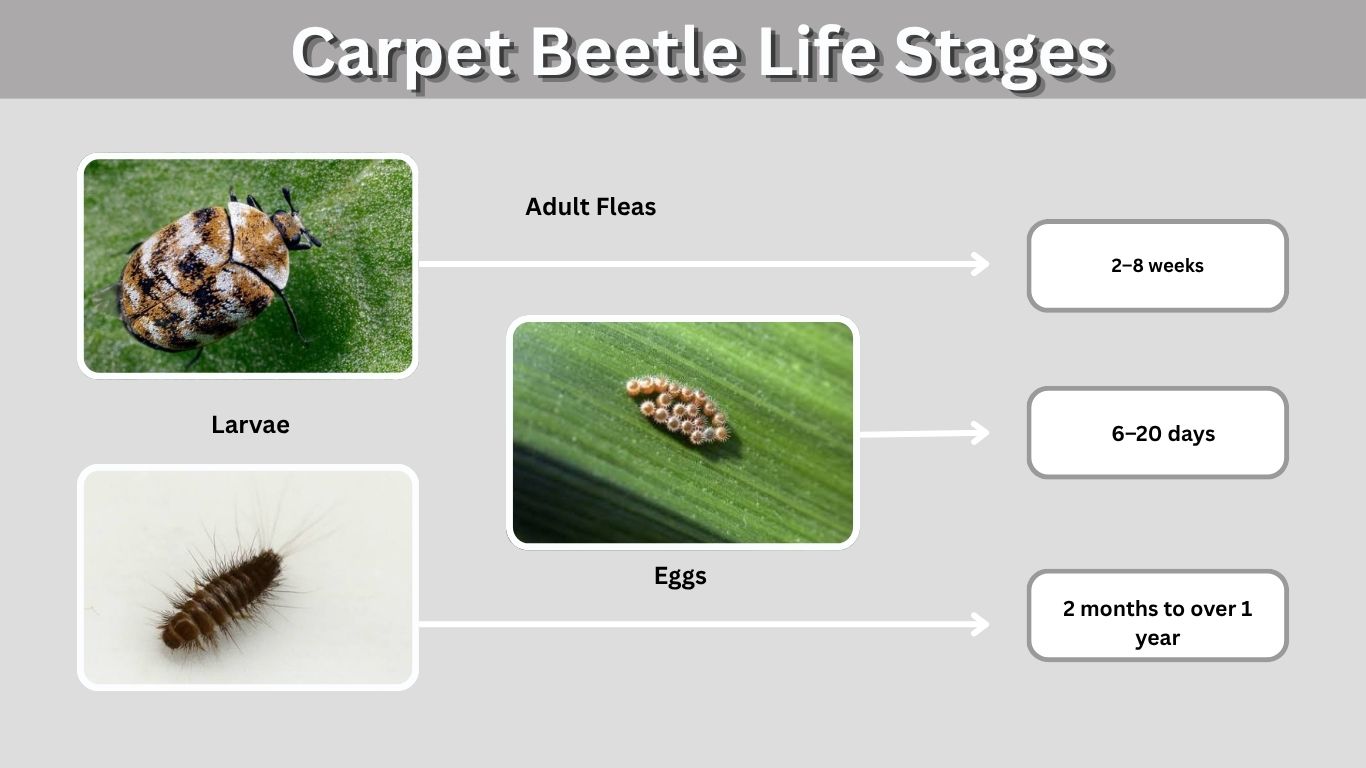
Understanding carpet beetle life stages helps homeowners identify infestations before these tiny insects damage clothing, furniture, and carpets. Carpet beetles develop through four distinct stages: egg, larva, pupa, and adult. Each stage has a different appearance, lifespan, and behavior. The larval stage is particularly important because larvae feed on wool, fur, feathers, and other natural materials. Depending on the species and environmental conditions, the complete life cycle can take several months to more than a year. This guide explains every carpet beetle stage, development time, and identification feature.
What Are the Four Carpet Beetle Life Stages?
Carpet beetles undergo complete metamorphosis, a biological process in which an insect develops through four different life stages. Each stage has a particular role in the insect’s growth, survival, and reproduction.
The four stages are egg, larva, pupa, and adult. Their development depends on temperature, food availability, humidity, and species.
Carpet Beetle Life Cycle Overview
| Life Stage | Appearance | Approximate Duration |
| Egg | Tiny, white or cream-colored | 6–20 days |
| Larva | Brown, elongated, and hairy | 2 months to over 1 year |
| Pupa | Pale, developing adult form | 8–17 days |
| Adult | Small, oval, and hard-shelled | 2–8 weeks |
These are representative ranges for common household carpet beetles, not fixed durations for every species. Some larvae may develop for considerably longer.
Stage 1: Carpet Beetle Eggs
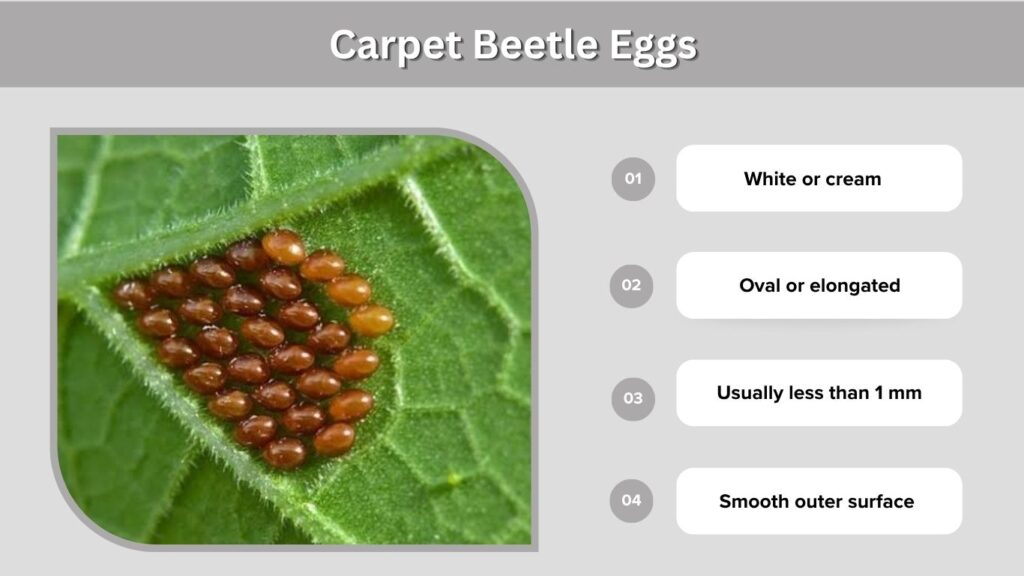
The carpet beetle life cycle begins when an adult female deposits eggs near suitable food sources. These eggs are usually placed in protected locations where newly hatched larvae can immediately find materials to consume.
Carpet beetle eggs are extremely small and often remain unnoticed until larvae emerge.
What Do Carpet Beetle Eggs Look Like?
Carpet beetle eggs have several identifying characteristics:
- Color: White or cream
- Shape: Oval or elongated
- Size: Usually less than 1 mm
- Texture: Smooth outer surface
- Location: Hidden cracks, fabric folds, and storage spaces
- Visibility: Difficult to detect without magnification
Female carpet beetles may deposit several dozen eggs, depending on the species.
How Long Do Carpet Beetle Eggs Take to Hatch?
Carpet beetle eggs generally hatch within one to three weeks.
According to the University of California Integrated Pest Management Program, varied carpet beetle eggs hatch in approximately 10–20 days, while black carpet beetle eggs hatch in about 6–16 days.
Warmer conditions can accelerate development, while cooler temperatures may extend the hatching period.
Stage 2: Carpet Beetle Larvae
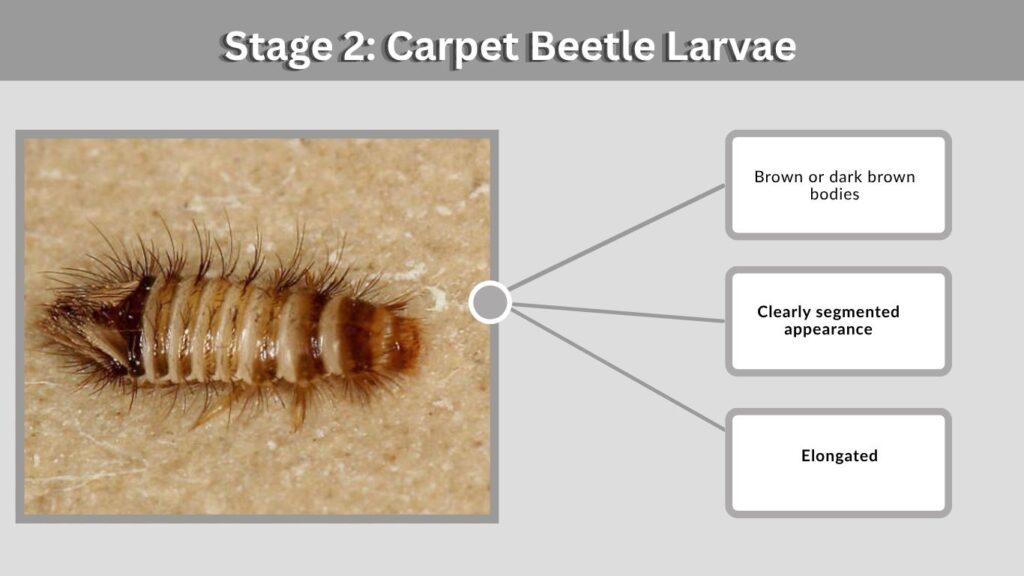
The carpet beetle larval stage is the most destructive part of the insect’s life cycle. Unlike adults, larvae feed on animal-derived materials and can cause substantial damage to household fabrics.
This stage also lasts much longer than the egg or pupal stages.
What Do Carpet Beetle Larvae Look Like?
Carpet beetle larvae resemble tiny, hairy caterpillars or elongated worms.
Their physical characteristics include:
- Brown or dark brown bodies
- Clearly segmented appearance
- Numerous stiff hairs or bristles
- Elongated or tapered body shape
- Small legs near the front of the body
- Hair tufts at the rear in some species
- Slow crawling movement
Mature larvae may measure approximately 4–13 mm long, depending on the species.
Varied carpet beetle larvae often have light and dark bands, while black carpet beetle larvae are generally more elongated and uniformly brown.
Carpet Beetle Larvae Growth Stages
Carpet beetle larvae pass through several developmental stages called instars.
During each instar, the larva grows until its outer covering becomes too restrictive. It then molts, shedding its old skin.
The number of molts differs among species and environmental conditions. Some carpet beetle larvae molt more than ten times before pupating.
Discarded larval skins are common indicators of an indoor infestation.
How Long Does the Larval Stage Last?
The larval stage can last several months or considerably longer.
For example, varied carpet beetle larvae may develop for approximately 220–630 days, while black carpet beetle larvae often require around 166–330 days.
Insufficient food, cooler conditions, and other environmental factors can delay development.
What Do Carpet Beetle Larvae Eat?
Carpet beetle larvae feed on materials containing animal proteins, particularly keratin.
Common food sources include wool carpets, fur, feathers, silk, animal hair, dead insects, and natural-fiber upholstery.
They may also damage certain plant-based or synthetic fabrics when these materials are contaminated with food residues, oils, or other nutritious substances.
Stage 3: Carpet Beetle Pupa
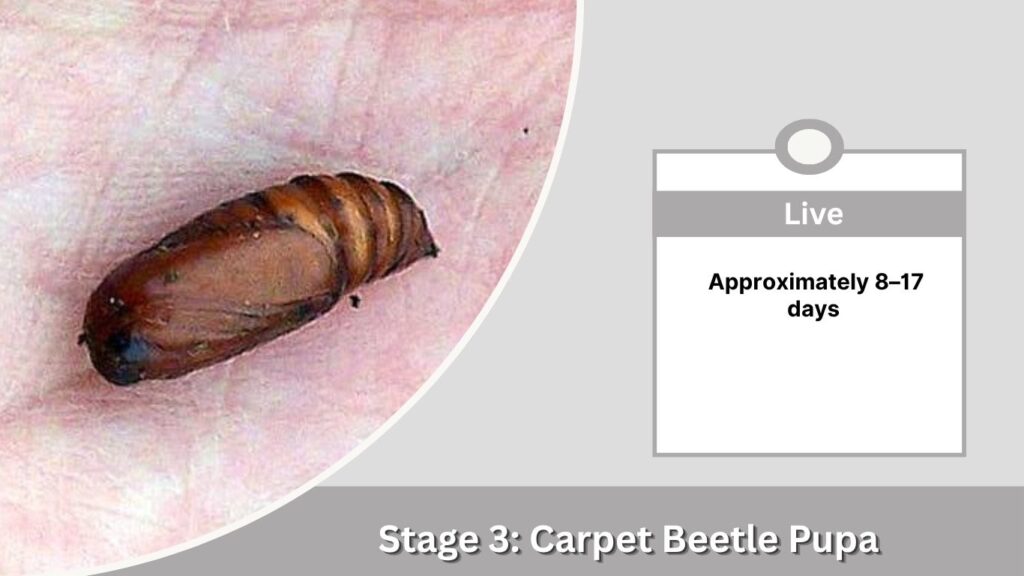
After completing larval development, carpet beetles enter the pupal stage. During this period, the insect undergoes major internal changes that transform it into an adult beetle.
The pupa does not actively feed, and its movement is extremely limited.
What Does a Carpet Beetle Pupa Look Like?
Carpet beetle pupae are generally pale or cream-colored when newly formed.
Their appearance gradually changes as adult structures develop.
Unlike butterfly pupae, carpet beetle pupae are often concealed within the final larval skin.
Because they remain hidden in protected areas, homeowners rarely notice them.
How Long Does the Pupal Stage Last?
For several common carpet beetle species, pupation lasts approximately 8–17 days.
Black carpet beetles may remain in the pupal stage for about 8–14 days, while varied carpet beetles generally spend around 10–13 days pupating.
Temperature influences the speed of development.
After metamorphosis is complete, the adult may remain inside the old larval skin briefly before emerging.
Stage 4: Adult Carpet Beetle
The adult stage represents the final phase of carpet beetle development. Adults have hardened wing covers, functional wings, and fully developed reproductive organs.
Unlike larvae, adult carpet beetles generally do not damage household fabrics.
Instead, many species feed on pollen and nectar outdoors.
What Do Adult Carpet Beetles Look Like?
Adult carpet beetles are typically small, oval insects measuring approximately 2–5 mm long.
Their appearance depends on the species.
Varied carpet beetles have mottled white, brown, and yellowish markings. Black carpet beetles are usually dark brown or black with more elongated bodies.
Adults have six legs, short antennae, and wings that allow them to fly.
How Long Do Adult Carpet Beetles Live?
Adult carpet beetles generally live for several weeks.
According to UC IPM, adult varied carpet beetles may survive approximately two to six weeks, depending on sex.
Furniture and black carpet beetle adults commonly live around four to eight weeks.
During this period, adults mate, females lay eggs, and the next generation begins developing.
Black vs. Varied Carpet Beetle Life Stages
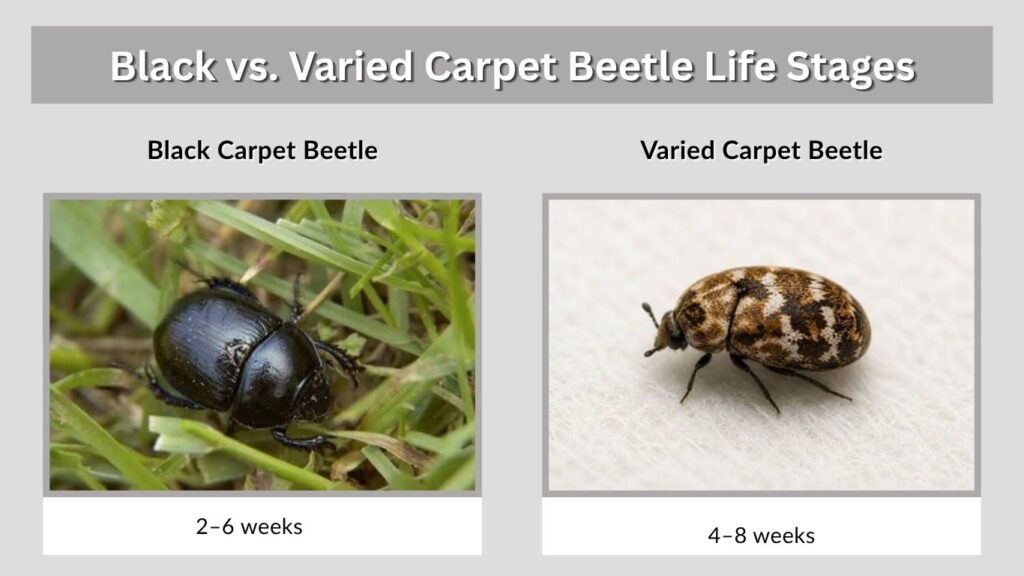
Although carpet beetles share the same four-stage life cycle, their development times vary considerably between species.
Varied carpet beetles often spend longer developing as larvae than furniture carpet beetles.
Development Time by Species
| Development Stage | Varied Carpet Beetle | Black Carpet Beetle | Furniture Carpet Beetle |
| Egg | 10–20 days | 6–16 days | 9–16 days |
| Larva | 220–630 days | 166–330 days | 70–94 days |
| Pupa | 10–13 days | 8–14 days | 14–17 days |
| Adult | 2–6 weeks | 4–8 weeks | 4–8 weeks |
These figures are representative development ranges reported by UC IPM. Actual durations vary with environmental conditions.
Which Carpet Beetle Stage Causes the Most Damage?
The larval stage causes nearly all carpet beetle damage to household fabrics.
Larvae require substantial amounts of food to support growth and repeated molting. They often remain concealed inside carpets, furniture, or clothing storage areas.
Adult beetles may enter homes and reproduce, but they usually do not feed on fabrics.
Signs of Carpet Beetle Larval Damage
Important warning signs include:
- Small irregular holes in wool clothing
- Damaged carpet edges
- Bare patches on fur or animal-based materials
- Brown, hairy larvae beneath furniture
- Shed larval skins in storage areas
- Damage to natural-fiber upholstery
Finding adult beetles near windows does not necessarily indicate a serious infestation. Discovering feeding larvae is a stronger indication of an active problem.
How to Stop Carpet Beetles at Every Life Stage
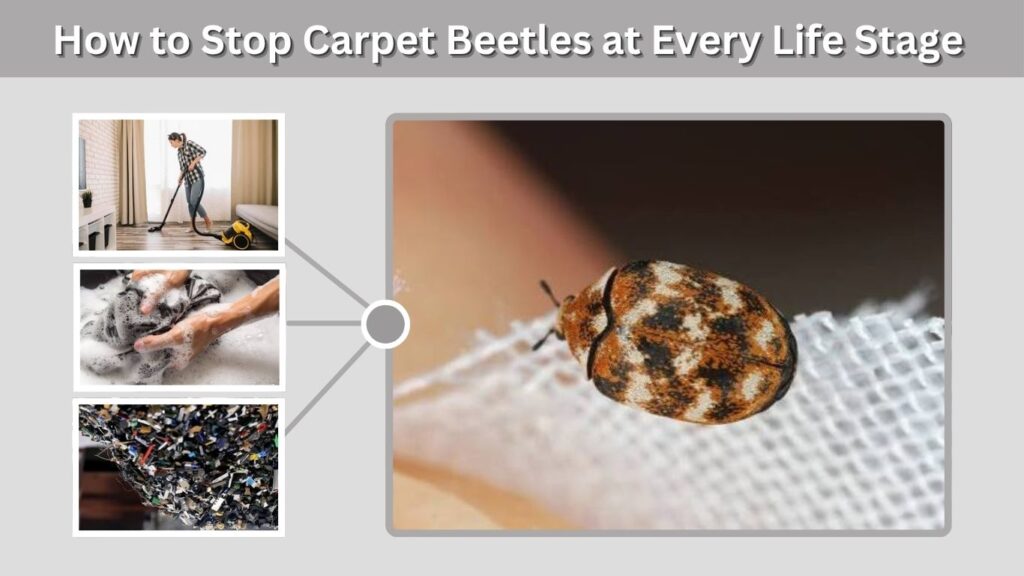
Effective carpet beetle control involves removing larvae, eggs, and infested materials while preventing adults from establishing new populations.
Because larvae are often hidden, thorough cleaning and inspection are essential.
Carpet Beetle Prevention and Control Methods
- Vacuum Regularly: Clean carpets, furniture edges, baseboards, and other concealed locations.
- Wash Infested Clothing: Use suitable hot-water laundering or professional dry cleaning to eliminate insect stages from affected fabrics.
- Remove Larval Food Sources: Eliminate accumulated pet hair, lint, dead insects, and heavily infested materials.
- Protect Stored Fabrics: Keep clean wool, silk, and other vulnerable textiles inside airtight containers.
- Inspect Hidden Spaces: Check closets, attics, furniture seams, and areas beneath rugs.
- Seal Entry Points: Repair damaged window screens and gaps that allow adult beetles indoors.
- Monitor Activity: Reinspect affected locations for larvae, shed skins, or new fabric damage.
Addressing the larval food source is generally more effective than treating only the adult beetles you can see.
FAQs
1. How many stages are in a carpet beetle’s life cycle?
Carpet beetles have four life stages: egg, larva, pupa, and adult. They undergo complete metamorphosis, meaning their appearance changes significantly during development. The larval stage is usually the longest and causes most household fabric damage.
2. How long does the complete carpet beetle life cycle take?
The complete carpet beetle life cycle can take several months to more than a year. Development depends on the species, temperature, humidity, and food availability. Varied carpet beetles often have particularly long larval stages, sometimes lasting over 600 days.
3. What is the first stage of a carpet beetle?
The egg is the first stage of carpet beetle development. Adult females deposit tiny, pale eggs near suitable larval food sources. Depending on the species and environmental conditions, these eggs generally hatch within approximately one to three weeks.
4. Do carpet beetles fly during every life stage?
No, carpet beetles can fly only during the adult stage. Eggs, larvae, and pupae cannot fly. Adult beetles have functional wings and may travel between outdoor feeding locations and indoor spaces where females can deposit eggs.
5. Which carpet beetle stage is hardest to eliminate?
The larval stage is often the most challenging to eliminate because larvae hide in dark, undisturbed locations and may survive for months. Effective control requires identifying their food sources, cleaning concealed areas, and removing or treating infested materials.
