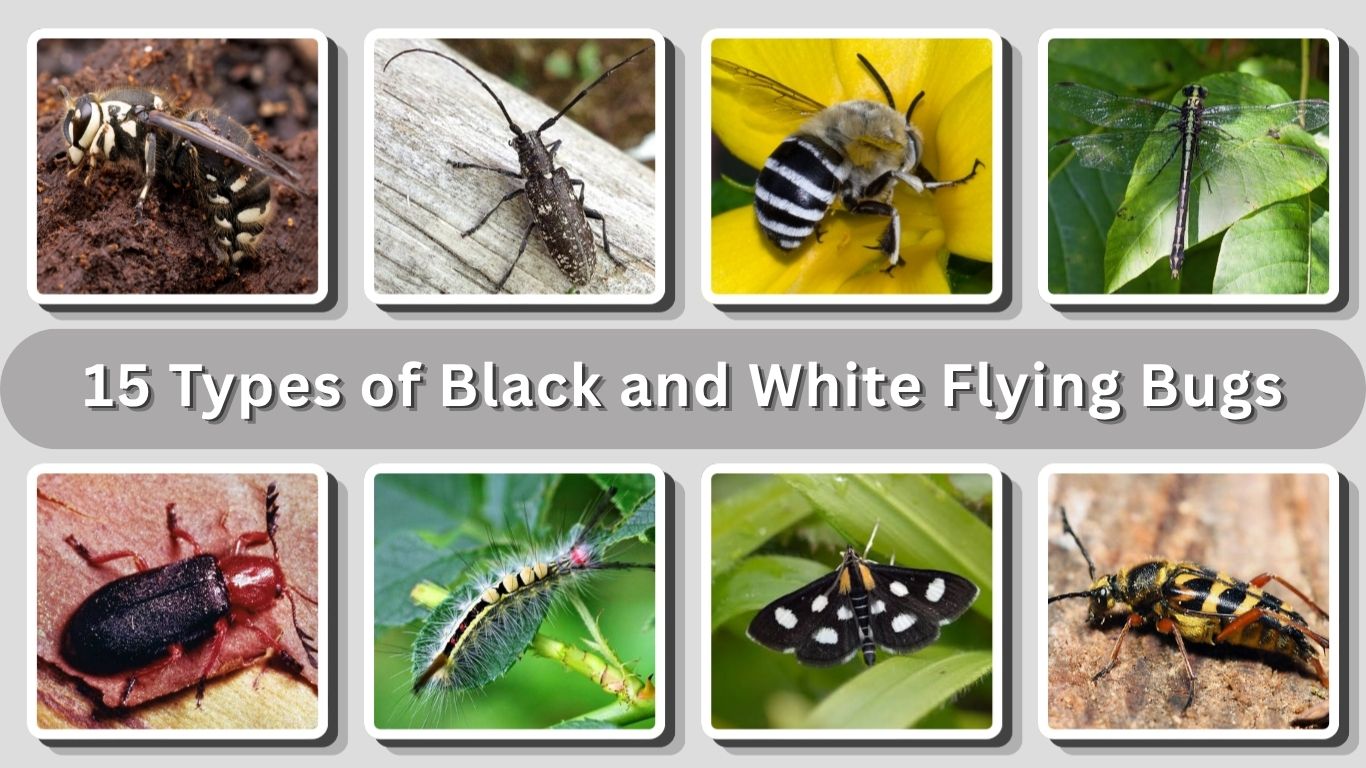
Black and white flying bugs can range from harmless moths and beetles to bees, wasps, and hornets that may sting when threatened. Some have bold stripes, while others show white spots, patterned wings, or black-and-white legs and antennae. Because many of these insects look similar, proper identification can be difficult. This guide covers 15 common black and white flying bugs, including small, large, striped, and spotted species, with details about their appearance, habitat, behavior, diet, and whether they can bite or sting.
1. Bald-Faced Hornet
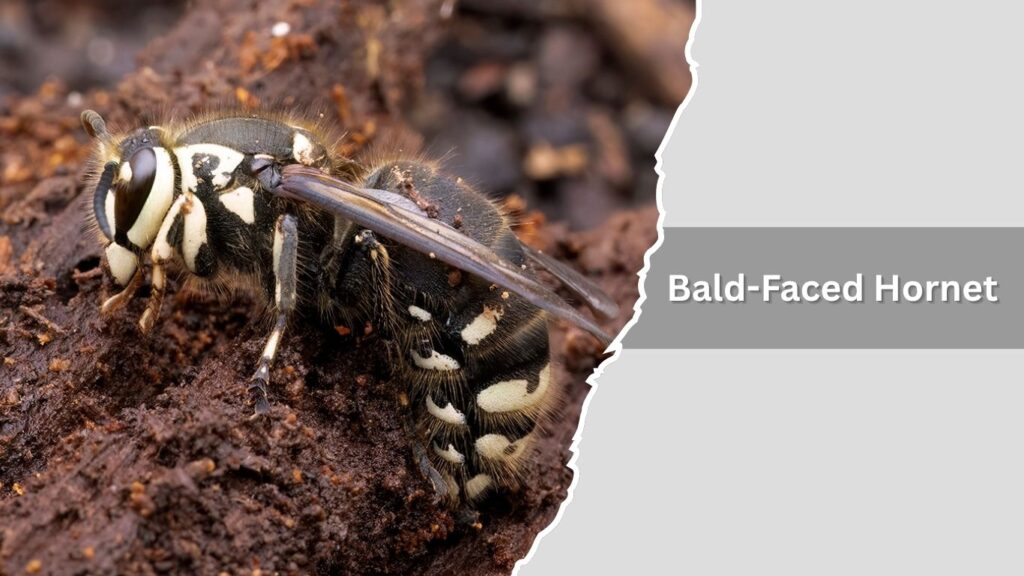
The bald-faced hornet is one of the most noticeable black and white flying bugs found around homes, gardens, forests, and wooded areas in North America. Despite its name, it is not a true hornet but a type of yellowjacket wasp. Its bold white markings, dark body, and relatively large size make it easy to recognize. These social insects build large paper nests and can become defensive when their colony is disturbed.
Identification
- Mostly black body with distinctive ivory-white markings on the face
- White bands or patches near the end of the abdomen
- Usually about 1/2 to 3/4 inch long
- Six dark legs and two transparent wings
- Broad head with noticeable black-and-white facial markings
- Larger and more robust than many common yellowjackets
- Often appears as a large black and white flying bug around trees and gardens
Habitat and Nesting
Bald-faced hornets commonly live in forests, parks, gardens, orchards, and suburban areas. They construct enclosed, football-shaped nests from chewed wood fibers mixed with saliva. These nests are usually attached to tree branches, shrubs, utility structures, or occasionally buildings.
A colony can grow substantially during summer. The nest is generally abandoned when cold weather arrives, while newly produced queens survive winter elsewhere and begin new colonies the following spring.
Behavior and Sting Risk
This black and white striped flying bug is usually more interested in hunting insects than interacting with people. However, workers can become highly defensive near their nest. Unlike honey bees, bald-faced hornets can sting repeatedly.
Their sting can be painful, so nests located near doors, walkways, playgrounds, or other frequently used areas should be approached carefully. Seeing a single hornet feeding away from the nest is generally less concerning than encountering several individuals around a colony.
Diet and Role in Nature
Bald-faced hornets are predators and scavengers. They capture flies, caterpillars, and other insects to feed developing larvae. Adults also consume nectar, fruit juices, and other sugary substances.
Although people often fear this black and white flying bug with a stinger, it can be beneficial because it helps control populations of other insects. Its predatory behavior makes it an important part of the local food web and natural insect-control system.
2. Four-Toothed Mason Wasp
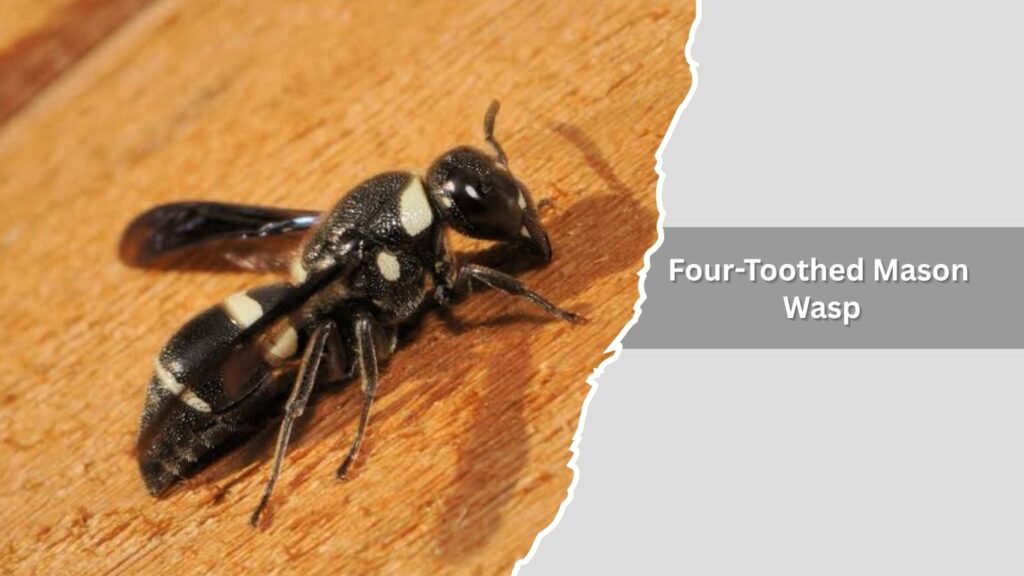
The four-toothed mason wasp is a striking black and white flying bug that is often mistaken for a small hornet or yellowjacket. Its dark body is marked with pale white or ivory bands, giving it a sharp striped appearance. Unlike social wasps that live in large colonies, mason wasps are solitary. They are commonly seen around gardens, wooden structures, and flowering plants where they hunt caterpillars and search for nesting cavities.
Identification
- Mostly black body with white or ivory markings
- Pale bands visible across parts of the abdomen
- Usually around 1/2 inch long
- Narrow waist between the thorax and abdomen
- Dark wings that may appear slightly smoky
- Six slender legs and long antennae
- Often resembles a black and white striped flying bug
Habitat and Nesting
Four-toothed mason wasps are commonly found in gardens, woodland edges, fields, and residential areas. Females often use pre-existing holes in wood, hollow stems, or abandoned insect tunnels for nesting.
They build partitions inside these cavities using mud or clay. Each chamber contains food for a developing larva, making these wasps very different from large social colonies such as hornets.
Behavior and Sting Risk
This species is usually not aggressive toward people. Because it is solitary, it has no large communal nest to defend. Females have a stinger, but stings generally occur only when the insect is trapped, squeezed, or handled.
For most homeowners, seeing one around flowers or walls is not a serious concern. Its behavior is focused mainly on hunting and nesting rather than defending territory.
Diet and Garden Benefits
Adult mason wasps feed on nectar, while females hunt caterpillars to provision their nests. The captured prey is paralyzed and stored as food for developing larvae.
Because caterpillars can damage garden plants, this small black and white flying bug can actually be beneficial. Its natural hunting activity helps reduce certain plant-feeding insects without harming flowers or vegetables.
3. Tiger Bee Fly
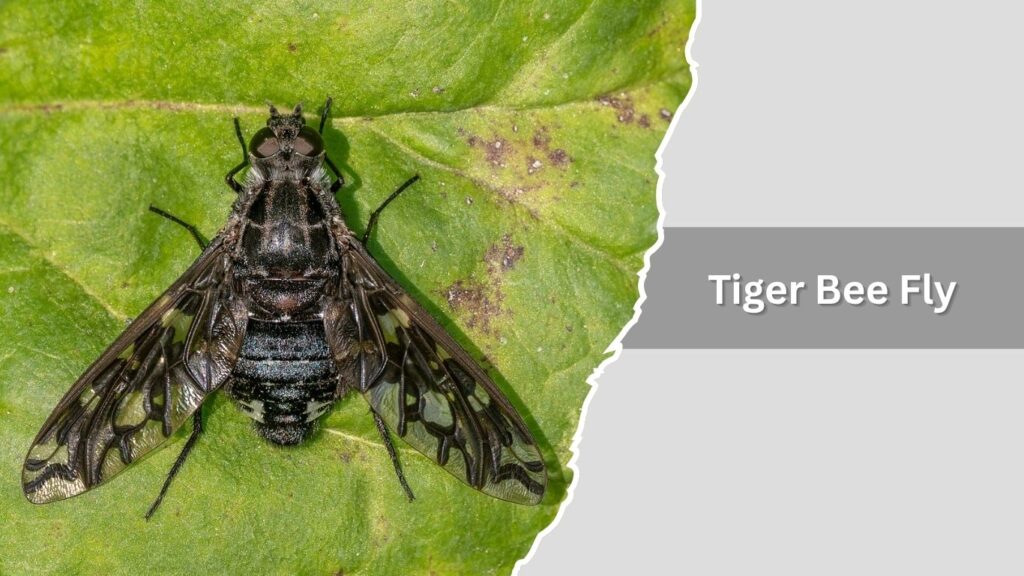
The tiger bee fly is a large, unusual black and white spotted flying bug commonly noticed around wooden fences, decks, barns, and homes. Its dark body and patterned wings give it a dramatic appearance, while its hovering flight can make it look intimidating. Despite its size and bee-like name, this insect does not sting and is harmless to people.
Identification
- Large, stout-bodied fly
- Mostly dark brown or black body
- Wings marked with bold black and clear patches
- Pale or whitish markings may be visible on the body
- Long, forward-pointing mouthparts
- Often hovers near wooden structures
- Can resemble a big black and white flying bug
Habitat and Common Locations
Tiger bee flies are especially common where carpenter bees are active. They may be seen around wooden siding, fence posts, decks, barns, and exposed timbers.
Females search for carpenter bee nesting holes because their larvae develop in association with carpenter bee nests. Adults are also found near flowers and sunny open spaces during warm months.
Behavior and Safety
Although its appearance can be alarming, the tiger bee fly is not aggressive. It does not possess a stinger and does not bite people.
Its hovering behavior sometimes causes confusion because it may remain suspended in the air near a person or wooden wall. In reality, it is usually investigating nesting areas or searching for suitable places to lay eggs.
Diet and Life Cycle
Adult tiger bee flies feed mainly on nectar and other sugary plant liquids. Their larvae have a more unusual lifestyle, developing near carpenter bee larvae inside nest tunnels.
The larvae feed on provisions and immature carpenter bees. This relationship helps naturally regulate carpenter bee populations, making the tiger bee fly an interesting and ecologically important black and white flying insect.
4. White-Spotted Sawyer Beetle
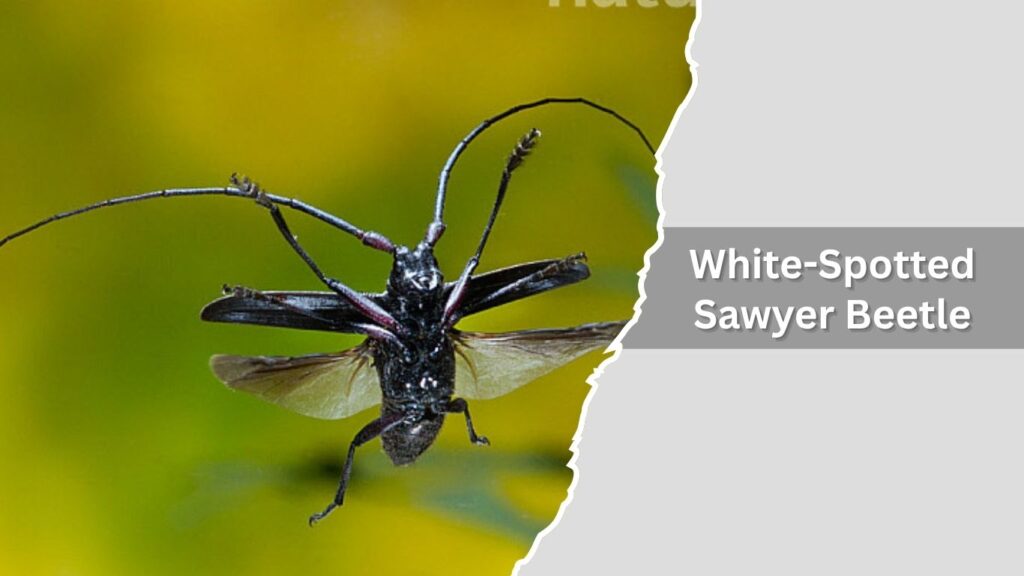
The white-spotted sawyer beetle is a long-bodied black and white flying bug found primarily in forested regions where conifer trees grow. It belongs to the longhorn beetle family and is recognized by its dark coloration, very long antennae, and distinctive pale spot near the base of the wing covers. Adults are strong fliers and are often seen resting on tree trunks, logs, or outdoor structures.
Identification
- Dark brown to nearly black body
- Noticeable white spot near the base of the wing covers
- Long antennae, often as long as or longer than the body
- Elongated, cylindrical shape
- Six sturdy legs
- Adults can reach around 3/4 to over 1 inch long
- May appear as a large black and white flying bug
Habitat and Tree Association
White-spotted sawyer beetles are most commonly associated with pine, spruce, fir, and other coniferous trees. They are especially attracted to weakened, dying, recently cut, or fire-damaged wood.
Adults may appear around lumber piles, cabins, campsites, and wooded properties. Their presence often indicates nearby conifer wood rather than an infestation of healthy structures.
Behavior and Human Interaction
These beetles can fly actively during warm weather, and their size sometimes causes concern. However, they do not sting and are not considered dangerous to people.
Their strong jaws can pinch if handled roughly, but they generally avoid humans. They are much more interested in trees and suitable wood for egg laying.
Diet and Life Cycle
The larvae tunnel inside dead or weakened conifer wood, feeding beneath the bark and deeper into the timber. Adults may feed on bark, twigs, or plant materials.
Although they can contribute to wood deterioration in damaged trees, they also help break down dead wood. This recycling role makes the white-spotted sawyer an important part of forest ecosystems.
5. Banded Alder Borer
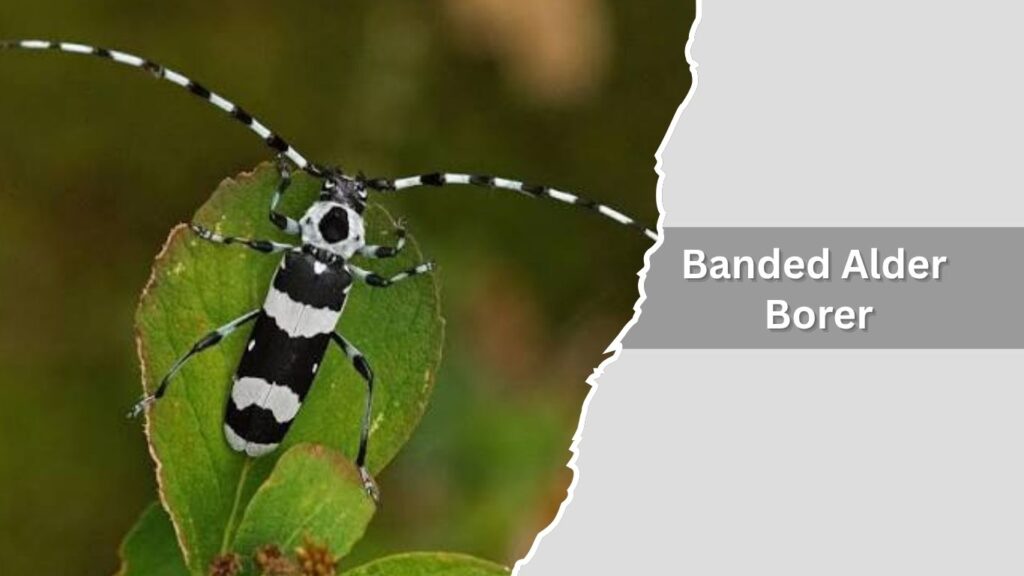
The banded alder borer is one of the most visually striking black and white striped flying bugs in North America. This longhorn beetle has alternating black and pale bands across its body, creating a zebra-like pattern. Its long antennae and relatively large size make it easy to notice when it lands on trees, firewood, buildings, or vehicles.
Identification
- Black body with broad white or cream-colored bands
- Long, segmented antennae
- Elongated beetle-shaped body
- Six long legs
- Bold black-and-white pattern across the wing covers
- Usually around 3/4 to 1 inch long
- Easily mistaken for a flying bug with black and white stripes
Habitat and Host Trees
Banded alder borers are generally found near forests, streams, and moist areas where alder and other hardwood trees grow. The larvae develop inside dead or decaying wood.
Adults may also appear around freshly cut firewood, fallen branches, and timber piles. They sometimes land on painted surfaces or buildings, possibly because certain colors resemble suitable wood.
Behavior and Safety
Despite its dramatic appearance, the banded alder borer is harmless to people. It does not sting and is not known for aggressive behavior.
The beetle may fly quickly when disturbed, but it generally spends its time searching for mates or suitable wood for egg laying. Its long antennae are used to detect environmental cues.
Diet and Ecological Role
Larvae feed within dead or dying hardwood, helping break down woody material. Adults may feed very little or consume plant juices and other natural materials.
By assisting in decomposition, these beetles help return nutrients to the soil. Their black-and-white pattern also makes them one of the most recognizable longhorn beetles encountered outdoors.
6. Eyed Click Beetle
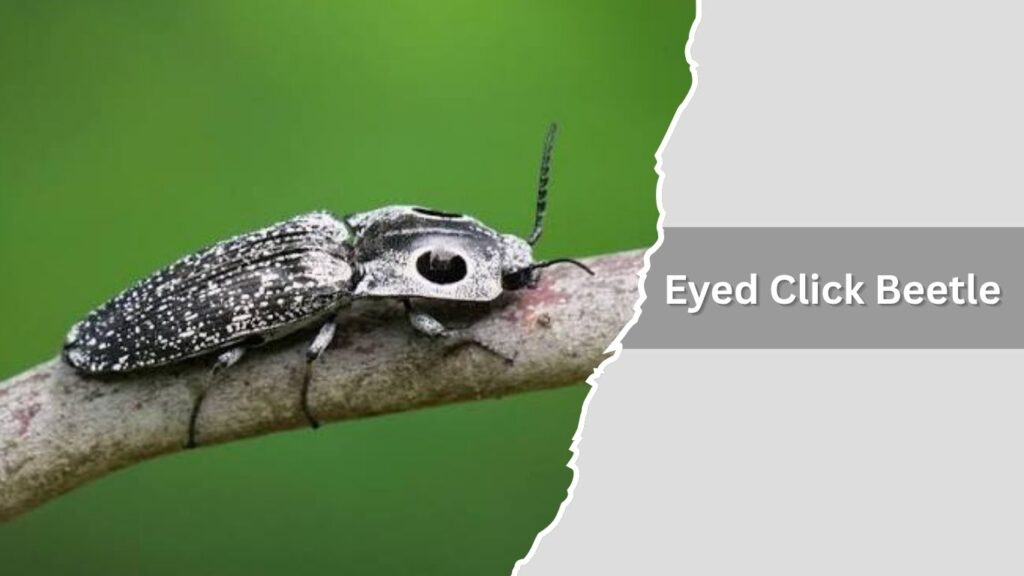
The eyed click beetle is a large flying beetle known for the two enormous eye-like markings on its thorax. Although the insect itself is mostly black, pale speckling and white edging around the false eyes can give it a distinct black and white flying bug appearance. It is especially common near forests, fallen logs, and outdoor lights.
Identification
- Large elongated black or dark gray body
- Two prominent eye-like spots on the thorax
- White or pale borders around the false eye markings
- Speckled gray-and-white pattern across the wing covers
- Usually more than 1 inch long
- Can flip or “click” into the air when placed on its back
- Often described as a big black and white flying bug
Habitat and Where It Appears
Eyed click beetles are usually found in wooded areas with plenty of dead or decaying timber. Adults may rest on tree trunks, logs, fences, and walls.
They are sometimes attracted to outdoor lighting at night, which can bring them close to homes. Their large size often makes them seem more threatening than they actually are.
Behavior and Human Safety
This beetle is harmless to humans. It does not sting, and bites are extremely unlikely. Its most famous behavior is its clicking mechanism.
When threatened or overturned, the beetle snaps a structure on its underside, producing a loud click and launching itself upward. This helps it escape predators and return to its feet.
Diet and Life Cycle
Eyed click beetle larvae, often called wireworms, live inside decaying wood. Unlike many wireworms that feed on plants, these larvae often prey on other insects living in rotting timber.
Adults may feed on plant fluids or take little food. Their predatory larvae can help regulate insect populations inside dead wood.
7. Polka-Dot Wasp Moth
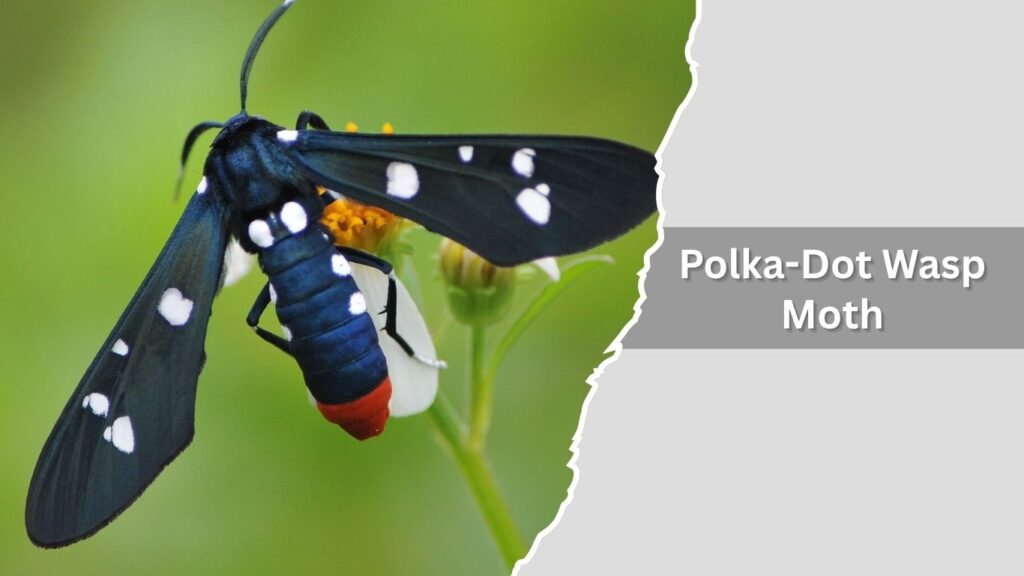
The polka-dot wasp moth is a colorful black and white spotted flying bug that closely resembles a wasp. Its dark body, white spots, and bright orange or red accents make it especially easy to recognize. This moth is active during the day and may be seen flying around gardens, flowering shrubs, and areas where oleander plants grow.
Identification
- Dark blue-black or black body
- Numerous white spots across the wings and abdomen
- Bright orange or red tip on the abdomen
- Slender, wasp-like body shape
- Transparent or dark wings with pale spots
- Long antennae
- Often described as a black and white polka dot flying bug
Habitat and Distribution
Polka-dot wasp moths are most common in warm climates, especially in Florida, the Caribbean, and other subtropical areas. They are closely associated with oleander plants.
Adults may be found in gardens, urban landscapes, parks, and coastal areas. Their bright pattern makes them stand out when resting on leaves or flowers.
Behavior and Defense
Despite looking like a stinging wasp, this moth cannot sting. Its wasp-like colors and shape are thought to help discourage predators.
Adults are active during daylight and often fly quickly between flowers. Their harmless nature makes them much less dangerous than their appearance suggests.
Diet and Caterpillars
Adult moths feed on flower nectar. The larvae, commonly called oleander caterpillars, feed heavily on oleander leaves.
Large numbers of caterpillars can strip foliage from ornamental oleanders. However, the plants often recover. This insect is therefore both an eye-catching pollinator as an adult and a noticeable plant feeder during its caterpillar stage.
8. Zebra Longhorn Beetle
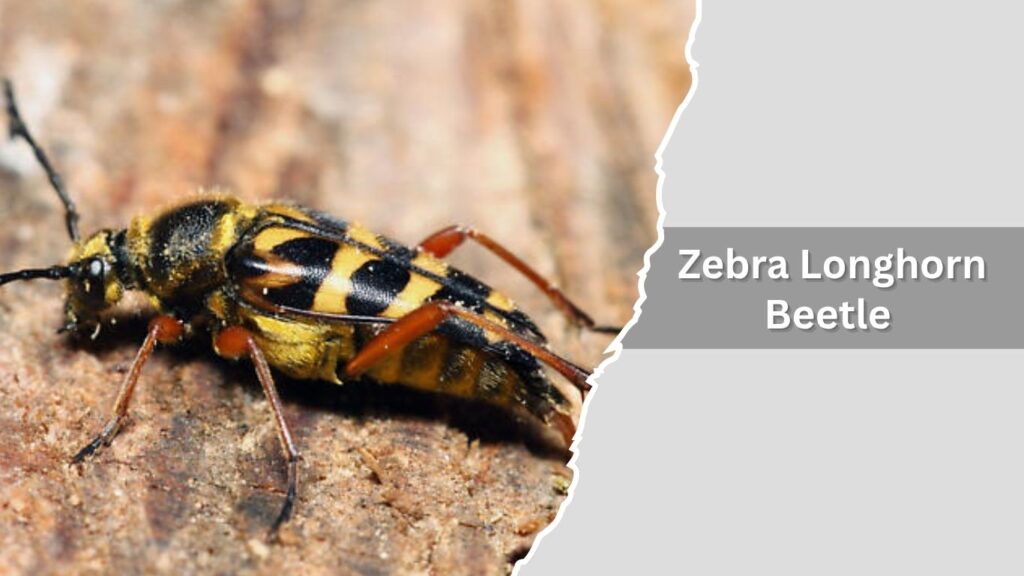
The zebra longhorn beetle is a patterned black and white flying bug named for its alternating pale and dark markings. Like other longhorn beetles, it has an elongated body and prominent antennae. Depending on the species being described by the common name, the markings may appear white, cream, gray, or yellowish against a black background.
Identification
- Long, narrow beetle-shaped body
- Black or very dark base coloration
- Pale bands or stripes across the wing covers
- Long segmented antennae
- Six slender legs
- Strong wings hidden beneath hardened wing covers
- Commonly resembles a flying black and white striped bug
Habitat and Wood Preference
Zebra-patterned longhorn beetles are usually associated with wooded habitats, dead branches, fallen logs, and aging trees. Some species develop in hardwood, while others use specific host trees.
Adults are often seen on tree bark, flowers, wood piles, or recently cut timber. Warm sunny weather can increase their flying activity.
Behavior and Human Interaction
These beetles are generally harmless to people. They do not sting and are not aggressive. Like other longhorn beetles, they may use their jaws defensively if handled, but accidental bites are uncommon.
Their long antennae are important for sensing their environment and detecting potential mates or suitable host plants.
Diet and Life Cycle
Larvae typically develop inside dead, dying, or weakened wood. They create tunnels while feeding, sometimes remaining inside the wood for an extended period before emerging as adults.
Adult beetles may feed on nectar, pollen, bark, or plant fluids depending on the species. Their wood-feeding larvae contribute to decomposition and nutrient recycling in forests.
9. White-Spotted Sable Moth
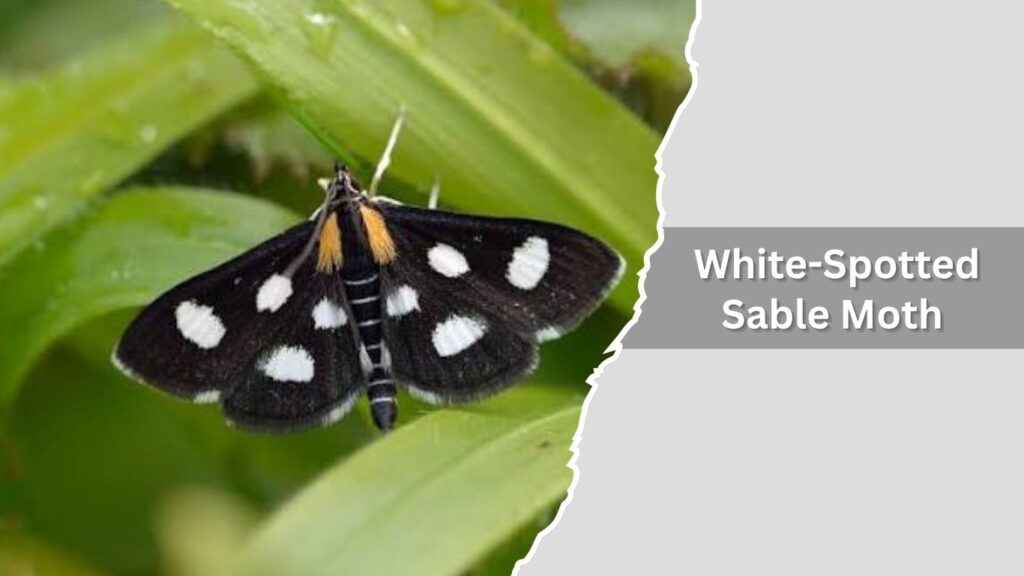
The white-spotted sable moth is a small, elegant black and white flying bug known for its dark wings decorated with contrasting pale spots. It is active during the daytime and is often seen around flowers, hedgerows, woodland edges, and grassy areas. Because of its narrow body and quick flight, people may initially mistake it for a tiny wasp or beetle rather than a moth.
Identification
- Small black or very dark body
- Wings marked with noticeable white or cream spots
- Slender body with relatively long legs
- Narrow wings held flat or slightly angled while resting
- Long antennae compared with many other small moths
- Usually less than 1 inch across
- Often appears as a tiny black and white flying bug
Habitat and Distribution
White-spotted sable moths are usually found in places with plenty of low vegetation and flowering plants. Woodland margins, meadows, gardens, hedges, and damp grassy areas can all provide suitable habitat.
Adults are most noticeable during warm, sunny weather when they fly between flowers. Their patterned wings make them relatively easy to notice despite their small size.
Behavior and Human Safety
This moth is completely harmless to people. It cannot sting, and it does not bite. Its black-and-white pattern can make it resemble a small defensive insect, but it relies mainly on quick flight and camouflage to escape predators.
Adults are often active during daylight, which is unusual compared with the many moth species that fly primarily at night.
Diet and Life Cycle
Adult sable moths commonly feed on nectar from small flowers. Their caterpillars feed on specific host plants, depending on the exact species.
The larvae may live among folded or webbed leaves for protection while feeding. As adults, these moths can contribute modestly to pollination while moving between flowers in search of nectar.
10. White-Banded Digger Bee
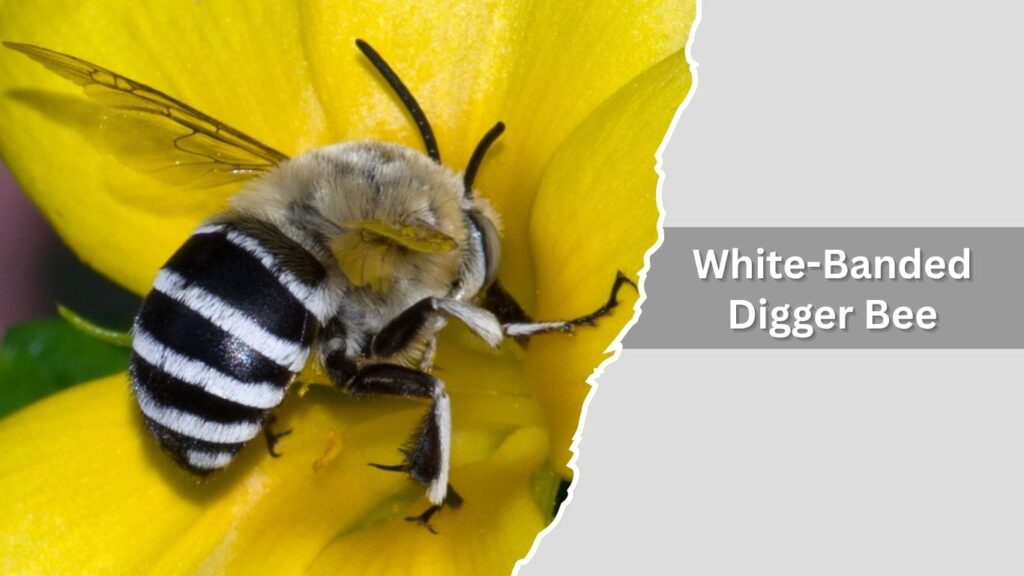
The white-banded digger bee is a solitary bee that can look like a black and white flying bug that looks like a bee, especially when pale hair bands are visible across its abdomen. These bees are usually found close to the ground because females excavate individual nests in soil. They are useful pollinators and are generally much less aggressive than social bees or wasps.
Identification
- Dark brown to black body
- Pale white or grayish hair bands on the abdomen
- Hairy thorax and legs
- Six legs with pollen-collecting hairs on females
- Transparent wings
- Moderate-sized, compact body
- May resemble a black and white striped flying bug
Habitat and Nesting
Digger bees commonly live in gardens, lawns, open fields, sandy banks, and areas with loose, well-drained soil. A female creates her own underground nest rather than sharing a large colony.
Several females may nest close together when the soil is suitable, creating what appears to be a colony. However, each bee generally maintains its own nest entrance and brood chambers.
Behavior and Sting Risk
These bees are usually peaceful around people. Males do not have stingers, while females can sting but rarely do so unless they are handled or trapped.
Even when many nest entrances appear in one area, digger bees usually pose little danger. Their activity is concentrated on gathering pollen, nectar, and nesting materials.
Diet and Pollination Value
Adults collect nectar and pollen from a variety of flowering plants. Females carry these resources back to their nests, where they create food stores for developing larvae.
Because they visit many flowers, white-banded digger bees are beneficial pollinators. Their presence in a garden is usually a positive sign of a healthy flowering habitat.
11. Black-and-White Sand Wasp
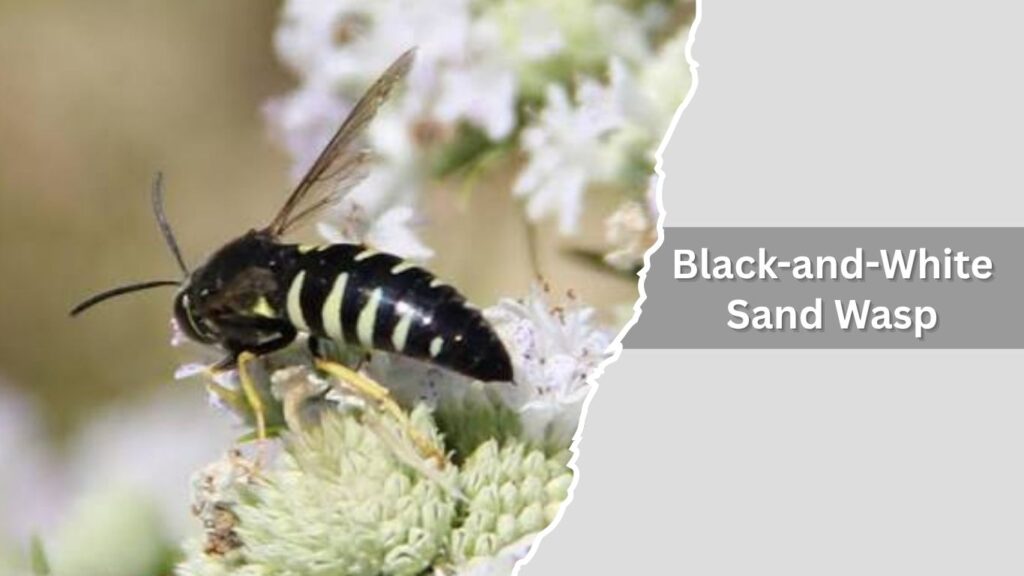
The black-and-white sand wasp is a fast-moving solitary wasp frequently found in sandy or open areas. Its dark body is often decorated with white or cream bands, making it an excellent match for searches involving a flying bug with black and white stripes. Although it may resemble an aggressive social wasp, sand wasps usually focus on hunting prey and maintaining underground nests.
Identification
- Black body with pale white or cream abdominal bands
- Slender waist between thorax and abdomen
- Large eyes and strong jaws
- Transparent or lightly tinted wings
- Six relatively long legs
- Fast, direct flight close to the ground
- Often resembles a small black and white flying bug similar to a wasp
Habitat and Nesting
Sand wasps prefer sunny locations with loose or sandy soil. They may live along dunes, paths, riverbanks, open fields, gardens, or sparsely vegetated ground.
Females dig burrows where they raise their offspring. These nests are solitary, although numerous females may use the same suitable patch of soil.
Behavior and Sting Risk
Despite their wasp-like appearance, sand wasps are not normally aggressive toward humans. Females can sting, but they generally reserve their stingers for prey or self-defense.
They are often seen flying low over the soil while searching for nesting sites or insects. Their quick movements can make them look more threatening than they really are.
Diet and Hunting
Adult sand wasps feed primarily on flower nectar. Females also hunt flies and other insects that are carried back to underground nests as food for their larvae.
This hunting behavior makes sand wasps helpful natural predators. By reducing populations of certain flies and other insects, they play a useful ecological role in open habitats.
12. Checkered Beetle
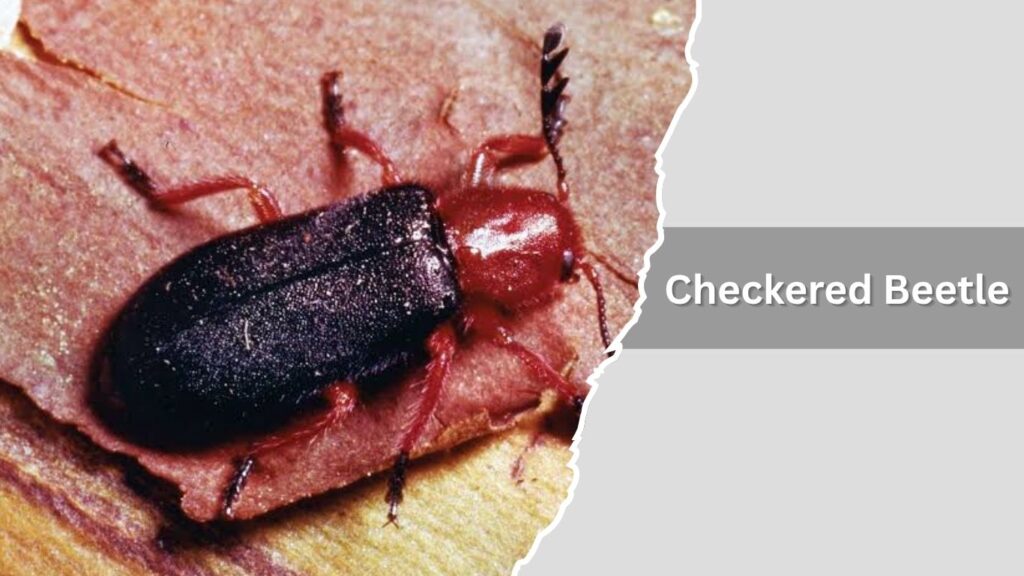
Checkered beetles are colorful predatory insects that often display bold combinations of black, white, red, orange, or yellow. Some species appear primarily black and white and may be noticed as a small black and white flying bug on tree trunks, flowers, dead wood, or stored timber. Their patterned bodies and active movements make them easy to distinguish from many plain-colored beetles.
Identification
- Elongated or slightly cylindrical body
- Black coloration with white, cream, or pale patches
- Some species have additional red or orange markings
- Six active legs
- Clubbed or slightly thickened antennae
- Hardened wing covers with contrasting patterns
- Usually small to medium in size
Habitat and Where They Live
Checkered beetles are commonly associated with woodlands, dead trees, bark, flowers, and places where other insects are abundant. Some species frequently occur around recently cut or dying wood.
Adults can also be found hunting on plant surfaces or visiting flowers. Their exact habitat depends on the species and the prey available.
Behavior and Safety
These beetles are not dangerous to people. They do not sting and are not considered aggressive. Their active running and flying behavior is primarily related to searching for prey or mates.
When disturbed, they may quickly fly away or hide under bark. Their bold markings may provide camouflage or warning-like coloration.
Diet and Ecological Importance
Many checkered beetles are predators. Both adults and larvae may feed on bark beetles, wood-boring insects, and other small arthropods.
Because some of their prey species can damage trees or stored wood, checkered beetles may act as natural pest controllers. Adults of certain species also visit flowers and consume pollen.
13. White-Marked Tussock Moth
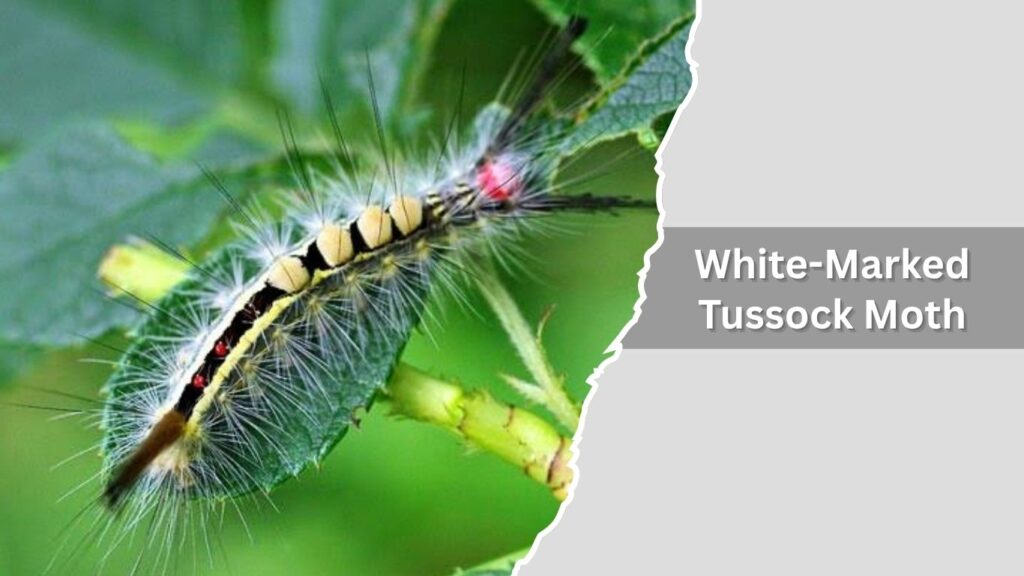
The white-marked tussock moth is a distinctive species whose adults and caterpillars look dramatically different. Adult males are winged and may appear as a black and white flying bug, while adult females are largely wingless. The species is especially well known for its unusually hairy caterpillar, which has tufts of white, black, and brightly colored hairs.
Identification
- Male moths have gray, brown, black, and whitish wing markings
- Wings may show wavy dark and pale bands
- Males have noticeably feathery antennae
- Compact, hairy body
- Female adults have reduced wings and do not fly normally
- Caterpillars have four prominent pale tussocks on the back
- Adults may be mistaken for a small white and black flying bug
Habitat and Host Plants
White-marked tussock moths occur in woodlands, gardens, parks, orchards, and urban landscapes. Their caterpillars feed on a broad range of deciduous trees and shrubs.
Common host plants can include oak, willow, maple, apple, birch, and many ornamental trees. This ability to use numerous plants allows the moth to survive in many different environments.
Behavior and Human Contact
Adult males are harmless and spend much of their time searching for females. The caterpillars, however, should generally not be handled.
Their hairs can cause skin irritation in some people. Reactions vary, but direct contact may result in itching or a rash, particularly in sensitive individuals.
Diet and Life Cycle
The caterpillar is the main feeding stage and consumes foliage from its host plants. Adult moths feed very little or may not feed at all, depending on the individual and conditions.
After completing their growth, caterpillars form cocoons and later emerge as adults. Their unusual appearance makes this species one of the more recognizable moths found around trees.
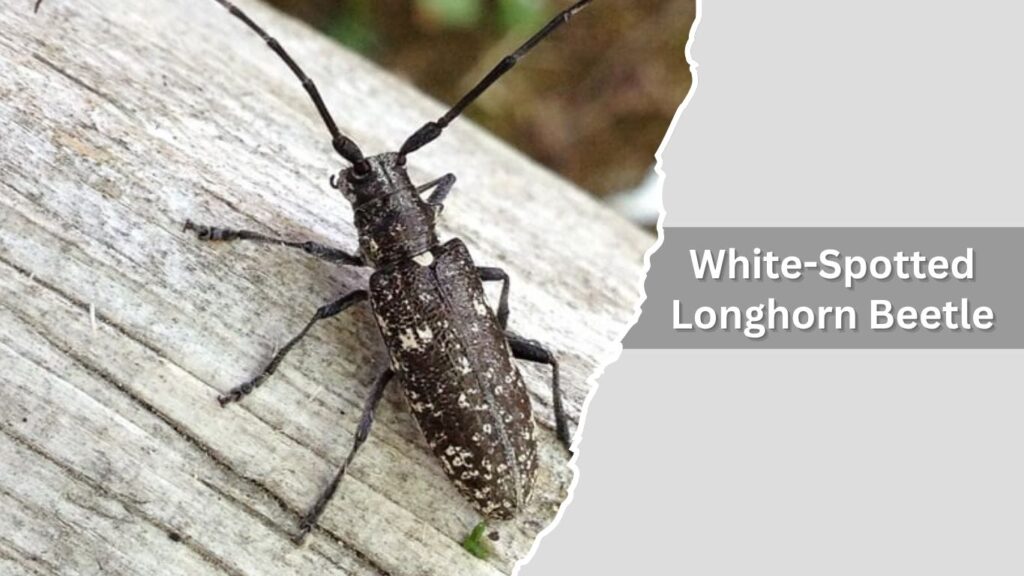
14. White-Spotted Longhorn Beetle
Identification
White-spotted longhorn beetles include several species that combine a dark body with conspicuous pale markings. Their very long antennae make them especially easy to recognize. When they take flight from wood piles or tree trunks, they may be described as a large flying bug with a black body and white spots.
- Dark brown, gray, or black body
- White or cream spots on the wing covers
- Extremely long antennae
- Elongated cylindrical body
- Six strong legs
- Hardened outer wings covering the flight wings
- Often around 1/2 to more than 1 inch long
Habitat and Wood Association
These beetles are closely associated with trees and wood. Adults may appear in forests, gardens, lumber yards, firewood piles, or around recently fallen branches.
Depending on the species, larvae can develop in dead, dying, or weakened hardwoods and conifers. Some species prefer freshly cut timber where the bark is still present.
Behavior and Safety
White-spotted longhorn beetles are not stinging insects. They generally try to escape when approached and pose little risk to people.
Their jaws are capable of giving a small defensive pinch if a beetle is handled roughly, but this is uncommon. Their long antennae are mainly sensory organs used to locate mates and host plants.
Diet and Development
Larvae are wood borers that create tunnels inside their host material. They feed on plant tissue beneath bark or within wood before pupating.
Adults may consume bark, leaves, pollen, or plant fluids depending on the species. Species that develop in dead wood also contribute to decomposition and nutrient recycling in forests.
15. Black-and-White Hover Fly
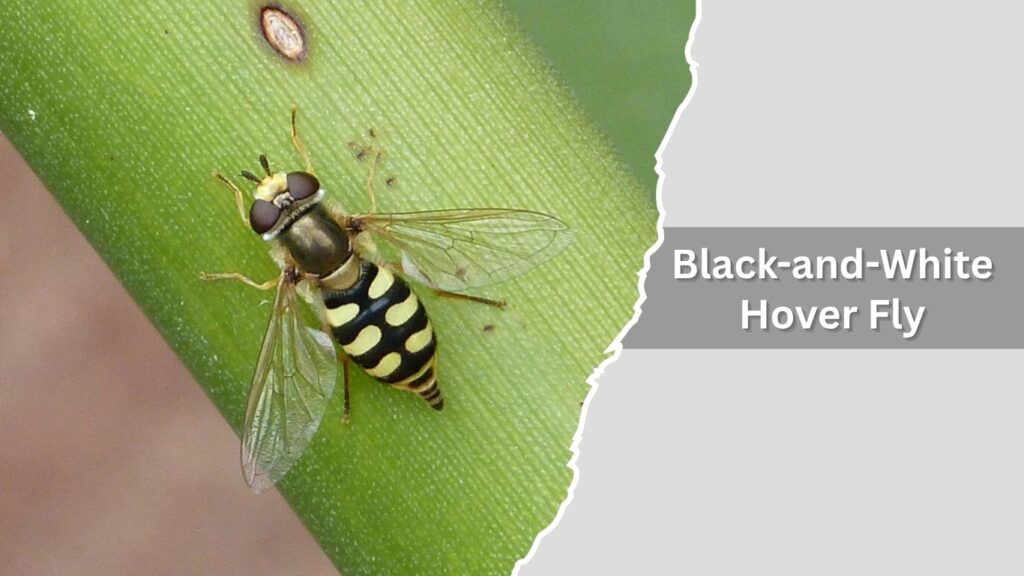
A black-and-white hover fly is a harmless fly whose striped or spotted body can make it look surprisingly similar to a bee or wasp. These insects are skilled fliers and can remain almost motionless in the air before darting rapidly in another direction. Their patterned appearance often leads people to search for a black and white flying bug that looks like a bee.
Identification
- Dark body with white, gray, or pale abdominal markings
- One functional pair of wings
- Large fly-like compound eyes
- Shorter antennae than most bees and wasps
- Ability to hover almost motionless
- No narrow wasp-like waist in many species
- Often appears as a tiny white and black striped flying bug
Habitat and Where They Are Found
Hover flies occur in gardens, parks, meadows, agricultural areas, and woodland edges. They are especially common around flowering plants where adults search for nectar and pollen.
They may also hover near people, but this behavior is usually exploratory rather than aggressive. Areas with aphid populations can attract species whose larvae prey on aphids.
Behavior and Sting Safety
Hover flies do not have stingers and cannot sting people. Their bee- or wasp-like patterns are a form of protective mimicry that may discourage birds and other predators.
They are agile fliers and can quickly change direction. A hovering individual may remain in the same spot for several seconds before disappearing almost instantly.
Diet and Garden Benefits
Adults feed primarily on nectar and pollen, making many hover flies useful pollinators. Their larvae have varied diets depending on the species.
Some larvae are important predators of aphids, scale insects, and other small plant pests. For this reason, a black and white flying bug that turns out to be a hover fly can be highly beneficial in gardens and agricultural landscapes.
FAQs
1. What is the most common black and white flying bug?
Several insects can match this description, including bald-faced hornets, tiger bee flies, longhorn beetles, sand wasps, and hover flies. Identification usually depends on body shape, size, wing pattern, antennae, and whether the insect has stripes or spots.
2. Do black and white flying bugs bite or sting?
Some can sting, while many are harmless. Bald-faced hornets and certain wasps have stingers and may defend themselves or their nests. Hover flies, tiger bee flies, moths, and most beetles do not sting people. A black and white flying bug that bites should be identified carefully before handling.
3. What is a black and white flying bug that looks like a bee?
A hover fly, digger bee, sand wasp, or tiger bee fly may look similar to a bee. Hover flies and tiger bee flies are harmless flies, while digger bees and some wasps can sting but are generally not aggressive.
4. Why are small black and white flying bugs around my house?
They may be attracted to flowers, outdoor lights, nearby trees, firewood, or suitable nesting areas. Some small black and white flying bugs accidentally enter homes through open windows and doors. Their presence does not always mean there is an indoor infestation.
5. How can I identify a black and white striped flying bug?
Look closely at its size, number of wings, antennae, body shape, leg markings, and stripe pattern. Wasps usually have narrow waists, beetles have hardened wing covers, and flies typically have large eyes and one pair of functional wings. Photos can also help distinguish similar black and white striped flying bugs.